

TL;DR:
- Teaching teens fundamental money management skills, like budgeting and saving, builds confidence for financial independence.
- Experiential learning with real money, tools, and ongoing review is most effective for developing lifelong financial habits.
Financial literacy for teens is defined as the set of skills that lets young people earn, save, spend, and borrow with confidence. 81% of students say they need practical money skills like budgeting and saving to feel confident about their financial future. That number tells you something direct: teaching teens about money is not optional enrichment. It is a foundational life skill on par with reading or basic math. The good news is that you do not need to be a financial expert to do it well. You need a clear framework, the right tools, and the willingness to keep the conversation going.
What are the fundamental money management skills every teen should learn?
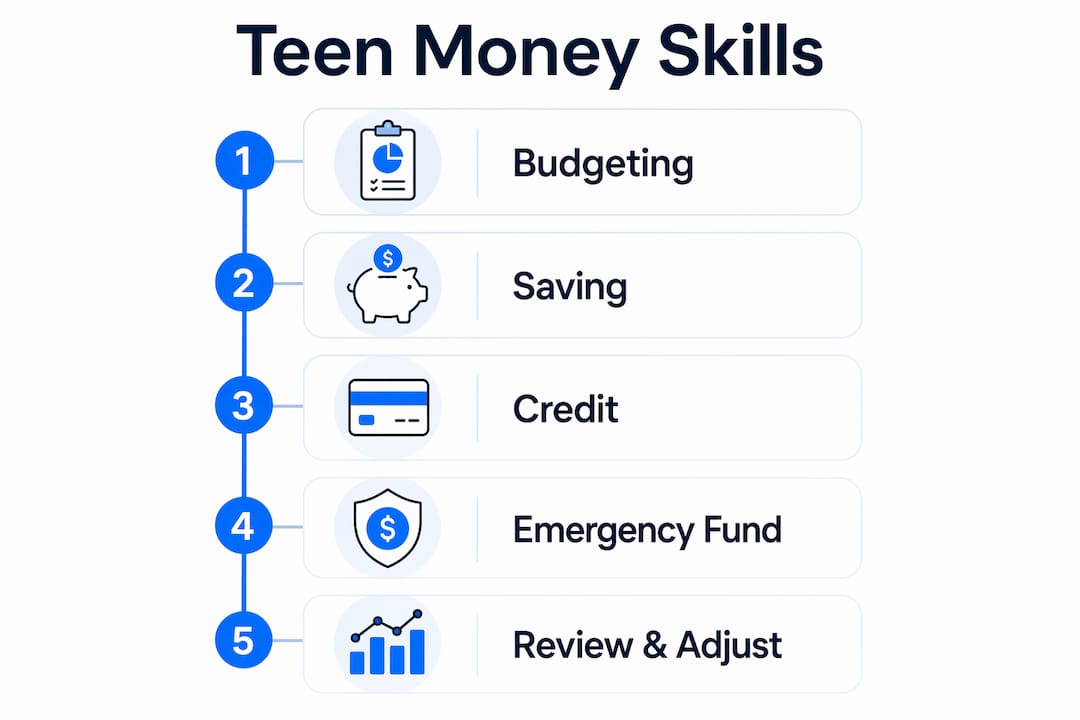
Money management skills fall into four core categories: budgeting, saving, understanding credit, and building an emergency fund. Teens who master these four areas have the foundation to handle most financial decisions they will face in early adulthood.
Budgeting basics
Budgeting is the practice of tracking income against expenses and deciding in advance where money goes. The most important first lesson is the needs vs. wants distinction. Needs are rent, food, and transportation. Wants are streaming subscriptions, new sneakers, and takeout. Teens often struggle to separate these two categories, and that confusion drives most overspending. Teaching kids about budgeting starts with writing down every dollar coming in and every dollar going out, even if the amounts are small.
A simple three-column budget works well for teens:
| Category | Monthly Income/Expense | Notes |
|---|---|---|
| Income (job, allowance) | $X | Total money available |
| Fixed needs (phone plan, transit) | $X | Non-negotiable monthly costs |
| Discretionary wants | $X | Spending money after needs |
| Savings goal | $X | Set aside before spending |
Pro Tip: Have your teen build their first budget on paper before moving to an app. Writing it out forces them to think through every category instead of relying on auto-categorization.
Saving consistently
Saving is not what is left over after spending. It is the first line item in a budget. The habit of paying yourself first, meaning setting aside a fixed amount before any discretionary spending, is the single behavior that separates people who build wealth from those who do not. Successful money management depends more on discipline and planning than on income level. A teen saving $20 a week from a part-time job is practicing the same discipline a high earner uses to fund a retirement account.
Understanding credit and debt
Credit is borrowed money that must be repaid with interest. Teens need to understand that a credit card is not extra income. Carrying a balance month to month costs real money in interest charges. The best way to introduce credit is through a secured card or a student card with a low limit, used only for planned purchases that the teen can pay off in full each month.
Building an emergency fund
An emergency fund is a cash reserve set aside for unexpected expenses. A healthy emergency fund covers 3–6 months of essential living expenses. For a teen, that goal scales down to something realistic, such as $300–$500 to cover a phone repair, a medical copay, or a missed shift at work. Having that buffer prevents teens from turning to credit cards or family loans every time something unexpected happens. You can find more detail on building this habit at Finblog’s guide on emergency fund basics.
How can parents and educators create effective money lessons for teens?
The most effective approach is experiential learning: giving teens real money to manage, real decisions to make, and real consequences to face. Teens learn best through controlled money management practice in a safe-to-fail environment. A lecture about budgeting is forgotten by dinner. Managing a $50 weekly allowance and running out of money on Thursday is remembered for years.
Here is a practical sequence for parents and educators to follow:
- Start with an allowance tied to responsibility. Give teens a fixed weekly or monthly amount and let them manage it without rescue. If they spend it all in two days, that is the lesson.
- Open a bank account together. Bank account ownership increases teens’ sense of responsibility and engagement through digital money tracking. Walk through the app together and show them how to read a statement.
- Involve teens in real household decisions. Take them grocery shopping with a set budget. Let them compare unit prices. Ask them to plan a family dinner within a $30 limit. Real contexts build real skills faster than worksheets alone.
- Encourage part-time work. A job teaches teens that money represents time and effort. That realization changes spending behavior more than any conversation about saving.
- Set a savings goal together. Whether it is a new phone, a trip, or a car, a concrete goal gives saving a purpose. Break the goal into weekly savings targets so progress feels visible.
- Review the budget monthly. Budgets should be reviewed weekly or monthly to stay realistic and connect spending choices to goals. A budget that never gets updated becomes useless within two months.
Pro Tip: Frame money mistakes as data, not failures. When a teen overspends, ask “What would you do differently next month?” instead of criticizing the choice. That question builds analytical thinking, not shame.
The CFPB frames financial literacy as a developmental process that builds skills over time rather than through a single conversation. That framing matters because it takes the pressure off any one lesson or talk. You are building a habit over months and years, not delivering a one-time lecture.
What tools and resources best support financial literacy for teens?
The right tools reduce friction and make tracking money feel less like homework. The best approach combines digital tools with structured programs.
- Teen-friendly budgeting apps. Apps that connect to a bank account and categorize spending automatically give teens real-time feedback on their habits. Look for apps that offer goal-setting features so teens can watch their savings grow toward a specific target.
- Spreadsheet templates. A simple Google Sheets or Excel budget template works well for teens who prefer to see everything in one place. Finblog’s guide on creating a budget walks through the setup step by step.
- Financial literacy programs. Intuit for Education offers free financial literacy curricula designed for high school students. These programs use simulations and real-world scenarios to teach budgeting, taxes, and credit in a classroom setting.
- Savings and investment accounts for minors. Custodial savings accounts and custodial brokerage accounts let parents open accounts in a teen’s name. These accounts make the concept of compound interest tangible. A teen who watches $500 grow over two years understands investing better than any textbook explanation.
- Practical worksheets. Printed worksheets for tracking weekly spending work well for younger teens who are not yet comfortable with apps. The physical act of writing down purchases creates a moment of reflection that digital auto-tracking skips.
For teens curious about how to invest for teens, starting with a custodial index fund account is the most straightforward path. Index funds carry lower risk than individual stocks and require no active management, making them appropriate for beginners. Finblog’s resource on financial literacy for beginners covers these concepts in plain language.
How do you overcome common challenges in teaching teens about money?
Resistance is the most common obstacle. Teens often see money conversations as lectures or criticism. The fix is to make the conversation collaborative, not corrective.
- Avoid static budgets. A budget written once and never reviewed stops reflecting reality within weeks. Build the habit of a monthly “money check-in” where the teen reviews what happened and adjusts the plan.
- Address the needs vs. wants confusion directly. Helping teens separate needs and wants through clear budget categories strengthens spending control. Use real examples from their own spending history, not hypothetical scenarios.
- Keep messaging consistent between home and school. When parents and teachers send conflicting signals about money, teens default to the path of least resistance. A shared vocabulary around budgeting, saving, and goals helps.
- Use positive reinforcement. When a teen hits a savings goal or makes a disciplined spending choice, acknowledge it specifically. “You saved $150 in six weeks” lands better than “good job.”
- Let natural consequences happen. If a teen spends their clothing budget on entertainment and has nothing left for a school event, resist the urge to bail them out. The discomfort of that experience teaches more than any warning could.
“Financial education is best treated as ongoing developmental steps rather than one-off talks. Building lifelong habits requires repeated practice, real consequences, and consistent guidance over months and years, not a single conversation.” — CFPB Youth Financial Education
For parents navigating this across cultures and financial contexts, resources like financial security strategies from international personal finance experts offer useful perspective on how money habits form differently across households.
Key Takeaways
Teaching teens about money works best when it combines real practice, consistent review, and age-appropriate tools rather than relying on lectures or one-time conversations.
| Point | Details |
|---|---|
| Start with budgeting basics | Teach the needs vs. wants distinction before any other money concept. |
| Use experiential learning | Give teens real money to manage, with real consequences for mistakes. |
| Review budgets regularly | Monthly check-ins keep the budget realistic and tied to actual goals. |
| Build an emergency fund early | Even a $300–$500 buffer prevents teens from relying on credit for surprises. |
| Use tools that match the teen | Combine apps, bank accounts, and worksheets based on what the teen will actually use. |
What I have learned from watching teens actually handle money
The conventional wisdom says to start the money conversation early and keep it simple. That advice is correct but incomplete. What I have seen repeatedly is that the format of the conversation matters as much as the timing.

Parents who sit down and deliver a financial lecture, even a well-researched one, get polite nods and zero behavior change. Parents who hand a teen $40 for groceries and say “make it work” get a teenager who reads price tags for the first time in their life. The lesson lands because it is real.
The other thing I would push back on is the idea that teens need to understand everything before they start. They do not. A 14-year-old does not need to understand compound interest to benefit from opening a savings account. They need to see the number go up. The understanding follows the experience, not the other way around.
Consistency matters more than perfection here. A parent who models checking their own budget monthly, talks openly about financial trade-offs, and lets teens see real household decisions builds more financial literacy than any curriculum. You do not need to have all the answers. You need to keep showing up for the conversation.
The best budgeting techniques are the ones a teen will actually use. That means meeting them where they are, whether that is a spreadsheet, an app, or a notebook on the kitchen counter.
— Povilas
Finblog’s resources for the next step in teen financial education
Finblog publishes in-depth guides on budgeting, saving, and financial goal setting designed for readers at every experience level, including teens just starting out and parents looking for structured frameworks to use at home. The financial literacy for students guide explains why these skills matter and how to build them systematically. For teens ready to set their first real financial targets, the financial goal setting guide provides a step-by-step framework that works at any income level. Continued education is what turns a single good habit into a lifetime of confident financial decisions.
FAQ
What age should you start teaching teens about money?
Financial literacy education works best when it begins in early adolescence, around ages 12–14, when teens start making independent spending decisions. The CFPB treats financial literacy as a developmental process, so earlier exposure always helps.
What are the most important money management skills for teens?
Budgeting, consistent saving, understanding credit, and building an emergency fund are the four core skills. Teens who practice these four habits are better prepared for financial independence than those who learn only one or two.
How do you teach a teen who resists money conversations?
Use experiential learning instead of lectures. Give the teen real money to manage, involve them in household budget decisions, and let natural consequences happen when they overspend. Real experience creates engagement that conversation alone cannot.
How much should a teen save each month?
There is no fixed amount, but the habit matters more than the number. A teen saving even 10% of any income, whether from an allowance or a part-time job, builds the discipline that scales up as earnings grow.
What tools help teens track their spending?
Teen-friendly budgeting apps connected to a bank account, simple spreadsheet templates, and custodial savings accounts all support spending awareness. The best tool is whichever one the teen will check consistently.