

A lean 2–4 card system, targeted sign-up bonuses, and transfer-partner redemptions will typically unlock the most value from your spending. The six moves that drive the majority of reward gains are: capturing a welcome bonus on a new card, building a small portfolio where each card covers a different spending category, routing online purchases through shopping portals, stacking issuer offers on top of card multipliers, redeeming points through airline or hotel transfer partners rather than statement credits, and paying your full statement balance every month.
- Sign-up bonuses are an efficient way to earn a large number of points quickly, often equivalent to several months of ordinary spend rewards.
- A 2–4 card portfolio covers your biggest categories without the overhead of managing a dozen cards.
- Category matching puts the highest multiplier on every purchase instead of defaulting to a flat rate.
- Shopping portals and issuer offers can add incremental gains on planned purchases when combined with card rewards.
- Transfer-partner redemptions routinely deliver 2–5 cents per point, compared with roughly 1 cent or less for statement credits.
- Paying in full is not optional. Carrying a balance at a typical APR above 20% wipes out every cent of reward value.
The one thing to avoid: spending money you would not otherwise spend just to chase points.
Pro Tip: Set up autopay for your full statement balance today. That single action protects every reward strategy in this guide from being erased by interest charges.
Key Takeaways
A lean 2–4 card portfolio, combined with sign-up bonuses and transfer-partner redemptions, delivers the most reward value for the least complexity.
| Point | Details |
|---|---|
| Transfer partners beat cash back | Points transferred to airlines or hotels commonly deliver 2–5 cents per point versus ~1 cent for statement credits. |
| Sign-up bonuses are the fastest gains | Welcome offers can equal months of ordinary spend rewards; never overspend to hit the minimum. |
| Pay in full, always | Carrying a balance at a typical APR above 20% erases reward value; autopay to the full balance is non-negotiable. |
| Annual-fee math matters | Subtract usable credits from the sticker fee to find the true cost before keeping any fee card. |
| Finblog for personalized guidance | Finblog offers consulting and a newsletter to help you build a card strategy matched to your actual spending and goals. |
Table of Contents
- What can you do this week to boost your rewards?
- How do sign-up bonuses work, and when should you apply?
- How do you build an efficient card portfolio?
- How do you match cards to your spending categories?
- How do shopping portals and issuer offers stack your rewards?
- What is the best way to redeem your points?
- What mistakes erase your reward value?
- How do you track multiple cards without losing control?
- What advanced tactics are worth the added complexity?
- How do you choose the right rewards strategy for your goals?
- Sources
What can you do this week to boost your rewards?
Speed matters early. These five actions take under an hour and produce immediate results.
- Set autopay to pay the full statement balance on every card you hold. Not the minimum. The full amount. This is the foundation that makes everything else worth doing, as Bankrate confirms.
- Map your last 90 days of spending by category. Pull three months of statements and total up dining, groceries, gas, travel, and online shopping. You will almost certainly find one or two categories where you are leaving multiplier money on the table.
- Activate any rotating-category or limited-time offers. Chase Freedom Flex® and Discover it® Cash Back both require quarterly activation to earn 5% on rotating categories. Log in and activate now.
- Sign up for one shopping portal and install its browser extension. Rakuten is the most widely used starting point. The extension pops up automatically when you visit a participating retailer, so you never forget to click through.
- Add calendar reminders for every spend window and quarterly activation. If your Chase Sapphire Preferred® welcome bonus requires $4,000 in spending within three months, put the deadline in your calendar today.
Pro Tip: Download your bank’s mobile app and check the “Offers” tab right now. Chase Offers and Amex Offers frequently include targeted deals worth $5–$25 on merchants you already use. Adding them takes 10 seconds.
How do sign-up bonuses work, and when should you apply?
Sign-up bonuses, also called welcome offers, are the single fastest way to accumulate a large block of points. A typical offer on a mid-tier travel card might be 60,000 Chase Ultimate Rewards points after spending $4,000 in the first three months. At a conservative 2 cents per point in transfer value, that is $1,200 in travel from one application. NerdWallet notes that welcome offers can equal several months of ordinary rewards in a single shot, but the rule is absolute: never spend more than you otherwise would to hit the minimum.
Timing your application
- Identify a natural high-spend window. The months before a planned vacation, a home renovation, or the holiday season are ideal. You will hit the minimum spend on purchases you were already making.
- Apply 2–3 weeks before the spend window opens. Card approval and delivery take time. Applying too late compresses your window.
- Shift existing bills onto the new card immediately. Insurance premiums, subscriptions, and utility payments count toward minimum spend and require zero extra spending.
- Track your progress weekly. Log into the issuer’s app and confirm the spending counter is moving. Errors happen.
- Avoid applying for multiple cards in the same month. Each application triggers a hard inquiry. Spacing applications at least 90 days apart limits credit-score impact.
What to watch for
- Manufactured spending (buying gift cards or money orders to inflate spend) violates most card terms and can result in bonus forfeiture or account closure.
- Authorized-user spend counts toward the primary cardholder’s minimum on most cards, which is a legitimate way to accelerate the window. The primary cardholder remains fully liable for the balance.
- Referral bonuses are worth using. Many issuers pay 10,000–20,000 bonus points when a friend applies through your referral link and is approved. Check your card’s referral portal before recommending a card to anyone.
Pro Tip: Before applying, check whether the card has a “once per lifetime” bonus rule. American Express, for example, generally limits welcome bonuses to once per card. Applying again after years away may not yield a second bonus.
A simple example: if you have $3,000 in regular monthly expenses (rent via a payment processor, groceries, utilities, subscriptions), a three-month window gives you $9,000 in natural spend, which comfortably covers most welcome-offer thresholds without buying a single extra thing.
How do you build an efficient card portfolio?
Most of the reward value in a typical household comes from a small subset of cards. A 2–4 card portfolio covers the major spending categories, keeps annual fees manageable, and avoids the complexity of tracking a dozen different programs. The Points Guy’s pairing guide makes the case clearly: combining cards that serve different functions inside the same ecosystem produces outsized returns and simplifies pooling for transfers.
The three portfolio archetypes
Beginner (1–2 cards): One category card plus one flat-rate card. Low complexity, solid returns, no annual fees.
Intermediate (2–3 cards): A transferable-points hub plus a category multiplier. Points from the Freedom Flex pool into the Sapphire Preferred account and become transferable to airline and hotel partners. This is the Chase trifecta in its simplest form.
Advanced (3–4 cards): A premium card with high-value credits plus co-benefits, layered over category cards. supermarkets) and a flat-rate card for everything else.
Annual-fee math
Before keeping any fee card, run this quick calculation:
The Amex Platinum’s $695 sticker fee looks steep until you subtract the credits you were going to spend anyway. If you use Uber Eats, subscribe to streaming services, and stay at hotels, the effective cost drops sharply. If you do not, the credits are worthless and the fee is real.
Pro Tip: Hold at least one card that earns transferable points (Chase Ultimate Rewards, Amex Membership Rewards, Capital One Miles, or Citi ThankYou Points). Transferable currencies give you access to airline and hotel partners, which is where the highest redemption values live.
How do you match cards to your spending categories?
Every dollar you spend on the wrong card is a missed multiplier. The fix is a one-time audit followed by a simple routing system.
- Pull three months of transactions from every account and sort them into categories: dining, groceries, gas, travel, online shopping, streaming, and everything else. Most banking apps have a spending breakdown built in.
- Identify your top two or three categories by dollar volume. For most households, groceries and dining together represent the largest discretionary spend. Those two categories alone justify a dedicated card.
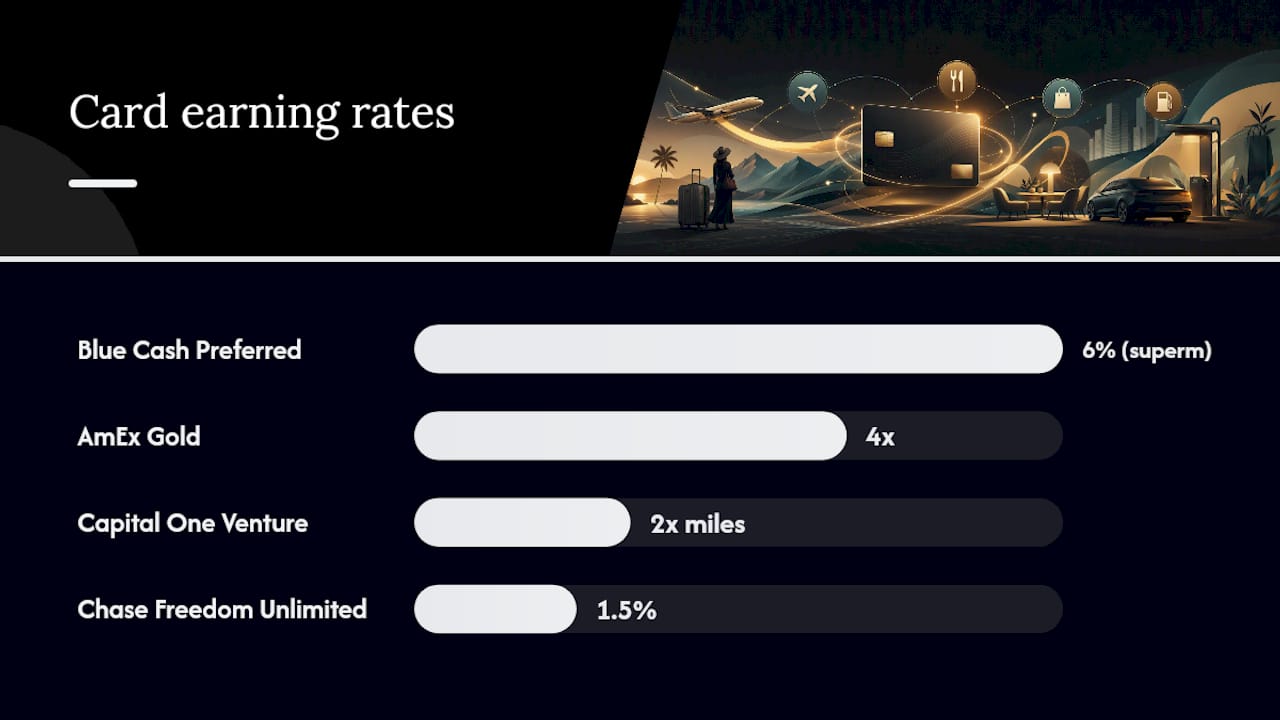
- Match each category to the card with the highest multiplier. The American Express® Gold Card earns 4x at U.S. supermarkets (up to $25,000 per year) and 4x at restaurants. The Blue Cash Preferred® from American Express earns 6% at U.S. supermarkets (up to $6,000 per year) and 6% at select U.S. streaming services, but pays cash back rather than transferable points. If you value flexibility and travel, the Gold Card wins. If you want pure cash back, Blue Cash Preferred® is hard to beat in those categories.
- Assign a flat-rate card for everything else. Chase Freedom Unlimited® at 1.5% or Capital One Venture at 2x miles covers the long tail of miscellaneous spending without requiring you to think about it.
- Set up quarterly calendar reminders for rotating categories. Chase Freedom Flex® and Discover it® Cash Back both offer 5% on rotating categories (gas stations, grocery stores, Amazon, PayPal, and others) each quarter, capped at $1,500 in combined purchases. That cap represents $75 in cash back or points per quarter, per card, on top of your base rate.
Pro Tip: For shared household expenses, put the primary cardholder’s name on the card that earns the highest multiplier for that category. Add them as an authorized user on the right card instead.
That $300 difference is the cost of not paying attention to category matching.
How do shopping portals and issuer offers stack your rewards?
Shopping portals are websites that sit between you and a retailer. You click through the portal to the retailer’s site, buy normally, and the portal pays you a bonus in points or cash back on top of whatever your card earns. American Express confirms that stacking portals with card rewards and issuer offers can add 1–10% extra value on planned online purchases.

How stacking works in practice
Say you are buying a $200 pair of shoes from a retailer that participates in a shopping portal:
- Card multiplier: Chase Sapphire Preferred® earns 3x on online shopping = 600 points (~$12 at 2¢/point)
- Shopping portal bonus: Rakuten offers 5% cash back on that retailer = $10
- Issuer offer: Chase Offers has a targeted $10 back on $100+ at that retailer = $10
- Total return: $32 on a $200 purchase, or 16%
Without the portal and the offer, you would have earned $4 in points.
Finding and applying issuer offers
- Amex Offers: Log into your American Express account, click “Amex Offers,” and scroll through targeted deals. Add each relevant offer to your card. The discount applies automatically when you meet the terms.
- Chase Offers: Same mechanic. Found under “Earn” in the Chase app. Offers are targeted, so what you see differs from what another cardholder sees.
- Discover Cashback Bonus: Discover it® Cash Back cardholders can activate rotating 5% categories quarterly and stack them with Discover’s own portal.
Cautions
- Cookie tracking can fail. If you use an ad blocker or open a new browser tab between clicking the portal link and completing your purchase, the portal may not credit your account. Disable ad blockers for the retailer’s site during the transaction.
- Returns reverse portal credits. If you return an item, the portal cash back is typically clawed back. Factor this in before buying something you might return.
- Offers have expiration dates. An Amex Offer you added in January may expire in March. Check the terms before assuming it is still active.
| Portal | Currency | Best for |
|---|---|---|
| Rakuten | Cash back or Amex points | Broad retailer coverage |
| Chase Ultimate Rewards portal | Chase points | Chase cardholders shopping online |
| Amex Membership Rewards portal | Amex points | Amex cardholders |
| Airline shopping portals (e.g., United MileagePlus Shopping) | Airline miles | Earning miles on everyday purchases |
What is the best way to redeem your points?
Redemption is where most people leave money on the table. The hierarchy is straightforward: transfer partners first, issuer travel portals second, statement credits and gift cards last.
Points transferred to airline and hotel partners commonly deliver 2–5 cents per point. Statement credits and gift cards typically land at 1 cent or less. That gap is the entire argument for holding a transferable-points card.
The redemption value hierarchy
- Transfer partners (airlines and hotels): Highest value. Chase Ultimate Rewards transfers to United, Southwest, Hyatt, Marriott Bonvoy, and others. Amex Membership Rewards transfers to Delta, Air France/KLM, Hilton, and more. Capital One Miles transfer to Air Canada, Turkish Airlines, Wyndham, and others.
- Issuer travel portals: Chase Sapphire Reserve® cardholders redeem at 1.5 cents per point through the Chase Travel portal. Sapphire Preferred® holders get 1.25 cents. Solid value without the complexity of award booking.
- Statement credits and cash back: Typically 1 cent per point. Fine for simplicity, but you are leaving value behind.
- Gift cards and merchandise: Often 0.8–1 cent per point. Rarely worth it.
A step-by-step transfer example
You have 60,000 Chase Ultimate Rewards points. You want to fly from New York to Chicago.
- Check award availability on United’s website for the dates you want.
- If a Saver award is available at 12,500 miles one-way, the round trip costs 25,000 miles.
- Transfer 25,000 Chase points to United MileagePlus (transfers are instant).
- Book the award. You pay 25,000 miles plus taxes and fees (often $5–$11).
- A cash ticket for the same flight might cost $250–$350. Your 25,000 points just delivered 1–1.4 cents per point, which beats a statement credit.
For international business class, the math gets more dramatic. A business-class award on a partner airline might cost 60,000 Amex points, while the cash price is $3,000–$5,000. That is 5–8 cents per point.
Timing transfers around transfer bonuses can increase redemption value by 20–40% or more. Watch for these.
What to watch for
- Point devaluations happen. Airlines and hotels periodically increase award costs. Transfer points only when you have a specific booking in mind, not to “save” them in a partner program.
- Transfers are irreversible. Once points move to an airline or hotel, they cannot come back. Confirm award availability before transferring.
- Hyatt is widely considered the best hotel transfer partner for Chase Ultimate Rewards. A Category 1–4 Hyatt property costs 5,000–15,000 points per night, while cash rates for the same property can run $150–$300.
What mistakes erase your reward value?
The fastest way to destroy a rewards strategy is to carry a balance. Bankrate is direct on this: autopay set to the full statement balance is the primary guardrail in any rewards strategy.
Warning: If you are currently carrying a balance on any card, pause your rewards strategy. The interest you are paying almost certainly exceeds the rewards you are earning. Pay down the balance first. Finblog’s guide to managing credit card debt walks through the payoff options in detail.
Annual-fee traps
A $550 annual fee is only worth paying if you can extract at least $550 in value from the card’s credits and rewards. Run the math every year at renewal. If your travel habits changed and you are no longer using the lounge access or travel credits, downgrade or cancel before the fee posts.
Earning caps and category limits
- Amex Gold: 4x at U.S. supermarkets is capped at $25,000 in purchases per year. Above that, it drops to 1x.
- Blue Cash Preferred®: 6% at U.S. supermarkets is capped at $6,000 per year ($360 in cash back). After that, it earns 1%.
- Chase Freedom Flex® and Discover it® Cash Back: 5% rotating categories are capped at $1,500 per quarter per card.
Security and fraud risks
Using third-party services to meet minimum spend (manufactured spending, gift card reselling) puts your account at risk. Issuers monitor for unusual activity and can close accounts, forfeit points, and report the activity. The risk is not theoretical.
Pro Tip: Set up transaction alerts on every card. Most issuers offer real-time push notifications for every charge. You will catch fraud immediately and stay aware of your spending pace toward bonus thresholds.
How do you track multiple cards without losing control?
Managing three or four cards is not complicated if you build a simple monthly routine. The goal is to spend 15 minutes per month, not hours.
Recommended tracker types
- Issuer apps and portals: The most reliable source for point balances, offer status, and bonus progress. Check each card’s app directly rather than relying on third-party aggregators for accuracy.
- A simple spreadsheet: One row per card. Columns: card name, annual fee, renewal date, current points balance, active offers, bonus deadline. Update it once a month.
- Calendar reminders: One reminder per card per quarter for rotating-category activation. One reminder 30 days before each annual fee posts (to decide whether to keep or cancel). One reminder for each welcome-bonus spend deadline.
Monthly routine
- Log into each issuer’s app and note the current points balance.
- Check whether any rotating categories need activation for the upcoming quarter.
- Scroll through Amex Offers and Chase Offers and add any relevant deals.
- Confirm you are on track for any active welcome-bonus spend windows.
- Verify that autopay is set to the full statement balance on every card.
That is it. The whole routine takes about 15 minutes once you have the habit.
A practical example: on the first Sunday of each month, open your spreadsheet, update balances from each app, add any new offers, and check the calendar for upcoming deadlines. If you have a welcome bonus expiring in six weeks and you are $800 short, you know now, not the day after the deadline.
What advanced tactics are worth the added complexity?
Some moves add meaningful value with modest effort. Others carry real risk. Here is how to think about each.
Referral bonuses and authorized users
Referral bonuses are among the cleanest extra-accrual methods available. Many issuers pay 10,000–20,000 bonus points when someone applies through your personal referral link and is approved. If you are recommending a card to a friend or family member anyway, always share your referral link. The Points Guy’s accrual guide notes that retention offers, authorized-user bonuses, and referrals are legitimate accrual methods, though they come with management considerations.
Adding an authorized user to your card can accelerate welcome-bonus spend and, on some cards, earns a bonus for the addition itself. The primary cardholder is fully liable for all authorized-user charges. Set a spending limit and communicate it clearly before adding anyone.
Paying large bills by card
The math only works if your reward rate exceeds the fee.
Credit-score impact
Every new card application triggers a hard inquiry, which typically reduces your FICO score by a few points temporarily. Opening multiple cards in a short window can signal risk to lenders. Space applications at least 90 days apart. Managing your credit utilization across multiple cards is also worth understanding: spreading spend across several cards generally keeps individual card utilization low, which helps your score.
Pro Tip: Before applying for a new card, check your credit score and make sure you are not within 6 months of a major loan application (mortgage, auto loan). A temporary score dip from a hard inquiry matters a lot more when you are about to borrow.
- Watch for account-activity requirements. Some issuers close inactive accounts, which can affect your credit utilization ratio and average account age.
- Never apply for a card you plan to cancel immediately after earning the bonus. Issuers track this behavior and may deny future applications or claw back bonuses.
How do you choose the right rewards strategy for your goals?
The right strategy depends on three things: whether you want flexible cash or aspirational travel, how much you spend and in which categories, and how much complexity you are willing to manage.
The decision flow
- Do you want cash back or travel points? If you rarely travel or prefer simplicity, a flat-rate cash-back card (Chase Freedom Unlimited® at 1.5%, Discover it® Cash Back at 5% rotating plus 1% flat) is the right foundation. If you want to fly business class or stay at luxury hotels for less, transferable points are worth the learning curve.
- What are your top two spending categories? Match those to the highest-multiplier card available. Dining and groceries point toward the Amex Gold or Blue Cash Preferred®. Travel points toward the Chase Sapphire Preferred® or Reserve®. Flat general spending points toward Capital One Venture X or Chase Freedom Unlimited®.
- Can you justify an annual fee? Run the effective-fee calculation from the portfolio section. If the credits cover the fee and the card earns more than a no-fee alternative, keep it. If not, a no-fee card is the better choice.
Checklist for choosing a card
- Does it have a strong welcome bonus you can hit without overspending?
- Does it earn a high multiplier in your top spending categories?
- Are the annual-fee credits ones you will actually use?
- Does it fit inside a transfer ecosystem you already use or want to build?
- Does it have foreign transaction fees? (Avoid these if you travel internationally. Chase Sapphire Preferred®, Reserve®, and most Capital One cards charge none.)
The 90-day experiment
Pick one new card or one new tactic (a shopping portal, a category card, a referral). Run it for 90 days. Track what you earned versus what you would have earned on your old setup. If the gain is real and the complexity is manageable, keep it. If it is not, simplify. Rewards optimization is iterative, not a one-time decision.
Why a lean strategy usually wins
The rewards hobby has a complexity ceiling most people hit faster than they expect. Managing 8 cards, tracking 12 different bonus categories, and chasing every transfer bonus sounds like a system. In practice, it becomes a part-time job with diminishing returns.
The consumers who consistently extract the most value from their cards tend to hold 2–3 cards, run the same routing system for years, and focus their energy on two things: capturing welcome bonuses on new cards every 12–18 months and booking transfers only when award availability is confirmed. That is it.
Premium cards like the Chase Sapphire Reserve® and The Platinum Card® from American Express make sense when your lifestyle already includes the benefits they reimburse. If you are not flying enough to use lounge access and you are not staying at hotels that qualify for the credits, the effective fee math turns negative fast.
The one rule that never changes: pay in full. A rewards strategy built on a carried balance is not a strategy. It is a subsidy to the bank. Building good credit habits and keeping utilization low are the foundation that makes everything else work.
Finblog can help you put this into practice
Knowing the tactics is one thing. Figuring out which cards fit your specific spending mix, credit profile, and financial goals is where most people get stuck. Finblog offers financial education and personalized consulting for consumers who want a clear, tailored plan rather than a generic list of cards.
Whether you want a second opinion on your current card lineup, help running the annual-fee math, or a structured approach to balancing rewards with broader financial goals, Finblog’s team can walk you through it. The newsletter also delivers practical tools, updated card comparisons, and templates for tracking your portfolio.
Visit Finblog to sign up for the newsletter or book a free consultation. It takes two minutes and gives you a starting point that is built around your numbers, not a generic recommendation.
Sources
- 6 strategies to earn more points and miles — NerdWallet
- How to maximize credit card reward points — American Express
- How to maximize credit card points — MileIntel
- How to maximize your credit card rewards — Bankrate
This article is general information, not a substitute for advice from a qualified financial advisor. Consult a qualified financial professional about your own circumstances before acting on anything here.