



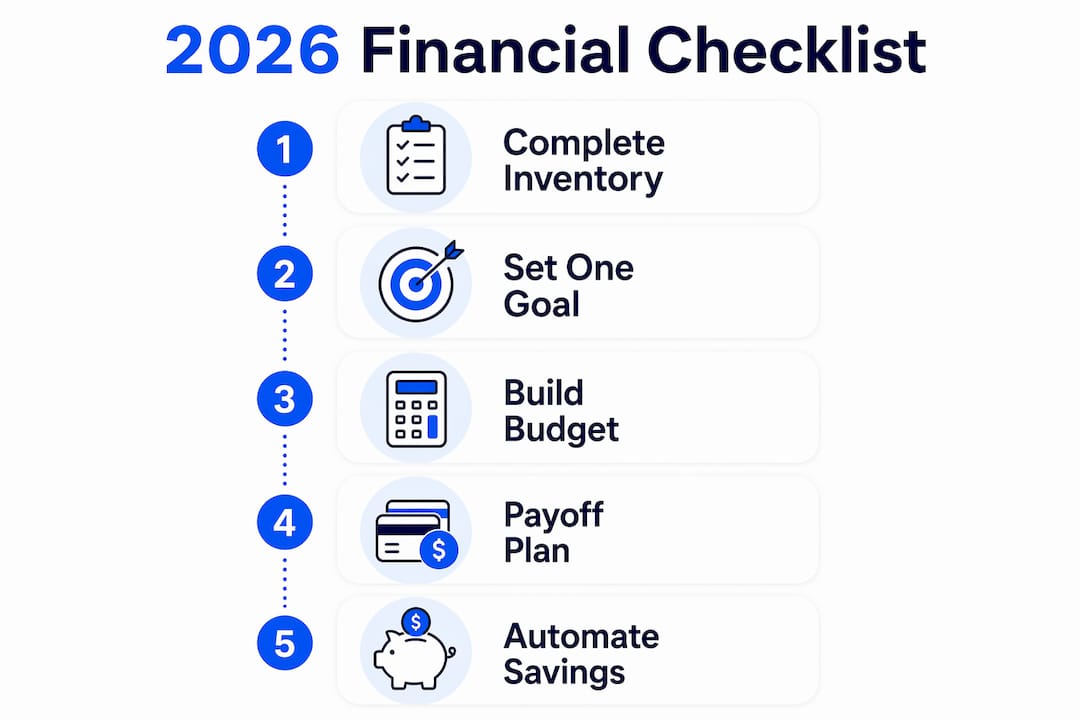
The fastest way to start the new year strong is a prioritized, action-first checklist you can begin today. Here are the 9 moves that matter most, in order of impact, each with a realistic time estimate so you can triage by what fits your schedule right now.
- Take a financial inventory — List every account, balance, and recurring charge. 60–90 minutes.
- Set one clear 1-year goal — Write it down with a dollar amount and a deadline. 30 minutes.
- Build or refresh your budget — Apply the 50/30/20 rule to last month’s actual spending. 45–60 minutes.
- Map your debt — List balances and interest rates; pick snowball or avalanche. 30–60 minutes.
- Check retirement contributions — Confirm you’re capturing your full employer match. 20–30 minutes.
- Verify your emergency fund — Calculate your monthly expenses and compare to your current balance. 15–20 minutes.
- Review insurance and beneficiaries — Check that policies and designations are current. 45–90 minutes.
- Automate at least one savings transfer — Set it up today, even if it’s $25 a month. 20–30 minutes.
- Schedule a tax planning check-in — Review withholding and flag any tax-advantaged accounts you’re not using. 20–40 minutes.
Start with the inventory. Everything else builds from knowing your actual numbers.
Table of Contents
- What does a complete financial inventory look like?
- How do you set financial goals that actually stick?
- How do you build a household budget that works all year?
- What’s the best way to pay off high-interest debt?
- Are your retirement contributions actually on track?
- Is your safety net strong enough?
- Which tax-advantaged accounts should you be using?
- How do you automate savings so the plan runs itself?
- When should you hire a financial advisor?
- Finblog’s new-year financial checklist and 30/60/90 starter plan
- Key Takeaways
- The process matters more than perfect numbers
- Ready to put your plan into action with Finblog?
- Useful sources and further reading
What does a complete financial inventory look like?
Before you can plan, you need a clear picture of where you stand. DFPI recommends reviewing financial statements and using apps or worksheets to turn raw data into a working spending plan. The goal is simple: gather the facts first, then make decisions.
Collect the following for every account you hold: bank accounts, credit cards, student loans, auto loans, mortgages, investment accounts, and retirement accounts. For each one, you need four data points.
| Account Name | Type | Balance | Interest Rate | Owner |
|---|---|---|---|---|
| Chase Checking | Checking | — | — | Primary |
| Discover Card | Credit Card | — | 22.99% | Primary |
| Federal Student Loan | Student Loan | — | 5.50% | Primary |
| Fidelity 401(k) | Retirement | — | N/A | Primary |
| HYSA (Ally) | Savings | — | — | Joint |
Copy this structure into a spreadsheet or a free budgeting app. The interest rate column is the one most people skip, and it’s the one that tells you where to focus first. A 22.99% credit card balance costs you far more per month than a 5.50% student loan.
Set aside 60–90 minutes total. Break it into two 30-minute sessions if that’s easier: one to pull statements, one to fill in the table. Use a net worth calculator to get a quick assets-minus-liabilities snapshot once the table is complete.
Pro Tip: When scanning statements, filter for charges over $20 that recur monthly. Those are your subscription audit targets and often the fastest source of found money.
How do you set financial goals that actually stick?
An inventory without goals is just a spreadsheet. The next step is converting those numbers into a direction. DFPI advises focusing on a few doable goals rather than a long list of big changes, because momentum matters more than ambition at the start.
Think in three time horizons:
- Short-term (6–12 months): Pay off a specific credit card, build a $1,000 starter emergency fund, or save for a planned vacation. These are concrete, dollar-specific, and achievable within the year.
- Mid-term (1–5 years): Save a home down payment, pay off a car loan, or max out a Roth IRA for three consecutive years. These require consistent monthly action.
- Long-term (5+ years): Retire by a target age, fund a child’s college education, or reach a specific net worth. These are directional and need annual recalibration.
AARP reports that a majority of Gen Xers and a significant share of boomers are setting financial resolutions for 2026, with priorities like bulking up emergency funds and auditing insurance. That’s a useful reminder that new year financial goals aren’t just for people in their 20s.
Pick one primary 1-year goal and write it in this format: “By December 31, 2026, I will [specific outcome] by [specific monthly action].” That single sentence does more than a five-page plan because it forces you to be specific. Spend 30–60 minutes drafting your three-horizon list, then circle the one that matters most this year. For practical financial milestone planning, Finblog’s step-by-step guide walks through how to sequence goals by timeline and income.

How do you build a household budget that works all year?
Most budgets fail not because the math is wrong but because they’re built on ideal spending instead of actual spending. Pull last month’s bank and credit card statements before you touch a budget template.

The 50/30/20 rule is a practical starting framework: 50% of after-tax income to needs, 30% to wants, and 20% to savings and debt repayment. Here’s what that looks like on a $5,000 monthly take-home:
| Category | % of Income | Monthly Amount | Examples |
|---|---|---|---|
| Fixed needs | 50% | — | Rent, utilities, groceries, insurance |
| Wants | 30% | — | Dining out, streaming, hobbies |
| Savings/debt repayment | 20% | $1,000 | Emergency fund, 401(k), credit card payoff |
The table is a starting point, not a verdict. If your rent alone is 40% of take-home, the 50% needs bucket is already tight. Adjust the wants column first before cutting savings.
Subscriptions to audit right now:
- Streaming services (how many do you actually watch?)
- Gym memberships used fewer than twice a week
- Software subscriptions auto-renewed from last year
- Premium app tiers you’re not using
- Delivery service memberships with overlapping benefits
For families managing multiple income streams and variable expenses, Finblog’s budgeting tips for families covers household-specific allocation strategies worth reviewing alongside this framework.
Pro Tip: When you get a tax refund, bonus, or any unexpected cash, treat it as pre-allocated to your top financial goal before it hits your checking account. “Found money” disappears fast when it lands without a plan.
Set a weekly 15-minute check-in, same day and time each week. That cadence catches overspending before it compounds.
What’s the best way to pay off high-interest debt?
Two methods dominate personal finance advice, and both work. The question is which one works for you.
Snowball: Pay minimums on everything, then throw every extra dollar at the smallest balance first. When that’s gone, roll that payment to the next smallest. The psychological win of eliminating accounts keeps motivation high.
Avalanche: Pay minimums on everything, then attack the highest interest rate first. Mathematically, this saves more money over time. It’s the right call if you can stay disciplined through a long payoff timeline.
Here’s a concrete example. Say you have $6,000 in credit card debt at 22% APR and you can put $300 a month toward it after minimums:
- Minimum payments only (~$120/month): Payoff takes roughly 7+ years and costs significantly more in interest.
- $300/month (avalanche or snowball on a single card): Payoff in approximately 24 months, with far less interest paid.
- $400/month: Payoff in roughly 17 months.
The difference between $300 and $400 a month is about 7 months of your life. That’s worth finding $100 somewhere in the budget.
Small moves that free up cash flow:
- Cancel one subscription you haven’t used in 30 days
- Call your credit card issuer and ask for a rate reduction (it works more often than people expect)
- Move savings to a high-yield savings account to earn more while you pay down debt
- Redirect any windfalls (tax refund, bonus) directly to the highest-rate balance
Pro Tip: Set up an automatic extra payment of even $25 on your highest-rate card the day after payday. Automating it removes the decision entirely, and small consistent payments compound faster than occasional large ones.
Creating a payoff plan takes about 60 minutes. The math is simple; the follow-through is where most people need structure.
Are your retirement contributions actually on track?
A retirement account review doesn’t need to take all afternoon. A focused 30–90 minute check covers the essentials.
Work through this checklist:
- Employer match: Are you contributing at least enough to capture the full match? This is the closest thing to free money in personal finance. If you’re leaving any match on the table, fix this before anything else.
- Contribution rate: Is your current percentage still appropriate given any income changes this year?
- Asset allocation: Does your current mix of stocks, bonds, and other assets still match your target? Markets drift allocations over time.
- Fees: Check the expense ratios on your fund choices. A 1% difference in annual fees compounds into a significant gap over 20–30 years.
- Account types: Are you using the right mix of pre-tax (traditional 401(k), traditional IRA) and post-tax (Roth) accounts for your current tax situation?
IRS contribution limits change periodically, and Citizens Bank’s 2026 checklist notes that catch-up contribution rules are subject to indexed thresholds that can shift year to year. Always confirm current-year caps with IRS.gov or your plan documents before assuming last year’s numbers still apply.
If your portfolio includes concentrated stock positions, tax-sensitive events like a Roth conversion, or you’re within 10 years of retirement, a one-time professional review is worth the cost. The complexity at that stage usually exceeds what a spreadsheet can handle well.
Is your safety net strong enough?
An emergency fund and a quick insurance audit belong on the same annual checklist because both protect against the same thing: an unexpected event derailing everything else you’ve built.
Emergency fund targets:
- Three months of expenses is the minimum most guidance recommends.
- Six months is the more protective target, especially if your income is variable, you’re self-employed, or your industry is cyclical.
- Calculate your actual monthly expenses (not income) and multiply to set your target amount.
Insurance quick-check:
- Life insurance: Is the coverage amount still appropriate for your current income and dependents?
- Disability insurance: Do you have it? Most people underestimate how likely a disability event is relative to death.
- Homeowner or renter insurance: Has your property value or the replacement cost of your belongings changed?
- Auto insurance: Are you carrying the right liability limits?
- Long-term care: For adults in their 50s and 60s, reviewing long-term care options early matters because qualifying becomes harder and more expensive as health changes.
Estate basics checklist:
- Will: Does it reflect your current wishes?
- Durable power of attorney: Is it current and does your agent know where to find it?
- Health care proxy / advance directive: Does it match your current wishes?
- Beneficiary designations: Check every retirement account, life insurance policy, and bank account with a transfer-on-death designation.
Pro Tip: Check beneficiary designations every January and immediately after any major life event: marriage, divorce, a birth, or a death in the family. Outdated designations override a will, and courts can’t fix that after the fact.
This full review takes 45–90 minutes and is one of the highest-value uses of time on this entire checklist.
Which tax-advantaged accounts should you be using?
Early in the year is the right time to check this because some contribution windows close sooner than people realize, and a missed deadline means a missed tax benefit.
Common tax-advantaged accounts to review:
- 401(k) / 403(b): Pre-tax contributions reduce taxable income now. Roth 401(k) contributions grow tax-free. Confirm your contribution rate and check whether your employer offers a match.
- Traditional IRA: Contributions may be tax-deductible depending on your income and whether you have a workplace plan. The IRA contribution deadline is typically Tax Day (April 15) for the prior year.
- Roth IRA: No upfront deduction, but qualified withdrawals are tax-free. Income limits apply. Contributions can be made up to Tax Day for the prior year.
- HSA (Health Savings Account): Available only with a qualifying high-deductible health plan. Contributions are triple tax-advantaged: deductible going in, tax-free growth, and tax-free for qualified medical expenses. Unused balances roll over indefinitely.
Timing reminders:
- If your income changed in 2025, review your W-4 withholding to avoid a surprise tax bill or an unnecessarily large refund.
- If you’re self-employed or have significant non-wage income, confirm your estimated tax payment schedule for 2026.
- Verify current-year contribution limits at IRS.gov before assuming prior-year figures still apply.
This check takes 20–40 minutes and can save you hundreds or thousands of dollars in taxes over the course of a year.
How do you automate savings so the plan runs itself?
Automation is the single most underused tool in personal finance. Once it’s set up, it removes the decision entirely, and that’s the point.
Four things to automate:
- Payroll contributions: Increase your 401(k) or HSA contribution directly through your employer’s payroll system so the money never hits your checking account.
- Savings transfers: Set a recurring transfer from checking to a high-yield savings account on the day after payday. Even $50 a month builds a habit.
- Bill autopay: Automate fixed bills (rent, utilities, loan minimums) to eliminate late fees and protect your credit score.
- Recurring investments: If you invest in a brokerage account, set a recurring monthly purchase in a low-cost index fund.
Here’s a simple tracking row you can copy into a spreadsheet and update monthly:
| Goal | Monthly Target | Current Month | % Complete |
|---|---|---|---|
| Emergency fund | $300 | $300 | 100% |
| Credit card payoff | $400 | — | — |
| Roth IRA | $500 | $500 | 100% |
Update this table once a month. It takes five minutes and shows you exactly where you’re on track and where you’re slipping before it becomes a problem. For a deeper look at building quarterly financial planning habits, Finblog’s guide covers what to review at each 90-day mark.
Pro Tip: Batch all financial tasks into one weekly 20-minute slot, same day every week. Decision fatigue is real, and spreading money tasks across the week means most of them don’t happen.
Setting up automations takes 30–60 minutes depending on how many accounts and employer systems you’re working with.
When should you hire a financial advisor?
Most of the checklist above is genuinely DIY-friendly. But some situations benefit from professional input, and knowing the line saves both money and mistakes.
Scenarios where professional help is worth it:
- You’re within 10 years of retirement and haven’t stress-tested your income plan
- You received an inheritance, equity payout, or large windfall
- You’re going through a divorce or major life transition
- You hold concentrated stock in a single company
- Your tax situation involves multiple income streams, rental properties, or a business
- You need estate planning beyond a basic will
How to screen an advisor quickly:
- Ask whether they are a fiduciary at all times (not just sometimes). A fiduciary is legally required to act in your interest.
- Ask how they are compensated: fee-only, fee-based, or commission. Fee-only advisors have the fewest conflicts of interest.
- Ask for their credentials: CFP (Certified Financial Planner) is the most recognized standard for personal financial planning.
- Ask for a sample financial plan from a client with a similar situation (anonymized).
Red flags:
- Guaranteed returns on any investment
- Pressure to sign or commit at the first meeting
- Vague answers about how they’re paid
- No clear explanation of what services are included
Spend 30–60 minutes preparing before an advisor meeting: gather your account inventory, your goals list, and your tax returns from the last two years. You’ll get more out of the conversation and be harder to upsell.
Finblog’s new-year financial checklist and 30/60/90 starter plan
Finblog’s financial planning tools and resources include a downloadable New Year financial checklist that consolidates the full account inventory template, the BLUF 9-step checklist, and a structured 30/60/90 starter plan into a single reference you can work through at your own pace.
What’s included in the checklist:
- Account inventory template (account name, type, balance, rate, owner)
- Goal-setting worksheet with short, mid, and long-term columns
- Budget template with 50/30/20 allocation rows
- Debt payoff tracker with snowball and avalanche columns
- Beneficiary and insurance audit checklist
- 30/60/90 task assignments
The 30/60/90 starter plan in brief:
In the first 30 days, focus on the foundation: complete your account inventory, set your one primary 1-year goal, and build your first monthly budget using last month’s actual spending. Automate at least one savings transfer before the month ends.
By day 60, move to optimization: review your debt list and pick a payoff method, confirm you’re capturing your full employer 401(k) match, and run the insurance and beneficiary checklist. If you haven’t opened an HSA and you’re eligible, do it now.
By day 90, shift to maintenance: schedule your quarterly financial review, verify your tax withholding, and check that your automations are running correctly. This is also a good time to do a first progress check against your 1-year goal.
DFPI’s 6-step financial plan reinforces this: budgeting, goal setting, building knowledge, and periodic review are the core components of a plan that holds up over time. Run the full checklist again at each quarter, and do a deeper review every January.
Key Takeaways
A complete new-year financial plan requires an honest inventory, one clear goal, and at least one automation in place before the end of January.
| Point | Details |
|---|---|
| Start with the inventory | List every account, balance, and interest rate before making any other decisions. |
| One goal beats ten | Pick a single 1-year financial goal with a dollar amount and a deadline. |
| Automate before you optimize | Set up at least one recurring savings transfer this week, even a small one. |
| Emergency fund baseline | Aim for three months of expenses minimum; six months if your income is variable. |
| Finblog’s 30/60/90 plan | Use Finblog’s downloadable checklist to assign tasks across the first 90 days and schedule quarterly reviews. |
The process matters more than perfect numbers
Here’s the thing most financial content won’t tell you directly: the math is the easy part. DFPI’s budgeting guidance puts it plainly — financial planning success is driven by establishing enduring spending and saving habits, not by building a perfect spreadsheet. Practitioners who work with real clients often describe budgeting as roughly 90% psychological and 10% math. That ratio sounds extreme until you watch someone with a detailed budget abandon it in February because it required too much willpower.
The practical implication is that starting small and building momentum beats starting ambitious and burning out. A $50 automated savings transfer you never touch is worth more than a $500 manual transfer you skip when life gets busy. A monthly 20-minute budget check-in you actually do beats a quarterly deep-dive you keep postponing. Finblog’s approach to building lasting financial habits is built on exactly this principle: small, consistent actions compound into real outcomes over time.
The goal of this checklist isn’t a perfect financial plan. It’s a working one. Get the inventory done, set one goal, automate one thing, and check in monthly. That process, repeated consistently, is what separates the people who actually improve their finances from the ones who plan to.
Ready to put your plan into action with Finblog?
Working through a financial checklist on your own is genuinely possible, and this guide gives you everything you need to start. But if you want help implementing the plan, not just reading about it, Finblog offers one-on-one financial planning engagements designed for exactly this moment: the start of a new year, when the decisions you make in the next 90 days set the tone for the rest of it.
A paid engagement with Finblog includes:
- A personalized financial checklist built from your actual accounts and goals
- Implementation help for automations, contribution changes, and budget setup
- A quarterly review session to keep the plan on track
- Guidance on tax-advantaged accounts and contribution timing specific to your situation
Finblog works on a flat project fee or hourly basis, so you know the cost upfront before committing. No retainer, no ongoing subscription required unless you want one.
If you’re ready to stop planning and start executing, connect with Finblog to get your personalized 2026 financial plan started.
Useful sources and further reading
These are the authoritative references behind this guide. Use them to verify current-year figures and access free tools.
- IRS Retirement Topics: Contributions — The primary source for current 401(k), IRA, and HSA contribution limits. Check here before assuming prior-year numbers still apply.
- CFPB: How to get a free copy of your credit reports — Step-by-step instructions for accessing your free annual credit reports from all three bureaus.
- USA.gov: Credit freeze — Official guidance on placing and lifting a credit freeze to protect against identity theft.
- DFPI: 6-Step Financial Plan for 2026 — A practical, state-agency-backed framework covering budgeting, goal setting, and periodic review.
- AARP: 7 Financial Resolutions for the New Year — Resolutions and action items tailored to Gen X and boomer readers, including emergency fund and insurance guidance.
- Tickerplace Financial Calculators — Free calculators for net worth, retirement projections, loan payoff, and more; useful alongside the account inventory template.