
Rebalance when your allocation drifts beyond the tolerance you set, or when your calendar says it’s time. Most investors do it with one of three methods: calendar-based (for example, on a regular schedule), threshold-based (act once an asset class moves beyond a set tolerance), or a hybrid of the two. Which one wins depends less on theory and more on your account size, tax exposure, and how much you hate paying commissions.
TL;DR:
- Rebalancing strategies should be chosen based on account size, tax considerations, and your aversion to trading costs, with threshold-based methods often responding faster.
- Consistently monitoring asset allocation drift is crucial, especially as you near retirement, to maintain your desired risk level and avoid emotional trading.
- Using contributions and dividends to rebalance can minimize tax liabilities and trading expenses, especially in taxable accounts.
- Frequency of rebalancing is less important than discipline, with most investors benefiting from annual or semiannual reviews and avoiding over-trading.
- Proper rebalancing involves consolidating holdings across accounts, calculating drift accurately, and executing trades with attention to tax and cost implications.
Table of Contents
- What Is Portfolio Rebalancing and Why It Protects Your Risk Level
- How to Rebalance Your Portfolio in 5 Steps
- How Often Should You Rebalance Your Portfolio?
- Tax-Smart Rebalancing: Keep More of What You Earn
- A Worked Example: Rebalancing a 60/40 Portfolio
- Your Rebalancing Checklist: What to Do Right Now
- Why Discipline Beats Timing Every Time
- Get a Personalized Rebalancing Check From Finblog
- Sources
What Is Portfolio Rebalancing and Why It Protects Your Risk Level
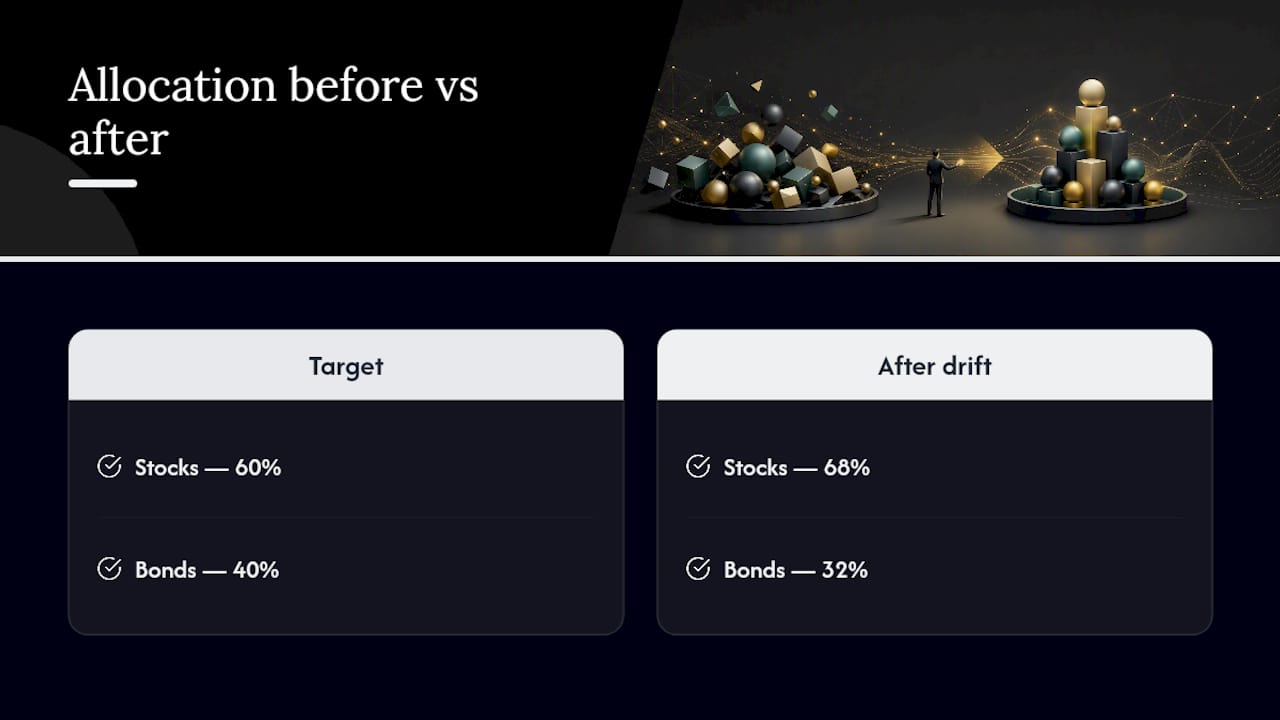
Portfolio rebalancing means selling or buying assets to bring your holdings back to your target allocation, the mix of stocks, bonds, and cash you decided on when you built your plan. Left alone, portfolios drift. A strong year for stocks can quietly push a 60/40 portfolio to 68/32, and now you’re carrying more risk than you signed up for.
That drift is the whole reason rebalancing exists. It forces a mechanical version of “sell high, buy low,” which sounds simple but is one of the hardest things to do on purpose. Vanguard notes that rebalancing enforces exactly this kind of discipline, trimming the winners and adding to the laggards when every emotional impulse says to do the opposite.
Investor first, not a return-boosting trick. That distinction matters as you age. A 30-year-old who drifts to 75% stocks might shrug it off. Someone five years from retirement can’t afford the same swing, which is why Morningstar recommends shifting toward short-to-intermediate bonds and cash as that buffer gets more important with age.
A few things rebalancing does for you include keeping your actual risk exposure matched to your intended risk, removing emotion from buy and sell decisions, and encouraging at least an annual review of your holdings.
How to Rebalance Your Portfolio in 5 Steps
Rebalancing isn’t complicated, but skipping a step is how people end up trading more than they need to. Here’s the order that works.
-
Pull every account into one view. Export holdings from your brokerage, 401(k), IRA, and any taxable accounts, then group everything by asset class, not by account. A tech stock in your Roth IRA and a tech fund in your taxable brokerage are the same exposure for this exercise.
-
Calculate your drift. Add up the dollar value in each asset class, divide by total portfolio value, and compare to your target. If your target is 60% stocks and you’re sitting at 66%, that’s a 6 percentage-point drift, enough to trigger action under most threshold rules.
-
Pick your method. Rebalancing strategies generally split into three camps: calendar-based (check on a fixed date), threshold-based (act only when drift crosses a set band, often 5% or 10%), or hybrid (check on a schedule, but only trade if the threshold is breached). Calendar-based is easiest to remember. Threshold-based responds faster to real market moves but requires you to actually watch your numbers.
-
Execute the trade, or avoid one entirely. You can sell the overweight asset and buy the underweight one directly. Or, better in many cases, direct new contributions, dividends, and interest payments into whatever is underweight instead of selling anything. Practitioners frequently prefer this cash-flow approach because it sidesteps both taxes and trading costs. Inside a 401(k) or IRA, you can also just move money between funds with no tax consequence of all.
-
Record what you did and confirm the math. Note the date, the trade, and the resulting allocation somewhere you’ll actually look again, a spreadsheet is fine. Then check that your new percentages land within a point or two of target.
Pro Tip: Set a recurring calendar reminder for your annual check, but don’t feel obligated to trade every time it fires. The reminder’s job is to make you look, not to make you sell.
How Often Should You Rebalance Your Portfolio?
There’s no single right cadence, but a few patterns consistently work better than the alternatives.
- Annual or semiannual reviews fit most long-term investors just fine. Vanguard’s own research points out that frequency should track your personal risk tolerance and how much time you’re willing to spend on it, and that very frequent rebalancing tends to add cost without a meaningful improvement in outcomes.
- A 5% band is common for investors who want tighter control and don’t mind checking more often.
- A 10% band suits investors who’d rather trade less and accept slightly more drift between adjustments.
- Hybrid is the practical favorite among advisors: check quarterly or annually, but only pull the trigger if a threshold is actually breached.
- As retirement nears, or after a sharp market move in either direction, check more often, but resist the urge to fine-tune every 1% wobble. That’s how small accounts lose money to fees instead of gaining it back from precision.
Tax-Smart Rebalancing: Keep More of What You Earn
Selling appreciated assets in a taxable account triggers capital gains, and that bill can quietly erase a chunk of the benefit you were chasing by rebalancing in the first place. The fix isn’t to avoid rebalancing. It’s to be deliberate about where the trades happen.
- Route rebalancing trades through IRAs and 401(k)s first, since trades inside these accounts don’t create a taxable event.
- Use new contributions, reinvested dividends, and interest payments to buy underweighted assets instead of selling winners in a taxable account, a technique Vanguard specifically recommends for taxable holdings.
- Consider tax-loss harvesting separately from routine rebalancing. They solve different problems, and conflating them tends to lead to sloppy trades made for the wrong reason.
- Watch commissions, bid-ask spreads, and any per-trade fees, since small accounts can lose more to trading costs than they gain from precision.
Statistic Callout: Vanguard’s guidance is blunt on this point: rebalancing too frequently, monthly or even weekly, usually stacks up transaction costs and tax drag that outweigh whatever marginal risk control you’d gain.
A Worked Example: Rebalancing a 60/40 Portfolio
Say you started with a $100,000 portfolio split 60% stocks and 40% bonds. After a strong year for equities, here’s where things stand.
| Asset Class | Target | Current Value | Current % | Drift |
|---|---|---|---|---|
| Stocks | 60% | $66,000 | 68% | +6 |
| Bonds | 40% | $34,000 | 32% | −6 |
That drift clears typical threshold rules, requiring you to sell some of the overweighted asset and buy the underweighted one to restore your target allocation. Alternatively, directing new contributions and dividend payouts into the underweighted assets can close the gap over time without selling, avoiding capital gains. For odd lots or fractional shares, round to the nearest whole share and accept being within a percentage point of target. Chasing exact precision on a small account usually costs more in fees than the precision is worth.
Your Rebalancing Checklist: What to Do Right Now
- Export holdings from every account and group them by asset class, not by account name.
- Calculate drift against your target allocation for each asset class.
- Decide: sell and buy directly, or redirect new contributions and dividends.
- Place trades inside tax-advantaged accounts first when a choice exists.
- Log the date, trades, and resulting percentages somewhere you’ll check again.
Before trading, ask your broker or advisor about capital gains impact, per-trade fees, and how long a trade takes to settle. Watch for red flags like unusually high commissions, forced partial fills on illiquid holdings, or narrow trading windows that limit when you can execute.
Pro Tip: If your platform offers automatic rebalancing inside a retirement account, use it for that account and reserve manual decisions for taxable holdings where tax consequences actually matter.
Why Discipline Beats Timing Every Time
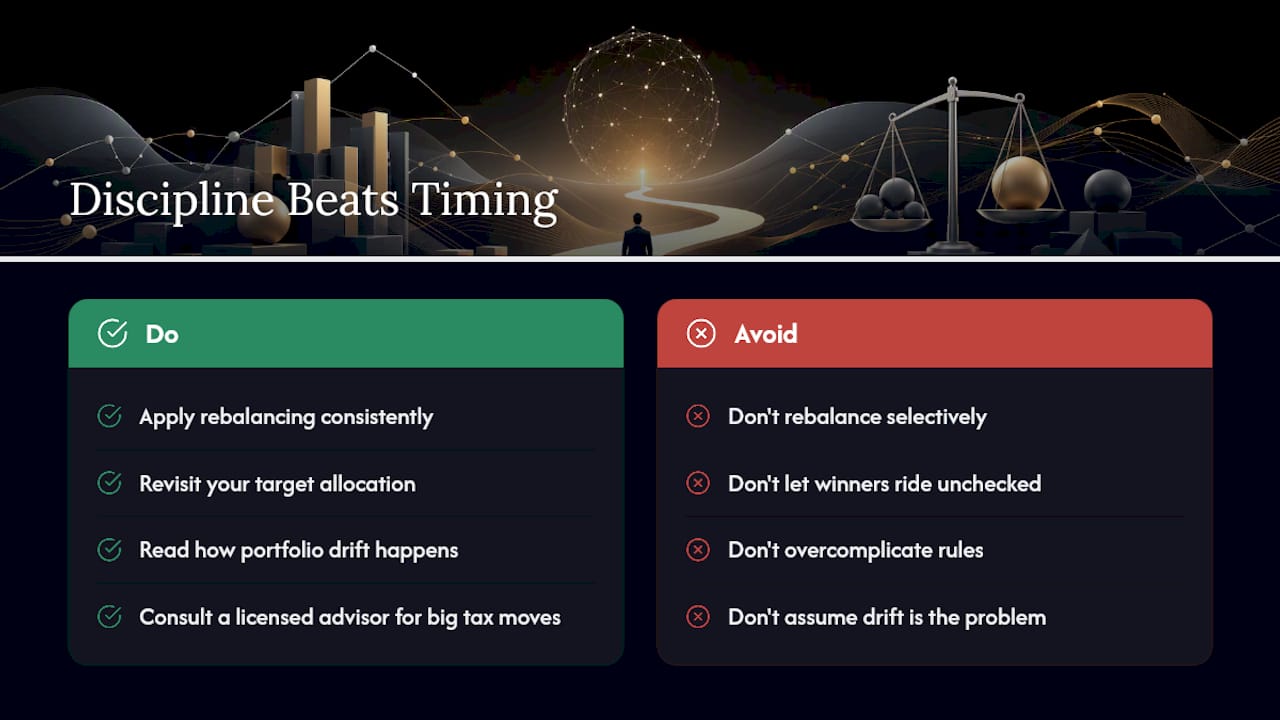
The biggest mistake I see isn’t skipping rebalancing entirely, it’s rebalancing selectively. Investors trim the bond allocation that “isn’t doing anything” but let a runaway tech stock ride because it feels wrong to sell a winner. That’s not rebalancing. That’s momentum chasing dressed up as a strategy.
The fix isn’t more sophistication. It’s fewer exceptions to your own rule. Read up on how portfolio drift actually happens if you want to see why this creeps up on even careful investors, and revisit your target allocation before assuming the drift itself is the problem. Sometimes the target is what’s outdated, not the portfolio. A licensed advisor should weigh in before any large, tax-sensitive move, this is guidance, not a substitute for someone who knows your full financial picture.
— Povilas
Get a Personalized Rebalancing Check From Finblog
Finblog turns the guesswork out of rebalancing timing into a straightforward next step: our educational content and consultation intake connect you with resources built specifically around allocation drift, tax-aware execution, and life-stage adjustments, the exact issues covered above. If your accounts span taxable and tax-advantaged vehicles and you’re not sure which trades belong where, that’s precisely the kind of question worth a second set of eyes. Head to Finblog and submit a quick consultation request to get a rebalancing review tailored to your actual holdings, not a generic model portfolio.
Sources
Guidance above draws on Vanguard, Investor.gov, Investopedia, Morningstar, and the SEC. For deeper background, see Finblog’s guide to what rebalancing means for investors.
- Rebalancing your portfolio: How to rebalance – Vanguard
- Investor
- How to Rebalance Your Portfolio – Investopedia
- How to Rebalance Your Portfolio Before 2025 – Morningstar