

More than 80 percent of American investors miss out on valuable tax savings simply because they are unaware of smart strategies like tax loss harvesting. Tax season can bring overwhelming questions about how to keep more of your hard-earned returns, especially when volatile markets impact your portfolio. Understanding the fundamentals and practical steps behind tax loss harvesting can empower you to reduce your tax bill while keeping your investment strategy on track.
Table of Contents
- Defining Tax Loss Harvesting And Core Concepts
- Eligible Assets And Common Tax Harvesting Scenarios
- Key Steps And How The Process Works
- Irs Wash Sale Rule And Legal Requirements
- Potential Benefits, Pitfalls, And Mistakes To Avoid
Key Takeaways
| Point | Details |
|---|---|
| Tax Loss Harvesting Defined | This strategy minimizes tax liabilities by selling depreciated investments to offset capital gains. |
| Core Mechanism | It allows investors to convert paper losses into tax benefits, potentially reducing taxable income. |
| Wash Sale Rule Awareness | Investors must avoid repurchasing similar securities within a 30-day period to maintain tax advantages. |
| Systematic Review Approach | Regularly assess your portfolio for loss harvesting opportunities to maximize tax efficiency while preserving investment strategy. |
Defining Tax Loss Harvesting and Core Concepts
Tax loss harvesting is a strategic financial approach that allows investors to minimize their tax liabilities by selling investments that have declined in value. This sophisticated technique enables you to offset capital gains with investment losses, potentially reducing your overall tax burden. Tax loss harvesting involves strategically selling investments at a loss to create tactical opportunities within your investment portfolio.
The core mechanism of tax loss harvesting centers on converting investment paper losses into immediate tax advantages. When you sell securities that have decreased in value, you can use those losses to counterbalance capital gains from other successful investments. This means if you earned $10,000 from selling one stock but experienced a $7,000 loss in another, you could potentially reduce your taxable gains significantly. Investors can deduct up to $3,000 of net losses against ordinary income annually, with any additional losses carried forward to future tax years.
Successful tax loss harvesting requires careful navigation of complex regulations. Investors must be mindful of rules like the wash sale rule, which prevents claiming losses if you purchase a substantially identical security within 30 days before or after the sale. This regulation ensures investors cannot manipulate the tax code by making superficial transactions. Strategic investors often replace sold securities with similar but not identical investments to maintain their portfolio’s overall structure while still capturing tax benefits.
Pro Tax Harvesting Tip: Review your investment portfolio quarterly and identify potential loss harvesting opportunities before the tax year ends, ensuring you maximize your tax efficiency while maintaining your long-term investment strategy.
Eligible Assets and Common Tax Harvesting Scenarios
Tax loss harvesting can be applied to a diverse range of investment assets, enabling investors to strategically manage their portfolios and minimize tax liabilities. The most common eligible assets include individual stocks, exchange-traded funds (ETFs), mutual funds, and bonds. Each asset type offers unique opportunities for tax optimization, allowing investors to offset capital gains with strategic loss realization across their investment portfolio.
Stocks represent the primary vehicle for tax loss harvesting, particularly during market volatility. Investors typically target individual stocks that have experienced significant price declines, selling these depreciated securities to generate tax-advantaged losses. Mutual funds and ETFs also provide excellent tax harvesting opportunities, especially when these funds have underperformed relative to market benchmarks. Common scenarios involve selling depreciated securities to offset gains from profitable investments, creating a balanced approach to managing investment tax exposure.

The most effective tax loss harvesting strategies involve careful asset selection and timing. Investors should focus on assets with meaningful unrealized losses while maintaining their overall investment strategy. This might involve replacing sold securities with similar (but not identical) investments to preserve portfolio allocation and avoid wash sale rule violations. Bonds, sector-specific ETFs, and international market funds can all serve as potential candidates for tax loss harvesting, providing flexibility in managing investment tax efficiency.
Pro Asset Selection Tip: Conduct a comprehensive portfolio review every quarter, identifying investments with unrealized losses that can be strategically sold to optimize your tax position while maintaining your long-term investment objectives.
Here’s a summary of key assets and how they are commonly used in tax loss harvesting:
| Asset Type | Typical Strategy | Unique Consideration |
|---|---|---|
| Stocks | Sell losers to offset gains | Watch volatility and timing |
| ETFs | Swap sector or index exposure | Pick non-identical replacements |
| Mutual Funds | Realize losses in underperformers | Mind fund classifications |
| Bonds | Target depreciated holdings | Consider bond term and issuer |
Key Steps and How the Process Works
The tax loss harvesting process involves a systematic approach to managing investment losses for maximum tax efficiency. Investors begin by conducting a comprehensive review of their investment portfolio, identifying securities that have declined in value below their original purchase price. This critical first step requires careful analysis of each investment’s performance, market conditions, and potential tax implications.
The core mechanics of tax loss harvesting center on strategic asset selling and replacement. Investors must carefully identify investments that have declined in value while ensuring they do not violate the wash sale rule, which prohibits repurchasing substantially identical securities within 30 days before or after the sale. This means selling depreciated assets and replacing them with similar but not identical investments that maintain the overall portfolio strategy. For example, an investor might sell an underperforming technology sector ETF and replace it with a different technology sector fund that has a distinct underlying index or investment approach.
Implementing tax loss harvesting requires precise calculation and documentation. Investors must track the exact amount of capital losses realized, understanding that these losses can offset capital gains and potentially reduce ordinary taxable income. The IRS allows investors to deduct up to $3,000 of net capital losses against ordinary income annually, with any excess losses carried forward to future tax years. This approach demands meticulous record-keeping, including detailed documentation of purchase prices, sale dates, and the specific tax lots being sold to maximize potential tax benefits.
Pro Tax Planning Tip: Create a dedicated spreadsheet to track potential tax loss harvesting opportunities throughout the year, noting unrealized losses, potential replacement securities, and precise sale timing to optimize your tax strategy.
IRS Wash Sale Rule and Legal Requirements
The wash sale rule represents a critical legal constraint in tax loss harvesting strategies, designed to prevent investors from manipulating tax regulations through artificial loss generation. This IRS regulation specifically prohibits claiming a tax deduction for a security sold at a loss if a substantially identical security is purchased within a 30-day window before or after the sale. The rule applies to purchases made in individual retirement accounts, spouse accounts, and other investment platforms, creating a comprehensive framework to maintain tax code integrity.
Understanding what constitutes a “substantially identical” security is crucial for compliance. Investors must carefully navigate the complex guidelines to avoid inadvertently triggering the wash sale rule, which can nullify potential tax benefits. This typically means avoiding repurchasing the exact same stock, identical ETF, or options contracts related to the same security. However, investors can strategically replace sold securities with similar but not identical investments, such as switching between two technology sector ETFs with different underlying indexes or moving between funds tracking slightly different market segments.
The consequences of violating the wash sale rule can be significant. When a wash sale occurs, the disallowed loss gets added to the cost basis of the replacement security, effectively deferring the tax benefit rather than eliminating it completely. This means investors must maintain meticulous records of all transactions, including the purchase dates, sale prices, and replacement securities. The complexity of these regulations underscores the importance of careful planning and potentially consulting with a tax professional who can provide guidance on navigating the intricate details of tax loss harvesting within legal boundaries.
Pro Compliance Tip: Develop a comprehensive tracking system for all investment transactions, including detailed documentation of purchase and sale dates, to ensure strict adherence to the wash sale rule and maximize your tax optimization strategy.
Potential Benefits, Pitfalls, and Mistakes to Avoid
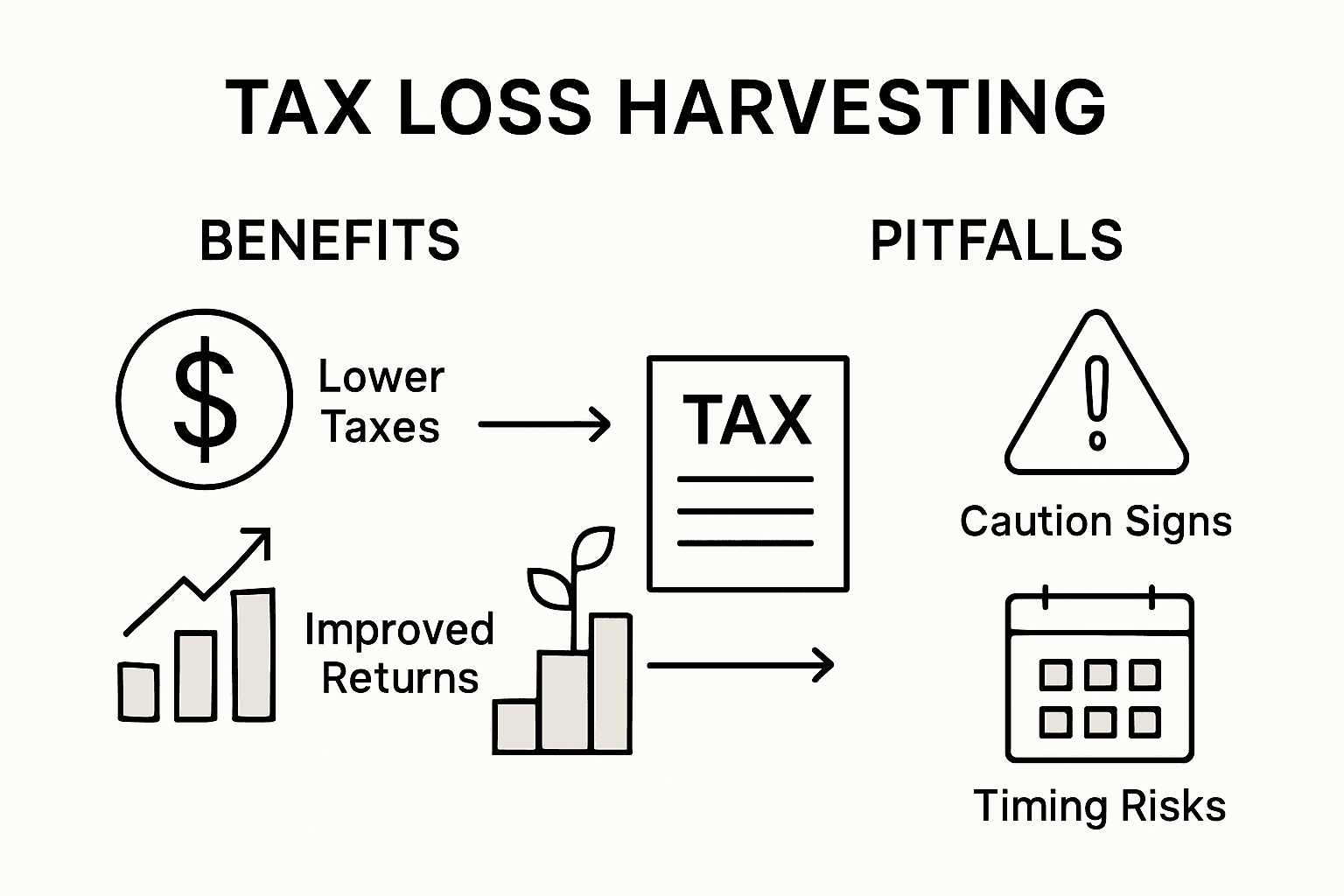
Tax loss harvesting offers significant potential benefits for strategic investors, primarily through reducing tax liabilities and optimizing investment returns. The primary advantage lies in offsetting capital gains with realized losses, effectively lowering an investor’s overall tax burden. By strategically selling underperforming securities, investors can generate tax deductions that can be applied against both investment gains and a portion of ordinary income, creating a powerful tax management technique.
However, the strategy is fraught with potential pitfalls that require careful navigation. Investors must be cautious of inadvertently triggering complex regulatory constraints that could nullify their tax optimization efforts. Common mistakes include violating the wash sale rule, failing to maintain proper documentation, and making replacement investments that substantially alter the original portfolio’s risk profile. Some investors mistakenly believe they can simply sell and rebuy the same security, not realizing the strict 30-day window and substantial similarity restrictions imposed by tax regulations.
The most critical mistakes in tax loss harvesting stem from insufficient planning and lack of comprehensive understanding. Investors often underestimate the importance of maintaining their overall investment strategy while executing tax loss harvesting. This means replacing sold securities with alternatives that preserve the original portfolio’s asset allocation, sector exposure, and risk characteristics. Failing to do so can lead to unintended consequences, such as unexpected portfolio volatility or deviation from long-term investment objectives. Additionally, investors should be aware that while tax loss harvesting can provide immediate tax benefits, it also adjusts the cost basis of replacement investments, which can impact future tax calculations.
Pro Strategy Tip: Develop a systematic approach to tax loss harvesting by creating a dedicated tracking spreadsheet that monitors potential tax-loss opportunities, replacement securities, and precise transaction timing to maximize tax efficiency while maintaining your investment strategy.
The table below compares common benefits and pitfalls of tax loss harvesting for investors:
| Potential Benefit | Typical Pitfall |
|---|---|
| Lowers annual tax bill | Triggering wash sale rule |
| Offsets capital gains | Poor record-keeping |
| Defers tax to future years | Straying from investment goals |
| Increases after-tax returns | Choosing unsuitable replacements |
Maximize Your Investment Strategy with Expert Tax Loss Harvesting Guidance
Tax loss harvesting is a powerful tool to reduce your tax burden and improve after-tax returns but it comes with challenges like navigating the wash sale rule and maintaining portfolio balance. If you feel overwhelmed by the complexity of timing, asset selection, and precise record-keeping this resource can make a real difference. You deserve a clear, effective strategy that aligns with your long-term investment goals and avoids costly mistakes.
At finblog.com we specialize in helping serious investors unlock smart tax strategies including tax loss harvesting. Take control of your investments and ensure you capitalize on every tax advantage without risking regulatory pitfalls. Get started today by exploring our easy-to-use expert advice and personalized financial insights. Visit finblog.com now to transform your portfolio and boost your tax efficiency before the next tax season arrives.
Frequently Asked Questions
What is tax loss harvesting?
Tax loss harvesting is a strategy used by investors to minimize tax liabilities by selling investments that have declined in value. This technique allows investors to offset capital gains with investment losses, potentially reducing their overall tax burden.
How does the wash sale rule affect tax loss harvesting?
The wash sale rule prevents investors from claiming a tax deduction for a security sold at a loss if a substantially identical security is purchased within 30 days before or after the sale. Violating this rule can nullify the tax benefits associated with the loss.
What types of investments can be used for tax loss harvesting?
Common eligible investments for tax loss harvesting include individual stocks, exchange-traded funds (ETFs), mutual funds, and bonds. Investors typically focus on assets that have experienced significant price declines to effectively offset capital gains.
How can I effectively implement tax loss harvesting in my investment strategy?
To implement tax loss harvesting effectively, review your investment portfolio quarterly to identify securities with unrealized losses. Sell these underperforming investments and replace them with similar but not identical securities to maintain your portfolio’s overall structure while capturing tax benefits.