

TL;DR:
- Cross-asset diversification outperforms traditional US-only or international-only portfolios on risk-adjusted return.
- Effective asset allocation involves spreading investments across stocks, bonds, and alternatives, not just individual stocks.
- Regularly rebalancing and tailoring your portfolio to your goals and risk tolerance enhances resilience and long-term growth.
The classic stock-and-bond split has guided investors for decades, but new research shows it may be leaving real money on the table. Cross-asset diversification outperforms traditional US-only or international-only portfolios when measured by Sharpe ratio, a key measure of risk-adjusted return. That’s a significant finding for anyone building a portfolio today. Whether you’re a working professional just starting to invest or a seasoned individual investor looking to sharpen your edge, understanding how to structure your assets is the single most important decision you’ll make. This guide breaks down the principles, the evidence, and the practical steps to help you build a smarter, more resilient portfolio in 2026.
Table of Contents
- What is asset allocation and why does it matter?
- Types of asset allocation strategies
- The evidence: What actually works?
- Building your optimal portfolio
- Why most investors get asset allocation wrong
- Take your next step with Finblog
- Frequently asked questions
Key Takeaways
| Point | Details |
|---|---|
| Diversification matters | Spreading investments across assets and regions can boost returns and limit losses. |
| Evidence beats tradition | Modern research shows that flexible, global strategies often outperform old 60/40 rules. |
| Personalization is key | The best asset allocation matches your risk profile and adapts to changing markets. |
| Rebalancing is crucial | Adjusting your mix regularly keeps your portfolio aligned with your goals. |
What is asset allocation and why does it matter?
Asset allocation is simply how you divide your investment money across different categories, or asset classes. Think of it as deciding how many eggs go in each basket before you even pick the eggs. The three core asset classes most investors work with are:
- Stocks (equities): Ownership in companies, higher growth potential, higher short-term volatility.
- Bonds (fixed income): Loans to governments or corporations, typically lower returns but more stability.
- Alternatives: Real estate, commodities like gold and oil, private equity, or hedge funds that behave differently from stocks and bonds.
The reason allocation matters so much is that different asset classes rarely move in the same direction at the same time. When stocks fall sharply, bonds often hold steady or rise. When inflation spikes, commodities frequently outperform. Spreading your money across these classes reduces the overall swings in your portfolio, which is what finance professionals call volatility.
Here’s where many investors go wrong: they assume that simply owning many stocks counts as diversification. It doesn’t. Owning 50 US tech stocks is still a concentrated bet on one sector and one country. True diversification means spreading across asset classes, geographies, and economic drivers. Research confirms that cross-asset allocation enhances performance specifically during market crises, which is exactly when you need your portfolio to hold together.
Another common mistake is the “set it and forget it” mindset. Investors pick an allocation, then ignore it for years while markets shift their actual percentages dramatically. A portfolio that started at 60% stocks could easily drift to 75% after a bull run, exposing you to far more risk than you intended.
“Asset allocation is not about predicting markets. It’s about building a structure that can survive conditions you didn’t predict.”
Pro Tip: Don’t confuse asset allocation with market timing. Allocation is a structural decision about how your money is organized. Timing is a bet on short-term price movements. One is a strategy; the other is speculation. Focus on your asset allocation strategies guide to build a framework that doesn’t depend on guessing what markets will do next.
Types of asset allocation strategies
With the basics clear, it’s time to explore the strategic choices you have when building your allocation. There are three primary models most investors choose from, and each has a distinct philosophy.
Strategic allocation sets a fixed target mix, say 60% stocks and 40% bonds, and rebalances back to that mix periodically. It’s disciplined and low-maintenance, but it doesn’t adapt to changing market conditions.
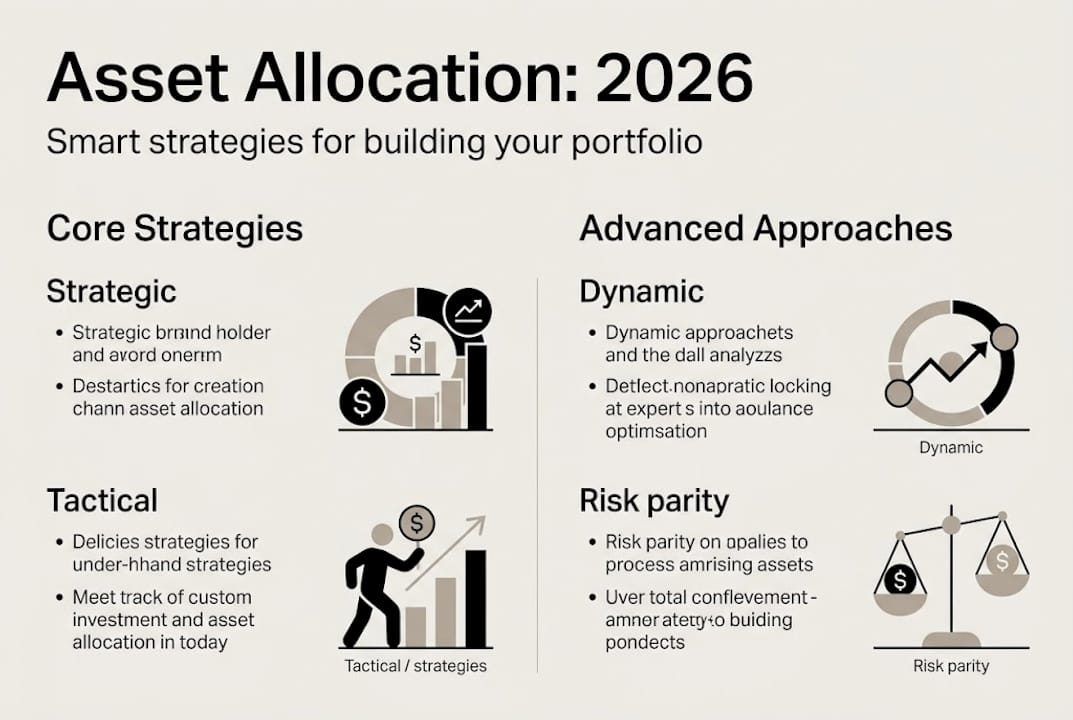
Tactical allocation allows short-term deviations from your target mix to take advantage of market opportunities. If bonds look overvalued, a tactical investor might temporarily shift more into stocks. This requires more active management and carries the risk of being wrong.
Dynamic allocation adjusts the portfolio continuously based on changing risk levels, economic data, or life stage. It’s the most flexible but also the most complex approach.
Here’s a simple comparison of how a $10,000 investment might look across common models:
| Strategy | Stocks | Bonds | Alternatives | Risk Level |
|---|---|---|---|---|
| Classic 60/40 | $6,000 | $4,000 | $0 | Moderate |
| All-equity global | $10,000 | $0 | $0 | High |
| Risk parity | $4,000 | $4,000 | $2,000 | Low-Moderate |
| International tilt | $4,000 | $2,000 | $4,000 | Moderate-High |
Risk parity is worth a closer look. Instead of allocating by dollar amount, it allocates by risk contribution. Bonds are less volatile than stocks, so you’d hold more bonds by dollar value to make their risk contribution equal to stocks. This approach tends to smooth out portfolio swings significantly. Research now challenges the 60/40 standard as the default lifecycle strategy, suggesting that more globally diversified or equity-heavy approaches may serve long-term investors better.

Explore dynamic allocation strategies if you want a model that adjusts as market conditions shift rather than locking you into a static formula.
The evidence: What actually works?
Choosing a strategy is important, but how do you know which one stands up to real-world markets? Let’s look at what works, backed by the numbers.
Since 2009, portfolios that included a broad mix of stocks, bonds, gold, and oil have consistently outperformed both US-only and international-only portfolios on a risk-adjusted basis. The metric used to measure this is the Sharpe ratio, which compares returns to the amount of risk taken. A higher Sharpe ratio means you’re getting more return for every unit of risk.
| Portfolio Type | Avg. Annual Return | Sharpe Ratio (Post-2009) | Max Drawdown |
|---|---|---|---|
| US stocks only | 13.2% | 0.84 | 34% |
| International stocks | 7.1% | 0.51 | 38% |
| Cross-asset diversified | 10.4% | 1.12 | 19% |
The cross-asset portfolio earns a lower raw return than US stocks, but it does so with far less risk and a dramatically smaller maximum loss. For most investors, that tradeoff is worth it. Cross-asset diversification outperforms the simpler models precisely because it captures returns from multiple economic drivers simultaneously.
Here’s a number that should stop you in your tracks: target-date funds, which are the default option in many retirement accounts, require 61% more savings over a lifetime to match the utility of a globally diversified all-equity strategy. That means if you’re relying on a standard target-date fund, you may need to save dramatically more just to reach the same financial outcome.
“Bull markets hide bad allocation decisions. Crises expose them. Build your portfolio for the storm, not the sunshine.”
Real-world market crises, like 2008 or the 2020 COVID crash, are the true tests of any allocation. A portfolio that looks great in a bull market but loses 40% in a downturn can take years to recover. The diversification benefits of a cross-asset approach are most visible in exactly those moments. To see which approaches are holding up right now, check out winning diversification strategies in 2026.
Building your optimal portfolio
Understanding the evidence is powerful, but building your own asset allocation is where knowledge turns into results. Here’s a five-step process to get you started.
- Assess your financial goals. Are you saving for retirement in 30 years, a home purchase in 5 years, or income in the next 12 months? Your goal shapes everything else.
- Define your time horizon. Longer horizons allow you to take more risk because you have time to recover from downturns. Shorter horizons demand more stability.
- Score your risk tolerance. This is both financial (how much loss can your portfolio absorb?) and emotional (how much volatility can you handle without panic-selling?). Be honest with yourself here.
- Pick your asset mix. Use the evidence, not just a rule of thumb. Research confirms that risk level and international exposure can dramatically alter long-term outcomes, so don’t default to a generic model without considering your specific situation.
- Rebalance regularly. Set a schedule, quarterly or annually, and stick to it. Rebalancing forces you to sell high and buy low automatically, which is the opposite of what most emotional investors do.
Pro Tip: Adding even a 10-15% allocation to international stocks or alternatives like gold can meaningfully reduce your portfolio’s volatility without sacrificing long-term growth. It feels counterintuitive to add assets that seem “riskier,” but the correlation benefit is real.
Two pitfalls to avoid above all else: reacting to financial headlines and ignoring international assets. Headlines create noise. Your allocation should be driven by your plan, not the latest market panic. And skipping international exposure means missing out on growth from economies that don’t move in lockstep with the US market. Understanding the core stocks vs bonds difference is a great starting point, and pairing that knowledge with hedging strategies can add another layer of protection to your portfolio.
Why most investors get asset allocation wrong
Bringing all this together, here’s what most investors and experts overlook, and how it might change your approach.
The 60/40 portfolio was built for a world of high bond yields and relatively stable US market dominance. That world has changed. Interest rates, inflation cycles, and global market dynamics look very different today than they did in the 1980s and 1990s when this model became conventional wisdom. Yet millions of investors still treat it as the default.
The uncomfortable truth is that following a generic strategy because it’s familiar is not a plan. It’s inertia. The research now questions old assumptions about US stocks and bonds performing reliably together, and the evidence points toward more adaptive, globally aware approaches.
The best allocations are personal, flexible, and updated as your life and the market evolve. Continuous learning, reviewing recent data, and being willing to adjust separates resilient investors from those who get caught flat-footed. Start by understanding why diversify investments at a deeper level, and commit to revisiting your allocation at least once a year with fresh eyes and current data.
Take your next step with Finblog
Ready to put these insights to work? Building a smarter portfolio starts with having the right resources at your side. At Finblog, we publish regularly updated guides, tools, and analysis designed specifically for individual investors and working professionals who want evidence-based strategies, not generic advice. Whether you’re just mapping out your first allocation or stress-testing a portfolio you’ve held for years, our comprehensive asset allocation guide walks you through every decision point with clarity. Markets change, and your allocation should keep pace. Explore our library, subscribe for updates, and start making decisions backed by data rather than guesswork.
Frequently asked questions
What is the main purpose of asset allocation?
Asset allocation aims to balance risk and return by strategically dividing investments among different asset classes. Cross-asset diversification shows this approach consistently improves risk-adjusted performance compared to single-class portfolios.
Is the classic 60/40 portfolio still the best choice for investors?
Recent research suggests that global diversification and all-equity or cross-asset approaches may outperform the traditional 60/40 portfolio. The optimal lifecycle allocation research directly challenges the 60/40 model as the default retirement strategy.
How often should you rebalance your asset allocation?
Most experts recommend rebalancing once or twice a year, or when your allocations drift more than 5-10% from your targets. Consistent rebalancing keeps your risk profile aligned with your actual goals.
Does including international assets reduce my portfolio risk?
Yes, research shows that adding international assets improves returns and reduces risk, especially during market crises. International diversification lowers correlation between holdings, which smooths out overall portfolio volatility.
How do I know which asset allocation is right for me?
Your ideal allocation depends on your specific goals, risk tolerance, and investment timeline. Start by mapping those three factors clearly, then use evidence-based models rather than generic rules to build your mix.