

TL;DR:
- Financial estate planning involves organizing assets and legal documents to transfer wealth efficiently and minimize taxes. It includes key documents like wills, trusts, powers of attorney, and beneficiary forms, each with specific roles and modification rules. Regular reviews and coordination among professionals help prevent common mistakes and enable advanced strategies to preserve wealth across generations.
Financial estate planning is the process of organizing your assets, legal documents, and tax strategies so your wealth transfers to the right people, at the right time, with minimal loss to taxes or probate. The standard industry term is “estate planning,” but financial estate planning captures the full scope: it connects your investment accounts, insurance policies, retirement funds, and legal instruments into one coordinated system. Estate planning functions at the intersection of tax law, property law, and financial planning. Without that coordination, even large estates can shrink dramatically through court costs, tax inefficiency, and misdirected assets. This guide covers the documents, tax strategies, common mistakes, and advanced techniques you need to protect your financial legacy.
What are the key documents in financial estate planning?
Every estate plan rests on six core legal instruments. Each one serves a specific function, and gaps between them create the failures most families never see coming.
Last will and testament. A will directs how your probate assets transfer after death. It names an executor, appoints guardians for minor children, and specifies distributions. A will does not control assets with named beneficiaries or joint ownership.
Revocable living trust. A revocable trust holds assets during your lifetime and distributes them at death without probate. You remain the trustee and can change the trust at any time. The critical requirement: you must retitle assets into the trust’s name. Unfunded revocable trusts fail to avoid probate because assets that stay in your personal name still pass through the court system.
Irrevocable trusts. An irrevocable life insurance trust (ILIT) removes life insurance proceeds from your taxable estate. Once created, you cannot easily modify it. That loss of control is the trade-off for the tax and asset protection benefits.
Powers of attorney. A financial power of attorney authorizes someone to manage your finances if you become incapacitated. A healthcare power of attorney does the same for medical decisions. Both documents expire at death, so they serve a different purpose than a will or trust.
Advance healthcare directive. Also called a living will, this document states your medical treatment preferences when you cannot speak for yourself. It works alongside the healthcare power of attorney.
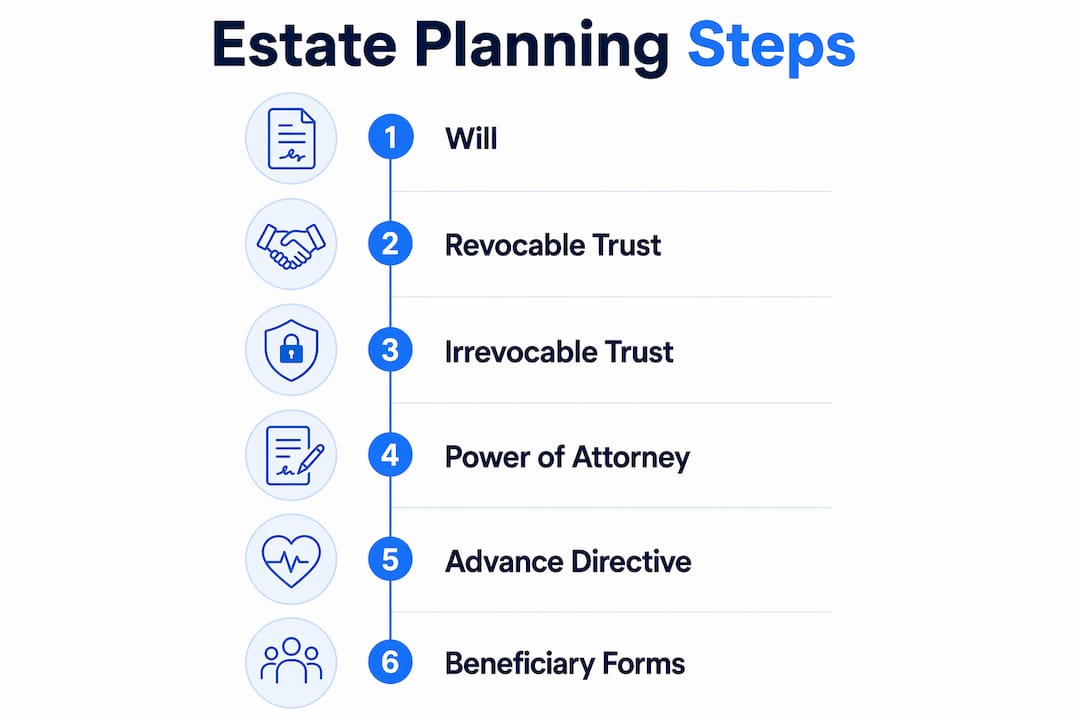
Beneficiary designation forms. These forms on retirement accounts, life insurance policies, and payable-on-death bank accounts override your will entirely. Beneficiary designations override will provisions under contract law. A will cannot redirect a 401(k) to a different heir if the beneficiary form says otherwise.
| Instrument | Primary purpose | Avoids probate | Modifiable |
|---|---|---|---|
| Last will and testament | Directs probate asset distribution | No | Yes |
| Revocable living trust | Manages and transfers assets privately | Yes, if funded | Yes |
| Irrevocable trust (ILIT) | Removes assets from taxable estate | Yes | No |
| Financial power of attorney | Manages finances during incapacity | N/A | Yes |
| Advance healthcare directive | States medical treatment preferences | N/A | Yes |
| Beneficiary designation form | Controls non-probate account transfers | Yes | Yes |
Pro Tip: Review every beneficiary designation form after a divorce, remarriage, or birth of a child. Courts cannot override a named beneficiary, even when the designation is clearly outdated.
How does estate planning intersect with tax strategy?
Tax planning is no longer a secondary concern in estate planning. It is the primary one for most families.

The One Big Beautiful Budget Act (OBBBA) permanently set the basic exclusion amount at $15 million per person, adjusted for inflation. That level removes the vast majority of American estates from federal estate tax exposure entirely. The result: estate planning has shifted its focus from avoiding estate tax to minimizing income tax for heirs.
The step-up in basis rule is now central to that shift. Assets inherited at death receive a step-up in basis, resetting the cost basis to the fair market value on the date of death. An heir who sells an inherited stock portfolio pays capital gains tax only on appreciation after the date of death, not on decades of growth. Gifting the same asset during your lifetime passes your original cost basis to the recipient, creating a larger taxable gain when they sell.
That distinction changes how you think about gifting. Giving cash or low-basis assets during life may cost your heirs more in income tax than it saves in estate tax. Holding appreciated assets until death and letting the step-up reset the basis is often the better move for heirs in higher tax brackets.
Key tax planning strategies within an estate plan:
- Annual exclusion gifts. You can give up to the IRS annual exclusion amount per recipient per year without using your lifetime exemption. This removes assets from your estate gradually.
- Credit shelter trusts. These trusts capture the deceased spouse’s exemption and keep assets out of the surviving spouse’s taxable estate.
- Charitable remainder trusts. These provide income during your lifetime and pass the remainder to charity, generating a partial charitable deduction.
- Roth conversions. Converting traditional IRA funds to Roth accounts during your lifetime reduces the income tax burden on heirs who inherit the account.
- Beneficiary designation alignment. Naming a trust as IRA beneficiary requires careful drafting. The SECURE Act forces most non-spouse beneficiaries to fully distribute inherited IRA accounts within 10 years, compressing the tax hit significantly.
Pro Tip: Work with a tax professional and an estate attorney together, not separately. A coordinated tax and estate strategy catches conflicts between your investment plan and your legal documents before they cost your heirs real money.
What common mistakes should you avoid in estate planning?
Most estate plan failures trace back to a short list of preventable errors. Knowing them in advance is the most practical protection you have.
Misaligned beneficiary designations. This is the single most common and costly mistake. A will that leaves everything to your children means nothing if your IRA still names your ex-spouse as beneficiary. The beneficiary form wins every time. Check every account individually.
Unfunded trusts. A revocable living trust that holds no assets is a legal document with no practical effect. You must retitle your home, investment accounts, and other assets into the trust’s name after signing it. Many people sign the trust document and stop there, leaving their estate fully exposed to probate.
Outdated powers of attorney. Financial institutions sometimes reject powers of attorney that are more than a few years old. An outdated document can leave a family unable to manage finances during a medical crisis. Reexecuting powers of attorney every three to five years prevents this problem.
Ignoring the SECURE Act’s 10-year rule. Naming a non-spouse individual as an IRA beneficiary without planning for the 10-year distribution requirement can push heirs into higher tax brackets during peak earning years. A conduit trust or accumulation trust drafted to comply with SECURE Act rules can spread the tax impact more effectively.
Skipping regular reviews. An estate plan written in 2015 reflects 2015 tax law, 2015 family circumstances, and 2015 asset values. Periodic reviews triggered by life changes and law updates are what keep a plan functional.
Critical review checkpoints:
- Marriage, divorce, or remarriage
- Birth or adoption of a child or grandchild
- Death of a named beneficiary, executor, or trustee
- Significant change in asset values or account types
- Major tax law changes at the federal or state level
- Relocation to a different state with different probate or trust laws
Pro Tip: Schedule a plan audit with your financial advisor, estate attorney, and tax professional together every three years at minimum. A solo review by one professional misses the cross-discipline conflicts that cause the most damage.
How do advanced strategies preserve wealth across generations?
Once your core estate plan is in place, advanced techniques can extend its reach across multiple generations and significantly reduce the tax drag on transferred wealth.
Dynasty trusts, spousal lifetime access trusts (SLATs), and leveraged sales to grantor trusts are the primary tools for this work. Each one serves a different purpose, and the right combination depends on your family structure, asset types, and state of residence.
Dynasty trusts. In states with favorable trust laws, a dynasty trust can exist perpetually, holding assets for multiple generations without triggering estate tax at each generational transfer. States like South Dakota and Nevada have eliminated the rule against perpetuities, making them popular choices for trust formation. Assets inside the trust grow outside your taxable estate and outside your heirs’ taxable estates.
Spousal lifetime access trusts (SLATs). A SLAT is an irrevocable trust that benefits your spouse during their lifetime while removing assets from your combined taxable estate. The trade-off is that you lose direct access to those assets. If your spouse dies first, access to the trust assets ends.
Grantor retained annuity trusts (GRATs). A GRAT transfers asset appreciation to heirs at a reduced gift tax cost. You place assets in the trust and receive annuity payments for a fixed term. Any growth above the IRS hurdle rate passes to heirs tax-free at the end of the term.
Leveraged sales to grantor trusts. You sell appreciated assets to an intentionally defective grantor trust (IDGT) in exchange for a promissory note. The sale is not a taxable event for income tax purposes, and future appreciation on those assets accumulates outside your estate.
| Strategy | Primary benefit | Key drawback | Best for |
|---|---|---|---|
| Dynasty trust | Multi-generational tax-free growth | Irrevocable; state law dependent | Large estates, long-term planning |
| SLAT | Removes assets from estate; spouse retains access | Loss of direct access; divorce risk | Married couples with high net worth |
| GRAT | Transfers appreciation tax-efficiently | Mortality risk during term | Rapidly appreciating assets |
| IDGT sale | Removes assets and future growth from estate | Promissory note must carry IRS interest rate | Business interests, real estate |
State law variations matter significantly here. Trust duration limits, income tax treatment of trust income, and creditor protection rules differ by state. Moving a trust to a more favorable jurisdiction is possible in many cases but requires careful legal work.
Key Takeaways
Effective estate planning requires coordinating legal documents, tax strategies, and beneficiary designations into one plan that you review regularly as laws and life circumstances change.
| Point | Details |
|---|---|
| Beneficiary forms override wills | Update every account’s beneficiary form after major life events to prevent misdirected assets. |
| Fund your trust after signing it | Retitle assets into the trust’s name or probate avoidance fails entirely. |
| Step-up in basis changes gifting math | Holding appreciated assets until death often saves heirs more in income tax than lifetime gifting. |
| SECURE Act compresses IRA distributions | Non-spouse beneficiaries must empty inherited IRAs within 10 years, requiring proactive tax planning. |
| Review every three to five years | Life changes and tax law updates can invalidate key provisions without a periodic audit. |
Why I think most people approach estate planning backward
Most people treat estate planning as a one-time legal task. They hire an attorney, sign a stack of documents, and file everything in a drawer. That approach is how estates end up in probate, how ex-spouses inherit retirement accounts, and how trusts sit empty for decades.
Estate planning is not a standalone legal exercise. It is a living component of your financial plan that needs the same attention you give your investment portfolio. Tax law changes. Family structures change. Asset values change. A plan that does not adapt to those changes stops working.
The misconception I see most often is the belief that a will controls everything. It does not. A will controls only probate assets. Your IRA, your 401(k), your life insurance, and your jointly held property all pass outside the will entirely. If those accounts have outdated or missing beneficiary designations, the results can be the opposite of what you intended.
The other gap I see consistently is the failure to connect estate planning with wealth preservation strategies. An estate attorney drafts documents. A financial advisor manages investments. A tax professional files returns. None of them automatically talks to the others. The conflicts that create real damage live in those gaps. Closing them requires deliberate coordination, not just good intentions.
My practical advice: treat your estate plan as a team sport. Schedule a joint review with all three professionals at the same table, even if it is just once every few years. That single meeting catches more problems than three separate reviews ever will.
— Povilas
Finblog’s resources for your estate planning strategy
Building a sound estate plan takes more than signing documents once. Staying current on tax law changes, trust strategies, and beneficiary rules requires ongoing attention. Finblog publishes detailed, research-backed content on estate taxes and wealth transfer to help you understand how legislation affects your plan in real time. The site also covers the full range of financial planning topics that connect to estate planning, from investment strategy to retirement accounts. Whether you are starting your first plan or reviewing an existing one, Finblog’s estate planning guide for 2026 gives you a practical framework to work from. Visit Finblog to access the full library of resources.
FAQ
What is financial estate planning?
Financial estate planning is the process of coordinating legal documents, tax strategies, and beneficiary designations to manage and transfer your assets according to your wishes during incapacity or after death.
Do beneficiary designations override a will?
Yes. Beneficiary designation forms on retirement accounts and life insurance policies override will provisions under contract law, regardless of what the will states.
What happens if I don’t fund my revocable trust?
An unfunded revocable trust provides no probate protection. Assets that remain titled in your personal name still pass through the probate court system, defeating the trust’s primary purpose.
How does the SECURE Act affect inherited IRAs?
The SECURE Act requires most non-spouse beneficiaries to fully distribute inherited IRA accounts within 10 years of the original owner’s death, which can push heirs into higher income tax brackets during that period.
When should I update my estate plan?
Update your estate plan after any major life event, including marriage, divorce, the birth of a child, the death of a named beneficiary, a significant change in assets, or a major change in federal or state tax law.