


Most people genuinely want to get their finances in order, yet 37% of Americans have no emergency fund at all. That gap between intention and action is not a willpower problem. It is a priorities problem. When debt, savings, and investing all feel urgent at the same time, most people freeze or pick the wrong starting point. This guide cuts through that confusion with evidence-backed frameworks, real allocation examples, and practical steps you can apply this week. Whether you are just starting your career or trying to reset a stalled financial plan, you will leave with a clear, ranked action list.
Table of Contents
- Understanding financial priorities: What matters most
- Pitfalls and misconceptions: Why most people stumble
- Step-by-step approach: How to set effective priorities
- Emergency funds: The foundation of financial security
- Cash flow and budgeting: Keeping priorities on track
- Next steps: Move from planning to action
- Frequently asked questions
Key Takeaways
| Point | Details |
|---|---|
| Establish clear priorities | Identify your top goals—debt payoff, emergency savings, investing—based on current needs. |
| Avoid common mistakes | Overcome indecision and behavior traps by using cash flow planning and regular goal reviews. |
| Build a solid emergency fund | Aim for 3-6 months of expenses; automate savings to reach your target and protect yourself from surprise costs. |
| Budget for progress | Use effective budgeting to keep spending in sync with your priorities and maximize wealth building. |
| Take actionable steps | Follow simple, evidence-backed frameworks to turn financial confusion into strategic clarity. |
Understanding financial priorities: What matters most
Financial priorities are the ranked decisions you make about where your money goes first. They are not just goals. They are a decision framework that tells you what to fund before anything else. The three core categories are debt repayment, savings (especially emergency savings), and investing. Most people need all three, but the order matters enormously depending on your life stage and income.
Benchmark data makes the picture clearer. 42% of Americans prioritize paying down debt, 39% focus on budgeting, and 46% emphasize saving for an emergency fund. These numbers show that most people instinctively know what matters. The problem is executing all three at once without a system.
Good personal finance management starts with knowing your “why.” A 28-year-old with student loans has different priorities than a 45-year-old with a paid-off mortgage and a thin retirement account. Life stage, income stability, and risk tolerance all shape which category deserves the most attention right now.
Here is a quick breakdown of the main priority areas:
- Debt repayment: High-interest debt (above 7%) almost always comes before investing
- Emergency fund: A cash buffer that prevents you from going deeper into debt during a crisis
- Budgeting: The system that keeps all other priorities funded consistently
- Investing: Long-term wealth building that compounds over time
| Priority area | % of Americans who rank it first | Typical income allocation |
|---|---|---|
| Emergency savings | 46% | 5-10% of take-home pay |
| Debt repayment | 42% | 10-20% of take-home pay |
| Budgeting/cash flow | 39% | Ongoing system, not a fixed % |
| Investing | Varies by income | 10-15% of take-home pay |
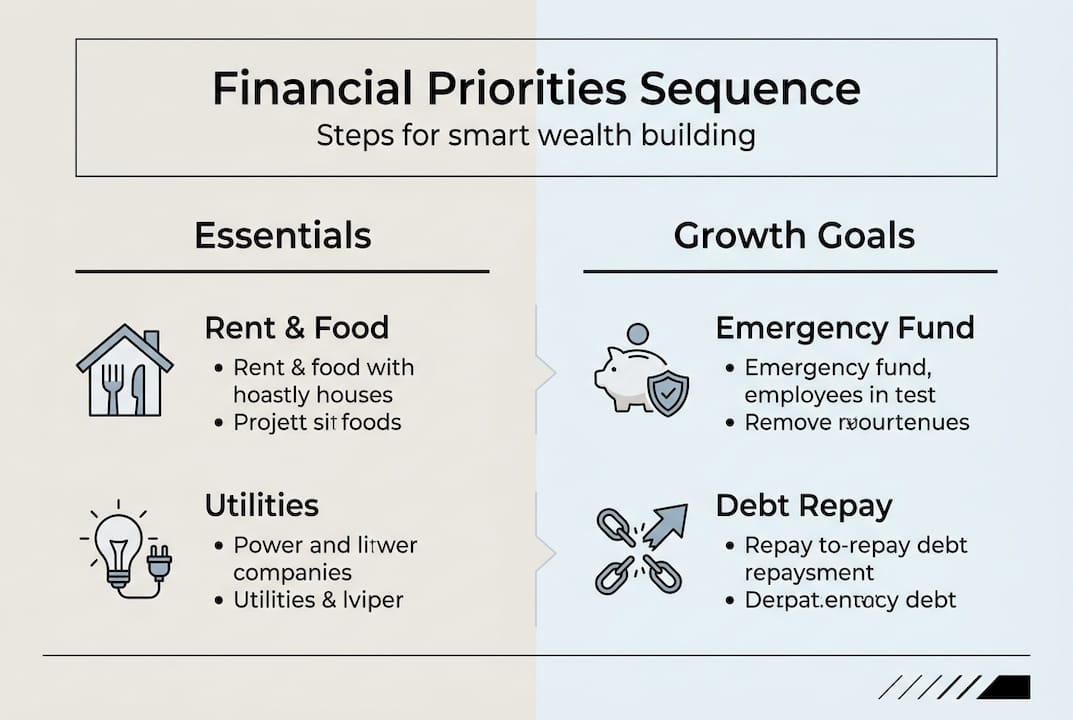
The financial goal setting process works best when you treat these categories as a sequence, not a simultaneous sprint.
Pitfalls and misconceptions: Why most people stumble
Knowing your priorities is one thing. Sticking to them is another. The most common reason people derail is not laziness. It is a structural problem in how they plan.
Common pitfalls include indecision about where to start, over-relying on goal-setting without accounting for cash flow, and skipping the emergency fund entirely. When a crisis hits and there is no cash buffer, people reach for credit cards. That single move can set a financial plan back by months or even years.
Here are the traps that catch even motivated people:
- Setting ambitious goals without a monthly cash flow plan to fund them
- Investing before eliminating high-interest debt (paying 22% APR on a credit card while earning 8% in the market is a losing trade)
- Treating budgeting as optional rather than as the engine behind every other priority
- Ignoring behavioral patterns, like lifestyle inflation after a raise
“The biggest financial mistake is not a bad investment. It is having no plan for when things go wrong.”
Avoiding these financial mistakes requires more than awareness. It requires building systems that work even when motivation dips. That means automating savings, scheduling monthly reviews, and treating your budget as a living document.
Many of the personal finance mistakes that cost people real money come down to one root cause: skipping the foundation and jumping straight to the exciting parts like stock picking or real estate.
Pro Tip: Before you chase any investment goal, build a cash flow cushion of at least one month of expenses. This single buffer prevents most financial emergencies from becoming financial disasters.
Step-by-step approach: How to set effective priorities
Here is a simple, repeatable framework for ranking your financial priorities. It works whether you earn $40,000 or $140,000 a year.
- List every financial obligation and goal. Write down all debts (with interest rates), your current savings balance, and your top three financial goals. Be specific.
- Rank by urgency and cost. High-interest debt costs you money every day. Rank it above low-interest debt and most investment goals.
- Assign a percentage to each category. Employed Americans save an average of 23% of take-home pay (median 15%). Use that as a benchmark, then adjust based on your debt load.
- Build your monthly allocation plan. Decide exactly how much goes to each priority before the month starts.
- Review and adjust monthly. Life changes. Your allocation should too.
Here is how a $3,000 monthly take-home income might be allocated:
| Category | Monthly amount | % of income |
|---|---|---|
| Essential expenses (rent, food, utilities) | $1,500 | 50% |
| Emergency fund (building phase) | $300 | 10% |
| High-interest debt repayment | $450 | 15% |
| Investing (401k, IRA) | $300 | 10% |
| Discretionary spending | $450 | 15% |
Early-career professionals should weight emergency savings and debt repayment more heavily. Established professionals with stable income can shift more toward investing once the foundation is solid. Use the financial goal setting steps to refine this framework for your specific situation, and explore setting financial goals to make each target measurable. Pair this with effective budgeting to keep the whole system running.
Emergency funds: The foundation of financial security
If there is one financial priority that protects everything else, it is the emergency fund. Without it, a single unexpected expense, a car repair, a medical bill, a job loss, can wipe out months of progress and push you back into debt.

The data is striking. The average emergency fund is $18,500 among those who have one, and 46% of Americans cite emergency savings as their top financial priority. Yet a large share of the population has nothing saved at all. That gap represents enormous financial vulnerability.
Here is how to build your emergency fund systematically:
- Set a target. Aim for 3 to 6 months of essential living expenses. If your monthly essentials cost $2,000, your target is $6,000 to $12,000.
- Open a dedicated account. Keep emergency savings separate from your checking account to reduce the temptation to spend it.
- Start small. Even $500 in an emergency fund dramatically reduces the chance you will need to use a credit card for an unexpected expense.
- Increase contributions after debt payoff. Once high-interest debt is gone, redirect those payments into your emergency fund.
- Replenish immediately after use. If you draw from the fund, treat rebuilding it as your top priority.
For a deeper look at building this safety net, the emergency fund planning guide walks through every step. You can also explore why emergency fund importance goes beyond just having cash on hand.
Pro Tip: Automate a fixed transfer to your emergency fund on payday. When the money moves before you see it, you will not miss it, and your fund will grow faster than you expect.
Cash flow and budgeting: Keeping priorities on track
Even the best financial priorities fall apart without a system to fund them consistently. That system is your budget. Budgeting and cash flow management are what turn financial goals from intentions into results.
Think of your budget as the operating system for your financial life. It does not restrict you. It tells your money where to go so your priorities actually get funded each month.
Here are the most effective tactics for keeping your priorities on track:
- Track every expense for 30 days. You cannot optimize what you cannot see. Most people are surprised by where their money actually goes.
- Separate needs from wants. Needs are non-negotiable (rent, groceries, utilities). Wants are everything else. Cutting wants funds priorities.
- Sync your budget to your priority list monthly. At the start of each month, confirm that your spending plan matches your ranked priorities.
- Use the zero-based method. Assign every dollar a job before the month starts. Unassigned dollars tend to disappear.
- Review and adjust after any income change. A raise, a bonus, or a new expense should trigger an immediate budget update.
Strong cash flow management is what separates people who make progress from those who stay stuck. If you need a structured starting point, the guide on creating a budget gives you a step-by-step process that works for any income level.
Next steps: Move from planning to action
You now have a clear picture of how to rank your financial priorities, avoid the most common traps, build your emergency fund, and keep everything on track with a solid budget. The next move is yours. Start by picking one action from this guide and completing it today, whether that is opening a dedicated savings account, listing your debts by interest rate, or setting up an automatic transfer.
For tools, checklists, and deeper guides on every topic covered here, explore the financial wellness resources available on our site. The personal finance guide is a strong next step if you want a structured path from where you are now to where you want to be. You do not need to figure this out alone.
Frequently asked questions
How much should I allocate to emergency savings?
Experts recommend saving at least 3 to 6 months of living expenses. The average emergency fund among Americans who have one is $18,500, which is a useful real-world benchmark.
What’s the first priority if I have debt and no savings?
Build a small emergency fund first (at least $500 to $1,000), then shift focus to high-interest debt. 46% prioritize emergency savings while 42% focus on debt payoff, and doing both in sequence is smarter than choosing one entirely.
How do I avoid common mistakes in setting priorities?
Plan your cash flow before setting goals, build consistent savings habits, and review your priorities monthly. Many people stumble because they rely on goals alone without a cash flow plan to back them up.
Can budgeting help me set financial priorities?
Absolutely. A budget forces you to assign money to each priority before spending begins. Budgeting is a top priority for 39% of Americans because it is the system that makes every other goal possible.
How often should I review my priorities?
Review your financial priorities at least once a month. Any change in income, expenses, or life circumstances is a signal to revisit and rerank your goals right away.
Recommended
- Smart money habits: build wealth with proven strategies – Finblog
- How to Build Wealth: Proven Steps for Lasting Financial Success – Finblog
- Financial habits from wealthy people that build wealth – Finblog
- Setting Smart Financial Goals: Achieve Financial Success – Finblog
- Finanzas Personales – Finanzas Libres