

If you’re planning a career change, start with a two-week task audit and a microplan that proves the pivot before you quit. Write down every task you do at work for two weeks, mark which ones energize you and which ones drain you, then use that pattern to point your research.
Here’s the one-paragraph version of the whole plan: spend two weeks auditing your current work, run 5 informational interviews with people in the field you’re eyeing, and set a runway target before you touch your resignation letter. Do these three things in the next 10 days:
- Track your tasks for two weeks and rate each one on energy, not just competence.
- Book 5 informational interviews with people doing the job you think you want.
- Calculate your financial runway and set a savings target before you make any big move.
Judge your progress by concrete markers, not vague optimism. A validated pivot usually shows 3 tested projects, 5 to 8 completed informational interviews, and 6 to 12 months of expenses saved. Hit those benchmarks and you’re making a decision based on evidence.
Key Takeaways
A successful career change depends on validating fit through informational interviews and hands-on projects before quitting, backed by 6 to 12 months of financial runway.
| Point | Details |
|---|---|
| Validate before you leap | Complete 5 to 8 informational interviews and 20+ hours of hands-on project work before resigning. |
| Build financial runway | Save 6 to 12 months of expenses to avoid rushed decisions during the transition. |
| Use the VIPS framework | Assess values, interests, personality, and skills to define a clear target role. |
| Set a realistic timeline | Budget 6 to 18 months depending on whether your pivot is adjacent or a full reinvention. |
| Rewrite your resume as hybrid | Lead with a transition summary and skills section before your reverse-chronological history. |
Table of Contents
- How Do You Know It’s Time for a Career Change?
- Take Stock: Values, Interests, Skills, and What You Actually Want
- Explore Your Options Before You Commit to One
- Build a Timeline and Run the Numbers Before You Leap
- Build Evidence While You’re Still Employed
- Rewrite Your Resume and Build a 90-Day Microplan
- Choosing Your Entry Route Into the New Field
- Avoiding the Mistakes That Derail Most Career Changes
- Make the Leap Without Betting Your Whole Financial Life on It
- Editorial Take: The 90-Day Plan Beats the Leap of Faith
- Frequently Asked Questions
- Sources
How Do You Know It’s Time for a Career Change?
Boredom on a Tuesday isn’t a career crisis. A sustained loss of meaning, months of burnout that a vacation doesn’t fix, or a values shift that makes your current work feel pointless are different signals entirely. Persistent curiosity about another field, especially one that’s shown up as a growing side hustle or unpaid hours spent learning something new, is a strong indicator too.
- Work has stopped feeling connected to anything you value, and that gap hasn’t closed in six months or more.
- You’re exhausted in a way that rest doesn’t touch, not just tired from a hard quarter.
- You keep circling back to the same industry or skill in your free time, unprompted.
- You’ve finished a course or certification that points somewhere your current job doesn’t go.
Run this five-minute check: Would a new manager or team fix this? Have I felt this way for over six months? Am I avoiding the problem or actively building toward something else? If the answer to the first question is yes, you likely have a management problem, not a career problem, and no résumé rewrite will solve that.
Pro Tip: If you can’t tell whether it’s the job or the field, write down three tasks you’d keep doing even in a different company. If none exist, the field itself might be the issue.
Take Stock: Values, Interests, Skills, and What You Actually Want

Career advisors consistently point to a structured self-assessment as step one, before research, before applications, before anything else. The Harvard Extension School frames this as “taking stock,” and the fastest way to do it is a framework built around four categories: Values, Interests, Personality, and Skills, or VIPS. Each one narrows your search instead of widening it, which is the opposite of what most career quizzes do.
Answer these prompts in writing, not in your head:
- What three things do I value most in how I spend my working hours (autonomy, income, impact, structure)?
- What topics do I read about for fun that never show up in my job description?
- Do I do my best work alone, in small teams, or in front of people?
- Which five skills do colleagues actually ask me for help with?
Then turn your answers into one target statement. Here’s a sample: “I want a role that uses my project management background and communication skills, gives me more autonomy than my current job, and lets me work on something with visible social impact, ideally in healthcare operations or nonprofit program management.” That single paragraph becomes your filter for every job posting, informational interview, and course you consider next.
Explore Your Options Before You Commit to One
Self-assessment tells you what you want. Research tells you whether it exists and what it actually pays. Start with the Bureau of Labor Statistics Occupational Outlook Handbook, which lists median salary, projected growth, and typical entry requirements for hundreds of occupations, and cross-check with CareerOneStop’s skills matcher for a free, government-run second opinion.
- BLS Occupational Outlook Handbook for salary and growth data.
- Recent job postings on LinkedIn or Indeed to see what employers actually ask for.
- Five to eight informational interviews with people currently doing the job.
- Industry reports or trade association sites for hiring trends specific to that field.
A simple outreach message works better than a long one: “Hi [Name], I’m exploring a move into [field] and came across your background. Would you have 15 to 20 minutes for a few questions about your day-to-day work?” On the call, ask what surprised them most, what skills matter more than the job description suggests, and what they’d do differently starting over.
Pro Tip: When you read a job posting, highlight every verb, not just the nouns. “Managed,” “analyzed,” “coordinated” map directly to what you’ve already done. If 6 of 10 requirements match your existing experience, that’s a strong fit worth pursuing.
Build a Timeline and Run the Numbers Before You Leap
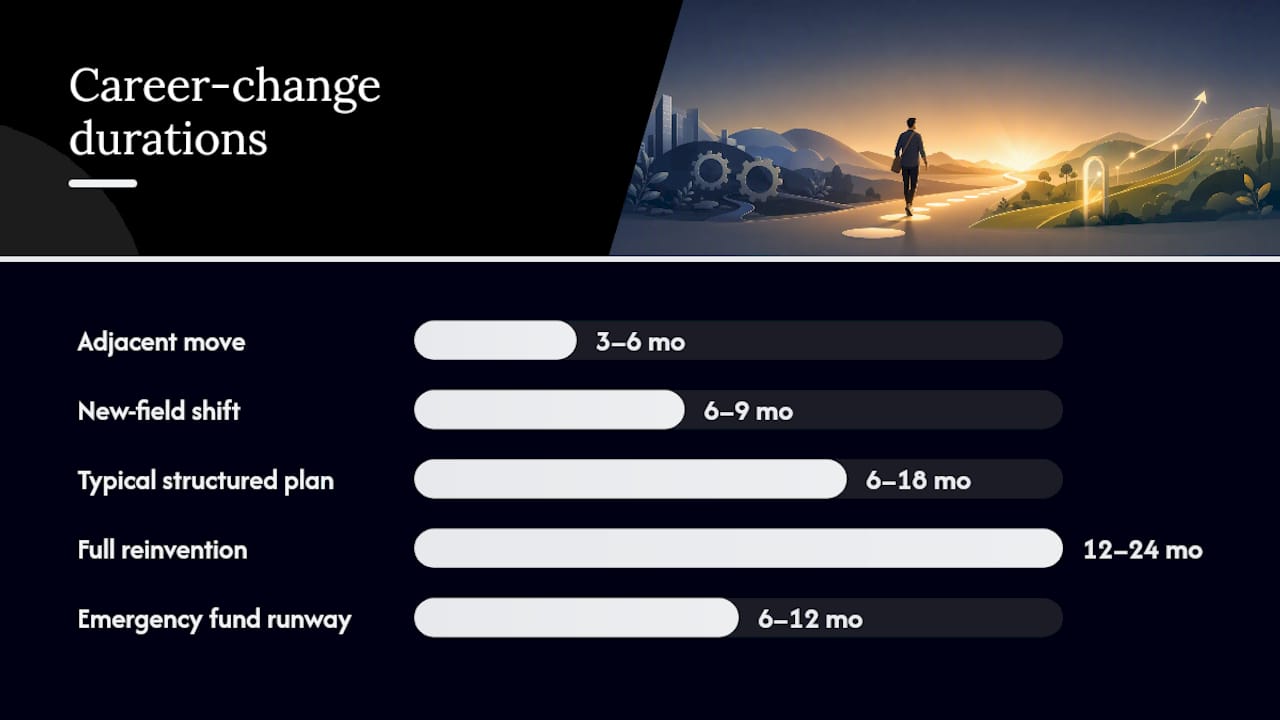
Career changes rarely happen overnight. A structured plan typically takes 6 to 18 months, with the exact length depending on how far you’re jumping. An adjacent move, say from sales into customer success, can take 3 to 6 months. A shift into a genuinely new field usually runs 6 to 9 months. A full reinvention, like leaving finance for nursing, tends to stretch 12 to 24 months.
Set milestones so you can measure progress instead of just hoping:
- 30 days: Finish your VIPS assessment and complete 3 informational interviews.
- 90 days: Ship one hands-on project or portfolio piece and complete 5 to 8 total interviews.
- 180 days: Apply to a range of targeted roles with a rewritten resume.
- 12 months: Land the role or reassess based on what you’ve learned.
Before you accelerate, run the financial checklist. Calculate your monthly runway, estimate your likely first-year salary in the new field (it may dip before it climbs), and price out any training or certification costs. Building an emergency fund that covers 6 to 12 months of expenses gives you room to negotiate instead of grabbing the first offer out of desperation. A SMART goal for week one might read: “Complete 2 informational interviews and draft my transition summary by Friday.”
Build Evidence While You’re Still Employed
You don’t need to quit to start building proof you can do the new job. Side projects, volunteer work, and stretch assignments at your current employer all generate the kind of evidence a resume alone can’t. Bootcamps and formal courses have their place, but exploratory validation should come first so you’re not paying for a credential you don’t actually need.
- Volunteer for a nonprofit that needs the exact skill set your target role requires.
- Ask your manager for a stretch assignment adjacent to the new field.
- Take on freelance work, even unpaid, to build a portfolio piece.
- Complete one focused course that fills a specific, identified skill gap.
Keep a simple project log: what the context was, what your role involved, and what measurable outcome resulted. “Redesigned a volunteer intake process, cut onboarding time by half” is a hireable sentence. “Helped with a project” is not.
Pro Tip: Turn every side project into a concise story before your first interview: what problem you solved, and what changed because of it. That’s your talking point, rehearsed and ready.
Rewrite Your Resume and Build a 90-Day Microplan
Ditch the strict chronological resume. A hybrid format works better for career changers: open with a brief transition summary, follow with a skills section built around transferable capabilities, then list your work history in reverse order with outcome-focused bullets. Reframe accomplishments using language pulled directly from your target job postings, and quantify wherever you can.
Sample transition summaries:
- “Operations manager pivoting to UX research, bringing 6 years of process analysis and stakeholder interviews.”
- “Teacher transitioning to instructional design, with deep experience in curriculum development and learner assessment.”
- “Sales lead moving into customer success, backed by a track record in relationship management and retention.”
Here’s a week-by-week skeleton for your first 90 days:
- Weeks 1 to 2: Finish the task audit, draft your VIPS statement, rewrite your resume summary.
- Weeks 3 to 6: Complete 5 informational interviews, start one hands-on project.
- Weeks 7 to 10: Log many hours on your project, update LinkedIn with new keywords and headline.
- Weeks 11 to 13: Finish your portfolio piece. Begin targeted outreach and applications
Pro Tip: Update your LinkedIn headline before you touch your resume. Recruiters searching by keyword will find you weeks before you’re ready to apply.
Choosing Your Entry Route Into the New Field
Not every pivot needs a resignation letter on day one. Pick the route that matches your risk tolerance and financial cushion.
- Internal lateral move: Lowest risk, keeps your salary and benefits, but options depend entirely on your current employer’s openings.
- Bridge role: A hybrid position that uses old and new skills together, easing the transition without a full leap.
- Apprenticeship or bootcamp: Faster skill-building for a genuinely new field, but costs time and money upfront.
- Entry-level hire: Full commitment to the new field, often with a pay cut, but the fastest path to real experience.
Whichever route you pick, tailor every application: quantify outcomes in your bullets, write a cover letter specific to that role, and include one portfolio piece relevant to the job. Follow up within a week if you haven’t heard back. In interviews, frame your pivot as a deliberate decision backed by research, not an escape from something you hated.
Avoiding the Mistakes That Derail Most Career Changes
Announcing your pivot to your entire network before you’ve validated it invites unsolicited opinions that can shake your confidence. Skipping the research phase and jumping straight to applications wastes months. Quitting without financial runway forces bad decisions out of panic. Assuming you need a new degree before you can even apply often isn’t true. Check the actual job postings first.
- Announcing too early: keep it to a trusted few until you have real evidence.
- Skipping research: five interviews beat fifty hours of solo speculation.
- No runway: save before you leap, not after.
- Credential obsession: many roles value demonstrated skill over formal degrees.
Adopt an exploration mindset instead of an all-or-nothing one, break the plan into small weekly deliverables, and find one accountability partner who checks your progress monthly.
Pro Tip: Set a decision checkpoint every 30 days: keep going, adjust the target, or pause. That single habit prevents most of the drift that kills career changes halfway through.
Make the Leap Without Betting Your Whole Financial Life on It
A career change works best when treated like a controlled experiment, not a leap of faith. That means testing your assumptions with real interviews and real projects before you touch your savings, and it means being honest about the money math long before you’re excited enough to ignore it.
Most people planning a career change fail not because the new field was wrong, but because they skipped the financial reality-check that would have told them so. A thorough runway plan protects you from taking the first offer out of panic, and a resilient financial cushion gives you room to negotiate rather than settle. If your pivot involves freelance or gig work along the way, understanding freelance financial planning before you go independent will save you from a rough first year. Finblog’s financial planning resources exist for exactly this stage: the point where ambition meets a spreadsheet.
Editorial Take: The 90-Day Plan Beats the Leap of Faith
Most career-change advice treats self-assessment as the hard part and execution as an afterthought. The evidence points the other way. Values and interests worksheets are useful, but they’re cheap to complete and easy to abandon. The real bottleneck is validation: the interviews, the side projects, the honest financial math that most people skip because it’s less fun than daydreaming about a new title.
Conventional wisdom oversells the “follow your passion” leap and undersells the boring parts, the two-week task audit, the runway calculation, the informational interview you didn’t want to schedule. Those unglamorous steps are what separate a successful pivot from a regretted one.
If you take one thing from this, prioritize evidence over enthusiasm. Book the interviews before you research bootcamps. Save the runway before you draft a resignation letter. A career change built on tested assumptions and real financial cushion succeeds far more often than one built on conviction alone.
Frequently Asked Questions
How long does planning a career change usually take?
Most structured transitions take 6 to 18 months, with adjacent pivots finishing in 3 to 6 months and full reinventions often running 12 to 24 months.
How much money should I save before switching careers?
Aim for 6 to 12 months of living expenses as runway, more if your target field pays significantly less starting out or requires unpaid training.
Do I need a new degree to change careers?
Not always. Many transitions succeed on transferable skills and demonstrated projects alone; check actual job postings before assuming you need formal credentials.
What’s the fastest way to test if a new career is right for me?
Run a two-week task audit on your current job, then complete 5 to 8 informational interviews with people already doing the target role.
Should I quit my job before starting the transition?
Generally no. Build evidence, savings, and interviews while employed, and only leave once you’ve hit your validation and runway targets.
Sources
- How to Change Careers Successfully: Tips, Resume and Transition Guide | OU Online
- 5 Tips for Changing Careers – Harvard Extension School
- How to Change Careers: The Realistic 2026 Guide | JobGetter
- Career Change Guide: Steps, Timelines, and Resources
- Occupational Outlook Handbook — Bureau of Labor Statistics