

Retirement income planning is the process of aligning your income sources with your expenses so your money lasts as long as you do. It’s not the same as saving for retirement. Once you stop working, the challenge shifts from growing a portfolio to drawing it down without running out. That shift comes with a completely different set of risks, and most people underestimate how quickly those risks can surface.
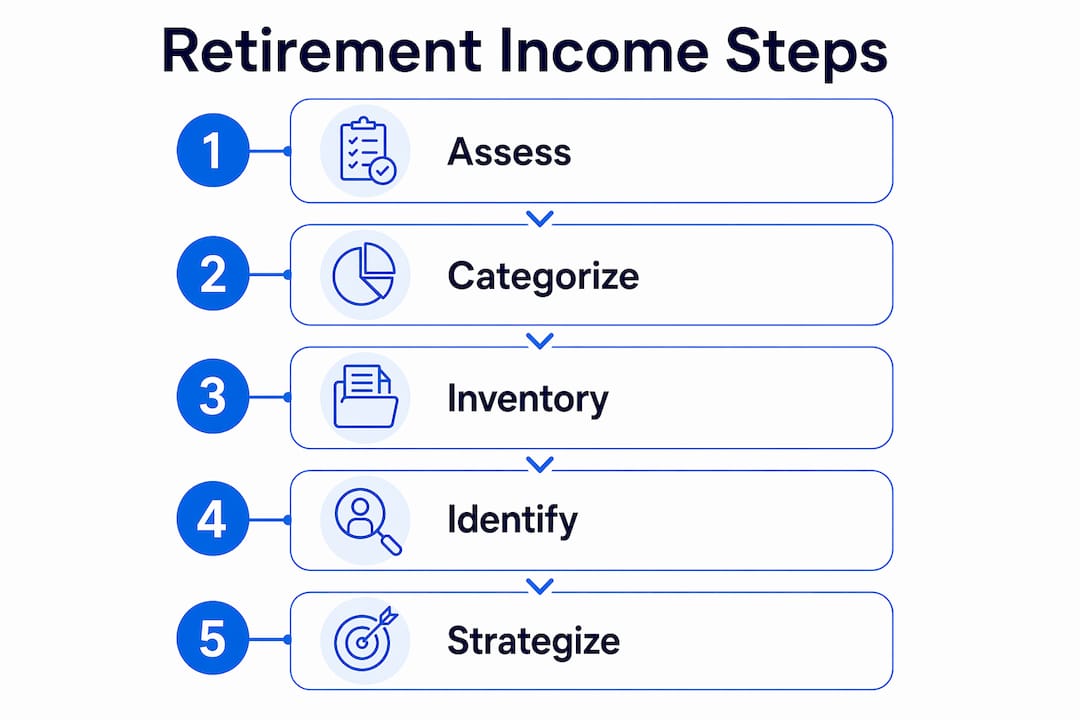
The five-step process Allianz Life outlines covers the full picture: identify your risks, review your expenses, inventory your income sources, uncover any gaps, and build solutions to close them. At the center of that process sits a simple but critical question: does your guaranteed income cover your essential expenses? If it doesn’t, you have an income gap, and closing it before you retire is far easier than scrambling to close it after.
Here’s what a complete income plan addresses:
- Guaranteed income sources: Social Security, pensions, and annuities that pay regardless of market conditions
- Variable income sources: investment withdrawals, rental income, and part-time work
- Expense categories: essential needs, discretionary spending, and legacy goals
- Retirement risks: longevity, inflation, sequencing, market volatility, and health care costs
- Income gaps: the shortfall between guaranteed income and essential expenses
- Tailored solutions: strategies to close gaps and sustain purchasing power over decades
What retirement risks could derail your income plan?
Most retirement risks don’t announce themselves. They compound quietly until a bad year in the market, an unexpected medical bill, or a longer-than-expected lifespan turns a manageable situation into a crisis. Identifying these risks early gives you time to plan around them rather than react to them.
The five risks that most directly threaten retirement income stability are:
- Longevity risk: outliving your savings, especially if you retire at 62 and live into your 90s
- Sequencing risk: suffering a market downturn in the first few years of retirement, which forces you to sell assets at depressed prices while still withdrawing income
- Inflation risk: watching your purchasing power erode over a 20- or 30-year retirement, particularly on fixed income sources
- Market volatility: unpredictable swings that affect investment-based income and portfolio sustainability
- Health care costs: one of the largest and least predictable expense categories in retirement, often growing faster than general inflation
Sequencing risk deserves particular attention because it works differently from the volatility you managed during your working years. When you were accumulating assets, a market drop just meant your contributions bought more shares at lower prices. In retirement, a drop forces you to sell shares at those lower prices to fund living expenses, permanently reducing the number of shares left to recover. The math is unforgiving.
Pro Tip: Diversifying your income streams across guaranteed sources like Social Security and annuities, alongside investment accounts, reduces your exposure to sequencing risk. When guaranteed income covers your essential expenses, you can leave your investment portfolio alone during a downturn instead of selling at the worst possible time.
Evaluating your personal risk exposure means looking at your health history, your planned retirement age, your current portfolio mix, and whether you have a pension. Someone retiring at 55 with no pension and a heavy equity allocation faces a very different risk profile than someone retiring at 67 with a pension and a conservative portfolio.
How should you categorize your retirement expenses?
Before you can determine whether your income is sufficient, you need a clear picture of what you’ll actually spend. Most people underestimate retirement expenses, particularly in the early years when they’re healthy and active, and again in the later years when health care costs climb.
The most useful framework divides expenses into three categories:
- Essential expenses: housing, food, utilities, insurance premiums, Medicare costs, and minimum debt payments. These must be covered every month, no matter what the market does.
- Discretionary expenses: travel, dining out, hobbies, gifts, and entertainment. These are real quality-of-life expenses, but they can flex if income tightens.
- Legacy goals: charitable giving, leaving assets to heirs, or funding a grandchild’s education. These are funded only after essential and discretionary needs are met.
Guaranteed income should cover essential expenses first. That’s the foundational rule of retirement income planning. If your Social Security benefit and pension together cover your mortgage, groceries, utilities, and health insurance, you’ve protected your baseline quality of life regardless of what happens in the stock market.
Inflation adds a layer of complexity to every expense category. Essential expenses like health care and housing tend to rise faster than the general Consumer Price Index, so your estimates need to account for that trajectory rather than assuming today’s costs stay flat. A budget that works at 65 may fall short at 80 if you haven’t built in realistic cost escalation.
Pro Tip: When estimating health care costs in retirement, use a conservative assumption that they’ll grow faster than your other expenses. Medicare premiums, supplemental coverage, and out-of-pocket costs have historically outpaced general inflation, and planning for that gap now prevents a painful adjustment later.
How do you inventory and evaluate all your retirement income sources?
Knowing exactly what income you’ll have, when it starts, and how reliable it is forms the backbone of any retirement income plan. Not all income sources are equal. Some are guaranteed for life; others depend on market performance, your health, or your willingness to keep working.

| Income source | Type | Inflation adjustment | Market risk | Longevity protection |
|---|---|---|---|---|
| Social Security | Guaranteed | Yes (COLA) | None | Yes |
| Pension | Guaranteed | Sometimes | None | Yes |
| Annuity | Guaranteed | Optional rider | None | Yes |
| 401(k) / IRA withdrawals | Variable | No | High | No |
| Rental income | Variable | Partial | Moderate | No |
| Part-time work | Variable | No | Low | No |
Social Security is the most widely available guaranteed income source, and it comes with built-in cost-of-living adjustments. Pensions function similarly but are increasingly rare outside government employment. Annuities, purchased from insurance companies, can replicate pension-like income for people who don’t have one.
Annuities provide guaranteed income for life along with optional death benefits, making them a flexible tool for closing income gaps. They’re not right for every situation, but for retirees without a pension, a well-structured annuity can provide the income floor that everything else is built on. You can explore the trade-offs in detail through Finblog’s annuities guide.
Tax treatment varies significantly across income sources. Social Security benefits may be partially taxable depending on your combined income. Traditional 401(k) and IRA withdrawals are taxed as ordinary income. Roth IRA withdrawals are generally tax-free. Rental income is taxable but can be offset by depreciation deductions. Understanding these differences matters because your gross income and your net spendable income can look very different depending on how you draw down your accounts. Finblog’s guide to tax-efficient withdrawals covers the sequencing strategies that minimize your lifetime tax bill.
One often-overlooked optimization: delaying Social Security past age 62 raises your guaranteed monthly benefit and provides better inflation protection over a long retirement. Many people claim early and leave a significant amount of lifetime income on the table.
How do you identify income gaps in your retirement plan?
An income gap exists when your guaranteed income doesn’t fully cover your essential expenses. It’s the most important number in your retirement plan, and most people don’t calculate it until they’re already retired.
The calculation itself is straightforward: add up your guaranteed monthly income from Social Security, pensions, and annuities, then subtract your essential monthly expenses. A positive number means you’re covered. A negative number is your gap, and it needs a plan.
Signs that you likely have an income gap worth addressing:
- Your Social Security benefit alone is your only guaranteed income source
- Your essential expenses exceed your projected Social Security and pension combined
- You plan to rely primarily on 401(k) withdrawals to fund day-to-day living costs
- You haven’t accounted for Medicare premiums and out-of-pocket health costs in your expense estimate
- Your retirement timeline extends 25 or more years, increasing the probability that investment returns will be uneven
Income planning calculators can quantify this gap by analyzing your income sources, projected expenses, and financial goals to produce an income adequacy ratio. That ratio tells you whether your anticipated income covers your needs, and by how much it falls short if it doesn’t.
Gaps are more common than most pre-retirees expect. The shift away from defined-benefit pensions toward 401(k) plans over the past four decades means that a growing share of retirees enter retirement with no guaranteed income beyond Social Security. That creates a structural gap for anyone whose essential expenses exceed their Social Security benefit, which is a large portion of the retiring population. A complete retirement planning checklist can help you map this out before you leave work.
What strategies can close income gaps and sustain retirement income?
Once you know the size of your gap, you can build a plan to close it. The right combination of strategies depends on your gap size, your timeline, your risk tolerance, and your tax situation. There’s no single answer, but there are proven tools.
- Delay Social Security: every year you wait past your full retirement age adds roughly 8% to your annual benefit, up to age 70. That’s a guaranteed, inflation-adjusted return that no investment can reliably match.
- Purchase an income annuity: a portion of your savings converted to a guaranteed lifetime income stream can close a gap permanently, removing the longevity risk from that portion of your plan.
- Structured withdrawal portfolio: a bucket strategy separates short-term cash needs from long-term growth assets, so you’re not forced to sell equities during a downturn to pay bills.
- Tax-efficient withdrawal sequencing: drawing from taxable accounts first, then tax-deferred, then Roth can reduce your lifetime tax burden and extend portfolio longevity.
- Part-time work: even modest earned income in the early retirement years reduces portfolio withdrawals and gives your investments more time to grow.
- Inflation hedging: Treasury Inflation-Protected Securities (TIPS), dividend-growth stocks, and real estate can help your portfolio keep pace with rising costs over time.
Tailored solutions work best when they’re coordinated. An annuity that covers your essential expense gap, combined with a growth-oriented portfolio for discretionary spending and a Roth account for tax-free flexibility, creates a layered structure that handles both stability and growth. Finblog’s breakdown of retirement withdrawal strategies goes deeper on how to sequence these tools.
Contingency planning often gets skipped, but it shouldn’t. A home repair, a medical event, or a family emergency can force unplanned withdrawals at the worst possible time. Keeping a liquid cash reserve of 12–24 months of essential expenses outside your investment portfolio gives you a buffer that protects the rest of your plan.
Pro Tip: The sustainable withdrawal rate from a diversified portfolio is not fixed. It depends on your asset allocation, your retirement length, and market conditions at the time you retire. Work with a financial advisor to stress-test your withdrawal rate against historical downturns rather than assuming a single percentage will hold across all scenarios.
Periodic review keeps the plan current. Tax laws change, Social Security rules evolve, health costs shift, and your own spending patterns will look different at 75 than they did at 65. Working with financial professionals to revisit your plan every year or two catches drift before it becomes a problem.
What do experts say about balancing guaranteed income and growth?
The most durable insight from current industry guidance is that retirement income planning is a fundamentally different discipline from accumulation investing. The goal during your working years is to grow assets. The goal in retirement is to convert those assets into reliable income without depleting them. Those two objectives require different tools and different thinking.
Allianz Life’s framework emphasizes that sustainable income streams require balancing guaranteed income with investment growth. Guaranteed income handles the floor: the expenses that must be paid every month. Growth-oriented assets handle the ceiling: the discretionary spending, inflation protection, and legacy goals that make retirement more than just survival.
Social Security optimization is one of the most underutilized strategies in retirement planning. Delaying benefits past the early claiming age raises guaranteed income, hedges longevity risk, and provides inflation protection through annual cost-of-living adjustments. For a married couple, coordinating claiming strategies between spouses can maximize the survivor benefit, which matters enormously if one partner lives well into their 80s or 90s.
Tax implications run through every layer of a retirement income plan. The order in which you draw from different account types affects your annual tax bill, your Medicare premium calculations (which are income-based), and the size of the estate you leave behind. A plan that ignores taxes isn’t really a plan; it’s a withdrawal schedule. Blending guaranteed income with growth and financial security strategies is a principle that applies across different financial contexts, and the core logic holds: guaranteed income covers the floor, growth assets cover everything above it.
Inflation deserves a dedicated line in every retirement income plan. A 3% annual inflation rate cuts purchasing power roughly in half over 24 years. For someone retiring at 65 and living to 89, that means the dollars they spend at the end of retirement buy half what they bought at the beginning. Social Security’s cost-of-living adjustments help, but they don’t always keep pace with the specific costs retirees face, particularly health care. Building inflation protection into your portfolio through assets that grow in real terms is not optional for a long retirement.
Key Takeaways
Effective retirement income planning requires matching guaranteed income to essential expenses first, then building growth-oriented assets around that foundation to sustain purchasing power and cover discretionary goals across a multi-decade retirement.
| Point | Details |
|---|---|
| Guaranteed income covers the floor | Social Security, pensions, and annuities should cover essential expenses before any investment withdrawals are planned. |
| Sequencing risk is distinct from accumulation risk | A market downturn early in retirement forces asset sales at low prices, permanently reducing portfolio sustainability. |
| Income gaps need early identification | When guaranteed income falls short of essential expenses, closing that gap before retirement preserves far more options. |
| Delay Social Security when possible | Waiting past age 62 raises your guaranteed monthly benefit and adds built-in inflation protection through cost-of-living adjustments. |
| Periodic review keeps the plan current | Tax laws, health costs, and spending patterns shift over time; revisiting your plan every one to two years prevents drift from becoming a shortfall. |