

To stay debt free long term, protect a starter emergency fund, pay every credit balance in full, automate your savings before you can spend it, and run a simple budget you actually check each week. That’s the whole system in one sentence. The rest is just execution.
Here’s what to do this week, in order:
- Open a separate savings account and drop in whatever you can toward a small starter cushion.
- Set one autopay rule so your credit card balance clears in full every statement cycle, no exceptions.
- Automate a transfer of at least 10% of every paycheck into that savings account before you see the money.
- Pick one budgeting method (details below) and write down your top five spending categories tonight.
- Call one recurring bill this week and ask for a lower rate. It works more often than people expect.
The Federal Trade Commission lists a working budget and an emergency fund as two of the four core defenses against falling back into debt. The other two: contacting creditors early and considering nonprofit credit counseling if things slip.
Key Takeaways
Staying debt free long term depends on automated savings, a pay-in-full credit habit, a working emergency fund, and quarterly reviews that catch small slippage before it becomes new debt.
| Point | Details |
|---|---|
| Automate before you spend | Route savings transfers on payday so money is gone before it can be spent elsewhere. |
| Build tiered emergency funds | Start with $500 to $1,000, then grow toward 3 to 6 months, or 9 to 12 months for variable income. |
| Redirect old debt payments | Once a balance hits zero, send that same dollar amount straight into savings or investments. |
| Guard against lifestyle creep | Use a 30-day pause rule and increase savings automatically with every raise. |
| Review on a schedule | Check accounts monthly and audit insurance, subscriptions, and net worth every quarter. |
Table of Contents
- How Do You Stay Debt Free Once You’ve Paid It Off?
- Budget Frameworks That Stick: Pick One and Set It Up Today
- Emergency Funds and Sinking Funds: Build Them Without Drama
- Mindset and Guardrails: How to Make Maintenance Habitual
- Credit and Payment Management: Keep Benefits, Avoid Balances
- Protection and Contingency Planning: Insure and Buffer Before You Need To
- Automation Recipes and Systems: Exact Setups That Remove Friction
- Strategies for Increasing Income to Support Debt-Free Living
- Long-Term Financial Goal Setting Aligned With Staying Debt Free
- Impact of Mental and Emotional Factors on Financial Decisions
- How to Handle Peer Pressure and Social Influences to Overspend
- Tips for Negotiating Bills and Expenses to Reduce Financial Strain
- Sources
How Do You Stay Debt Free Once You’ve Paid It Off?
Staying debt free isn’t a single decision. It’s a sequence of decisions that get easier once you build the right habits into your calendar and your bank app. Below is the order that actually works, based on what stabilizes people fastest versus what just feels productive.
Week one: stop the bleeding.
- Freeze new debt. Physically remove saved card numbers from shopping apps if you have to.
- Build your starter emergency fund to $500 to $1,000 in a separate account you don’t touch for anything else.
- List every recurring payment (subscriptions, memberships, bills) so you know exactly what’s coming out and when.
- If you’re already behind on something, call the creditor this week. Debt settlement and negotiation works far better when you initiate contact early and get any agreement in writing, rather than waiting for a collections call.
Month one: build the systems.
- Set up a budget using one framework (covered in the next section) and commit to it for 30 days before judging it.
- Open sinking funds for irregular costs: car repairs, holiday gifts, annual insurance premiums.
- Automate transfers on payday so saving happens before spending, not after.
Year one: make it permanent.
- Redirect every dollar you used to spend on debt payments into savings or investments. If you were paying $400 a month toward a credit card, that $400 becomes your new savings contribution the day the balance hits zero.
- Review your budget quarterly and adjust for raises, new expenses, or life changes.
- Increase your emergency fund toward 3 to 6 months of expenses (or 9 to 12 months if your income is variable).
If you need a script for calling a creditor, keep it simple: state your account number, explain your situation in one sentence, and ask directly what options exist for a lower rate or a modified payment plan. Write down the name of whoever you speak with and get any change confirmed in an email or letter.
Pro Tip: The moment you pay off a debt, set up the automatic transfer for that same dollar amount into savings before you get used to having the extra cash. If you wait even one pay cycle, that money has a way of quietly disappearing into upgraded takeout orders and impulse buys.
Debt repayment strategies that prioritize high-interest balances first (the avalanche method) tend to save the most money overall, though the snowball method’s quick wins keep some people more motivated. Either way, Experian’s guidance is consistent: once a balance is gone, that payment becomes savings, not spending money.
Budget Frameworks That Stick: Pick One and Set It Up Today
The best budget is the one you’ll still be using in six months, not the one with the most spreadsheet columns. Four approaches cover almost every situation.
- 50/30/20: 50% needs, 30% wants, 20% savings and debt payoff. Fits people who want a simple ratio without tracking every purchase. Setup: calculate your after-tax income, split it three ways, review monthly.
- Zero-based budgeting: every dollar gets assigned a job before the month starts, so income minus expenses equals zero. Fits detail-oriented people who want full control. Setup: list income, assign every dollar to a category, adjust weekly as spending happens.
- Money mapping (bucket budgeting): separate accounts or buckets for bills, savings, and discretionary spending, with less daily tracking. Fits people who find line-item budgets exhausting. Investopedia’s research on flexible budgeting found that looser, personalized systems tend to stick better than rigid ones for busy people. Setup: open two or three accounts, automate transfers into each, check balances weekly.
- Pay-yourself-first (reverse budgeting): automate savings and debt payments the day you’re paid, then spend whatever’s left freely. Fits people who overthink categories. Setup: automate the savings transfer first, spend the rest without guilt.
Apps like YNAB, Goodbudget, and PocketGuard, or even a basic spreadsheet template, can run any of these. The Penny Hoarder notes that automation and app-based tracking meaningfully increase how long people stick with a budget. For a deeper walkthrough on choosing one, Finblog’s guide on budgeting techniques breaks down setup steps for each method.
Emergency Funds and Sinking Funds: Build Them Without Drama
An emergency fund isn’t a nice extra. It’s the thing standing between a broken car and a new credit card balance. WalletHub recommends a starter target of $500 to $1,000, a baseline of three to six months of expenses once you’re stable, and nine to twelve months if your income is variable or commission based.
Sinking funds work alongside your emergency fund for expenses you can see coming: car repairs, annual insurance premiums, holiday gifts, or a vacation. Instead of scrambling every December, you set aside $50 a month starting in January.
- Keep both funds in a high-yield savings account, separate from your checking account, so you’re not tempted to dip in.
- Automate a fixed transfer on payday rather than relying on leftover cash at month’s end.
- Set a rule: if you use the fund, replenishing it becomes the next automatic priority before anything discretionary.
- Label sub-accounts by purpose (car, gifts, taxes) if your bank allows it. Seeing the balance labeled “car repair” makes it much harder to spend on something else.
Mindset and Guardrails: How to Make Maintenance Habitual
The riskiest moment in a debt-free life isn’t the crisis. It’s the calm afterward. Paying off debt gives you a clear goal and a visible finish line. Staying debt free gives you neither, and that’s exactly when lifestyle inflation creeps in, usually right after a raise.
The Frugal Fire’s long-term guide makes the case that lasting debt freedom depends on systems and guardrails, not the willpower that got you out of debt in the first place. A few rules make the difference:
- When you get a raise, automatically increase your savings rate before you increase your spending.
- Use a 30-day rule on any nonessential purchase over a set amount (say, $100). Add it to a list, wait, and see if you still want it.
- Try “loud budgeting”: tell friends directly that you’re skipping an expensive dinner rather than quietly resenting the invite.
- Set a quarterly financial goal, even a small one, to replace the motivation that debt payoff used to provide.
Pro Tip: Treat your old debt payments as “freedom money” that now funds something you’re excited about, like a trip or an investment account, instead of letting it dissolve into your checking account unnoticed.
Credit and Payment Management: Keep Benefits, Avoid Balances
Credit cards aren’t the enemy. Carried balances are. Experian’s guidance points to keeping utilization low and paying in full as the two behaviors that protect your credit score while eliminating interest entirely.
- Pay your balance in full before the statement closes, not just by the due date. Some people make two payments a month to keep utilization low on paper.
- Aim for utilization under 10% to 30% of your total credit limit at any given time.
- Set autopay for at least the minimum as a safety net, then manually pay in full separately.
- Check your accounts weekly for fraud, and freeze or report immediately if something looks off.
- Keep older accounts open for credit history length unless there’s an annual fee you can’t justify.
Finblog’s breakdown of credit card debt strategies covers exact scripts for negotiating a lower rate if you ever do carry a balance temporarily.
Protection and Contingency Planning: Insure and Buffer Before You Need To
Most unplanned debt doesn’t come from bad spending. It comes from an uninsured gap. Prioritize health insurance, disability coverage, renters or homeowners insurance, and auto coverage in that rough order of financial risk.
- Check your disability coverage. Many people have none, and a lost paycheck is often what forces a credit card balance.
- Review renters or home insurance for gaps in liability or replacement value coverage.
- When your emergency fund isn’t enough, a 0% introductory-rate card used briefly and paid off before the promotional period ends is a safer stopgap than a payday loan.
- A second income stream, even a modest one, lowers your odds of ever needing to borrow.
Automation Recipes and Systems: Exact Setups That Remove Friction
Willpower runs out. Automation doesn’t. Adjust the percentages to your situation, but keep the structure.
The point of automation isn’t rigidity. It’s removing the moment of temptation entirely, so the money is already gone before you can talk yourself out of saving it.
- Set autopay for every recurring bill at least three days before the due date to avoid overdraft risk.
- Schedule a recurring transfer the same day your paycheck lands, before you check your balance.
- Increase your automated savings percentage every time you get a raise, before adjusting your spending.
Finblog’s debt repayment plan templates walk through setting up these exact transfer schedules if you want a starting worksheet instead of building one from scratch.
Monthly and Quarterly Review Checklist: Catch Slippage Early
- Monthly: check account balances, confirm autopay went through, and verify sinking fund levels match your plan.
- Quarterly: review insurance coverage, cancel unused subscriptions, and calculate your net worth.
- Red flags: a shrinking emergency fund, a credit card balance that didn’t clear, or three months of “wants” spending creeping upward. Any of these call for an immediate budget reset that week, not next month.
- Use a partner, app reminder, or calendar alert to make sure the review actually happens instead of getting pushed indefinitely.
Strategies for Increasing Income to Support Debt-Free Living
A tighter budget can only cut so far. At some point, staying debt free gets easier by earning more, not just spending less. The fastest lever for most people is negotiating a raise or promotion at their current job, since it requires no new time investment once secured.
Side income is the next most reliable option, and it doesn’t need to be dramatic. Freelancing in an existing skill, tutoring, selling unused items, or picking up seasonal weekend work all add real, immediate cash without a career pivot. The key is direction: route that income straight into savings or debt-prevention buckets rather than letting it blend into everyday spending, where it disappears without a trace.

Skill development pays off on a longer timeline but compounds. A certification, a new software skill, or a professional credential can shift your earning ceiling for years, not just one paycheck. If you’re deciding where to put spare hours, weigh a $200 course that opens a higher pay grade against a side gig that pays $200 this month. Both matter, but they solve different problems.
Diversifying income also lowers your risk profile. Someone with one employer and no other income has zero buffer if that job disappears. Someone with a side project, a small investment portfolio, or freelance clients has multiple smaller shocks instead of one catastrophic one. That’s not just about earning more. It’s about making any single loss survivable without reaching for a credit card.
Long-Term Financial Goal Setting Aligned With Staying Debt Free
Debt payoff gives you a finish line. Staying debt free doesn’t, unless you build one yourself. That’s why long-term goal setting matters more after the debt is gone than before.
Start with a horizon, not a number. What do you want your finances to look like in five years? Ten? A paid-off mortgage, a fully funded retirement account, the ability to take a career risk without financial fear? Write the destination down before worrying about the exact dollar figure.
Vague goals like “save more” don’t survive a busy month. Specific, dated targets do.
Revisit these goals at the same quarterly check-in where you review your budget. Life changes, income changes, and a goal set two years ago might not fit anymore. The Frugal Fire’s framework treats this ongoing goal-setting as one of the core systems that separates people who stay debt free for decades from those who slide back within a couple of years of paying it off.
Impact of Mental and Emotional Factors on Financial Decisions
Money decisions rarely come from pure logic. Stress, boredom, celebration, and grief all show up in spending patterns, often disguised as “treating yourself” or “just this once.”
Emotional spending tends to spike during two moments: high stress, when a purchase offers quick relief, and sudden relief, when a raise or bonus feels like permission to loosen up. Both moments are exactly when the 30-day pause rule mentioned earlier matters most, because neither state is when you make your clearest decisions.
Shame is another factor that quietly undermines progress. People who feel embarrassed about a past financial mistake often avoid checking their accounts altogether, which lets small problems grow into large ones simply because nobody was looking. The fix isn’t harsh self-discipline. It’s building a review habit so consistent that checking your numbers stops carrying any emotional weight at all. A Tuesday morning coffee-and-budget-check routine works better than white-knuckling through guilt every few months.
Financial anxiety also narrows decision-making. People under money stress tend to make more impulsive, short-term choices, not fewer, because long-term thinking requires mental bandwidth that stress consumes. That’s part of why the starter emergency fund matters so early in this guide. It’s not just a cushion. It’s a way of lowering baseline anxiety so your everyday decisions come from a calmer place.
How to Handle Peer Pressure and Social Influences to Overspend
Nobody budgets in a vacuum. Every dinner invite, wedding, group trip, and “let’s split an Uber” moment carries a small financial decision, and social pressure makes the expensive option feel like the only polite one.
“Loud budgeting” flips the usual script. Instead of quietly declining and feeling awkward about it, you say the actual reason out loud: “I’m skipping the tasting menu this month, I’m saving for a trip.” It sounds uncomfortable the first time. It gets easier fast, and it often invites other people to admit they’re doing the same thing.
Pre-deciding your limits before a social situation removes the in-the-moment pressure entirely. If you know your monthly dining-out budget before the group chat starts planning a birthday dinner, you’re choosing from a number, not negotiating with guilt in real time.
Watch for comparison spending specifically, the upgraded car, the bigger house, the fancier vacation that shows up right after someone in your circle gets one. That’s lifestyle inflation wearing a social mask. The people setting the pace rarely show you their bank balance, only their purchase.
Tips for Negotiating Bills and Expenses to Reduce Financial Strain
Most recurring bills are more negotiable than people assume, and a single phone call often beats months of budget cutting elsewhere.
Start with your internet, cable, or phone bill. Call and ask directly if there’s a lower-priced plan or a loyalty discount, especially if you’ve been a customer for over a year. Providers often have retention offers they don’t advertise, and asking costs nothing.
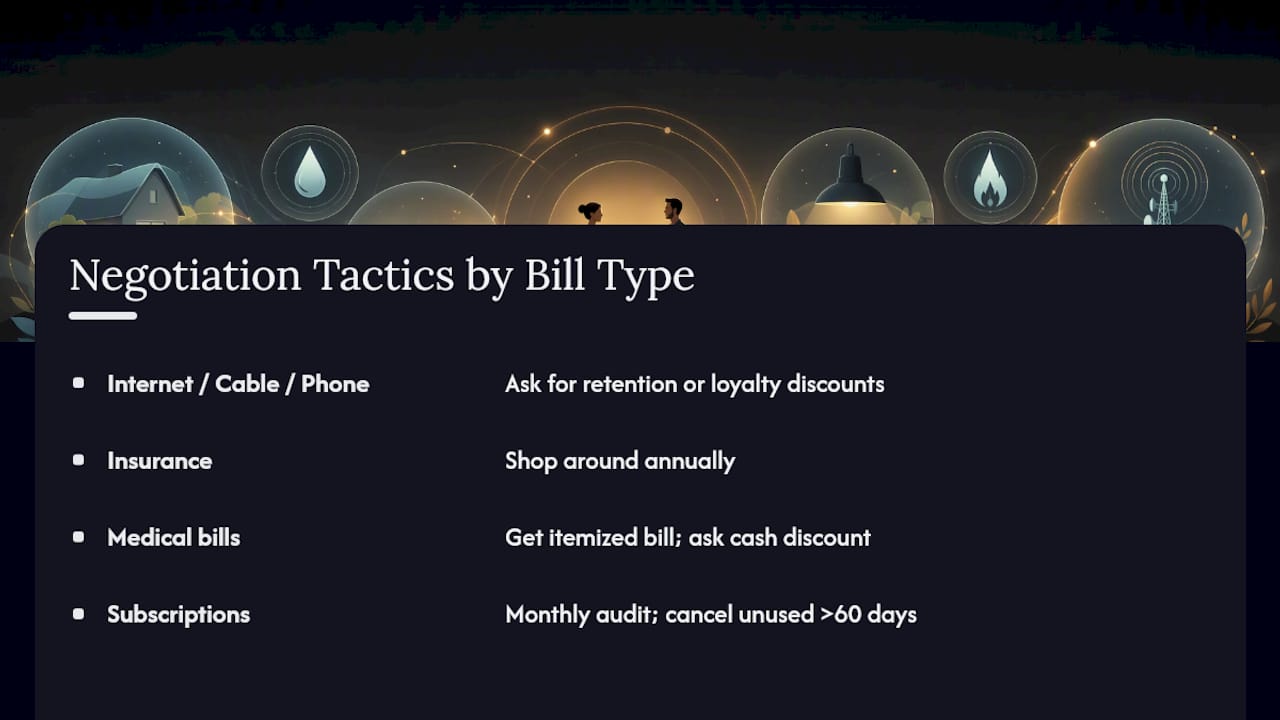
Insurance premiums deserve an annual shop-around, not just a renewal on autopilot. Rates shift constantly, and loyalty rarely earns you the best price. A quick comparison every twelve months can save more than most people cut from their grocery budget in the same period.
Medical bills are negotiable more often than people realize. Ask for an itemized bill, request a cash-pay discount, or ask about a payment plan with no interest before assuming you have to pay in full immediately or hand it to a collections agency.
Subscriptions deserve their own audit. A single monthly review of every recurring charge, canceling anything unused for more than 60 days, tends to uncover $30 to $100 a month in forgotten charges for a lot of people. That’s money that can go straight into your sinking fund without cutting anything you’d actually miss.
A short note from Povilas
Maintenance is the boring part nobody warns you about. The system that keeps you debt free is less exciting than the payoff, but it’s the part that actually matters. Finblog’s guides exist for exactly that stretch.
— Povilas
Sources
- How to get out of debt | Consumer Information (FTC)
- How To Build a Monthly Budget That Actually Fits Your Life | Investopedia
- How to get out of debt | Experian
- How to live debt-free | WalletHub
- The Ultimate Guide To Staying Debt Free Long Term | The Frugal Fire
This article is general information, not a substitute for advice from a qualified financial advisor. Consult a qualified financial professional about your own circumstances before acting on anything here.