


TL;DR:
- Most people believe money’s impact on happiness stops around $75,000, but recent studies show happiness can keep rising well beyond this point for most individuals. Autonomy, meaningful experiences, and giving to others have a greater influence on well-being than simply increasing income, especially after basic needs are met. To maximize happiness, focus on building financial security, aligning spending with values, and enhancing personal freedom and relationships.
The question of whether money buys happiness has occupied philosophers, economists, and psychologists for generations. Most people assume the answer is simple: yes, up to a point, and then it stops. But that assumption is wrong. Recent research has fundamentally shifted how we understand the relationship between income and emotional well-being, revealing that the story is far more layered than a single dollar threshold. This article cuts through the noise, bringing you the latest findings on how money affects happiness, what psychological factors actually drive contentment, and how to spend smarter for genuine well-being.
Table of Contents
- Key takeaways
- Does money buy happiness? What science now says
- The psychology behind money and well-being
- How you spend money shapes your happiness
- The limits of money and what actually changes
- How to actually use money for greater happiness
- My take on money and happiness
- Take the next step toward financial well-being
- FAQ
Key takeaways
| Point | Details |
|---|---|
| No universal income plateau | For 80% of people, happiness keeps rising with income well past $100,000 per year. |
| Autonomy matters more than amount | The freedom money creates predicts life satisfaction more than income size alone. |
| Spending strategy changes everything | Experiences, time-saving services, and giving to others return more happiness than buying things. |
| Money relieves misery first | Financial security removes stress and anxiety before it begins generating genuine joy. |
| Hedonic adaptation limits gains | People adapt quickly to income rises, so chasing more money alone rarely produces lasting contentment. |
Does money buy happiness? What science now says
For decades, the dominant view came from a landmark study by Nobel laureate Daniel Kahneman and economist Angus Deaton. Their research suggested that emotional well-being stopped improving around $75,000 in annual income. That number became gospel. Books referenced it, financial advisors cited it, and millions of people internalized it as fact.
Then researcher Matthew Killingsworth challenged it. His larger-scale data, collected through real-time experience sampling across tens of thousands of participants, found that happiness continued rising with income well beyond that threshold. The debate between the two researchers eventually produced a synthesis, published in 2023, that revealed something more nuanced than either study suggested alone.
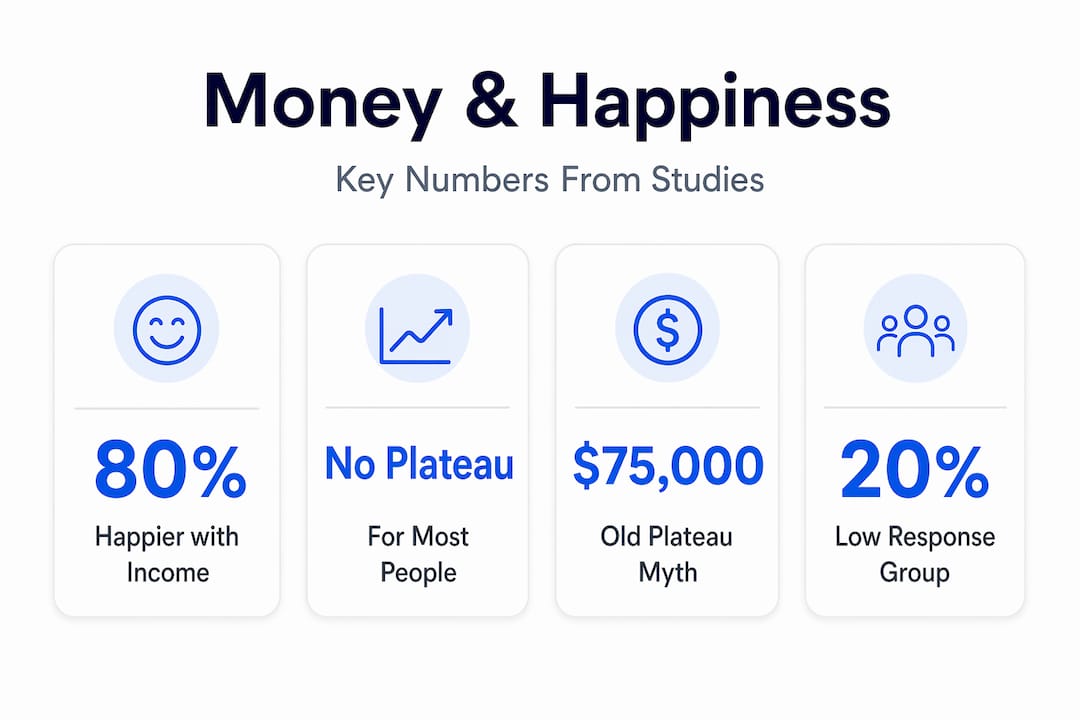
The key finding: happiness rises with income for about 80% of people, with no clear ceiling. The remaining 20%, a group already reporting low happiness, showed a plateau. This is a critical distinction. The old $75,000 rule was never universal. It was an average that masked enormous individual variation.
There is also an important split between two types of happiness researchers measure. Emotional well-being refers to day-to-day mood, the frequency of positive versus negative feelings. Life satisfaction is the broader sense of how well your life is going overall. Income tends to move both, but it moves life satisfaction more reliably. Understanding this distinction helps explain why two people at the same income level can report very different happiness outcomes.
| Study | Key Finding | Income Threshold |
|---|---|---|
| Kahneman & Deaton (2010) | Emotional well-being plateaus | ~$75,000 |
| Killingsworth (2021) | Happiness rises continuously | No clear ceiling |
| Killingsworth, Kahneman & Mellers (2023) | Both correct for different groups | Plateau only for unhappy 20% |
| SFU Autonomy Study (2026) | Autonomy predicts satisfaction more than income | N/A (quality, not quantity) |
The psychology behind money and well-being
Income alone does not determine whether you feel fulfilled. What money does is create the conditions where certain psychological needs can or cannot be met. Self-determination theory, developed by psychologists Edward Deci and Richard Ryan, identifies three core needs: autonomy (the sense of choice and control), competence (feeling capable and effective), and relatedness (meaningful connections with others). Money can support all three, but it does so unevenly.
Autonomy is where money has its clearest positive effect. Autonomy is a stronger predictor of life satisfaction than positive emotions alone, according to a 2026 study of over 1,200 adults. When money gives you the freedom to leave a job you hate, live where you want, or decline social obligations that drain you, it is doing real psychological work. That freedom is not trivial.
“Financial security buys freedom, and freedom is what happiness actually needs. The absence of money almost guarantees anxiety and limits your life choices in ways that compound over time.”
The relationship between money and competence or relatedness is weaker and often inverse. More wealth does not automatically make you feel more capable or more connected to others. In fact, people with high incomes sometimes report feeling more isolated, partly because wealth shifts the nature of social relationships. Can wealth bring joy through connection? Only if you actively invest in relationships rather than assume money handles it for you.
The implication is practical. If you want money to actually improve your well-being, the goal is not simply to earn more. The goal is to use money in ways that expand your autonomy and protect your relationships.
How you spend money shapes your happiness
Here is something most people get wrong about buying happiness with money: they focus on what they buy rather than how they buy it. Research on spending and well-being is consistent across multiple studies. The type of spending matters enormously.
Experiences beat things. Buying a vacation, a concert, or a cooking class generates more lasting happiness than buying a new phone or a designer item. Experiences become part of your identity and your memory. A material object, no matter how appealing at purchase, quickly becomes background furniture in your life. Prosocial and experiential spending boosts well-being in ways material purchases rarely match, according to experimentally validated research.

Giving to others compounds returns. Spending money on other people, whether through gifts, charitable giving, or treating a friend to lunch, produces a measurable happiness boost in the giver. This effect holds across income levels and cultures. You do not need to be wealthy to benefit from it.
Buying time is the most underrated move. Outsourcing chores or choosing flexible work arrangements enhances control over daily life, which research identifies as a strong predictor of satisfaction. Paying someone to clean your home, handle deliveries, or manage tasks you find tedious returns significantly more happiness than buying an equivalent dollar amount of goods.
| Spending Type | Happiness Impact | Why It Works |
|---|---|---|
| Material purchases | Low to moderate, fades fast | Hedonic adaptation erodes novelty quickly |
| Experiences | High, lasting | Become memories; harder to compare |
| Giving to others | High | Creates meaning, strengthens connection |
| Buying time/autonomy | Very high | Reduces stress, expands daily freedom |
| Aligned with values | High | Creates coherence between money and identity |
Pro Tip: Before any major purchase, ask yourself whether it expands your time and choices or just adds another object to maintain. The answer usually predicts whether it will still feel good in six months.
The limits of money and what actually changes
If income generally raises happiness, why do so many wealthy people still feel empty or anxious? The answer lies in several psychological forces that money cannot override.
The hedonic treadmill is the most powerful of these. People adapt to income increases and return to their baseline happiness levels. You get the raise, feel great for a few months, and then recalibrate your expectations upward. The new salary becomes the new normal. This explains why chasing income as a happiness strategy produces diminishing returns over time.
Several other factors complicate the picture:
- Personality acts as an amplifier. Money amplifies personality traits and coping mechanisms. Generous people use wealth to do more good and feel more connected. Anxious people often worry more once they have assets to protect. The money does not change your character. It magnifies it.
- Relative income matters as much as absolute income. Social comparison impacts happiness more than absolute income levels, meaning earning $90,000 in a neighborhood of millionaires feels worse than earning the same amount surrounded by peers at similar levels.
- Money relieves misery before it creates joy. Financial insecurity strongly correlates with lower well-being, while income beyond comfort produces diminishing returns. Getting out of debt, building an emergency fund, and covering basic needs generates a dramatic happiness gain. Going from comfortable to wealthy generates a smaller one.
- Unhappy people may not benefit the same way. The 2023 synthesis study found that individuals already reporting low happiness showed a plateau effect that others did not. For this group, money alone does not resolve the underlying causes of unhappiness.
Pro Tip: If financial stress is your primary source of anxiety, focus first on reducing that stress rather than maximizing income. The emotional return on stress relief is higher than on additional earnings once you are comfortable.
How to actually use money for greater happiness
The research points in a clear direction. Financial security and happiness are linked, but the link runs through specific behaviors and choices, not income totals. Here is how to make that connection work for you.
- Build a financial margin. A gap between income and spending expands your choices and reduces daily stress. Even modest savings create a sense of control that directly supports well-being. Start with a concrete plan through long-term stability tips that help you build that margin systematically.
- Align spending with your values. Spend on what genuinely matters to you, not what signals status to others. If you value connection, invest in shared experiences with people you care about. If you value health, spend on time outdoors or quality food rather than luxury goods.
- Invest in autonomy deliberately. Identify the tasks in your life that drain your time and energy most. Outsource where you can afford to. Consider whether living below your means in some areas could fund greater freedom in others.
- Prioritize experiences over possessions. This is not about being spartan. It is about recognizing that memories compound while objects depreciate.
- Protect and invest in relationships. Financial stability supports connection when it reduces stress and enables shared time. Couples who plan finances together tend to report higher relationship satisfaction. See the financial planning for couples guide for practical frameworks.
- Review your finances regularly. Control and awareness of your financial situation are themselves sources of autonomy. Quarterly reviews help you stay aligned with goals that actually reflect what you want from life.
My take on money and happiness
I have spent years looking at how people relate to money, and the pattern that surprises most people is this: the individuals I have seen who are genuinely content are rarely those with the highest incomes. They are the ones who have clarity about what they want and have structured their finances to support it.
In my experience, the biggest mistake people make is treating income as the goal. They assume that once cash lead to contentment past some imaginary threshold, everything will fall into place. It does not. What actually shifts happiness is the quality of choices your money gives you. A person earning $70,000 with low debt, flexible hours, and meaningful work often reports higher satisfaction than someone earning $200,000 who is trapped by a lifestyle they have inflated to match their paycheck.
I am not dismissing the importance of earning more. Is happiness a luxury for those below a comfortable income? In practical terms, yes. The absence of financial security is genuinely misery-generating, and no amount of positive framing changes that. But above a floor of security, the game changes completely. What matters then is not accumulation. It is what you do with what you have.
My honest view: stop asking whether money buys happiness and start asking whether your money is buying you freedom. That reframe changes everything.
— Povilas
Take the next step toward financial well-being
Money is a tool, and like any tool, its value depends entirely on how you use it. At Finblog, we focus on helping you build the kind of financial security that creates real choices in your life, not just a larger account balance. Whether you are working on reducing financial stress, building a margin between income and spending, or learning to align your money with what actually matters to you, the resources here are built for that purpose. Explore our financial wellness routines to build the consistency that turns good intentions into lasting habits.
FAQ
Does money buy happiness after $75,000?
The $75,000 threshold is outdated. A 2023 study found that for 80% of people, happiness continues rising with income well beyond that figure, with no clear plateau.
What type of spending increases happiness most?
Spending on experiences, giving to others, and buying time through outsourcing consistently produce greater happiness than material purchases, according to multiple studies.
Is happiness linked to money or to autonomy?
Both are connected. A 2026 study found that autonomy, the freedom to make your own choices, predicts life satisfaction more strongly than income alone. Money matters most when it expands that freedom.
Can wealth bring joy if you are already unhappy?
Research suggests that for individuals already reporting low happiness, income gains show a plateau effect. Money can reduce stress and remove barriers, but it does not resolve the deeper causes of unhappiness on its own.
How does financial security affect happiness?
Financial security primarily works by eliminating stress and anxiety rather than generating positive emotion. Once basic needs and stability are covered, additional income yields smaller happiness returns than improving autonomy or relationships.