

Improving by just 1% every day compounds to 37 times your starting point within a single year. That single fact dismantles the myth that wealth belongs only to the lucky or the privileged. The truth is that financial success is a learnable science, not a mysterious art. The habits you build today, the beliefs you hold about money, and the small decisions you make each morning all stack up into something extraordinary. In this guide, you will find specific, evidence-backed strategies to shift your thinking and take real action toward lasting financial freedom.
Table of Contents
- What is a wealthy mindset?
- Pillars of a wealthy mindset
- Turning mindset into daily habits
- Setting goals and tracking progress
- Disciplined saving and intentional spending
- Investing consistently and diversifying your portfolio
- Skills development and income maximization
- Automation for financial peace of mind
- Common mindset traps and how to avoid them
- Ready to transform your financial life?
- Frequently asked questions
Key Takeaways
| Point | Details |
|---|---|
| Abundance mindset matters | Shifting beliefs from scarcity to abundance transforms how you pursue and build wealth. |
| Habits drive results | Small, consistent actions such as saving 20 percent of your income lead to major financial gains over time. |
| Clear goals and tracking | Defining specific targets and monitoring progress keeps you focused and motivated. |
| Invest and diversify | Consistent, diversified investing shields you from risk and accelerates wealth accumulation. |
| Automate for success | Automatic transfers for saving and investing protect your long-term plans from procrastination and impulse decisions. |
What is a wealthy mindset?
A wealthy mindset is not about having money. It is about how you think about money. People with this mindset see wealth as buildable and shareable, not as a fixed pie where someone else’s gain is your loss. That is the core difference between an abundance mindset and a scarcity mindset.
A scarcity mindset is fear-driven. It tells you there is never enough, that risk is always dangerous, and that opportunity is for other people. An abundance mindset does the opposite. It trains you to spot opportunities, take calculated risks, and believe that your financial situation is within your control. As one framework puts it, adopting an abundance mentality is the foundational mechanic for building lasting wealth.
“Your beliefs about money shape every financial decision you make. Change the belief, and you change the outcome.”
Here is what a wealthy mindset looks like in practice:
- Viewing setbacks as data, not failure
- Seeking financial education consistently
- Prioritizing long-term gain over short-term comfort
- Treating wealthy mindset habits as daily non-negotiables
- Believing your income and net worth are expandable
The key insight: a wealthy mindset is cultivated through practice, not inherited through luck.
Pillars of a wealthy mindset
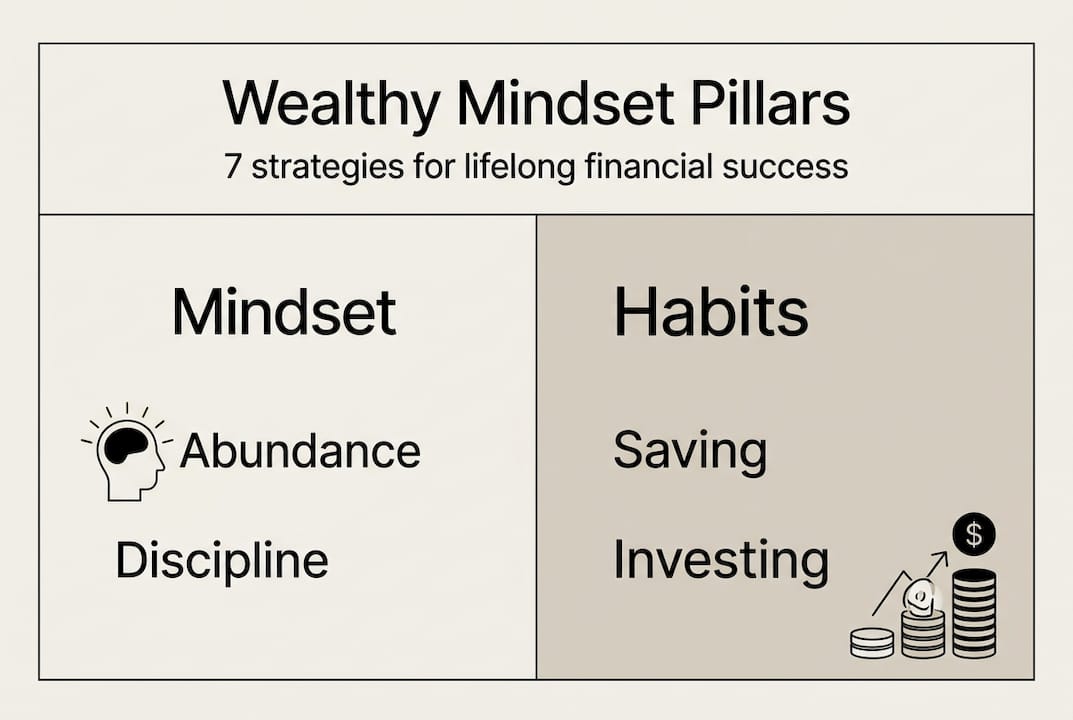
With the definition clear, let’s break down the mental pillars that wealthy individuals consistently embrace. These are not personality traits. They are repeatable behaviors anyone can adopt.
- Abundance mentality — Believe wealth is available to you and that helping others build wealth does not diminish yours.
- Delayed gratification — Sacrifice short-term pleasure for long-term gain. Skip the impulse buy; fund the investment account instead.
- Goal setting — Clear targets give your money a purpose and your decisions a filter.
- Disciplined saving — Save at least 20% of your income, every month, without exception.
- Continuous learning — Read, listen, and study financial topics regularly.
- Consistent investing — Adopt a regular, diversified approach rather than chasing trends.
- Income maximization — Upskill, negotiate, or explore entrepreneurial paths to grow your earning power.
- Automation — Remove willpower from the equation by automating smart money habits.
| Pillar | Action | Frequency |
|---|---|---|
| Disciplined saving | Transfer 20% of income to savings | Every payday |
| Consistent investing | Contribute to index funds or ETFs | Monthly |
| Continuous learning | Read one financial book or article | Weekly |
| Goal setting | Review and update financial goals | Quarterly |
| Automation | Set up auto-transfers and bill pay | One-time setup |
Pro Tip: Start with just two pillars. Master saving 20% and automating one investment contribution before adding more habits. Overloading yourself at the start is the fastest way to quit.
Turning mindset into daily habits
Knowing the pillars is only half the story. Here is how to make them part of your routine for real, lasting change. The bridge between mindset and results is daily action, and daily action is built through micro-habits.
Consistent action, like saving 20% of income or making 1% improvements each day, drives the compounding growth that transforms ordinary earners into wealth builders. The trick is to make these actions automatic so they require zero motivation.
Here is a simple weekly habit stack to get started:
- Monday — Review last week’s spending. Identify one unnecessary expense.
- Tuesday — Read or listen to 15 minutes of financial content.
- Wednesday — Check investment account balances and confirm auto-contributions are active.
- Thursday — Journal one financial win from the week, no matter how small.
- Friday — Confirm your savings transfer went through. Adjust if needed.
- Weekend — Plan next week’s discretionary spending before it happens.
Pro Tip: Attach new financial habits to existing ones. For example, check your budget app right after your morning coffee. This “habit stacking” technique dramatically increases follow-through. Explore more wealth-building steps to deepen your routine.
Setting goals and tracking progress
Once healthy habits are underway, the next step is ensuring you have a destination in mind and a scoreboard to track your journey. Without clear goals, even the best habits drift.
The SMART framework keeps goals actionable. SMART stands for Specific, Measurable, Achievable, Relevant, and Time-bound. Setting specific goals and tracking progress are pivotal mechanics in wealth-building because they force clarity and accountability.
| Vague goal | SMART goal |
|---|---|
| “Save more money” | “Save $500 per month for 12 months to build a $6,000 emergency fund by December 2026” |
| “Invest someday” | “Invest $200 per month into a diversified index fund starting this month” |
| “Pay off debt” | “Pay an extra $150 per month toward my credit card to eliminate $1,800 in debt by year-end” |
Here is how to stay on track:
- Review goals monthly, not just at year-end
- Use a simple spreadsheet or an app like Mint or YNAB
- Adjust targets when life changes, not when motivation dips
- Celebrate milestones to reinforce the behavior
For a deeper framework, explore setting smart financial goals and the financial goal setting process to build a system that actually sticks. A solid financial goal setting guide can also help you prioritize competing objectives.
Disciplined saving and intentional spending
Setting goals is the spark. Consistent saving and responsible spending is the fuel that turns your ambitions into wealth. These two habits work together, and neglecting either one stalls your progress.

The rule is simple: save and invest at least 20% of your income before you spend on anything else. Wealth is built through disciplined saving and minimizing unnecessary spending, not through earning a massive salary.
Here is how to put this into practice:
- Separate wants from needs before every purchase. Ask: does this move me closer to my goals?
- Audit your spending monthly. Most people find 10 to 15 percent of their budget leaking into subscriptions and impulse buys.
- Resist lifestyle creep. When your income rises, increase your savings rate first, then your lifestyle.
- Use the 48-hour rule for non-essential purchases over $100. Most impulses fade.
- Build disciplined saving habits into your identity, not just your budget.
Statistic to remember: Households that consistently save 20% or more of their income are significantly more likely to achieve financial independence before traditional retirement age.
Investing consistently and diversifying your portfolio
With disciplined saving in place, let’s explore how to put that money to work through consistent, diversified investing. Saving without investing means inflation quietly erodes your purchasing power every year.
Diversification and regular investing reduce risk and compound results over time. Spreading your money across asset types, such as stocks, bonds, real estate, and cash equivalents, means no single loss can derail your entire portfolio.
Key principles to follow:
- Invest at regular intervals regardless of market conditions. This strategy, called dollar-cost averaging, removes the pressure of timing the market.
- Spread across asset classes to reduce concentration risk.
- Automate contributions so investing happens without a decision each month.
- Rebalance annually to maintain your target allocation.
| Portfolio type | Risk level | Expected long-term outcome |
|---|---|---|
| Concentrated (1-2 assets) | High | Volatile, potential for large loss |
| Balanced (stocks, bonds, real estate) | Moderate | Steadier growth, reduced drawdowns |
| Diversified (multiple asset classes) | Lower | Compounding returns with managed risk |
Learn more about why diversify investments and the specific portfolio diversification benefits that protect your wealth over decades.
Skills development and income maximization
Wealth is accelerated when you not only manage what you have, but also expand your earning firepower. Maximizing income via skills or entrepreneurship is a core mechanic of building a wealthy mindset, and it is one most people underutilize.
Here is how to grow your income intentionally:
- Commit to lifelong learning. Take one course per quarter in your field or in a high-demand adjacent skill.
- Explore side income. Freelancing, consulting, or a small online business can add meaningful cash flow.
- Negotiate actively. Most professionals leave significant money on the table by never asking for raises or better rates.
- Diversify your skills to protect against industry disruption or job loss.
- Reframe your earning power as something you control, not something assigned to you.
Pro Tip: Track your hourly effective rate across all income sources. If a side hustle pays less per hour than your main job, either scale it or replace it with something higher-value. Your time is your scarcest asset.
Automation for financial peace of mind
The path is clearest when you take willpower out of the equation. Automation acts as your silent partner for sustainable wealth by making the right financial moves happen without requiring a decision each time.
Automation ensures consistency in saving, investing, and budgeting. When money moves automatically, you never have to rely on motivation, which is unreliable, to do the right thing.
Here is a simple automation setup:
- On payday: Auto-transfer 20% of your paycheck to a dedicated savings or investment account.
- Same day: Auto-contribute to your retirement account or brokerage.
- Bill due dates: Set up automatic bill pay to avoid late fees and credit score damage.
- Debt repayment: Schedule automatic extra payments toward your highest-interest debt.
- Quarterly: Set a calendar reminder to review all automations and adjust for income changes.
Once this system is running, your wealth-building happens in the background while you focus on earning more and living your life.
Common mindset traps and how to avoid them
Even with the best plans, mindset traps can creep in. Recognizing them early is the difference between a temporary setback and a derailed financial life.
Avoiding scarcity thinking and emotional decisions keeps your mindset on the path to wealth. Here are the most common traps and how to counter them:
- Scarcity thinking: Counter it by listing three financial opportunities available to you right now. Shift focus from lack to possibility.
- All-or-nothing mentality: Missing one savings transfer does not erase your progress. Progress over perfection, always.
- Comparing to others: Someone else’s highlight reel is not their balance sheet. Measure yourself against your own past, not someone else’s present.
- Emotional investing: A market dip feels like a crisis. Automation and a written investment plan keep emotions from driving decisions.
- Giving up after setbacks: Every wealthy person has a story of financial failure. Reframe setbacks as tuition paid for future success.
“The investor’s chief problem, and even his worst enemy, is likely to be himself.” — Benjamin Graham
Ready to transform your financial life?
You now have a complete map: the mindset, the pillars, the daily habits, the goal-setting framework, the saving and investing strategies, and the automation system. The next move is yours. Building wealth is not a one-time event. It is an ongoing education, and the best investors never stop learning. At Finblog, you will find a growing library of guides, tools, and resources designed specifically for aspiring investors and working professionals like you. Start with the step-by-step wealth building guide to put today’s insights into immediate action. Bookmark the site, subscribe for updates, and keep your financial education moving forward. The gap between where you are and where you want to be closes one informed decision at a time.
Frequently asked questions
What is the first step to building a wealthy mindset?
Start by adopting an abundance mentality and setting clear, actionable financial goals. Abundance thinking and specific goals are the two foundational moves that make every other strategy possible.
How much of my income should I save to build wealth?
Aim to save and invest at least 20% of income consistently. This threshold is widely recognized as the minimum needed for meaningful long-term wealth accumulation.
Does a wealthy mindset guarantee financial success?
A wealthy mindset greatly increases your chances, but sustained action drives wealth when combined with adaptable strategies. Mindset is the engine; consistent behavior is the fuel.
How does investing contribute to a wealthy mindset?
Regular, diversified investing reduces risk and compounds your results over time, reinforcing the discipline and patience that define a wealthy mindset.
Can automation really help me stick to financial goals?
Yes. Automating savings and investments removes emotion from the equation and makes consistency the default, not the exception.