

TL;DR:
- Start with one active income stream, one leveraged source, and one investment to build cash flow and growth. Focus on stabilizing your primary income, testing one new idea, and investing small amounts regularly before expanding your income streams.
Start with one stable active income, one leveraged income stream you can build over 3–12 months, and one investment-based stream. That three-part mix, which financial experts recommend as a starting distribution of 1–2 active, 1–2 leveraged, and 1–2 investment sources, gives you immediate cash flow, a path to scalability, and a foundation that grows while you sleep.
Before you add anything, do three things in the next 30 days:
- Stabilize your primary income and build an emergency fund covering several months’ expenses before risking your main cash flow on experiments.
- Pick one leveraged idea (a digital product, a course, or a content channel) and run a cheap validation test this week.
- Open a brokerage account and start directing even a small amount monthly into a dividend ETF or index fund.
Here is what the rest of this guide covers:
- Active/earned income: freelancing, consulting, gig work
- Leveraged/creator income: digital products, courses, memberships, content monetization
- Investment/portfolio income: dividends, REITs, index funds, rental properties
- Business income: buying an existing site or small business, royalties
Table of Contents
- How should you think about income streams?
- What income stream types are actually worth your time?
- How do you launch your first income stream without quitting your job?
- How do you manage multiple streams without burning out?
- What do real income portfolios look like?
- What mistakes kill income diversification efforts?
- How long does it take to reach $1k, $5k, or $100k per month?
- Which tools actually help you build and manage income streams?
- Key Takeaways
- Why most income diversification advice misses the point
- Finblog can help you build your income plan
- Useful sources for going deeper
How should you think about income streams?
The simplest framework splits every income source into three buckets: active, leveraged, and investment. Understanding the trade-offs between them is what separates people who build real financial resilience from people who just end up with multiple jobs.
Active (earned) income is time-for-money: consulting, freelancing, gig work. High control, fast first dollar, but it stops when you stop.
Leveraged income is front-loaded work that pays repeatedly: a course you record once, a digital product, a newsletter with sponsorships. You trade time now for cash flow later.
Investment income is capital-for-cash-flow: dividends, REITs, index funds, rental properties. You trade money now for returns over time.
The trade-offs matter:
- Time vs. capital: Active streams need time. Investment streams need money. Leveraged streams need both upfront, then less of each over time.
- Speed to first dollar: Active income pays fastest (days to weeks). Leveraged income takes months. Investment income takes years to compound meaningfully.
- Scalability ceiling: Active income is capped by hours. Leveraged and investment income can scale without you.
- Risk profile: Active income is low-risk but fragile. Investment income carries market risk. Leveraged income carries execution risk.
For a beginner, the practical target is one of each. That is not arbitrary. It means you have cash coming in now (active), something building toward scale (leveraged), and something compounding quietly in the background (investment). The best stream for you is the one that fits your current constraints, not the one that sounds most impressive.
Pro Tip: Before picking a stream, write down your honest weekly hours available and your liquid capital. If you have 10+ hours a week but under $5,000, start with a creator or service stream. If you have capital but limited time, go investment-first. Matching the stream to your constraints is more important than picking the “best” category.
What income stream types are actually worth your time?
A realistic income plan separates streams by time-to-first-dollar, income ceiling, active vs. passive demands, and startup capital. Here is a plain-language breakdown of the major types.
Consulting and freelancing are the fastest path to extra income. You sell a skill you already have (writing, design, coding, marketing, finance) directly to clients. Startup cost: near zero. First dollar: days to weeks. Ceiling: limited by hours, but rates can scale significantly. Platforms: Upwork, Toptal, LinkedIn, direct outreach.

Digital products and courses require heavy upfront work but pay repeatedly. A well-positioned course on Teachable or Gumroad can generate sales for years. Startup cost: low (recording gear, a platform subscription). First dollar: weeks to months after launch. Ceiling: high, especially with an existing audience.
Content monetization (YouTube, a blog, a podcast) is slow to monetize but builds compounding audience value. Ad revenue, sponsorships, and affiliate commissions all layer on top of each other over time. Startup cost: low. First meaningful income: 6–18 months. Ceiling: very high for top creators, modest for most.
Memberships and communities work when you already have an audience or a niche. Platforms like Substack or Patreon let you charge recurring fees for exclusive content or access. Startup cost: low. First dollar: fast if you have an existing following.
Real estate rentals require capital and management but generate reliable monthly cash flow. A single-family rental or a short-term rental on Airbnb can produce meaningful income, but the barrier to entry is high. Startup cost: high. First dollar: 30–60 days after acquisition.
REITs (Real Estate Investment Trusts) let you own a slice of commercial real estate without buying property. You can start with fractional shares or low-entry REITs with as little as a few hundred dollars. Startup cost: low. First dividend: quarterly. Ceiling: scales with capital invested.
Dividend and index investing is the most accessible investment stream. A broad index fund like VTI or SCHD generates dividends and long-term appreciation. Startup cost: low (fractional shares available). First dollar: quarterly dividends. Ceiling: scales with capital and time.
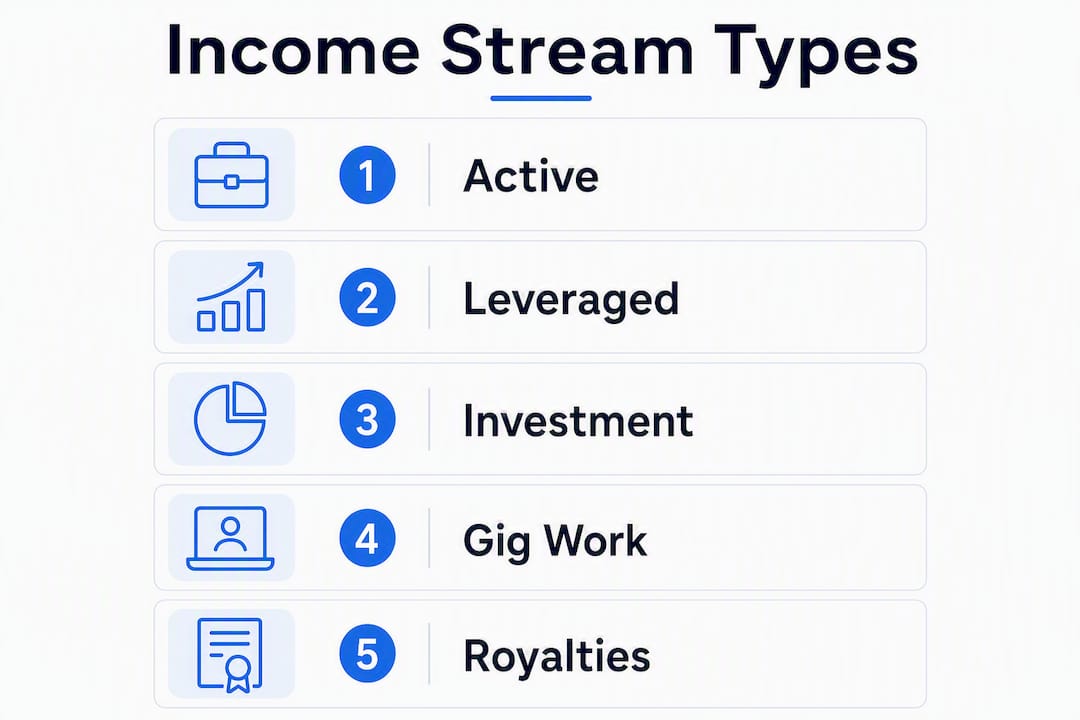
Gig work (DoorDash, TaskRabbit, Instacart) is the fastest way to earn extra cash but offers no scalability. Treat it as a bridge, not a destination.
Buying an existing business or website is underrated. A small content site generating $500/month can often be purchased for $15,000–$20,000 on marketplaces like Flippa. You inherit existing traffic and revenue. Startup cost: medium to high. First dollar: immediate.
Royalties from books, music, photography, or patents pay passively once the asset is created or licensed. Startup cost: low to medium. Timeline: variable.
| Income Type | Startup Cost | Time to First Income | Typical Beginner Monthly Range |
|---|---|---|---|
| Freelancing/Consulting | None | Days–weeks | $500–$5,000+ |
| Digital products/Courses | Low | Weeks–months | $100–$3,000 |
| Content monetization | Low | 6–18 months | $50–$2,000 |
| Memberships | Low | Weeks (with audience) | $200–$2,000 |
| Real estate rentals | High | 30–60 days | $500–$2,000 |
| REITs | Low ($500+) | Quarterly | $10–$200 |
| Dividend/Index investing | Low ($500+) | Quarterly | $10–$20 |
| Gig work | None | Days | $200–$500 |
| Buying a website | Medium–High | Immediate | $300–$1,000 |
| Royalties | Low–Medium | Variable | $50–$1,000 |
For deeper reading on the investment side, Finblog’s guide on passive income ideas covers the most realistic options for beginners, including how to start small and scale.
How do you launch your first income stream without quitting your job?
A six-step plan keeps this manageable. The goal is not to build everything at once. It is to get one stream to repeatable traction before touching the next.
- Scale what works, then add a second stream — When the first stream hits its 90-day target consistently, add a complementary one. A freelancer who hits $2,000/month reliably might add a digital product that packages their expertise. A dividend investor who has automated contributions might add a content channel.
Pro Tip: The cheapest validation tool is a direct conversation. Before building anything, message 10 people who fit your target customer profile and ask if they would pay for the solution you are considering. Five “yes” responses with a price attached are worth more than any market research report.
How do you manage multiple streams without burning out?
Insiders warn that more income streams can become multiple jobs without proper automation and role separation. The fix is not fewer streams. It is better systems.

The core principle: master one stream before adding another. A practical rule of thumb used by serious income builders is to never add a new stream until the prior one reaches repeatable traction or the new one requires almost no ongoing time. Breaking this rule is the single most common reason people burn out or produce mediocre results across the board.
Prioritize based on your constraints:
- Low time, low capital: start with one high-value freelance or consulting offer. It pays fast and requires no upfront investment.
- Low time, some capital: go investment-first. Set up automatic contributions to a dividend fund or REIT and let compounding do the work.
- Plenty of time, low capital: build a creator or digital product stream. It is slow to monetize but has the highest ceiling for effort invested.
- Time and capital: combine a leveraged stream with an investment stream from day one.
Operational safeguards that actually work:
- Batch your work. Record a month of content in one weekend. Write all client deliverables in two focused blocks per week. Batching cuts context-switching costs by more than you expect.
- Use simple KPIs per stream. Revenue per hour, monthly recurring revenue, or dividend yield. One number per stream, reviewed quarterly. If you cannot measure it in 10 minutes, the KPI is too complex.
- Separate your bookkeeping from day one. A dedicated bank account per income source and a simple spreadsheet (or Wave, which is free) prevents tax-season chaos.
- Delegate before you think you need to. A virtual assistant at $15–$25/hour handling scheduling, inbox management, or content formatting frees up hours that compound over months.
Pro Tip: Block a fixed number of hours per week for each stream and treat those blocks as non-negotiable. A simple split for someone with a day job and two side streams: 8 hours/week on the leveraged stream, 2 hours/week on investment review and contributions, and 0 hours on the active stream if it is already automated. The schedule forces prioritization.
Understanding your own risk tolerance also shapes which streams deserve the most attention at any given stage.
What do real income portfolios look like?
Three profiles, each with a realistic mix, timeline, and first-year range. These are illustrative constructions based on typical outcomes, not guaranteed results.
-
Early-career, time-rich, capital-poor (age 22–30, $1,000–$3,000 to invest)
Stream mix: Freelance writing or design (active) + a digital product or Gumroad template pack (leveraged) + automatic $100/month into a broad index fund (investment).
Startup cost: low, covering platform fees and basic tools.
Timeline: First freelance dollar in weeks. Digital product revenue in 3–6 months. Investment stream meaningful in 5–10 years.
First-year revenue range: a low to moderate income from active and leveraged combined; modest investment by year-end.
-
Mid-career, capital-available, time-scarce (age 35–50, $20,000–$50,000 to deploy)
Stream mix: Current salary (active) + dividend ETF portfolio and one REIT position (investment) + a small content site purchased on Flippa (leveraged/business).
Startup cost: medium to high for the site acquisition and investment into dividend funds.
Timeline: Dividend income starts immediately. Acquired site generates revenue from day one. Meaningful passive income after several years as capital compounds.
First-year revenue range: modest amounts from dividends and site combined, depending on capital deployed.
-
Creator/audience-builder (any age, existing niche or expertise)
Stream mix: Consulting or coaching (active) + newsletter or YouTube channel (leveraged/content) + Patreon or course membership (leveraged/recurring).
Startup cost: low, covering basic platforms like ConvertKit and course hosting.
Timeline: Consulting revenue in weeks. Newsletter sponsorships in 6–12 months. Course or membership revenue in 3–9 months with consistent publishing.
First-year revenue range: moderate to higher amounts depending on niche, audience size, and consistency.
| Profile | Primary Streams | Startup Cost | First-Year Revenue Range |
|---|---|---|---|
| Early-career, time-rich | Freelance + digital product + index fund | Under $500 | — |
| Mid-career, capital-available | Salary + dividend ETF + acquired site | $20,000–$50,000 | $3,000 (passive only) |
| Creator/audience-builder | Consulting + newsletter + membership | Under $200 | $15,000–$20,000 |
What mistakes kill income diversification efforts?
Most people do not fail because they picked the wrong stream. They fail because they made one of a handful of predictable errors.
Over-diversification is the most common. Starting three streams simultaneously means none of them get enough attention to reach traction. The result is three mediocre experiments instead of one working stream. Sequence, do not stack.
Ignoring tax reporting is expensive. Every income source in the U.S. is taxable, and self-employment income above $400 triggers self-employment tax. Track income by source from day one, set aside roughly 25–30% of net self-employment income for taxes, and use a tool like QuickBooks Self-Employed or Wave to stay organized. Consult a CPA before your first tax season with multiple streams.
Believing the “passive” myth. Most passive income requires significant upfront time or capital. A course does not sell itself. A blog does not monetize overnight. Dividend income on $5,000 invested generates maybe $150 a year. The passive label describes the eventual state, not the launch phase.
Failing to systemize. A stream that requires your personal attention every day is not a stream. It is a second job. Build SOPs, use automation tools, and document processes before you scale.
No tracking, no decisions. Without a simple dashboard showing revenue, hours, and growth per stream, you cannot tell what is working. A Google Sheet updated weekly is enough.
The average American household personal savings rate fluctuates significantly with economic conditions, underscoring why relying on a single income source leaves most households exposed to sudden financial shocks.
Pro Tip: Treat every “passive” income stream as an upfront investment project with a defined payback period. A digital product that takes 40 hours to build and earns $200/month pays back in 5 months. If the math does not work at a realistic conversion rate, the project is not worth starting.
How long does it take to reach $1k, $5k, or $100k per month?
Ranges depend on time, skill, capital, and the mechanics of how each stream scales. Here is a realistic breakdown.
Path to $1,000/month (fastest route: 1–3 months)
- Freelancing or consulting at $50–$100/hour requires 10–20 client hours per month.
- Gig work at peak hours can hit $1,000 in 4–6 weeks.
- A digital product with an existing small audience can reach $1,000/month in 60–90 days.
Path to $5,000/month (consistent leveraged or consulting mix: 6–24 months)
- A consulting practice at $150/hour needs roughly 33 client hours per month, achievable in 6–12 months with focused outreach.
- A course or membership with 200 paying members at $25/month hits $5,000. Building that audience typically takes 12–24 months.
- A dividend portfolio generating $5,000/month requires roughly $1.2–$1.5 million invested at a 4% yield. That is a long-term goal, not a near-term one.
Path to $100,000/month (business or scaled creator plus investments: 3–10+ years)
- This level almost always involves ownership: a scaled content business, a SaaS product, a portfolio of acquired sites, or a significant investment portfolio.
- Many high-dollar claims assume reinvestment, audience scale in the hundreds of thousands, or equity stakes. They are real but not typical starting points.
Quick answers to common questions:
- How long until my first dollar from a new stream? Active streams (freelance, gig): days to weeks. Leveraged streams (digital products, content): weeks to months. Investment streams: first dividend in 30–90 days, but meaningful income takes years.
- How much effort does it take to maintain a stream? A well-systemized stream should take 2–5 hours per week after the launch phase. If it takes more, it needs better automation or delegation.
- Can I build multiple streams while working full-time? Yes, but realistically you have 10–15 hours per week to allocate. That is enough for one leveraged stream and one investment stream simultaneously.
Which tools actually help you build and manage income streams?
The best tools are the ones you will actually use. Here is a short, U.S.-focused list organized by function.
Validation and landing pages
- Carrd ($19/year): build a one-page site to test demand before building anything.
- Notion: free option for a simple product or service page with a form.
Payment and marketplaces
- Gumroad: sell digital products with zero upfront cost; takes a percentage per sale.
- Stripe: accept payments for services or subscriptions directly.
- Teachable or Kajabi: host and sell courses with built-in checkout.
Creator platforms
- ConvertKit (now Kit): email list building and automation for creators; free up to 1,000 subscribers.
- Substack: newsletter platform with built-in paid subscription tools.
- YouTube: ad revenue plus sponsorship potential; slow to monetize but high ceiling.
Low-cost investing
- Fidelity or Schwab: fractional shares, no account minimums, broad index fund access.
- Fundrise: low-minimum REIT access for beginners (non-traded REIT platform).
Bookkeeping and tax tracking
- Wave: free accounting software for freelancers and small businesses.
- QuickBooks Self-Employed: tracks mileage, separates business and personal expenses, estimates quarterly taxes.
- Keeper: finds tax deductions automatically for self-employed earners.
For readers ready to put extra income to work, Finblog’s beginner investing guide walks through the first steps of building an investment stream from scratch.
Key Takeaways
Building multiple income streams works when you sequence carefully, systemize early, and match each stream to your actual constraints rather than chasing the most glamorous option.
| Point | Details |
|---|---|
| Start with the three-part mix | One active, one leveraged, and one investment stream gives you cash flow, scalability, and compounding from day one. |
| Sequence before stacking | Master one stream to repeatable traction before adding another; simultaneous starts usually produce three mediocre results. |
| Passive income is front-loaded | Every stream requires upfront time or capital; plan for a payback period before expecting hands-off income. |
| Track taxes from day one | Set aside 25–30% of self-employment net income and use a bookkeeping tool like Wave or QuickBooks Self-Employed from your first dollar. |
| Finblog as your next step | Finblog’s advisory resources and guides help you map a personalized income plan and convert extra earnings into a growing investment portfolio. |
Why most income diversification advice misses the point
The conventional wisdom on building multiple income streams focuses almost entirely on the “what” (which streams to pick) and almost never on the “when” and “how much attention.” That gap is where most people fail.
Here is the uncomfortable truth: the income streams that look most passive in YouTube thumbnails (dropshipping, print-on-demand, crypto staking) are often the ones that require the most active management and deliver the least predictable returns. Meanwhile, the streams that actually compound quietly, like a dividend index fund or a well-positioned consulting practice, rarely get the same attention because they are boring.
The other thing most guides understate is the management cost of variety. Adding a fourth or fifth stream before the first two are systemized does not multiply your income. It divides your attention. The people who build genuinely diversified income over time tend to be ruthlessly boring in their sequencing: one stream, systemized, then the next.
Realistic success looks like $2,000–$5,000 in combined monthly income from two to three streams after 12–24 months of consistent work, not the $50,000/month passive income claims that dominate search results. That is still life-changing money for most people, and it is achievable without quitting a job or taking on significant financial risk.
Finblog can help you build your income plan
Knowing the framework is one thing. Applying it to your specific income, risk tolerance, and timeline is another. Finblog offers financial education resources, investment primers, and advisory guidance designed for people who are serious about building real financial resilience, not just reading about it.
If you are ready to map your own income mix, explore Finblog’s financial planning resources to find guides on diversifying investments, understanding REITs, and building a portfolio that complements your active income. For tax questions specific to your situation, a licensed CPA is always the right call. Finblog’s resources are educational, not a substitute for personalized professional advice.
Useful sources for going deeper
- SEC: Questions Investors Should Ask — foundational investor protection guidance from the U.S. Securities and Exchange Commission
- Investor.gov Compound Interest Calculator — free tool to model how investment income compounds over time
- FINRA — regulatory body overseeing U.S. broker-dealers; use to verify any investment platform or advisor
- SIPC — protects investors if a brokerage firm fails; check coverage before opening accounts
- FRED Personal Savings Rate — Federal Reserve data on U.S. household savings trends
- Chamber of Commerce: Cities with Most Passive Income — data on where passive income is most prevalent in the U.S.
- Finblog: How to Diversify Investments — practical guide to combining stocks, REITs, and index funds in a multi-income portfolio
- Finblog: What Is a REIT? — beginner primer on real estate investment trusts as an income stream
- Finblog: Income Investing for Cash Flow — dividend and income-oriented investing strategies
- Finblog: Best Retirement Income Strategies — how to convert short-term income streams into long-term retirement security
- Finblog: Why Diversify Investments — the strategic case for combining multiple income and asset types
This article is general financial education, not personalized investment or tax advice. Confirm current rules and your specific situation with a qualified CPA or financial advisor.