


AI investment is moving from billions into trillions of dollars, raising one of the biggest questions facing technology investors: can AI eventually create enough economic value to justify everything being spent on chips, data centers and power?
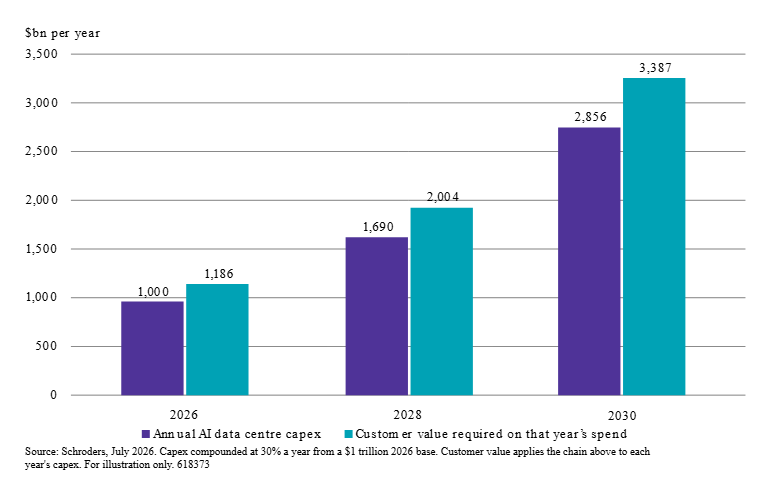
According to Schroders, AI capital spending could reach around $1 trillion in 2026, with significant further growth expected in 2027 and 2028. The scale of investment means strong AI adoption alone may no longer be enough, companies ultimately need to turn that adoption into real financial returns.
AI Infrastructure Spending Could Reach $3–4 Trillion a Year
The numbers could become much larger toward the end of the decade.
Nvidia CEO Jensen Huang has previously pointed to the possibility of $3 trillion to $4 trillion in annual AI infrastructure spending by 2030, according to Schroders. Even the lower end of that range would provide enormous demand for companies supplying AI chips, servers, networking equipment, power systems and other data-center infrastructure.
The investment goes far beyond GPUs. Building AI infrastructure requires data centers, electricity generation, cooling systems, networking equipment, memory chips and semiconductor manufacturing capacity.
Separate analysis from Goldman Sachs shows just how large this build-out could become. Its baseline model estimates annual AI capital spending of about $765 billion in 2026, rising to $1.6 trillion by 2031. That would amount to roughly $7.6 trillion of cumulative investment between 2026 and 2031.
But AI Needs to Create Trillions in Real Value
Spending money on infrastructure is only the first part of the equation.
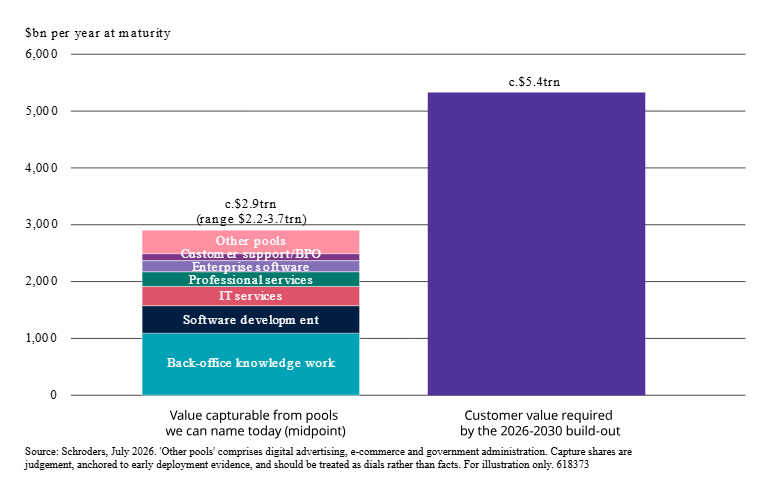
Schroders estimates that cumulative AI investment by 2030 could eventually require more than $5 trillion in annual value for customers to generate acceptable returns across the industry.
That is an enormous number, even compared with the global economy.
The IMF projects global GDP of around $126 trillion in 2026, while Schroders estimates worldwide corporate operating profits at roughly $30 trillion. AI would therefore need to capture or create a meaningful share of global economic activity to fully justify today’s investment expectations.

Where Could That Money Come From?
The opportunity is that AI does not necessarily need to create entirely new industries worth trillions of dollars.
It could also create value by replacing repetitive human work, increasing employee productivity, automating business processes and allowing companies to operate with lower costs.
For example, if AI allows a company to complete the same amount of work with fewer hours, automate customer service or make software development faster, those savings represent economic value even if they do not appear directly as revenue for an AI company.
That gives AI an unusually large potential market because labor costs exist across almost every industry.
But there is an important difference between AI creating economic value for businesses and companies such as Nvidia, Microsoft, Amazon, Alphabet and Meta successfully capturing enough of that value to earn attractive returns on their enormous investments.
The Risk Is Building Too Much, Too Quickly
This is where the debate becomes more complicated.
If AI adoption and monetization grow as quickly as infrastructure spending, today’s enormous investments could eventually look justified.
But if companies build trillions of dollars of AI capacity before customers are willing to pay enough for AI services, the industry could end up with too many expensive data centers and not enough profitable demand.
That risk is particularly important because AI hardware can become outdated quickly. Unlike infrastructure that can remain useful for decades, today’s most advanced GPUs may be replaced by significantly more powerful systems within only a few years.
Investors are already beginning to ask these questions. Apollo recently highlighted three major concerns facing the market: whether AI investment will generate sufficient returns, how increasingly expensive infrastructure will be financed, and whether demand for computing power can continue growing fast enough to absorb all the capacity currently being built.
The Opportunity Is Still Enormous
None of this means AI spending is necessarily a bubble.
If AI successfully substitutes labor, transforms existing business models and increases productivity across the global economy, the potential market could be enormous. AI itself could also expand the economy’s productive capacity, creating value that does not exist today.
The challenge is simply that the financial expectations have become extremely high.
Investor takeaway: The AI boom is entering a new phase. The question is no longer whether companies will spend heavily on AI, they already are. The bigger question is whether AI can create trillions of dollars in annual economic value quickly enough to justify the infrastructure being built. If it can, today’s spending could support years of growth across the technology sector. If it cannot, the industry risks discovering that it built too much, too fast.
Source: Schroders
Disclosure: This article does not represent investment advice. The content and materials featured on this page are for educational purposes only.