

TL;DR:
- Implementing a 13-week rolling cash flow forecast and accelerating receivables helps small businesses avoid cash shortages. Tracking key metrics like DSO, DPO, and cash conversion cycle provides timely insights into liquidity, while managing outflows and maintaining a reserve ensure stability. Regular updates and quick cash-inflows are essential to maintaining healthy cash flow and preventing avoidable shortfalls.
Stabilize your cash flow this month by launching a 13-week rolling forecast and pulling three immediate levers: accelerate receivables, stretch payables to their contractual limits, and secure a short line of credit before you need it. This sequence, done in order, covers the most common reasons small businesses run dry even when they’re profitable.
This week’s quick wins:
- Send every outstanding invoice today and add a payment link to each one
- Identify your three largest upcoming payables and confirm you’re using the full contractual term, not paying early
- Pull your accounts receivable (AR) aging report and call any account more than 15 days past due
After the first week, watch one number: your cash balance trend versus the same day last week. If it’s moving in the right direction, the levers are working. If not, your forecast will tell you exactly where the leak is.
Table of Contents
- What cash flow metrics should you actually track?
- How do you build a 13-week rolling cash flow forecast?
- How can you accelerate cash inflows this week?
- How do you control outflows without damaging supplier relationships?
- Which working-capital levers free up cash fastest?
- What financing options work best for short-term gaps?
- Which tools give you real-time cash visibility?
- How do you build a cash reserve and handle unexpected shortfalls?
- Defensive vs. proactive: which cash flow strategy fits your situation?
- Key Takeaways
- The cash flow mistake most small businesses keep making
- Finblog’s cash flow assessment for small businesses
- Useful sources and templates
What cash flow metrics should you actually track?
Most owners track revenue and profit. Neither tells you whether you can make payroll Friday. These are the metrics that do.
| Metric | Formula | Why it matters | Quick benchmark |
|---|---|---|---|
| Days Sales Outstanding (DSO) | (AR ÷ Revenue) × Days | Measures how long customers take to pay | Aim to reduce by several days over the coming months |
| Days Payables Outstanding (DPO) | (AP ÷ COGS) × Days | Measures how long you hold cash before paying suppliers | Maximize to full contractual terms |
| Cash Conversion Cycle (CCC) | DSO + Inventory Days − DPO | Net days cash is tied up in operations | Shorter is better; target continuous reduction |
| Runway | Cash on Hand ÷ Monthly Burn Rate | Months until cash runs out at current spend | 3 to 6 months is a common target for contingency planning |
| AR Aging | Buckets: 0–30, 31–60, 61–90, 90+ days | Flags collection risk before it becomes a crisis | Keep the 90+ days bucket as low as possible relative to total AR |
| Burn Rate | Total Monthly Cash Outflows | Baseline for reserve and runway calculations | Know this number cold |
| 13-Week Forecast Variance | Actual vs. Projected Cash | Measures forecast accuracy over time | Tighten variance to under 5% within a quarter |
The difference between cash and profit is the single most important concept here. A company can show strong net income on paper and still miss payroll if customers pay slowly and suppliers demand payment fast. DSO and DPO together reveal that timing gap.
Statistic: The cash conversion cycle, as defined by the FDIC’s small business training module, measures the number of days it takes to convert inventory investment into cash from sales. A shorter cycle means faster cash recovery and less working capital tied up at any given time.
How do you build a 13-week rolling cash flow forecast?
A 13-week rolling forecast is the right tool for near-term liquidity decisions. It’s short enough to be accurate, long enough to catch payroll cycles, tax deadlines, and seasonal dips before they arrive.
Build it in five steps:
- Set your opening cash balance. Pull the actual bank balance as of Monday morning. This is row one.
- Map scheduled inflows. List expected customer payments by week, broken down by invoice due date and historical payment behavior. Include any confirmed financing draws.
- Map recurring outflows. Payroll (exact dates), rent, loan payments, insurance, and subscriptions go in first. These are fixed and non-negotiable.
- Add variable outflows. Supplier invoices, contractor payments, and one-off purchases. Use purchase orders and contracts, not guesses.
- Calculate the weekly closing balance. Opening cash + inflows − outflows = closing cash. That closing balance becomes next week’s opening balance.
Update the forecast every Friday with actuals. Replace projected figures with real numbers, shift the window forward one week, and add week 13 with fresh estimates.
Sample 13-week layout:
| Column | Content |
|---|---|
| Week # | Week 1 through Week 13, rolling forward each Friday |
| Opening Cash | Actual bank balance at week start |
| Inflows | Customer payments, loan draws, other receipts |
| Outflows | Payroll, rent, suppliers, taxes, debt service |
| Net Cash Flow | Inflows minus outflows |
| Closing Cash | Running balance; becomes next week’s opening |
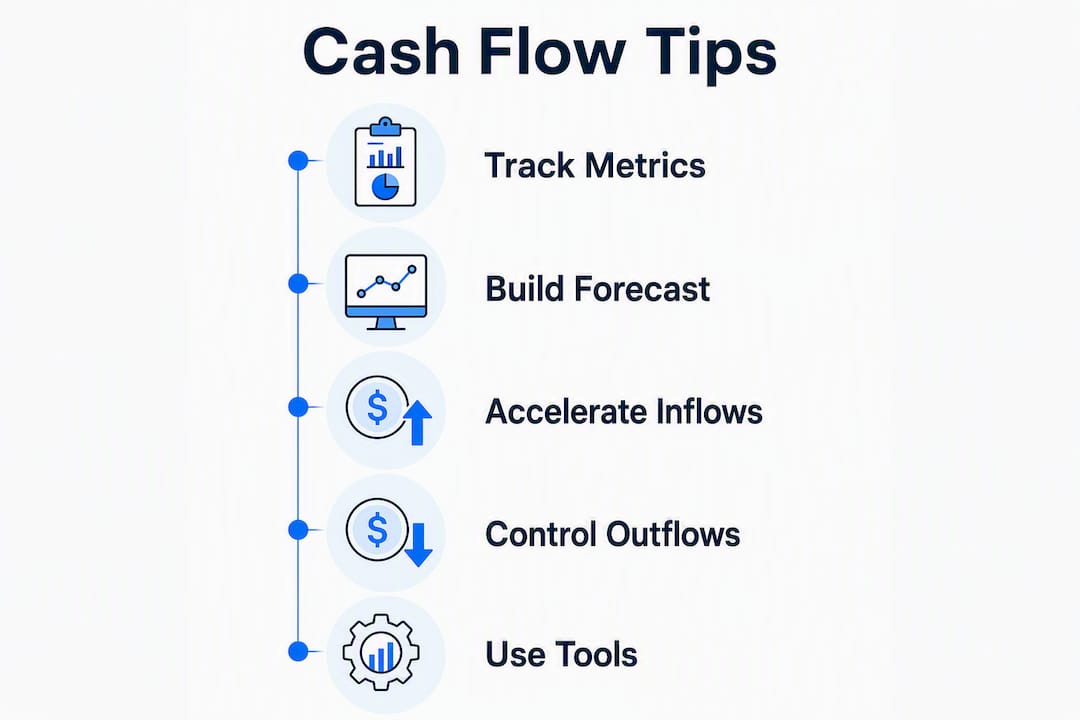
Pro Tip: A shortfall in week 2 demands a different response than one in week 10. Week 2 means you act today: call your top AR accounts, delay a discretionary purchase, or draw on your line of credit. Week 10 gives you time to negotiate better terms, adjust staffing, or plan a promotion to pull revenue forward.
How can you accelerate cash inflows this week?
Speed matters more than most owners realize. Every day an invoice sits unsent is a day you’ve extended free credit to your customer.
- Invoice the same day work is complete. Waiting until Friday to batch invoices adds days to your DSO for no reason. Same-day invoicing and embedded payment links are among the highest-impact, lowest-cost changes you can make.
- Require deposits on new projects. A substantial deposit upfront shifts risk and funds your initial costs before you’ve spent a dollar.
- Shorten your default payment terms. Net 30 is a convention, not a law. Many small businesses run Net 15 or even Net 10 without losing customers.
- Accept cards and ACH. Friction kills collections. If a customer has to mail a check, some of them will wait.
- Run your AR aging every week and call the 90+ bucket. A short, direct call works better than a reminder email.
On early-pay discounts: A 2/10 Net 30 discount (2% off if paid within 10 days) sounds small. But early-pay discounts act like short-term loans from your margin. The effective annualized cost of a 2/10 Net 30 is roughly 36% — higher than most lines of credit. Offer them selectively, only when the cash-on-hand value clearly outweighs the margin hit.
For practical AR and invoicing templates that reduce payment friction, InvoiceLabs has a solid set of small-business examples worth bookmarking.
How do you control outflows without damaging supplier relationships?
The rule is simple: pay what you must pay on time (payroll, taxes, critical suppliers), and use every contractual day available for everything else.

Paying on the last contractual day keeps cash in your account longer. That’s not a trick; it’s what experienced finance teams do as standard practice. The money earns interest, or at minimum stays available for unexpected needs.
Practical payables tactics:
- Rank your vendors by risk: critical (single-source suppliers, utilities, lenders) vs. flexible (subscriptions, non-urgent services). Pay critical vendors on time, every time. Stretch the rest.
- Ask for Net-45 or Net-60 terms when renewing supplier contracts. Most vendors will agree if you have a clean payment history.
- For large asset purchases, compare leasing vs. buying. Leasing preserves cash and keeps the asset off your balance sheet; buying makes sense when the asset appreciates or when financing costs exceed lease costs over the useful life.
- Cancel or pause subscriptions and software licenses you haven’t used in 60 days. These are invisible cash drains.
Pro Tip: Build a simple two-column bill-ranking list: “Pay by due date” and “Pay on last allowed day.” Review it every Monday. This one habit prevents both late fees and unnecessary early payments.
Which working-capital levers free up cash fastest?
For product businesses especially, inventory is often the biggest cash trap. Here’s a practical checklist:
- Identify your slowest-moving SKUs. Any item that hasn’t sold in 90 days is cash sitting on a shelf. Run a clearance promotion, bundle it with a fast mover, or return it to the supplier if your agreement allows.
- Switch to just-in-time ordering for non-perishable items where lead times allow. Carrying less inventory means less cash tied up.
- Run customer credit checks before extending Net 30 or longer terms to new accounts. One bad debt can wipe out a month of margin.
- Adjust staffing for seasonality. Use historical sales cycles to plan part-time or contract labor for peak periods rather than carrying full-time headcount year-round.
- SKU rationalization: If you carry 200 products and 20 of them generate 80% of revenue, the other 180 are probably costing you more in carrying costs than they’re worth.
For a quick win this week: pull your inventory report, sort by days-on-hand descending, and pick the top item. Price it to move. That single action often releases more cash than a week of expense-cutting.
What financing options work best for short-term gaps?
For predictable, recurring shortfalls, a pre-arranged line of credit is almost always the right tool. Draw it when you need it, repay it when receivables come in, and pay interest only on what you use. The key word is pre-arranged: apply before you need it, because banks don’t lend to businesses that are already in distress.
Main options and when to use them:
- Business line of credit: Best for seasonal gaps and short-term timing mismatches. Low cost if managed well. Requires good credit and financials.
- Invoice financing / factoring: Advances cash against outstanding invoices. Useful when AR is reliable but slow-paying. Costs vary widely; always calculate the effective annual rate before signing.
- Short-term business loan: Fixed repayment schedule. Good for a specific, one-time need with a clear repayment source. Less flexible than a line.
- Merchant cash advance (MCA): Fast access, but the effective cost is often extremely high. Use only as a last resort and only if you understand the factor rate math.
- Business credit card: Useful for small, recurring purchases with a grace period. Dangerous if balances carry month to month.
Decision checklist before taking any financing:
- What is the effective annualized cost of capital?
- How long until the gap closes, and does the loan term match?
- Are there covenants or restrictions that limit your flexibility?
- How quickly can you access the funds if needed?
- Does invoice factoring require notifying your customers, and how will they react?
For more on using borrowed capital strategically, Finblog’s guide on financial leverage covers the cost-of-capital tradeoffs in detail.
Which tools give you real-time cash visibility?
The goal isn’t the most sophisticated software stack. It’s accurate, timely data with minimal manual work.
Tool categories to consider:
- Accounting software (QuickBooks, Xero, FreshBooks): The foundation. Bank feeds pull transactions automatically; invoicing and AR tracking are built in.
- AR automation and payment processors (Stripe, Square, Bill.com): Reduce friction on the inflow side. Automated payment reminders alone can cut DSO meaningfully.
- Payroll platforms (Gusto, ADP, Paychex): Automate payroll tax calculations and direct deposit. Removes one of the largest fixed outflows from manual tracking.
- Cash flow forecasting tools (Float, Pulse, Dryrun): Connect to your accounting software and build rolling forecasts automatically. Worth the cost once you’re past the spreadsheet stage.
- Bank feeds: Non-negotiable. If your accounting software isn’t pulling daily bank transactions automatically, fix that first.
Pro Tip: Start with the simplest stack that works: bank feed + invoicing software + a payment link. Add forecasting tools once your data is clean. Layering complexity onto messy data just gives you faster wrong answers.
When evaluating any tool, check five things: data accuracy, update frequency, mobile payment support, ease of integration with your existing software, and the quality of cash-position reporting.

For a broader comparison of financial planning tools, Finblog’s expert review covers the leading options for small businesses.
How do you build a cash reserve and handle unexpected shortfalls?
A reserve target covering several months of core operating expenses is the standard guideline, designed to protect against typical short-term disruptions and more significant revenue losses or client payment delays.
Reserve policy basics:
- Open a separate savings account for the reserve. Keeping it in your operating account makes it invisible and easy to spend.
- Automate a fixed monthly transfer. Even $500 a month builds a meaningful buffer over a year.
- Define the trigger for using it: a forecast shortfall exceeding a specific dollar amount within the next 13 weeks is a clean, objective rule.
- Define who can approve a drawdown and what the replenishment plan looks like.
Integrate contingency into your forecast. Add a scenario row to your 13-week model: “What does the closing balance look like if I draw $X from my line of credit at week N?” Running that simulation every week means you’re never surprised by a shortfall; you’ve already modeled it and know the response.
Statistic: Practitioners widely recommend a dedicated cash reserve covering 3 to 6 months of essential operating expenses, funded through automated monthly contributions and held in a separate account from daily operations.
For a deeper framework on building financial resilience, Finblog’s resilience guide covers stress-testing and contingency policy templates.
Defensive vs. proactive: which cash flow strategy fits your situation?
Industry treasury guides frame cash management as two equal halves: defensive controls and proactive measures. Most small businesses default to defensive mode because it’s reactive and familiar. The businesses that build durable cash health combine both.
Defensive strategies (expense control, payment timing):
- Tighten payment terms and enforce them
- Delay discretionary spending during low-cash periods
- Reduce burn rate through subscription audits and headcount discipline
- Pay vendors on the last contractual day
Proactive strategies (working-capital optimization, technology):
- Shorten the cash conversion cycle through faster invoicing and inventory turns
- Automate AR follow-up to reduce DSO without manual effort
- Use historical seasonality data to pre-fund lean months rather than cutting reactively
- Secure financing before you need it
Think of it as a two-axis framework. When cash is tight and the business is under stress, lean defensive: cut, delay, collect. When cash is stable and the business is growing, lean proactive: invest in tools, optimize working capital, and build the reserve. Most businesses need both running simultaneously, just weighted differently.
Seasonal forecasting tip: Pull two years of monthly revenue data and calculate the average variance from your annual mean for each month. Those percentages become your seasonal adjustment factors. Apply them to your 13-week forecast when you’re entering a historically weak quarter.
Pro Tip: When your 13-week forecast shows a seasonal dip in weeks 6–9, that’s the signal to pre-fund payroll, delay non-critical inventory orders, and push a promotional offer in weeks 3–5. Reacting in week 7 costs more than preparing in week 3.
Key Takeaways
Consistent cash flow management comes down to one discipline: run a 13-week rolling forecast every week, act on what it shows, and build the reserve before you need it.
| Point | Details |
|---|---|
| Start with the 13-week forecast | Update it every Friday with actuals; it’s the single most useful cash visibility tool for small businesses. |
| Track DSO and DPO weekly | These two metrics reveal the timing gap between profit and cash faster than any income statement. |
| Accelerate inflows first | Invoice same-day, add payment links, and call your 90+ day AR bucket before cutting expenses. |
| Build a 3 to 6 month cash reserve | Automate monthly contributions to a separate account; define a clear trigger before drawing it down. |
| Finblog’s consulting approach | Finblog offers a cash flow assessment that delivers a 13-week forecast setup, an AR/AP playbook, and a prioritized action list. |
30-day milestones:
- Week 1: Build or update your 13-week forecast; pull AR aging; send all outstanding invoices
- Week 2: Call every account 15+ days past due; confirm all payables are using full contractual terms
- Week 3: Open a dedicated reserve account; set up automated monthly transfer
- Week 4: Identify your slowest-moving inventory item and price it to move; review all subscriptions
90-day milestones:
- Reduce DSO by 5–7 days through consistent invoicing and follow-up
- Establish a line of credit (apply now, before you need it)
- Achieve forecast variance below 10% week-over-week
- Fund the first month of your cash reserve
- Implement at least one AR automation tool to reduce manual follow-up
Weekly cadence reminder: update your 13-week forecast every Friday. That single habit, done consistently, is worth more than any software purchase.
The cash flow mistake most small businesses keep making
The most common mistake isn’t overspending. It’s confusing profit with cash and then making decisions based on the wrong number.
A business can show a healthy net income for three consecutive months and still run out of cash in month four. It happens when customers pay slowly, when a large inventory purchase hits before a major payment comes in, or when a tax bill arrives that wasn’t modeled into the forecast. The income statement doesn’t show any of that. The 13-week forecast does.
The second most common mistake is late invoicing. Owners finish a project, feel good about the work, and then let the invoice sit for a week while they move on to the next job. That delay is a self-inflicted cash shortage. There’s no good reason to wait.
The third is overbuying inventory. The instinct to stock up when a supplier offers a deal is understandable, but it trades cash today for margin later, and the math rarely works out as well as it looks in the moment.
The path out of all three is the same: diagnose with a 13-week forecast and an AR aging report, implement one quick win in week two, address the biggest structural leak in month two, and systemize the fix in month three. That sequence, drawn from practitioner guides, works because it doesn’t try to fix everything at once.
When the numbers stop making sense or the forecast keeps showing shortfalls despite your best efforts, that’s the right time to bring in an advisor. A CFO consultant or a CPA with small business experience can often spot the leak in an hour that an owner has been staring at for months.
This article is general financial information, not professional advice. Confirm current rules and strategies with a qualified financial professional for your specific situation.
Finblog’s cash flow assessment for small businesses
If you’ve read this far and the forecast still feels like a project you’ll start next month, Finblog’s cash flow consulting service is built to close that gap. The assessment delivers a working 13-week forecast set up for your actual business, an AR/AP playbook with specific term and collection recommendations, and a prioritized action list ranked by cash impact.
You leave with a document you can use Monday morning, not a report that sits in a folder. The consulting approach is direct: diagnose the gap, build the tool, hand it over with clear instructions. No long retainer required to get started.
What the assessment includes:
- A customized 13-week rolling forecast template, populated with your numbers
- An AR aging analysis with a collections priority list
- A payables timing review to identify cash you’re leaving on the table
- A cash reserve target and contribution plan
- A 30/90-day action checklist with measurable milestones
Start your cash flow assessment at Finblog and get a clear picture of where your cash is going and exactly what to do about it.
Useful sources and templates
The sources below are worth bookmarking. Each one covers a specific piece of the cash management picture.
| Source | What it covers | Best for |
|---|---|---|
| FDIC Module 10: Managing Cash Flows | Cash flow statements vs. projections, CCC formula, reserve-building basics | Foundational training; good for new owners |
| Unifiedbooks 13-Week Guide | 13-week rolling forecast methodology and weekly update cadence | Forecasting setup and template |
| CurrentCFO Small Business Strategies | Payables timing, reserve policy, 90-day diagnostic sequence | Payables management and contingency planning |
| J.P. Morgan Cash Flow Guide | Seasonality planning, treasury reporting, forecasting best practices | Seasonal adjustment and reporting |
| Truist: 10 Steps for Better Cash Management | Defensive vs. proactive framework, treasury strategy | Strategic framing and two-pronged approach |
| BDC: 5 Tips to Manage Cash Flow | Early-pay discount math, practical cash tips | Discount calculation and inflow tactics |
Recommended Finblog guides to read next:
- Complete Guide to Cash Flow Management: deeper templates and projection techniques
- Quarterly Financial Planning: historical cycle analysis and seasonal planning
- Good Budgeting Techniques That Actually Work: expense control and forecast accuracy