


Artificial intelligence models are becoming more efficient, but that does not necessarily mean AI will become cheaper to run. According to TechScoop, demand for computing power is growing even faster, keeping pressure on infrastructure costs.
The report argues that improvements in AI efficiency are encouraging companies to build and deploy more AI applications rather than spend less on computing. As a result, demand for GPUs, memory chips, networking equipment and data centre capacity continues to grow faster than efficiency gains can offset.
This reflects the Jevons Paradox, an economic principle suggesting that when a technology becomes more efficient, overall usage often increases instead of declines.
Several factors are expected to keep AI infrastructure expensive:
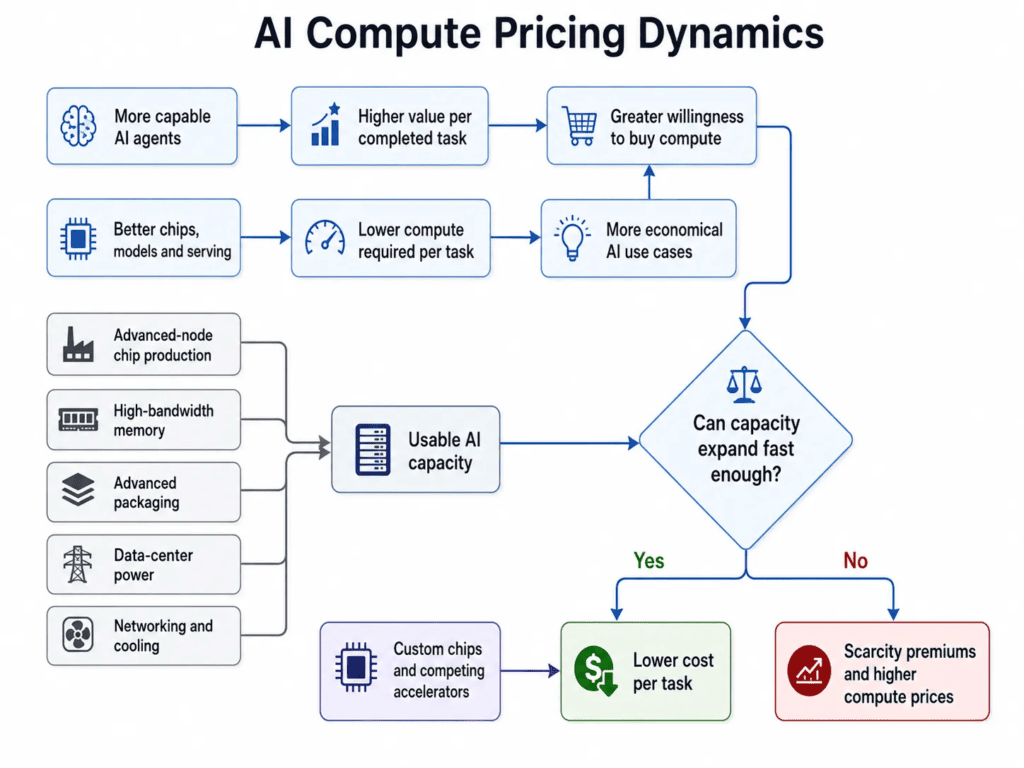
- Rising prices for high-bandwidth memory (HBM), a key component in AI chips.
- Limited availability of power and data centre capacity.
- Rapid growth in AI inference, as businesses move from training models to deploying AI products at scale.
- Continued heavy investment from hyperscalers such as Microsoft, Amazon, Google, and Meta, which are expanding AI infrastructure to meet growing demand.
The report notes that while newer AI models require fewer resources to train, they are also making AI more accessible. That is encouraging businesses to launch more AI-powered services, increasing overall computing demand instead of reducing it.
This trend is also changing where spending is directed. While training the largest frontier models remains expensive, inference, the process of running AI models for millions of users, is becoming an even bigger driver of infrastructure investment.
Investor takeaway: More efficient AI models are unlikely to reduce industry spending. Instead, lower costs per task could accelerate AI adoption, supporting continued demand for chips, memory, networking equipment and data centres. That means companies supplying AI infrastructure may continue to benefit, even as AI models themselves become cheaper to run.
Disclosure: This article does not represent investment advice. The content and materials featured on this page are for educational purposes only.