



TL;DR:
- An IRA is a tax-advantaged account used to hold investments that grow toward retirement. Choosing between a Traditional or Roth IRA depends mainly on your current versus future tax rates. Proper investment selection and strategic conversions can maximize long-term tax benefits and account growth.
An IRA retirement account is a tax-advantaged container you open at a bank, brokerage, or mutual fund company to hold investments that grow toward retirement. The core decision is straightforward: a Traditional IRA may give you a tax deduction today, while a Roth IRA lets qualified withdrawals come out completely tax-free later. Which one wins depends almost entirely on whether your tax rate is higher now or in retirement.
Before you read further, here are your immediate next steps:
- Confirm you have taxable compensation (wages, self-employment income) for the year you want to contribute
- Check the current contribution limits and whether income phase-outs affect your Roth or deductible Traditional contributions
- Open an account with a custodian and, critically, invest the cash once it lands — leaving contributions sitting in a money market account is the most common beginner mistake
- If you are moving funds from a 401(k) or another IRA, request a trustee-to-trustee transfer to avoid the 60-day rollover clock
The contribution limits carry into the current planning cycle with specific thresholds for those aged 50 or older. That ceiling applies across all your Traditional and Roth IRAs combined.
Table of Contents
- What is an IRA and how does it actually work?
- What are the main IRA types and who does each one suit?
- How much can you contribute, and when is the deadline?
- When do withdrawals trigger taxes and penalties?
- How do rollovers and Roth conversions work without surprises?
- Should you fund an IRA or a 401(k) first?
- How do you open and fund an IRA step by step?
- How much can IRA contributions grow over time?
- Key Takeaways
- The part most IRA guides skip
- Finblog can help you build your IRA strategy
- Authoritative sources and further reading
What is an IRA and how does it actually work?
An IRA is a retirement arrangement you can set up at banks, mutual fund companies, insurance companies, or brokers. Think of it as a tax-advantaged container: the account itself is not an investment. It holds investments, and the tax rules wrap around whatever you put inside.
That distinction matters more than it sounds. You can hold stocks, bonds, ETFs, mutual funds, and other assets inside the same IRA. The container determines the tax treatment; the investments determine the growth.
How the tax treatment splits:
- Traditional IRA: contributions may be tax-deductible (depending on income and whether you have a workplace plan), earnings grow tax-deferred, and distributions are taxed as ordinary income
- Roth IRA: contributions are made with after-tax dollars, earnings grow tax-free, and qualified distributions are tax-free
The IRS governs both account types through Publication 590-A (contributions) and Publication 590-B (distributions). Those two publications are the authoritative source for the rules — not a blog, not a brokerage FAQ.
Pro Tip: After you fund your IRA, go one step further and actually select investments. A contribution sitting in a default cash sweep earns almost nothing. Log back in within a week of funding and allocate to your chosen funds.
What are the main IRA types and who does each one suit?
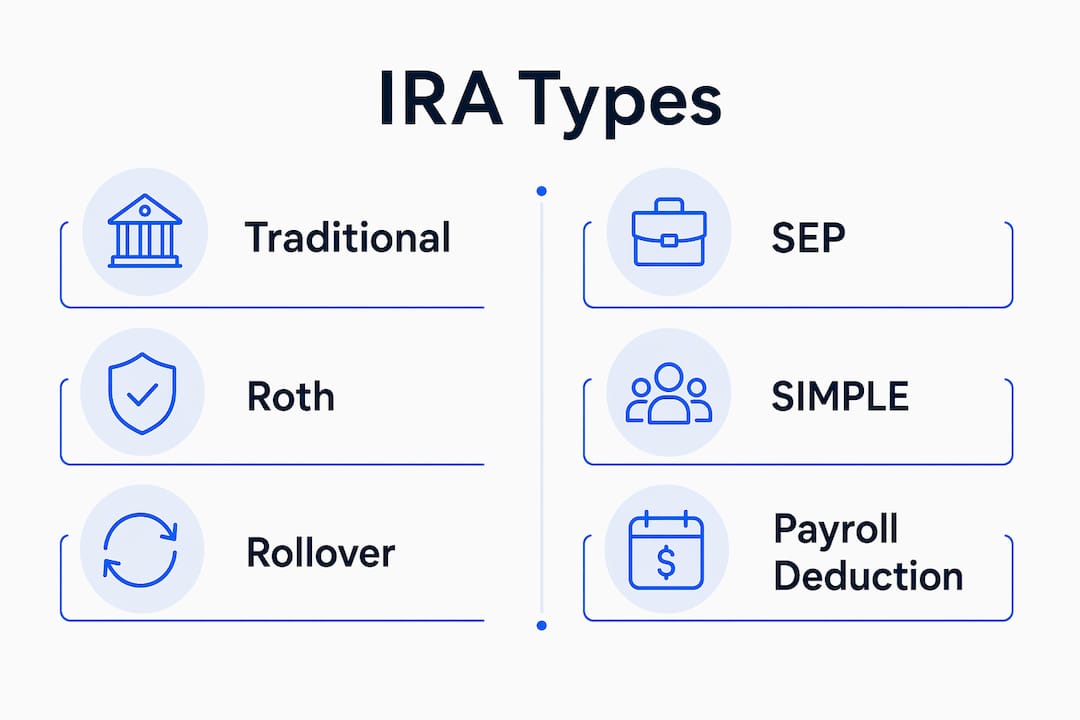
Six IRA types cover most situations. They share the same basic container concept but differ in who contributes, how much, and what tax treatment applies.
Traditional IRA
Anyone with taxable compensation can contribute. The deductibility of those contributions depends on your income and whether you (or a spouse) participate in a workplace retirement plan. If neither of you has a workplace plan, contributions are fully deductible regardless of income. If you do have a workplace plan, the deduction phases out above certain income thresholds the IRS updates annually. Distributions in retirement are taxed as ordinary income.

Best for: people who expect a lower tax rate in retirement than they have today, or who need the immediate deduction to reduce this year’s tax bill.
Roth IRA
Contributions are not deductible, but qualified distributions — including all the earnings — come out tax-free. To make a qualified distribution, you generally need to be at least 59½ and have held the account for at least five years (the “5-year rule”). Roth IRAs also have income limits: above certain modified adjusted gross income (MAGI) thresholds, your ability to contribute phases out entirely.
Best for: younger savers in lower tax brackets today who expect higher income (and taxes) in retirement. Also useful for people who want flexibility, since Roth contributions (not earnings) can be withdrawn at any time without penalty.
SEP IRA
A Simplified Employee Pension IRA is employer-funded. Self-employed individuals and small-business owners contribute on behalf of themselves and eligible employees. Contribution limits are substantially higher than Traditional or Roth limits, making SEP IRAs attractive for high-earning self-employed people who want to shelter a larger portion of income.
Best for: freelancers, sole proprietors, and small-business owners who want a straightforward, high-limit plan without complex administration.
SIMPLE IRA
The Savings Incentive Match Plan for Employees is designed for small businesses with 100 or fewer employees. Employees contribute through salary reduction, and employers are generally required to either match contributions up to a percentage of compensation or make a flat contribution for all eligible employees. IRA-based plans like SIMPLE IRAs give small employers a retirement benefit without the administrative overhead of a 401(k).
Best for: small-business owners who want to offer employees a retirement benefit with mandatory employer contributions built in.
Payroll Deduction IRA
The simplest employer-facilitated option. The employer sets nothing up beyond arranging payroll deductions; employees choose their own IRA custodian and the employer routes the deductions there. Contribution limits are the same as standard Traditional or Roth IRAs.
Best for: employers who want to help employees save without sponsoring a formal plan.
Rollover IRA
A Traditional IRA used specifically to receive funds rolled over from a 401(k) or another employer plan. Functionally identical to a Traditional IRA once the money is inside, but the rollover label helps track the source of funds for tax purposes.
Best for: anyone consolidating old workplace plan accounts after a job change.
How much can you contribute, and when is the deadline?
The IRA contribution limit applies in aggregate across all your Traditional and Roth IRAs combined. You cannot contribute $7,000 to a Traditional IRA and another $7,000 to a Roth in the same year — the limit covers both together. You also cannot contribute more than your taxable compensation for the year, so if you earned $4,000, that is your ceiling regardless of the published limit.

The 2024 limits were $7,000 or $8,000 for those 50 and older. The catch-up amount for age 50 and older has been $1,000 on top of the base limit. Always verify the current-year figures directly on the IRS website before contributing, since Congress adjusts limits periodically for inflation.
Income phase-outs to know:
- Roth IRA: your ability to contribute phases out above a MAGI threshold that the IRS adjusts annually. Above the top of the range, you cannot contribute directly to a Roth at all (though a “backdoor Roth” conversion is still available)
- Traditional IRA deductibility: if you or your spouse participates in a workplace plan, the deduction phases out above income thresholds that differ by filing status. If neither of you has a workplace plan, the deduction is available at any income level
| Contribution rule | Key detail |
|---|---|
| Base annual limit | IRS determines annual limits; verify current year directly |
| Catch-up (age 50+) | Additional catch-up amount applies for those age 50 and older |
| Aggregate rule | Limit applies across all Traditional + Roth IRAs combined |
| Earned income cap | Cannot exceed your taxable compensation for the year |
| Contribution deadline | Tax-filing deadline (typically April 15 of the following year) |
| Prior-year contributions | Allowed up to the filing deadline; designate the correct year when funding |
Deadline note: you have until the tax-filing deadline — typically April 15 — to make contributions for the prior tax year. If you fund an IRA in February, you can designate it as a prior-year contribution. Just tell your custodian which year it applies to, because they will not assume.
When do withdrawals trigger taxes and penalties?
The tax treatment on the way out mirrors the treatment on the way in, with some important exceptions.
Traditional IRA distributions are taxed as ordinary income. Pull money out before age 59½ and you generally owe that income tax plus a 10% additional tax on early distributions. There is no general hardship exception — the IRS does not care that you needed the money urgently. Exceptions are statutory and specific.
Roth IRA distributions follow a two-part test. Your contributions (the after-tax dollars you put in) can always come out tax-free and penalty-free. Your earnings require a qualified distribution: you must be at least 59½ and the account must have been open for at least five years.
Common statutory exceptions to the 10% early-distribution penalty:
- Permanent disability
- Death (distributions to beneficiaries)
- Substantially equal periodic payments (SEPP / 72(t) distributions)
- Unreimbursed medical expenses above a threshold
- Health insurance premiums while unemployed
- Qualified higher education expenses
- First-time homebuyer expenses (up to $10,000 lifetime)
- IRS levy on the IRA
Required Minimum Distributions (RMDs): the IRS requires you to start taking distributions from a Traditional IRA by April 1 of the year following the year you reach the IRS-specified RMD beginning age. Consult IRS Publication 590-B and the applicable life-expectancy tables for the exact age and calculation method, as the SECURE Act and SECURE 2.0 Act have changed the starting age in recent years. Roth IRAs have no RMD requirement for the original owner, which makes them useful for estate planning and late-life tax management.
Pro Tip: Coordinate IRA withdrawals with Social Security timing and any pension income. Taking large Traditional IRA distributions in the same year you start Social Security can push more of your benefits into taxable territory. A tax-efficient withdrawal sequence can meaningfully reduce your lifetime tax bill.
How do rollovers and Roth conversions work without surprises?
Moving money between retirement accounts is straightforward when you use the right method. The wrong method creates a tax bill you did not expect.
Trustee-to-trustee transfer vs. indirect rollover
A trustee-to-trustee transfer moves money directly from one custodian to another. You never touch the funds. There is no 60-day deadline, no withholding, and no limit on how many transfers you can do per year. This is almost always the better choice.
An indirect rollover means the old custodian sends a check to you, and you have 60 days to deposit it into the new IRA. Miss the 60-day window and the distribution becomes taxable income, plus the 10% early-distribution penalty if you are under 59½. The 60-day clock starts the day you receive the funds, not the day you decide to act.
There is also a one-rollover-per-12-months limit for IRA-to-IRA indirect rollovers. Trustee-to-trustee transfers are not counted under this limit.
How to execute a rollover or conversion
- Contact the receiving custodian first. Open the destination IRA account before initiating the transfer.
- Request a direct rollover or trustee-to-trustee transfer from the sending institution. Ask them to make any check payable to the new custodian, not to you.
- Confirm the funds arrive and are invested. Do not assume the transfer completed — follow up within two weeks.
- For a 401(k) rollover: ask your plan administrator for a direct rollover to your IRA. They will send funds directly to the custodian.
- For a Roth conversion: instruct your custodian to convert Traditional IRA funds to a Roth. The pre-tax amount converted is added to your taxable income for that year.
- File Form 8606 with your tax return to report nondeductible contributions and Roth conversions.
Tax consequence of a Roth conversion: every dollar of pre-tax Traditional IRA money you convert to a Roth is taxable as ordinary income in the year of conversion. Since the Tax Cuts and Jobs Act, you cannot undo (recharacterize) a conversion after the fact. Plan the conversion amount carefully — converting too much in one year can push you into a higher bracket or trigger Medicare premium surcharges.
- Conversions work best in years when your income is temporarily lower (career transition, early retirement before Social Security begins)
- Partial conversions spread the tax hit across multiple years
- Keep cash outside the IRA to pay the conversion tax; using IRA funds to pay it defeats part of the purpose
Should you fund an IRA or a 401(k) first?
The short answer: capture the full employer match in your 401(k) before contributing to an IRA. An employer match is an immediate 50%–100% return on your contribution — no investment can reliably beat that. After the match, the decision gets more nuanced.
Where IRAs have an edge:
- Broader investment selection (most 401(k) plans limit you to a curated fund menu)
- Potentially lower expense ratios if you choose index funds at a discount brokerage
- Roth IRA contributions can be withdrawn at any time without penalty, adding flexibility
- No RMDs for Roth IRA owners during their lifetime
Where 401(k)s have an edge:
- Higher contribution limits (substantially more than IRA limits per year)
- Payroll deduction makes saving automatic
- Creditor protection is generally stronger under ERISA
- Some plans offer a Roth 401(k) option, combining high limits with Roth tax treatment
A practical prioritization checklist:
- Contribute to 401(k) up to the full employer match
- Max out an IRA (Traditional or Roth depending on income and tax situation)
- Return to the 401(k) and contribute up to the annual plan limit if you have more to save
- Consider a taxable brokerage account for savings beyond tax-advantaged limits
For a deeper look at how these two accounts interact, Finblog’s 401(k) vs IRA comparison walks through specific income scenarios and tax tradeoffs.
How do you open and fund an IRA step by step?
Opening an IRA takes less than 30 minutes at most major custodians. The steps below apply whether you are starting fresh or rolling over funds from an old employer plan.
- Confirm eligibility. You need taxable compensation for the year. Roth contributions also require your MAGI to fall below the IRS phase-out threshold.
- Choose Traditional or Roth. If you expect to be in a higher tax bracket in retirement, lean Roth. If you need the deduction now, lean Traditional. Finblog’s Traditional vs Roth IRA guide walks through the decision in detail.
- Gather your documents. Social Security number, government-issued ID, and bank account information for the initial transfer.
- Select a custodian. Banks, brokerages, and mutual fund companies all offer IRAs. Evaluate: annual fees, investment options available, minimum balance requirements, and whether the platform is easy to use. If you want to hold real estate, private placements, or other nontraditional assets, you will need a specialized self-directed IRA custodian — standard custodians do not permit those.
- Open the account online or by paper application. Most major brokerages complete this in one session.
- Fund the account. Link your bank account and initiate a transfer, or roll over funds from an existing retirement account using a trustee-to-trustee transfer.
- Invest the contribution. This step is where most beginners stall. Select your funds or asset allocation before closing the browser.
Investment restrictions to know: the IRS prohibits IRAs from owning life insurance or collectibles (art, antiques, gems, most coins, alcoholic beverages). Standard custodians also block real estate and private placements. If you want those assets, a self-directed IRA custodian is required, and the administrative costs and compliance requirements are meaningfully higher.
Your first 30 days checklist:
- Verify the contribution posted and is designated for the correct tax year
- Confirm your investment allocation is active (not sitting in cash)
- Set up automatic monthly contributions if your budget allows
- Designate a beneficiary — this step gets skipped constantly and causes serious problems for heirs
How much can IRA contributions grow over time?
Two examples illustrate the compounding effect, using a straightforward future-value framework. These are illustrative projections, not guarantees; actual returns depend on your investment choices and market conditions.
Example 1: $6,000 per year at 6% average annual return for 20 years
Using the future value of an annuity formula, annual contributions of $6,000 compounded at 6% for 20 years produce roughly $220,000. That is not $120,000 in contributions with $100,000 tacked on — the growth accelerates in the later years as the base gets larger.
Example 2: Adding catch-up contributions at age 50
If you contributed $6,000 per year from age 35 to 49 (15 years) and then increased to $7,000 per year from age 50 to 65 (another 15 years), the additional $1,000 per year in the back half compounds on an already-substantial base. The catch-up provision exists precisely because the final years before retirement are when compounding has the most accumulated capital to work with.
Roth vs. Traditional: the after-tax comparison
The account with the higher after-tax value depends on your tax rate at withdrawal. If you contribute $7,000 pre-tax to a Traditional IRA and your marginal rate in retirement is 22%, you keep 78 cents of every dollar withdrawn. If you contribute $7,000 after-tax to a Roth and your retirement rate would have been 22%, the Roth wins by exactly that margin on the earnings. The math is neutral when tax rates are identical; the Roth wins when your future rate is higher, the Traditional wins when your current rate is higher.
Pro Tip: Increasing your contribution rate by even $50 per month — and capturing every dollar of employer match — produces a larger long-term difference than most people expect. The IRS contribution limit page and verified retirement calculators (like the one at investor.gov) let you model your own numbers with current limits.
Key Takeaways
An IRA is a tax-advantaged container, not an investment itself — the account’s outcome depends entirely on what you hold inside it and whether you actually invest the cash after funding.
| Point | Details |
|---|---|
| IRA as a container | An IRA holds investments; the tax rules wrap around whatever assets you choose inside it. |
| Traditional vs Roth tradeoff | Traditional may give you a deduction now; Roth gives tax-free qualified withdrawals later. Choose based on your current vs expected future tax rate. |
| 2024 contribution limits | $7,000 per year ($8,000 if age 50+); the limit applies across all your IRAs combined. |
| Rollover safety rule | Use trustee-to-trustee transfers to avoid the 60-day indirect rollover clock and the one-per-12-months limit. |
| Finblog next step | Finblog offers IRA planning consultations and educational resources to help you choose the right account type and contribution strategy. |
The part most IRA guides skip
Most IRA content focuses on the rules. The rules matter, but the decision that actually moves the needle is simpler: when you convert, not whether you convert.
The conventional wisdom says “convert to Roth when you’re young.” That is often right, but it misses the more powerful version of the strategy. The best Roth conversion opportunities tend to appear in the gap years — the period between when you stop working and when Social Security or RMDs begin. In those years, your taxable income can drop to a level where you can convert a meaningful chunk of Traditional IRA funds at a low marginal rate, filling up the 12% or 22% bracket deliberately before RMDs force larger distributions at higher rates later.
Most people ignore this window because they are not earning a paycheck and feel reluctant to trigger a tax bill. That reluctance is understandable but often costly. A financial advisor who specializes in retirement income can model the exact breakeven for your situation, but the general principle holds: the years between retirement and age 73 (the current RMD starting age for many people) are often the cheapest years to convert.
The other thing guides understate: beneficiary designations. An IRA passes outside your will. If your beneficiary form names an ex-spouse or a deceased parent, that is who gets the account — no matter what your will says. Review it every few years and after any major life change.
Finblog can help you build your IRA strategy
Knowing the rules is one thing. Applying them to your specific income, tax bracket, and retirement timeline is where most people get stuck. Finblog provides financial education and personalized consulting for U.S. savers working through IRA decisions — whether you are opening your first account, weighing a Roth conversion, or consolidating old 401(k)s into a single IRA.
The guidance here covers the framework. For a personalized look at which IRA type fits your situation, how much to convert and when, and how to coordinate your accounts for the lowest lifetime tax bill, schedule a consultation with Finblog’s team. You can also explore Finblog’s retirement account resources for deeper reading on specific scenarios before you reach out.
Authoritative sources and further reading
The IRS primary pages are the definitive source for IRA rules. When a blog post and an IRS publication disagree, the publication wins.
- Traditional and Roth IRAs (IRS) — contribution limits, deductibility rules, income phase-outs, and qualified distribution requirements. The first stop for any contribution or tax question.
- Individual Retirement Arrangements (IRS) — overview of IRA types, custodian options, and links to Publications 590-A and 590-B.
- IRA-Based Plans (IRS) — rules for SEP IRAs, SIMPLE IRAs, and Payroll Deduction IRAs; useful for self-employed individuals and small-business owners.
- Retirement Plans FAQs Regarding IRAs (IRS) — covers the 10% early-distribution penalty exceptions, RMD rules, and investment restrictions in plain Q&A format.
- Topic No. 451, Individual Retirement Arrangements (IRS) — concise summary of rollover rules, the 60-day window, and the one-per-12-months indirect rollover limit.
- Retirement Plan Investments FAQs (IRS) — prohibited transactions, collectibles restrictions, and life insurance prohibition for IRAs.
- Finblog: Traditional vs Roth IRA — detailed decision framework for choosing between account types based on tax brackets and long-term goals.
- Finblog: Tax-Efficient Withdrawals Guide — withdrawal sequencing strategies to reduce taxes across Traditional IRA, Roth IRA, and taxable accounts in retirement.
- Finblog: 401(k) vs IRA — side-by-side comparison of contribution limits, employer match mechanics, and scenarios for prioritizing each account type.
- Stretching Retirement Savings Longer (Savings Grove) — practical tactics for making retirement assets last, including withdrawal pacing and account sequencing.
This article is general financial information, not personalized tax or investment advice. Contribution limits, income thresholds, and RMD ages change periodically. Confirm current rules at IRS.gov or consult a qualified tax professional for your specific situation.