

Every working American faces the challenge of deciding how to grow retirement savings without missing out on valuable tax advantages. Choosing between a 401(k) and an IRA shapes not just your investment strategy but also your long-term financial freedom. Recognizing the difference between these accounts—employer-backed benefits, tax treatment, and investment flexibility—gives you a stronger position to secure your future. This guide helps you weigh your options so you can make confident decisions that maximize employer matches, take full advantage of contribution limits, and build real wealth for retirement.
Table of Contents
- What Are 401(k) And IRA Accounts?
- Key Differences Between 401(k) And IRA
- Eligibility Requirements And Contribution Limits
- Tax Treatment And Withdrawal Rules Explained
- Common Mistakes When Choosing A Retirement Plan
Key Takeaways
| Point | Details |
|---|---|
| Understand the Basics | A 401(k) is employer-sponsored with potential matching contributions, while an IRA is independently established by the individual. |
| Evaluate Contribution Limits | For 2024, you can contribute $23,500 to a 401(k) versus $7,000 to an IRA, highlighting the 401(k)’s higher savings potential. |
| Tax Treatment Matters | Traditional accounts offer tax deductions on contributions but tax withdrawals as income, whereas Roth accounts allow tax-free withdrawals in retirement. |
| Start Early and Maximize Benefits | Prioritize capturing any employer match and consider starting retirement contributions early for greater compound growth. |
What Are 401(k) and IRA Accounts?
When you’re thinking about your financial future, these two retirement accounts likely come up in conversations with colleagues, advisors, or friends. Both are tax-advantaged retirement savings vehicles, but they work differently, and understanding those differences matters for your bottom line. A 401(k) is an employer-sponsored retirement plan that lets you contribute a portion of your salary directly into an individual account, often with your employer matching some or all of your contributions. An IRA, or Individual Retirement Arrangement, is a retirement savings account you set up independently, on your own terms, without needing an employer to offer it. Think of the 401(k) as a group plan your company provides, while the IRA is your solo financial tool.
The mechanics of each account vary in important ways. With a 401(k), you decide what percentage of your paycheck goes into the account through a simple payroll deduction. Your employer then processes this directly, and many companies sweeten the deal by matching your contributions, typically up to a certain percentage of your salary. This match is essentially free money for retirement, and it’s one of the biggest advantages of workplace plans. IRAs work differently because you fund them yourself, transferring money from your bank account on your own schedule. You have complete control over when you contribute and how much, with different IRA types available, each with distinct tax treatment and rules. The contribution limits differ too. In 2024, you can contribute up to $23,500 to a 401(k), while IRA contributions max out at $7,000. For those 50 and older, catch-up contributions push these limits higher.
What really sets these accounts apart is flexibility and accessibility. A 401(k) gives you limited investment choices, typically between 10 and 30 fund options your employer selects. However, you gain access to that employer match, which can add significant wealth over time. IRAs offer you complete investment freedom. You can invest in individual stocks, bonds, mutual funds, exchange-traded funds, or virtually any security you want. This flexibility appeals to people who want more control over their portfolio strategy. The withdrawal rules also differ. With a traditional 401(k), you must start taking required minimum distributions at age 73, and withdrawals before 59.5 usually come with penalties unless you qualify for an exception. Roth IRAs are more forgiving, allowing tax-free withdrawals in retirement with no required distributions during your lifetime. Understanding these distinctions helps you make strategic decisions about which account, or combination of accounts, aligns with your retirement goals and your current financial situation.
Pro tip: If your employer offers a 401(k) match, contribute at least enough to capture the full match before maxing out an IRA, since employer matching is free money that compounds dramatically over your career.
Here is a concise comparison of 401(k), Traditional IRA, and Roth IRA features:
| Feature | 401(k) | Traditional IRA | Roth IRA |
|---|---|---|---|
| Who sets up | Employer | Individual | Individual |
| Tax treatment on input | Pre-tax dollars | Pre-tax (if deductible) | After-tax dollars |
| Employer matching | Often available | Not available | Not available |
| Investment options | Limited, set by employer | Broad, flexible | Broad, flexible |
| Required distributions | Start at age 73 | Start at age 73 | None during account owner’s life |
| Early withdrawal rules | Penalties except exceptions | Penalties except exceptions | Contributions penalty-free |
| Annual contribution cap (2024) | $23,500 (employee) | $7,000 | $7,000 |
| Catch-up for 50+ (2024) | $7,500 | $1,000 | $1,000 |
Key Differences Between 401(k) and IRA
While both accounts serve the same ultimate purpose, the way they work reveals significant differences that directly impact how much you save and how much control you have over your money. The most obvious distinction is who sets up the account. Your employer establishes and administers your 401(k), meaning you can only access one if your company offers it. An IRA, by contrast, is entirely your creation. You open it at a bank, brokerage firm, or investment company whenever you decide, regardless of whether your employer sponsors a retirement plan. This fundamental difference shapes everything else about how these accounts operate. Beyond setup, the contribution limits and employer matching benefits_and_IRA_accounts) create a major divergence. In 2024, you can contribute up to $23,500 annually to a 401(k) versus $7,000 to an IRA. If your employer matches your contributions, that’s additional money deposited into your 401(k) account at no cost to you. IRAs offer no employer matching at all because there is no employer involved. For a worker earning $60,000 annually, an employer match of three percent could add $1,800 per year to retirement savings. Over 30 years at seven percent annual growth, that employer match alone compounds to nearly $200,000.
Investment choices and control represent another crucial difference that affects your portfolio strategy. When you enroll in a 401(k), your employer limits your options to a curated menu of mutual funds and target-date funds, usually between 10 and 30 selections. You cannot invest in individual stocks or bonds directly through the plan. This limitation simplifies decision-making for some people but frustrates investors who want specific holdings. IRAs grant you complete investment freedom. You can purchase individual company stocks, bonds, exchange-traded funds, real estate investment trusts, or almost any security your broker offers. This flexibility appeals to active investors and those with specific convictions about market opportunities. The tax treatment also differs significantly. Traditional 401(k) contributions reduce your taxable income in the year you make them, lowering your current tax bill. When you withdraw money in retirement, those withdrawals are taxed as ordinary income. Traditional IRAs work the same way. However, Roth IRAs operate differently. You contribute after-tax dollars, meaning you get no current tax deduction, but qualified withdrawals in retirement are completely tax-free. This tax-free growth over decades can mean substantial savings if you expect to be in a higher tax bracket in retirement.
The withdrawal rules create practical differences that affect your retirement flexibility. With a 401(k), you must begin taking required minimum distributions starting at age 73, whether you need the money or not. Withdrawals before age 59.5 typically trigger a ten percent early withdrawal penalty plus income taxes, though some exceptions exist for hardships or substantially equal periodic payments. IRAs offer more flexibility. Traditional IRAs also require minimum distributions at 73, but Roth IRAs never require distributions during your lifetime, allowing your money to grow untouched if you don’t need it. This makes Roth accounts particularly valuable for building generational wealth to pass to heirs. Roth IRAs also allow penalty-free withdrawals of your contributions (not earnings) at any time, providing a safety net if you face financial emergencies. Understanding these differences helps you construct a retirement strategy that maximizes tax efficiency while aligning with your investment preferences and life circumstances.

Pro tip: If your employer offers a 401(k) match, prioritize capturing the full match first, then consider opening an IRA for investment flexibility and potential Roth tax-free growth benefits.
Eligibility Requirements and Contribution Limits
Getting into either retirement account is straightforward, but the rules differ based on which vehicle you choose. For a 401(k), your eligibility hinges entirely on your employer. If your company offers a plan, you’re typically eligible to participate, though some employers impose waiting periods before you can enroll. A few companies require you to work there for six months or a full year before joining the plan. Once you’re eligible, you control how much of your paycheck goes into the account through a simple payroll election. An IRA, on the other hand, has minimal eligibility barriers. You simply need earned income from working, whether through a job, self-employment, or running a business. This means you can open an IRA whenever you want, as long as you have income to contribute. You don’t need employer sponsorship or approval. Age itself is not a barrier to IRA eligibility, though income limits can restrict your ability to make deductible contributions or contribute to a Roth IRA if you earn above certain thresholds. For 2026, you cannot contribute to a Roth IRA if your income exceeds $146,000 as a single filer or $230,000 as a married couple filing jointly.
Contribution limits tell a revealing story about how these accounts are designed. The IRS sets much higher ceilings for 401(k)s because they represent your primary retirement savings vehicle through work. For 2026, you can contribute up to $24,500 to a 401(k), while IRA contribution limits are capped at $7,500. The difference is substantial. Over a 30-year career, that extra $17,000 annually in 401(k) contribution capacity compounds significantly. If you invested that difference at seven percent annual returns, you’d accumulate over $2 million in additional retirement savings. The IRS recognizes this disparity because 401(k)s are employer-sponsored plans designed to be your main retirement savings tool, while IRAs serve as supplemental accounts for individual savers. If you’re 50 or older, the IRS allows catch-up contributions to help you accelerate savings as retirement approaches. You can add $7,500 extra to a 401(k) and $1,100 extra to an IRA, bringing your 2026 totals to $32,000 for a 401(k) and $8,600 for an IRA if you’re over 50.
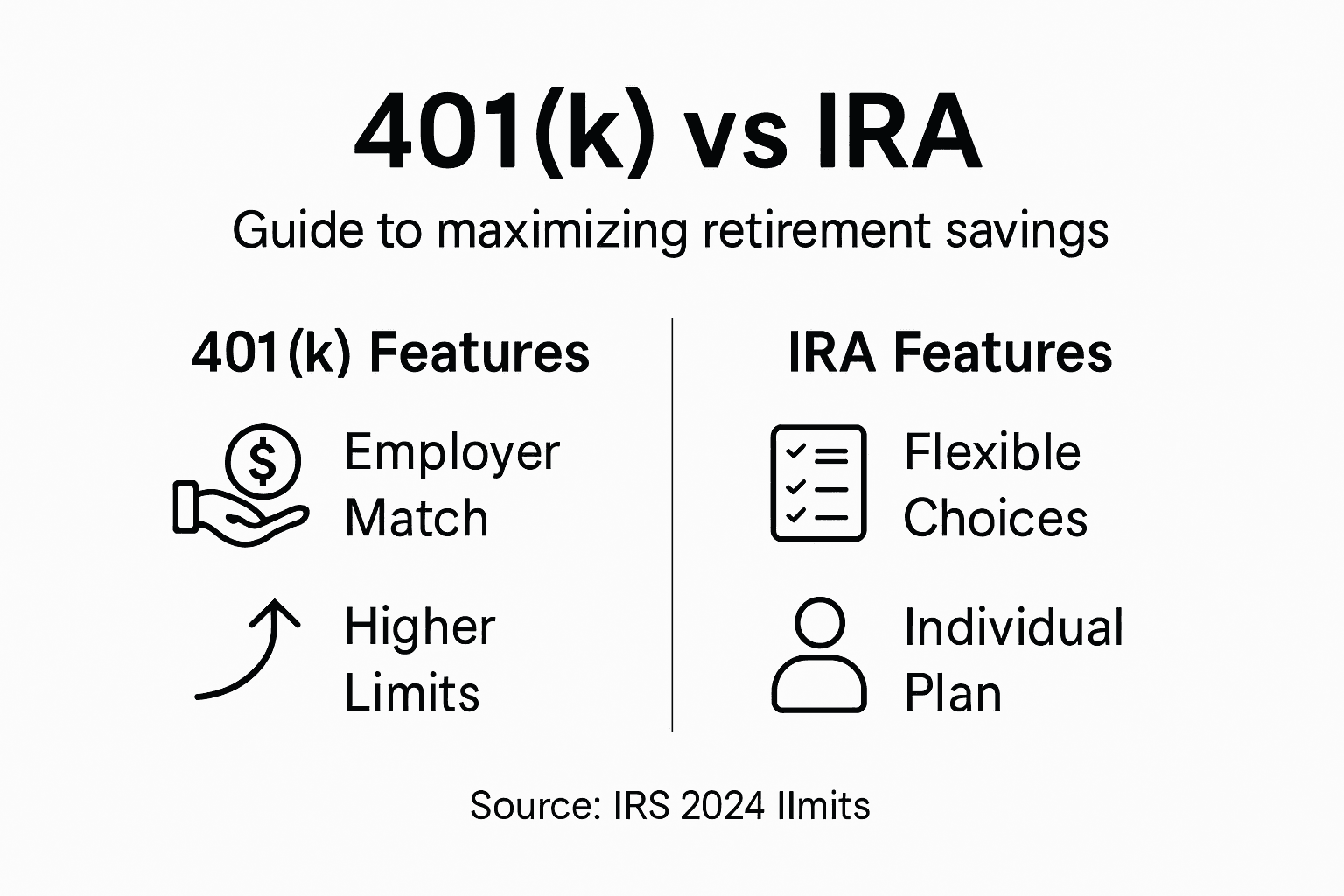
One critical rule limits total 401(k) contributions when you combine employee and employer additions. 401(k) contribution limits apply to your employee deferrals, but your employer’s matching contributions count toward a higher overall cap of $70,000 per year. This means if you contribute $24,500 and your employer matches $6,000, that’s $30,500 combined, well under the $70,000 limit. For most workers, this combined cap is not a practical concern. However, if you’re highly compensated or your employer provides generous matching, you might approach this threshold. IRAs have no employer contribution option, so you simply contribute your own money up to the annual limit. Income limits affect IRA deductibility more than 401(k)s. If you’re covered by a 401(k) at work and file as single, you can deduct traditional IRA contributions only if your income stays below $77,000 in 2026. Above that threshold, your deduction phases out until it disappears completely at $87,000. Married couples have higher thresholds at $123,000 and $143,000. These income limits don’t affect your ability to contribute to a Roth IRA if you’re below the Roth income limits, though they do require you to use post-tax dollars. Understanding your eligibility status and contribution capacity helps you maximize tax benefits and accelerate wealth accumulation.
Pro tip: Calculate what percentage of your salary you need to contribute to your 401(k) to capture your employer’s full match, then direct any additional retirement savings to an IRA where you have investment control and potentially access Roth tax-free growth.
Tax Treatment and Withdrawal Rules Explained
Tax treatment is where 401(k)s and IRAs truly diverge, and this difference can impact tens of thousands of dollars over your retirement. With a traditional 401(k), your contributions come directly from your paycheck before taxes are withheld, which means you get an immediate tax deduction. If you earn $75,000 and contribute $10,000 to your 401(k), your taxable income drops to $65,000 for that year. This lowers your current tax bill, which feels great when filing your return. However, the IRS collects its due later. When you withdraw money in retirement, those withdrawals are taxed as ordinary income at your marginal tax rate. A Traditional IRA works the same way on the contribution side if you qualify for the deduction. Your contributions may be tax-deductible, reducing your current taxable income, and then you pay taxes when you withdraw. The appeal is obvious: you reduce taxes now and potentially pay taxes later at a lower rate if you expect to be in a lower tax bracket in retirement.
Roth accounts flip this arrangement entirely. With a Roth 401(k) or Roth IRA, you contribute money that has already been taxed. You get no current deduction, and your tax bill today is higher. But here’s the payoff: qualified withdrawals in retirement are completely tax-free. Your contributions grow tax-free for decades, and you never pay taxes on that growth. Roth IRA withdrawal rules are particularly generous because you can withdraw your contributions anytime without penalty, providing emergency access if needed. The growth portion stays protected until retirement. This tax-free growth becomes extraordinarily valuable if you expect to be in a higher tax bracket in retirement, which many high-earning professionals anticipate. Consider a simple comparison: invest $10,000 in a Traditional IRA and another $10,000 in a Roth IRA at age 35. At seven percent annual growth, each account reaches roughly $90,000 by age 65. With the Traditional IRA, you owe taxes on the full $90,000 at withdrawal. With the Roth, you owe zero taxes. If you’re in a 32 percent tax bracket, that’s a $28,800 difference.
Withdrawal rules create practical constraints you must understand. Withdrawing money from either account before age 59.5 typically triggers a 10 percent penalty plus income taxes on the withdrawn amount, though exceptions exist for specific hardships like medical expenses, disability, or first-time home purchases up to $10,000. At age 73, Traditional 401(k) and IRA holders must begin taking Required Minimum Distributions, or RMDs, even if they don’t need the money. The IRS calculates these amounts based on your account balance and life expectancy, forcing you to withdraw a set percentage annually and pay taxes on it. Roth IRAs offer a major advantage here. You never face required distributions during your lifetime, meaning your money can continue growing tax-free indefinitely. This makes Roth accounts exceptional for building wealth to leave to heirs. When you pass away, beneficiaries inherit a Roth IRA tax-free, though they must distribute the account within ten years under current rules. Roth 401(k)s, however, do require RMDs during your lifetime, so they lack this particular advantage. If you own both Traditional and Roth accounts, RMD calculations combine them, though you can satisfy the total by withdrawing from either account. Strategic withdrawal sequencing from tax-efficient retirement income strategies helps you minimize overall tax liability across these different account types.
Pro tip: If you expect your tax bracket to be higher in retirement, prioritize Roth contributions now to lock in today’s lower tax rates on decades of tax-free growth; conversely, if you’re at peak earning years, maximize Traditional 401(k) contributions to reduce current taxes and plan strategic Roth conversions in lower-income years.
Common Mistakes When Choosing a Retirement Plan
People make predictable errors when selecting between 401(k)s and IRAs, and these mistakes compound over decades. The most costly one is ignoring employer matching in a 401(k). When your company offers to match your contributions up to, say, three percent of your salary, that is literal free money. If you earn $80,000 and your employer matches three percent, they’re handing you $2,400 annually just for showing up. Yet many employees either don’t enroll at all or contribute less than the match threshold. The math is brutal. Over a 35-year career, leaving that match on the table costs you roughly $250,000 in lost contributions plus compound growth. This is not a nuanced strategy decision. Capture the full match first, always. Another widespread mistake is waiting too long to start saving. Time is your greatest asset in retirement planning because compound growth accelerates exponentially. Someone who starts at 25 and saves $400 monthly until 65 accumulates roughly $1.2 million at seven percent annual returns. Someone who waits until 35 and saves the same amount until 65 accumulates only $650,000. That ten-year delay costs them more than $500,000, even though they contributed the same total amount. Starting early doesn’t require large contributions. Starting small beats starting late every single time.
Ignoring the tax implications of your account choice is another trap. Many people open a Traditional IRA without considering whether they can actually deduct the contributions based on their income and workplace coverage. If you earn $90,000, have access to a 401(k) at work, and file as single, your Traditional IRA deduction phases out completely. You’re left making non-deductible contributions that create tax reporting headaches. Similarly, some high earners miss opportunities to contribute to Roth IRAs because they think their income disqualifies them entirely. Roth conversion strategies exist to work around income limits, but only if you understand the rules. Common retirement planning mistakes often stem from not understanding how tax treatment differs between account types and how that impacts your long-term tax liability. A Traditional 401(k) lowers your current taxes but creates a massive tax bill in retirement. A Roth account costs you now but offers decades of tax-free growth. Your choice should align with your tax bracket trajectory, not just what feels convenient.
Fees and investment choices receive surprisingly little attention despite their massive impact. A 401(k) with expensive fund options can drag down returns by one percent or more annually. Over 30 years, that seemingly small difference turns into hundreds of thousands of dollars in lost growth. Many people accept whatever funds their employer selected without questioning costs. Review your 401(k) fund expense ratios, and if they’re above 0.50 percent per year, ask your HR department whether lower-cost options exist. IRAs offer superior fund choices at lower costs, but only if you actively select investments. Some savers open an IRA and leave the money in a money market account earning nothing because they didn’t make deliberate investment decisions. Diversification across plan types is also overlooked. Someone with only a 401(k) is entirely dependent on their employer’s fund menu. Someone with both a 401(k) and an IRA can balance employer match benefits with IRA investment freedom, creating a more resilient strategy.
Finally, savers routinely fail to plan for Required Minimum Distributions or assume they won’t face penalties for early withdrawals. RMDs begin at 73 and force withdrawals that you might not need, creating unexpected tax bills. Withdrawing early before 59.5 seems fine until the ten percent penalty and income taxes arrive. Life happens, but understanding that a Roth IRA allows penalty-free withdrawal of contributions could change how you structure your accounts. These mistakes compound, but they’re entirely preventable with basic planning. Start early, capture employer matches, understand your tax treatment, monitor fees, and plan your withdrawals strategically.
This table summarizes common mistakes and their financial impacts:
| Mistake | Missed Opportunity | Long-term Impact |
|---|---|---|
| Not capturing employer match | Forfeiting free contributions | ~$200,000–$250,000 lost compounding |
| Delayed saving start | Less time for compounding | Up to $500,000 less at retirement |
| Ignoring fees | Higher fund expenses | Hundreds of thousands in lost returns |
| Not considering tax efficiency | Unneeded taxes or penalties | Higher lifetime tax liability |
| Failing to diversify accounts | Limited investment choice | Reduced growth, less flexibility |
Pro tip: Treat employer matching as mandatory contributions you can’t skip, and once you’ve captured the full match, direct additional savings toward an IRA where you control investments and can potentially access Roth tax-free growth for your highest-earning years.
Take Control of Your Retirement Savings Strategy Today
Choosing between a 401(k) and an IRA can feel overwhelming with all the tax rules, contribution limits, and investment options to consider. If you want to avoid costly mistakes like missing out on employer matches or not optimizing your tax advantages you need expert guidance tailored to your unique financial situation. The challenge is figuring out how to blend the benefits of both accounts so you maximize your savings potential and secure a comfortable future.
At finblog.com we specialize in helping professionals like you understand the key differences between 401(k) and IRA accounts and create retirement plans that align with your goals. Don’t wait and risk losing decades of compound growth or incurring unexpected tax burdens. Visit finblog.com now to explore personalized advice and take the first step toward mastering your retirement strategy. Secure your financial future with confidence by harnessing insights that put you in control with a plan that works for you.
Frequently Asked Questions
What is the main difference between a 401(k) and an IRA?
A 401(k) is an employer-sponsored retirement plan with pre-tax contributions and often includes employer matching, while an IRA is an individual retirement account you set up independently, allowing for more investment flexibility.
How do contribution limits differ between a 401(k) and an IRA?
In 2024, you can contribute up to $23,500 to a 401(k) and $7,000 to an IRA, with additional catch-up contributions available for those aged 50 and older.
Can I withdraw money from my 401(k) or IRA early without penalties?
Early withdrawals from a 401(k) or traditional IRA before age 59.5 typically incur a 10% penalty, though exceptions exist. Roth IRAs allow penalty-free withdrawal of contributions at any time.
What are the tax advantages of a 401(k) compared to an IRA?
Both a traditional 401(k) and traditional IRA offer tax deductions on contributions, reducing current taxable income. However, Roth accounts provide tax-free growth and withdrawals in retirement, while traditional accounts are taxed upon withdrawal.