



TL;DR:
- Most adults have a financial plan that works in calm conditions but fails under pressure due to life disruptions. Mapping cash flow, building emergency funds, automating investments, and reviewing regularly create resilience that adapts to changing circumstances. Ongoing feedback and automatic systems are essential for true future-proofing throughout life’s inevitable shifts.
Unexpected job losses, medical emergencies, market crashes, and major life changes do not announce themselves in advance. One quarter you feel financially solid, and the next you are scrambling to cover basics. The reality is that most adults between 30 and 55 have a plan that works in calm conditions but fractures under pressure. Future-proofing your finances is not about having a perfect budget — it is about building systems that bend without breaking, no matter what life throws at you. This guide walks you through five concrete, expert-backed steps to create lasting financial resilience.
Table of Contents
- Mapping your current cash flow and obligations
- Building an emergency fund and liquidity safety net
- Automating and optimizing investments with age-appropriate asset allocation
- Tax-aware decisions and adapting to life changes
- Why financial future-proofing isn’t one-and-done — what most experts miss
- Take your next step to resilient financial security
- Frequently asked questions
Key Takeaways
| Point | Details |
|---|---|
| Start with cash flow | Mapping your income and expenses is fundamental to effective future-proofing. |
| Build strong liquidity | A well-sized emergency fund protects against disruptions and sharpens your resilience. |
| Automate investing | Automatic contributions and age-based asset allocation keep you on track for the long term. |
| Review and adapt | Check your plan at least yearly and after major changes to stay future-proof. |
| Prioritize flexibility | Financial resilience relies on adaptability—not just a fixed plan. |
Mapping your current cash flow and obligations
Once you understand why resilience matters, the first practical step is getting a clear, realistic picture of your financial flows. You cannot fix what you cannot see. Many people carry a rough mental estimate of their income and spending, but mental math leaves out the surprises — and surprises are exactly what erode financial security.
Start by pulling three months of bank and credit card statements. Sort every transaction into categories and total them honestly. The goal is a complete view of where money enters, where it exits, and what obligations are locked in.
Here is a simple framework to organize your mapping:
| Category | Examples |
|---|---|
| Income (regular) | Salary, rental income, freelance retainer |
| Income (irregular) | Bonuses, side gigs, dividends |
| Fixed expenses | Mortgage/rent, car payment, insurance premiums |
| Variable expenses | Groceries, utilities, dining, entertainment |
| Debt obligations | Student loans, credit cards, personal loans |
| Savings & investments | 401(k) contributions, brokerage deposits, savings transfers |
Common blind spots to watch for:
- Subscription services that auto-renew without review (streaming, software, gym memberships)
- Annual bills that skew your monthly average if you forget to divide them out
- Irregular debt payments like quarterly insurance premiums
- Income variability if you freelance or earn commissions, which means your “normal” month may not be representative
As your cash flow decision guide explains, understanding where every dollar moves is not about restriction — it is about power. Once you see the full picture, you spot opportunities to redirect money toward resilience-building instead of letting it disappear into vague spending.
A smart next step is to connect your accounts to an cash flow management system or app, such as Monarch Money or YNAB, which can automate the categorization and flag anomalies. These tools reduce the friction that keeps most people from ever doing this exercise at all.
You can also review a structured cash flow workflow steps approach to understand how disciplined tracking translates into better financial decisions over time.
“Future-proofing is best framed as building resilience capacity — cash-flow buffers, planning systems, and adaptability — not a one-time optimization.”
That quote matters. Mapping is not a checkbox. It is the ongoing habit of knowing your numbers so you can react intelligently when conditions shift.
Pro Tip: Set a recurring monthly calendar event called “Money Hour.” Use it to review your tracking app, note any surprises, and confirm your savings transfers went through. Thirty minutes a month prevents costly blind spots from growing.
Building an emergency fund and liquidity safety net
With a clear picture of your financial commitments, you are ready to start strengthening your foundations — beginning with liquidity and safety nets.
Your emergency fund is the single most important financial defense you own. It is the buffer that keeps a car repair from turning into credit card debt, or a job loss from becoming a housing crisis. For adults between 30 and 55 — who often carry mortgages, dependents, and larger lifestyle costs — this fund needs to be deliberate in both size and placement.
A core emergency fund principle is protecting liquidity with a buffer sized to your personal risk, typically three to six months of essential living expenses. But “typically” is the starting point, not the ceiling.
Steps to size your emergency fund correctly:
- Calculate your monthly essential expenses (housing, food, utilities, minimum debt payments, insurance). Do not include discretionary spending.
- Identify your income stability. If you have a tenured salary with strong job security, three months may be adequate. If you are self-employed, commission-based, or in a volatile industry, aim for six to nine months.
- Factor in dependents. Each dependent adds risk, which means your buffer should be larger.
- Account for health considerations. Chronic conditions or high-deductible insurance plans justify a larger cash reserve.
- Set a firm target number and track progress toward it as its own goal.
A solid emergency fund planning strategy also considers where you park the money. Not all savings vehicles are equal.
| Vehicle | Pros | Cons |
|---|---|---|
| High-yield savings account | FDIC-insured, instant access, earns 4–5% APY currently | Rates variable, easy to spend |
| Money market account | Higher rates, check-writing option | Minimum balance requirements |
| Short-term CD (3–6 month) | Locked-in rate, disciplined savings | Early withdrawal penalties |
The sweet spot for most people is a high-yield savings account holding three months of expenses, with an additional layer in a short-term CD for the remaining months. This structure earns more while still being accessible within days when needed.
You can also learn more about risk management for unexpected expenses and how treating personal finance like a risk-managed system changes how you prepare.
Pro Tip: Automate a fixed transfer from your checking account to your high-yield savings account on payday. Even $200 per month adds $2,400 per year without requiring willpower. You will not miss money you never see hit your spending account.
Automating and optimizing investments with age-appropriate asset allocation
With your safety net established, the next priority is making your investments both effective and adaptable for the long term.

Automation is the most underused tool in personal investing. When you manually decide each month whether to invest and how much, you introduce decision fatigue, emotional bias, and the risk of skipping contributions during stressful periods. Automating contributions removes all three problems at once.
Fidelity recommends automating contributions and maintaining appropriate asset allocation over your time horizon as a core strategy for building wealth through market cycles. This is not passive advice — it is the mechanism behind most successful long-term investors.
Age-based portfolio allocation examples:
- In your 30s: A growth-oriented portfolio with roughly 80–90% in equities (split between domestic large-cap, international, and small/mid-cap funds) and 10–20% in bonds or stable assets. You have the longest time horizon and can absorb volatility.
- In your 40s: Begin a gradual shift toward 70% equities and 30% fixed income. Your risk tolerance should still be moderate, but protecting some gains becomes more relevant as retirement moves closer.
- In your 50s: A balanced approach of 50–60% equities and 40–50% bonds or stable assets reflects a shorter runway and the need to reduce sequence-of-returns risk (the danger that a market drop just before retirement devastates your portfolio at the worst possible time).
These are starting points, not rigid rules. Your specific mix should reflect your timeline, risk tolerance, and other income sources like pensions or real estate.
One major risk most people ignore is portfolio drift. If you started with a 70/30 equity-to-bond split and equities rallied strongly, your portfolio may now be sitting at 85/15 without you realizing it. That extra risk exposure is invisible until a downturn reveals it. Annual rebalancing corrects this automatically.
Review asset allocation strategies to understand how different allocation models perform under various market conditions, and explore dynamic asset allocation for more flexible approaches that shift as market conditions change.
For investors who want algorithmic help, AI portfolio tools can analyze your holdings, flag drift, and suggest rebalancing moves with precision that manual review often misses.
Pro Tip: Set a recurring calendar reminder every January labeled “Portfolio Review.” Check your allocation against your target, rebalance if any asset class has drifted more than 5%, and increase your contribution rate by at least 1% if your income grew during the prior year.
Tax-aware decisions and adapting to life changes
Coordinating your investments with smart tax moves, and running regular reviews, makes your plan resilient and ready to adapt as life evolves.
Tax efficiency is one of the most underestimated levers in personal finance. Two investors with identical gross returns can end up in very different places after taxes depending on where they hold assets and in what order they withdraw them. Getting this right consistently adds tens of thousands of dollars over a career.
Key tax-aware moves for adults aged 30–55:
- Prioritize tax-advantaged accounts first. Max your 401(k) contribution up to the employer match before anything else (that match is an instant 50–100% return). Then fund a Roth IRA if your income qualifies, or a Traditional IRA for a current-year deduction.
- Understand account location strategy. Hold tax-inefficient assets (bonds, REITs) inside tax-deferred accounts like your 401(k), and keep tax-efficient assets (index funds, growth stocks) in taxable brokerage accounts.
- Plan withdrawal order in advance. In retirement, drawing from taxable accounts first, then tax-deferred accounts, then Roth accounts typically minimizes lifetime tax exposure.
- Use tax-loss harvesting. In taxable accounts, selling underperforming positions to offset capital gains reduces your tax bill in any given year.
For a deeper look at the mechanics, the tax-advantaged savings guide covers account selection in detail and helps you decide which vehicles make the most sense based on your income level and timeline.
Beyond the mechanics, life changes are the most common reason financial plans stop working. A plan built for a dual-income household with no children does not fit after a divorce, a new baby, or a career shift into self-employment.
Triggers that should prompt a full plan review:
- Job change, layoff, or shift to self-employment
- Marriage, divorce, or the death of a spouse or dependent
- Birth or adoption of a child
- Significant inheritance or large financial windfall
- A major market downturn that shifts your net worth materially
- A health diagnosis that changes your insurance or income outlook
- Approaching age 50 (catch-up contribution eligibility), 59½ (penalty-free IRA withdrawals), or 65 (Medicare)
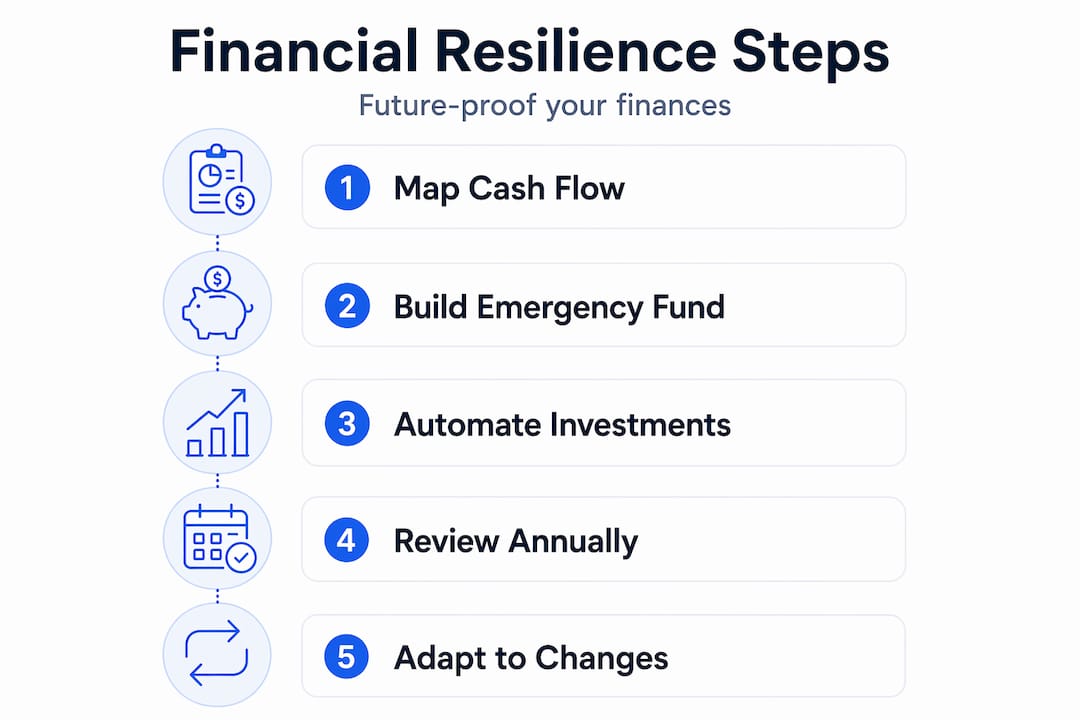
A robust future-proofing process for adults aged 30 to 55 is iterative: map cash flow, secure liquidity, automate age-appropriate investing, make tax-aware decisions, and run periodic reviews to adapt. The final step — reviews — is the one most people skip, and it is the glue that holds everything else together.
Use the financial review steps framework to structure your annual check-in so it is efficient and covers every critical area without taking an entire weekend.
Pro Tip: Schedule two financial review sessions per year — one in January to set the year’s priorities and one in October to make any tax moves before year-end. Add major life events as spontaneous triggers on top of those two anchors.
Why financial future-proofing isn’t one-and-done — what most experts miss
Most financial guides hand you a checklist and imply that completing it means you are done. Build the emergency fund. Max the 401(k). Rebalance annually. Done. But that framing is actually dangerous for adults in the 30 to 55 range, because this is the life stage where the most disruptive changes happen.
Career pivots, business ownership, eldercare responsibilities, children entering college, health events, second marriages — these are not edge cases. They are normal features of this life stage. A static financial plan built at 35 will not fit at 45, and forcing it to stretch creates hidden vulnerabilities.
Research on financial resilience frames it as a multi-level capability embedded in household resources and broader systems. That language matters. Capability is not a document — it is a living skill set that you exercise and upgrade over time.
The real gap most people have is not information. It is the absence of a feedback loop. They do their annual review, feel good about it, and then ignore their finances for another 12 months. Meanwhile, portfolio drift accumulates, tax situations shift, and new obligations quietly grow. By the time they notice, the correction is expensive.
Think of your financial plan less like a contract and more like a fitness routine. The value is not in doing it once — it is in the quarterly planning for resilience habit of checking in, adjusting, and staying engaged. People who review their finances quarterly, even briefly, catch drift early and make smaller, less stressful corrections than those who wait for a crisis to force a reckoning.
The other thing most guides underplay is behavioral adaptability. Knowing that you should rebalance is not the same as actually doing it during a bear market when every instinct tells you to wait. Building systems that execute automatically, independent of your emotional state in any given month, is the actual work of future-proofing. The best financial plan is the one your future self will actually follow under pressure.
Take your next step to resilient financial security
Understanding the steps is where clarity begins — but implementation is where financial security actually gets built. If you found this framework useful and want to go deeper on any of these areas, Finblog’s financial guides offer in-depth, expert-curated resources on everything from emergency fund sizing to retirement income sequencing. Whether you are just starting to map your cash flow or ready to optimize a well-established portfolio, there is a practical next step waiting for you. Start with the asset allocation essentials guide to make sure your investment mix is working as hard as it should for your specific timeline and goals.
Frequently asked questions
How much should I keep in my emergency fund?
Most experts recommend saving three to six months of essential living expenses, but factors like job stability and the number of dependents you support may push that emergency fund size toward nine months or more.
What if my income is unpredictable or seasonal?
Increase your cash buffer well beyond the standard recommendation and run more frequent cash flow checks, since building resilience capacity means tailoring your strategy to your actual income patterns, not an idealized average.
How often should I review my financial plan?
At minimum, review your plan once per year and immediately after any major life change, because periodic reviews to adapt to market and life shifts are what keep a plan functional rather than just theoretical.
Is it better to pay off debt or build savings first?
Build a basic emergency fund first — even one month of expenses — then split extra funds between high-interest debt repayment and savings, since prioritizing liquidity before aggressive debt payoff prevents a future shock from forcing you into more debt.
What’s the biggest mistake in future-proofing finances?
Treating future-proofing as a one-time event rather than an ongoing practice, because financial resilience is a multidimensional, continuing process that must evolve as your life and the broader economy change around you.