

TL;DR:
- Many Americans overlook that HSAs offer a triple tax advantage—contributions, growth, and withdrawals for qualified expenses are all tax-free.
- Eligibility depends on enrolling in a qualifying high-deductible health plan meeting IRS thresholds, which vary yearly and may disqualify you if you have certain other coverages.
- Maximizing contributions, investing the balance, and keeping detailed records can transform an HSA into a powerful long-term wealth-building tool beyond healthcare expenses.
Most people assume a health savings account (HSA) is either too complicated to bother with or reserved for people who are already wealthy and healthy. That assumption costs thousands of Americans real money every year. An HSA is one of the few financial tools with a genuine triple tax advantage, meaning contributions, growth, and withdrawals can all avoid taxation when used correctly. Whether you’re a salaried professional enrolled in a high-deductible health plan or a self-employed individual managing your own coverage, this guide breaks down exactly how to qualify, contribute strategically, spend wisely, and grow your balance in 2026.
Table of Contents
- What is a health savings account?
- Eligibility rules: Can you open an HSA in 2026?
- HSA contributions in 2026: How much can you save?
- Qualified medical expenses: What can you pay for?
- Growing your HSA: Investing and provider strategies
- The uncomfortable truths (and real opportunities) about HSAs
- Maximize your health and wealth: Next steps
- Frequently asked questions
Key Takeaways
| Point | Details |
|---|---|
| HSA eligibility basics | You need an HSA-qualified high-deductible health plan to open and contribute to an account. |
| 2026 contribution limits | You can contribute up to $4,400 (individual) or $8,750 (family) in 2026. |
| Qualified expenses | Only IRS-approved medical expenses can be paid tax-free with HSA funds. |
| Investing advantage | Invested HSA balances grow much faster over time than cash-only accounts. |
| Provider choice matters | Selecting an HSA provider with low fees and strong investment options boosts your long-term savings. |
What is a health savings account?
An HSA is a personal savings account that lets you set aside pre-tax dollars specifically for medical costs. It works alongside an HSA-eligible high-deductible health plan (HDHP), and the combination can significantly reduce what you pay in both premiums and taxes. As Fidelity explains, an HSA is designed to work with an HSA-eligible HDHP, and when you are eligible, contributions can be made and qualified medical expenses can be paid tax-free.
The triple tax benefit is what makes this account exceptional:
- Contributions reduce your taxable income in the year they’re made
- Investment growth inside the account is completely tax-free
- Withdrawals for qualified medical expenses are never taxed
Here’s something most people overlook: your HSA balance never disappears at year’s end. Unlike a flexible spending account (FSA), which operates on a “use it or lose it” basis, HSA funds roll over indefinitely. You could contribute today, let the balance grow for 20 years, and withdraw it tax-free in retirement to cover Medicare premiums or other medical bills.
“HSA funds are yours for life. There is no deadline to spend them, no forfeiture at the end of the year, and no loss of the balance if you switch employers or health plans.”
This permanence is what separates HSAs from most employer-sponsored benefits. It also makes avoiding retirement savings mistakes especially important, since an HSA can serve double duty as a long-term wealth-building tool.
Eligibility rules: Can you open an HSA in 2026?
Meeting the eligibility rules is the single biggest stumbling block for people who want an HSA. The core requirement is straightforward: you must be enrolled in a qualifying HDHP. However, the IRS sets specific numerical thresholds that your health plan must meet.
For 2026, IRS HDHP criteria require a minimum deductible of at least $1,700 for self-only coverage or $3,400 for family coverage, and out-of-pocket expenses must not exceed $8,500 (self-only) or $17,000 (family).
| Coverage type | Minimum deductible | Maximum out-of-pocket |
|---|---|---|
| Self-only | $1,700 | $8,500 |
| Family | $3,400 | $17,000 |
Beyond the HDHP requirement, you must also:
- Not be enrolled in Medicare (Part A or Part B)
- Not be claimed as a dependent on someone else’s tax return
- Not have other disqualifying coverage, such as a general-purpose FSA through your or your spouse’s employer
That last point trips up many dual-income couples. If your spouse has a traditional healthcare FSA through their employer, it may disqualify you from contributing to an HSA, even if you’re enrolled in an HDHP yourself. A limited-purpose FSA (which covers only dental and vision) generally does not disqualify you.
Pro Tip: Review your current health plan documents carefully before assuming you’re enrolled in an HDHP. Many PPO plans carry deductibles that seem high but still fall short of the IRS minimums, making them ineligible for HSA pairing.
Understanding these thresholds is a foundational part of any sound 2026 tax deduction strategy. Getting this wrong is one of the most common financial planning mistakes people make when switching health plans during open enrollment.
HSA contributions in 2026: How much can you save?
Once you’ve confirmed eligibility, the next priority is maximizing your annual contribution. The IRS adjusts limits each year for inflation, and 2026 brings meaningful increases.

For calendar year 2026, annual HSA contribution limits are $4,400 for self-only coverage and $8,750 for family coverage.
| Coverage type | 2026 contribution limit | Catch-up (age 55+) | Total possible |
|---|---|---|---|
| Self-only | $4,400 | +$1,000 | $5,400 |
| Family | $8,750 | +$1,000 | $9,750 |
The catch-up contribution is available to anyone who is 55 or older by the end of the tax year. If both spouses in a family plan are 55 or older, each can add $1,000, but they must hold separate HSAs to do so. That means a couple could potentially shelter up to $10,750 in pre-tax dollars in a single year.
Strategies for maximizing contributions:
- Front-load early in the year. Contributing the maximum in January rather than December gives your money more time to grow tax-free throughout the year.
- Use payroll deductions when possible. Employer payroll contributions avoid both income tax and FICA taxes (Social Security and Medicare), saving roughly an extra 7.65% compared to contributing after-tax money and claiming a deduction.
- Track your total carefully. Contributions from all sources, including employer contributions to your HSA, count toward the annual limit. Exceeding the limit triggers a 6% excise tax on the excess amount plus income tax.
- Contribute for the prior year up to tax day. Like an IRA, you can make HSA contributions for 2026 as late as April 15, 2027, giving you flexibility if your cash flow is tight mid-year.
These tax-advantaged savings strategies compound powerfully over time, especially when paired with investing your HSA balance rather than leaving it as cash.
Qualified medical expenses: What can you pay for?
Your HSA money is only tax-free on withdrawal when you spend it on qualified medical expenses. The IRS defines these broadly, but the definition has important edges worth knowing.
Under IRS Publication 969, qualified medical expenses generally must be for medical care as defined in IRC Section 213(d) for you, your spouse, or your dependents, and generally only to the extent not compensated by insurance or otherwise. Eligible amounts include menstrual care products and certain OTC medical items under IRS rules.
Common eligible expenses:
- Doctor and specialist office visits
- Prescription medications
- Dental care, including cleanings and orthodontia
- Vision care, including eye exams, glasses, and contact lenses
- Mental health therapy and psychiatric care
- Hearing aids and batteries
- Menstrual care products (added under the CARES Act)
- OTC medications such as pain relievers, allergy medicine, and antacids (no prescription required since 2020)
- COVID-19 tests and personal protective equipment used for health purposes
- Long-term care insurance premiums, up to IRS-set limits based on age
Pro Tip: Keep every receipt. If you’re audited, you’ll need to prove that each withdrawal matched a qualified expense. A simple digital folder organized by year works well and costs nothing.
What does NOT qualify:
- Gym memberships (unless prescribed for a specific medical condition)
- Cosmetic procedures
- Teeth whitening
- Health insurance premiums paid by your employer (though you can use your HSA for COBRA premiums and qualified long-term care insurance)
If you use HSA funds for a non-qualified expense before age 65, you’ll pay ordinary income tax on the amount plus a 20% penalty. After age 65, the penalty disappears, and withdrawals for any purpose are taxed like traditional IRA withdrawals. Knowing which HSA mistakes to avoid around distributions can save you a significant surprise at tax time.
Growing your HSA: Investing and provider strategies
Most people use their HSA like a checking account, depositing money and spending it within the same year. That approach wastes the account’s most powerful feature: the ability to invest and grow your balance tax-free indefinitely.
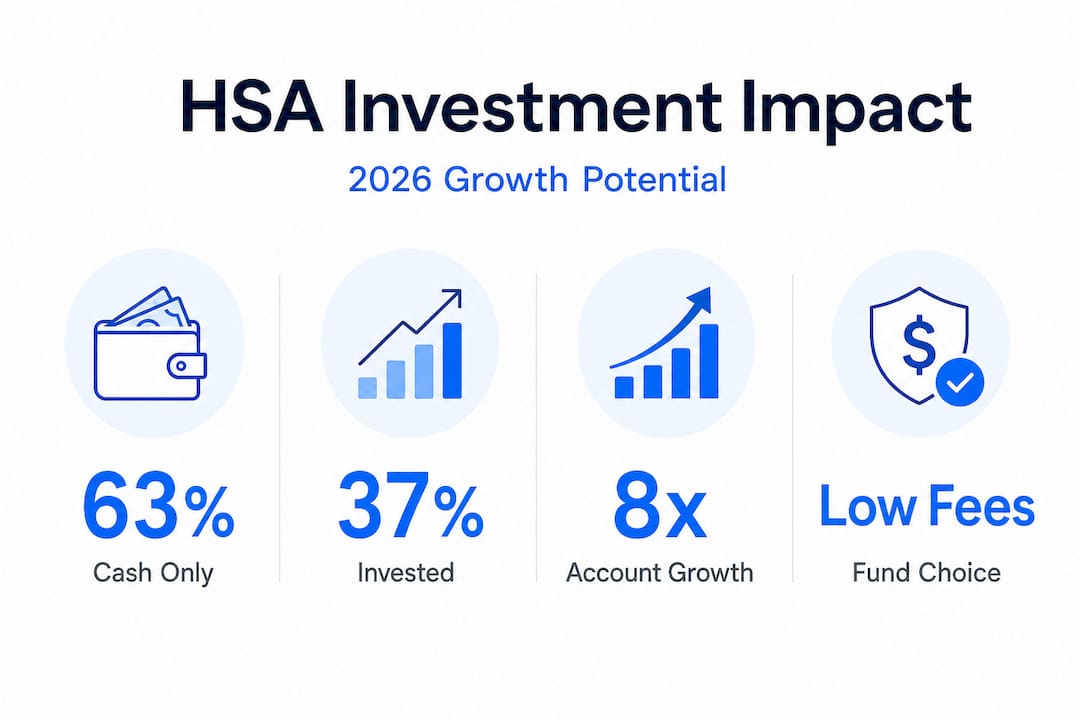
The numbers tell a striking story. According to GAO data citing Devenir estimates, as of December 31, 2022, about 63% of HSAs had balances under $1,000, including 21% that were completely unfunded. But among accounts with invested funds, the average balance in 2023 was $19,212 compared to just $2,538 for non-invested accounts.
That’s nearly an 8-to-1 difference. Investing your HSA doesn’t require complex strategies. Even a single low-cost index fund inside your HSA account can produce dramatically better outcomes than a cash balance earning minimal interest.
| Account type | Average balance (2023) |
|---|---|
| Invested HSA | $19,212 |
| Non-invested HSA | $2,538 |
Choosing the right HSA provider matters significantly. Features worth comparing include:
- Account fees. Some providers charge monthly maintenance fees that eat into your balance. For example, Fidelity’s HSA offers zero account fees and no minimum balance requirements for individuals and employers, though commissions and other expenses may apply depending on investment choices.
- Investment minimums. Some providers require a minimum cash balance (often $1,000 or $2,000) before you can invest any of your HSA funds.
- Investment options. Look for providers that offer low-cost index funds or ETFs rather than only high-expense mutual funds.
- Portability. Your HSA stays with you if you change jobs or insurance plans, but transferring between providers should be straightforward.
Comparing retirement account types alongside your HSA options helps you prioritize where each dollar works hardest. The long-term goal of retirement savings optimization often means treating the HSA as the first account to max out, before even a 401(k) in some scenarios, because its tax treatment is simply superior.
“An invested HSA is one of the few legal mechanisms where money can go in tax-free, grow tax-free, and come out tax-free—when used for qualified medical expenses at any age.”
The uncomfortable truths (and real opportunities) about HSAs
Here’s what most HSA guides won’t tell you: the biggest losses in HSA value rarely come from poor investment selection. They come from eligibility errors and off-limits withdrawals.
Many people contribute to an HSA during a period when they’re not actually eligible, perhaps because they switched to a non-qualifying plan mid-year and didn’t recalculate their contribution limit, or because their spouse’s employer FSA quietly disqualified them. The IRS has a “testing period” rule for the last-month rule that can result in a full year’s worth of contributions being treated as excess if you lose HDHP coverage before year’s end. As IRS Publication 969 details, ensuring you truly meet HDHP and HSA eligibility rules at the time of contribution, and using distributions only for qualified medical expenses under IRS definitions, are the two mechanics that most often derail otherwise sound HSA strategies.
The real opportunity that most people miss is using the HSA as a stealth retirement account. Pay for current medical expenses out of pocket, keep your receipts, and let your HSA balance grow invested for 10 or 20 years. Then, anytime after today, you can reimburse yourself for those old qualified expenses with no deadline. This strategy essentially converts your HSA into a tax-free slush fund for retirement, backed by documented medical receipts from years prior.
Record-keeping is unglamorous but essential here. A spreadsheet tracking every out-of-pocket medical expense you paid without using your HSA, along with scanned receipts, is worth keeping indefinitely. That documentation protects you and unlocks the reimbursement strategy whenever it makes the most sense financially. Avoiding investing mistakes means thinking about your HSA not as a medical expense account but as a tax-advantaged investment account that happens to allow healthcare spending.
Every year spent treating your HSA as a “spend it as you need it” account is a year of compounding growth permanently lost. This is the most underappreciated truth in personal finance for working professionals with access to an HDHP.
Maximize your health and wealth: Next steps
You now have the framework to make your HSA work far harder than most Americans ever allow theirs to. But eligibility rules, contribution timing, and investment provider decisions all require ongoing attention as your financial situation evolves. At Finblog, we publish expert guides covering tax-advantaged accounts, strategic investing, and retirement planning designed for financially engaged professionals like you. Whether you want to sharpen your 2026 contribution strategy or build a long-term investment plan that incorporates your HSA as a core vehicle, our resources are updated regularly to reflect current IRS guidance and market conditions. Start exploring and put your healthcare dollars to work building lasting wealth.
Frequently asked questions
Who is eligible for a health savings account in 2026?
You must be enrolled in an HSA-eligible HDHP that meets the IRS’s 2026 thresholds, with a deductible of at least $1,700 (self-only) or $3,400 (family) and out-of-pocket limits not exceeding $8,500 or $17,000 respectively. You also cannot be on Medicare or claimed as a dependent.
What are the 2026 HSA contribution limits?
For 2026, you can contribute up to $4,400 for self-only coverage or $8,750 for family coverage, per IRS Revenue Procedure 2025-19. Those aged 55 and older can add an extra $1,000 as a catch-up contribution.
What medical expenses can I pay with my HSA?
You can pay for a broad range of costs including doctor visits, prescriptions, dental and vision care, and certain OTC items like menstrual products and medications. Expenses must not have been reimbursed by insurance to qualify.
Do HSA balances carry over year to year?
Yes. Unlike FSAs, HSA funds roll over indefinitely with no expiration. As Fidelity notes, your balance remains yours even if you change jobs, switch health plans, or retire.
Can I invest my HSA funds, and why should I?
Yes, most providers allow you to invest your HSA balance in mutual funds, ETFs, or other vehicles. GAO data shows that in 2023 the average invested HSA balance was $19,212 compared to just $2,538 for non-invested accounts, illustrating the dramatic compounding advantage of putting your balance to work.