Most American investors face a greater risk of underperforming in volatile markets when relying only on static portfolio strategies. As global uncertainty grows, the ability to adjust asset allocation swiftly is no longer just an advantage—it is essential for long-term success. This overview reveals how dynamic asset allocation empowers wealth managers and high-net-worth individuals to maintain control and target higher returns by strategically rebalancing investments in response to evolving risks and opportunities.
Table of Contents
- Defining Dynamic Asset Allocation In Practice
- Types Of Dynamic Asset Allocation Strategies
- Core Steps: Portfolio Construction And Adjustment
- Benefits And Limitations For Wealth Managers
- Key Risks And Common Pitfalls To Avoid
Key Takeaways
| Point | Details |
|---|---|
| Dynamic Asset Allocation | This strategy allows active adjustments to portfolios based on market conditions and personal financial goals, promoting a balanced risk-return profile. |
| Key Strategies | Notable approaches include Glide Path, Risk Parity, Tactical Asset Allocation, and Constant-Weighting, each targeting different investment needs and market conditions. |
| Advantages for Wealth Managers | Provides enhanced risk management and potential for higher returns, but demands robust technology and deep market understanding for successful implementation. |
| Risks and Pitfalls | Investors must be aware of liquidity constraints and the danger of overreacting to market fluctuations to optimize performance and mitigate risks effectively. |
Defining Dynamic Asset Allocation In Practice
Dynamic asset allocation represents a sophisticated investment strategy that moves beyond traditional static portfolio management. Unlike fixed investment approaches, this method allows investors to actively adjust their portfolio composition in response to changing market conditions and personal financial objectives.
At its core, dynamic asset allocation involves systematically reallocating investment assets to maintain an optimal risk-return balance. Researchers have demonstrated that these strategies can adapt portfolio exposures over time based on an investor’s evolving risk profile and retirement goals. Specifically, this approach enables tactical shifts that help secure target retirement incomes without relying exclusively on precise market performance predictions.
The practical implementation of dynamic asset allocation typically involves several key mechanisms:
- Periodic Rebalancing: Regularly adjusting portfolio weights to maintain desired asset class proportions
- Risk Profile Monitoring: Continuously evaluating an investor’s changing risk tolerance and financial circumstances
- Market Condition Assessment: Making strategic shifts in response to macroeconomic trends and potential investment opportunities
- Goal-Oriented Adjustments: Aligning portfolio composition with specific long-term financial objectives
Successful dynamic asset allocation requires sophisticated analytical tools, disciplined execution, and a nuanced understanding of market dynamics. Investors must remain flexible while maintaining a structured approach to portfolio management.
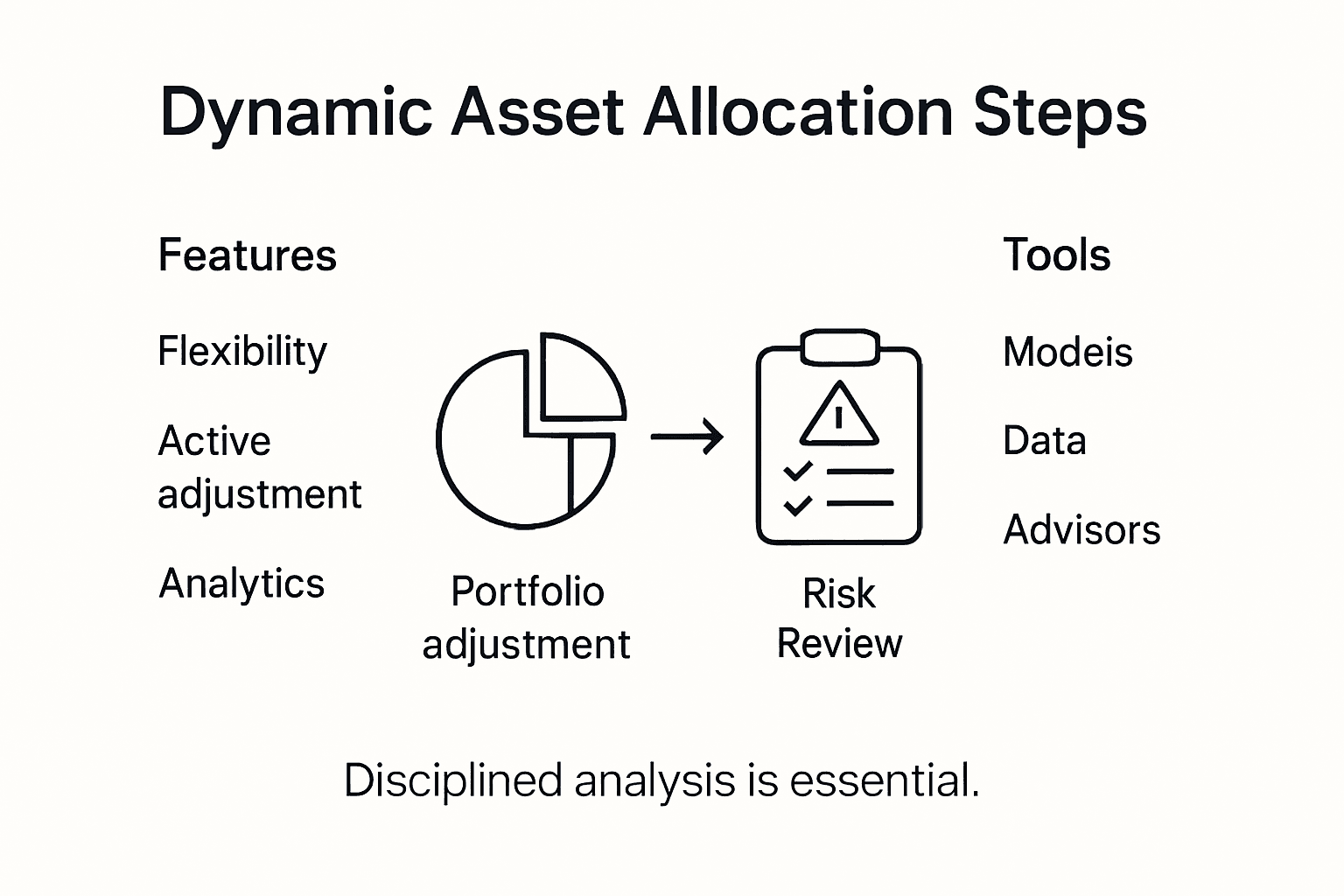
Here is a comparison of dynamic and static asset allocation approaches:
| Feature | Dynamic Asset Allocation | Static Asset Allocation |
|---|---|---|
| Flexibility | Adjusts based on market shifts | Fixed allocations over time |
| Risk Management | Responds to changing risk profiles | Maintains original risk exposure |
| Monitoring Needs | Requires continuous oversight | Periodic review sufficient |
| Typical Users | Active investors, wealth managers | Passive or long-term investors |
| Complexity | High—needs advanced analytics | Low—simple to implement |
Pro Tip: Consider working with a financial advisor who specializes in dynamic asset allocation strategies to develop a personalized investment approach tailored to your specific financial goals and risk tolerance.
Types Of Dynamic Asset Allocation Strategies
Dynamic asset allocation encompasses multiple strategic approaches that enable investors to adapt their portfolios to changing market conditions. These strategies offer sophisticated methods for managing investment risk and optimizing returns across different economic environments.
Research on Target Date Funds reveals several prominent types of dynamic asset allocation strategies, each designed to address unique investor needs:
- Glide Path Strategy
- Systematically reduces exposure to risky assets as investors approach retirement
- Automatically adjusts asset allocation based on age and risk tolerance
- Provides progressive risk management over an investment lifecycle
- Risk Parity Approach
- Balances portfolio risk across different asset classes
- Allocates investments to equalize potential volatility
- Uses leverage and diversification to optimize risk-adjusted returns
- Tactical Asset Allocation
- Allows short-term adjustments based on market predictions
- Enables quick responses to emerging economic trends
- Requires active management and continuous market analysis
- Constant-Weighting Strategy
- Maintains predetermined asset class proportions
- Automatically rebalances when asset values deviate from target allocations
- Provides disciplined approach to portfolio management
Successful implementation of these strategies demands deep market understanding, disciplined execution, and continuous monitoring of economic indicators.
Pro Tip: Consider consulting a professional financial advisor to design a dynamic asset allocation strategy that precisely matches your individual investment goals and risk profile.
Core Steps: Portfolio Construction And Adjustment
Portfolio construction represents the foundational process of creating an investment strategy that balances risk, return, and individual financial objectives. When developing a dynamic asset allocation approach, investors must carefully navigate multiple strategic considerations to build a robust and adaptable investment framework.
Investors seeking to build a comprehensive investment portfolio typically follow a structured approach that involves several critical steps:
- Initial Portfolio Assessment
- Evaluate current financial position
- Determine risk tolerance
- Establish clear investment goals
- Analyze existing asset allocations
- Strategic Asset Allocation
- Select appropriate asset classes
- Determine target allocation percentages
- Consider correlation between different assets
- Create a baseline portfolio structure
- Risk Management Framework
- Implement diversification strategies
- Set risk mitigation protocols
- Establish portfolio rebalancing triggers
- Define maximum loss thresholds
- Continuous Monitoring and Adjustment
- Track portfolio performance regularly
- Analyze macroeconomic indicators
- Identify potential rebalancing opportunities
- Adjust allocations based on changing market conditions
Successful portfolio construction requires a disciplined approach that combines systematic analysis with flexibility. Investors must remain vigilant and prepared to make calculated adjustments as market dynamics evolve.

Pro Tip: Develop a comprehensive investment policy statement that outlines your specific allocation strategy, rebalancing rules, and performance benchmarks to maintain consistent and objective portfolio management.
Benefits And Limitations For Wealth Managers
Dynamic asset allocation represents a sophisticated approach that offers wealth managers powerful tools for optimizing client investment strategies. By enabling more flexible and responsive portfolio management, this strategy introduces both significant advantages and notable challenges for financial professionals.
Research from wealth management studies reveals that dynamic asset allocation provides wealth managers with unprecedented flexibility in aligning portfolios with evolving client goals. The key benefits include:
-
Enhanced Risk Management
-
Ability to adjust portfolio risk exposure dynamically
-
Reduce potential downside during market volatility
-
Maintain alignment with client’s changing risk tolerance
-
Performance Optimization
-
Potentially higher returns compared to static allocation models
-
Faster response to market opportunities
-
More precise targeting of investment objectives
Limitations and Challenges require careful consideration:
- Increased complexity of portfolio management
- Higher operational and monitoring costs
- Potential misalignment with client expectations
- Sophisticated technological infrastructure requirements
Wealth managers must balance the strategic advantages of dynamic asset allocation against its inherent complexities. Successful implementation demands robust technological capabilities, deep market understanding, and exceptional client communication skills.
Pro Tip: Develop comprehensive client education programs that transparently explain dynamic asset allocation strategies to build trust and manage expectations effectively.
Key Risks And Common Pitfalls To Avoid
Dynamic asset allocation demands sophisticated risk management strategies to navigate the complex landscape of investment challenges. Understanding potential pitfalls is crucial for investors seeking to optimize their portfolio performance while minimizing unexpected negative outcomes.
Research on investment complexities reveals several critical risks inherent in dynamic asset allocation strategies:
Primary Risks to Consider:
-
Liquidity Constraints
- Challenges in quickly converting private assets
- Potential transaction costs during rebalancing
- Reduced flexibility during market stress
-
Performance Misinterpretation
- Serial correlation can distort return perceptions
- Risk of overestimating strategy effectiveness
- Potential confirmation bias in investment decisions
Common Pitfalls in Dynamic Asset Allocation:
- Overreacting to short-term market fluctuations
- Neglecting comprehensive risk assessment
- Insufficient technological infrastructure
- Poor understanding of correlation between asset classes
- Inadequate risk modeling techniques
Investors must develop robust risk management frameworks that account for market complexity, technological limitations, and inherent strategic uncertainties. Successful implementation requires continuous learning, adaptive strategies, and a disciplined approach to portfolio management.
The following table summarizes the main risks and pitfalls in dynamic asset allocation:
| Risk/Pitfall | Description (Why It Matters) | Mitigation Approach |
|---|---|---|
| Liquidity Constraints | Hard to quickly sell some assets | Maintain cash reserves |
| Performance Misinterpretation | Misjudging strategy effectiveness | Use objective benchmarks |
| Overreacting to Fluctuations | Hasty changes based on short-term moves | Focus on long-term trends |
| Technology Shortfalls | Insufficient tools for monitoring | Invest in robust platforms |
Pro Tip: Implement rigorous stress testing and scenario analysis to identify potential vulnerabilities in your dynamic asset allocation strategy before full deployment.
Master Dynamic Asset Allocation in Volatile Markets
Navigating volatile markets requires more than a static investment approach. You need strategies that adjust risk exposure, respond to shifting economic trends, and align with your evolving financial goals. This article highlights the real challenges investors face with liquidity constraints, performance misinterpretation, and the need for continuous oversight in dynamic asset allocation. If maintaining an optimal risk-return balance while avoiding costly pitfalls resonates with you, it is time to deepen your understanding and refine your portfolio management techniques.
Discover expert insights and personalized guidance at finblog.com where you can access comprehensive resources on portfolio construction and risk management. Take advantage of tailored financial advice designed to help you implement dynamic asset allocation confidently. Don’t wait for market conditions to dictate your success. Visit finblog.com now to start building a resilient investment strategy that adapts as your goals and the market evolve.
Frequently Asked Questions
What is dynamic asset allocation?
Dynamic asset allocation is an investment strategy that allows investors to adjust their portfolio composition actively in response to changing market conditions and personal financial objectives.
How does dynamic asset allocation differ from static asset allocation?
Dynamic asset allocation is flexible and adjusts based on market shifts, while static asset allocation maintains fixed allocations over time, regardless of market conditions.
What are some common types of dynamic asset allocation strategies?
Common types include Glide Path Strategy, Risk Parity Approach, Tactical Asset Allocation, and Constant-Weighting Strategy, each offering unique methods for managing investment risk and returns.
What risks are associated with dynamic asset allocation?
Key risks include liquidity constraints, performance misinterpretation, and the potential for overreacting to short-term market fluctuations. A robust risk management framework is essential to mitigate these issues.