

TL;DR:
- Many professionals have insufficient retirement savings by their 40s due to overlooked planning.
- Consistent, strategic contributions and annual reviews are key to closing savings gaps.
- Prioritizing tax-efficient investing and flexible strategies enhances long-term retirement security.
Most working professionals hit their 40s and realize, with a jolt, that their retirement savings look nothing like they imagined. You’ve been busy building your career, raising a family, and managing life. But the math doesn’t care about your schedule. According to Fidelity’s retirement guidelines, you should aim to save 15% of your income annually, including any employer match, and have 10 times your salary saved by age 67. If those numbers feel out of reach right now, you’re not alone. The good news is that a structured, step-by-step approach can close the gap faster than you think.
Table of Contents
- Assessing your retirement goals and current gaps
- Maximizing contributions: 401(k), IRA, and beyond
- Smart investing: asset allocation by age and risk
- Advanced optimization: reducing taxes, boosting returns
- Verification: tracking progress and troubleshooting common pitfalls
- The surprising truth: why steady optimization wins over chasing retirement fads
- Accelerate your retirement journey with expert guidance
- Frequently asked questions
Key Takeaways
| Point | Details |
|---|---|
| Set clear benchmarks | Use salary-based benchmarks to track your retirement savings progress at each age. |
| Maximize contributions | Make the most of 401(k), IRA, and catch-up contributions to build tax-advantaged wealth. |
| Invest wisely by age | Align your asset allocation to your risk tolerance and time horizon using proven frameworks. |
| Use advanced tax strategies | Implement asset location and dynamic withdrawals for greater long-term returns and efficiency. |
| Review and adjust regularly | Monitor your progress annually, correct mistakes, and adapt as your career and life evolve. |
Assessing your retirement goals and current gaps
Before taking action, you need to know your destination and where you’re starting from. Retirement planning without a clear target is like driving cross-country without a map. You might get somewhere, but probably not where you intended.
Start by defining two things: your target retirement age and the lifestyle you want. Do you plan to travel frequently? Downsize your home? Support adult children? These choices directly affect how much you need to accumulate. A good rule of thumb is that you’ll need 70 to 90 percent of your pre-retirement income each year in retirement.
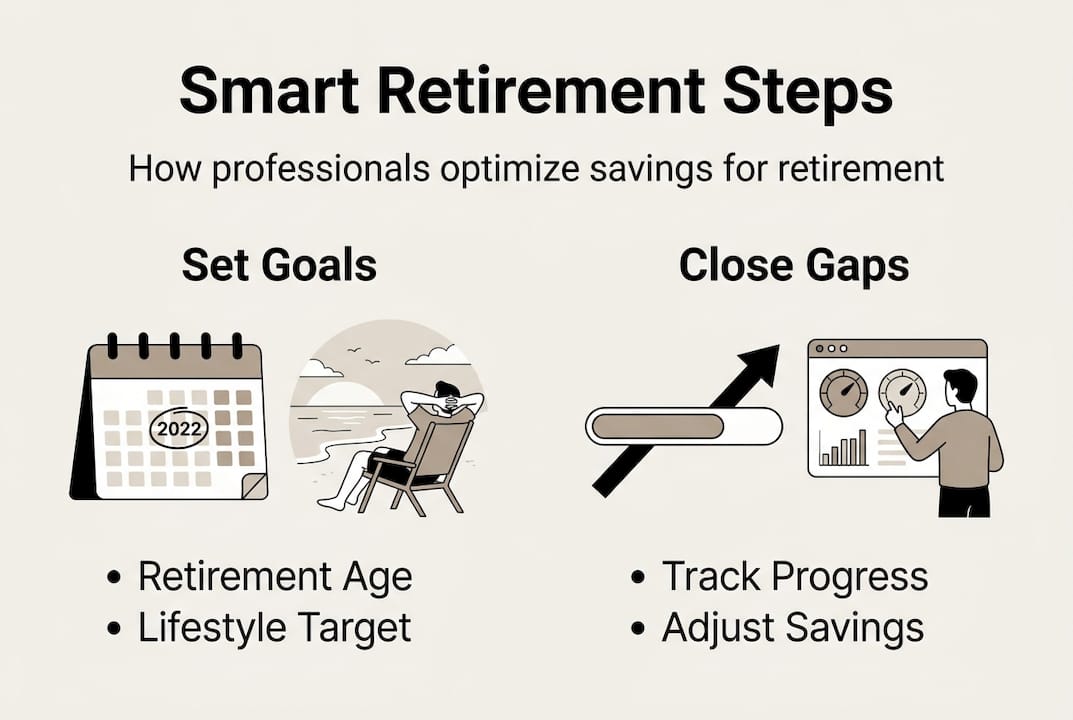
Once you have a target, compare it to where you stand today using salary-based benchmarks. Fidelity recommends saving 1x your salary by 30, 3x by 40, 6x by 50, and 8x by 60. These aren’t arbitrary numbers. They’re based on historical market returns and typical spending patterns.
Here’s how the benchmarks stack up against reality:
| Age | Fidelity benchmark | Typical median savings |
|---|---|---|
| 30 | 1x salary | ~$14,000 |
| 40 | 3x salary | ~$45,000 |
| 50 | 6x salary | ~$87,000 |
| 60 | 8x salary | ~$112,000 |
The gap is real. Average median savings for those aged 30 to 39 hover around $45,000, well below the 3x benchmark for someone earning even a modest salary. Knowing your gap is the first step toward closing it.
To run a simple gap analysis, subtract your current savings from your target number. Then use a compound interest calculator to estimate how much you need to contribute monthly to bridge that gap by your target retirement age. This exercise alone can shift your mindset from passive to purposeful. For a deeper look at your account options, explore this retirement accounts comparison to understand which vehicles fit your situation best.
Maximizing contributions: 401(k), IRA, and beyond
With your savings goals set, the next step is to make the most of every available vehicle. The IRS sets annual limits on how much you can contribute to tax-advantaged accounts, and most professionals leave significant money on the table by not using the full space available.
For 2026, the 401(k) elective deferral limit is $24,500 for those under 50. If you’re 50 or older, you can add a catch-up contribution of $8,000. If you’re between 60 and 63, a special super catch-up of $11,250 applies, bringing your potential total annual additions to $72,000 when including employer contributions.
On the IRA side, the 2026 IRA contribution limit is $7,500 for those under 50, with a $1,100 catch-up for those 50 and older. Roth IRA eligibility phases out for single filers earning between $153,000 and $168,000, and for joint filers between $242,000 and $252,000.
Here’s the smart prioritization order recommended by financial planners:
- Contribute enough to your 401(k) to capture the full employer match (free money, always first)
- Fund a Roth IRA up to the annual limit if you’re eligible
- Max out your 401(k) contributions
- Contribute to a Health Savings Account (HSA) if you have a high-deductible health plan
- Invest additional savings in a taxable brokerage account
For high earners above the Roth IRA income limits, the backdoor Roth strategy is a powerful workaround. You contribute to a traditional IRA (non-deductible) and then convert it to a Roth. The mega backdoor Roth, available through certain 401(k) plans, can push even more after-tax dollars into Roth accounts.
Pro Tip: If your employer offers a 401(k) match and you’re not contributing enough to capture it fully, you’re effectively taking a pay cut. Prioritize this above everything else, even debt payoff in most cases.
For a full breakdown of how these accounts interact, check out this guide on tax-advantaged accounts and this 401k vs IRA comparison to sharpen your strategy. If you’re unsure about Roth versus traditional, this Traditional vs Roth IRA guide lays out the long-term tradeoffs clearly.
Smart investing: asset allocation by age and risk
After maximizing contributions, make sure your investments are working efficiently for your timeline and appetite for risk. Saving is only half the equation. How you invest those savings determines whether they grow fast enough to meet your goals.

The classic starting point is the 100-minus-age rule. Subtract your age from 100 to get your target stock allocation. At 30, that means roughly 70 percent stocks and 30 percent bonds. At 50, it shifts to 50/50. Many modern advisors now use 110 or 120 minus age to account for longer life expectancies, meaning more equity exposure for longer.
Here’s a practical breakdown by decade:
- In your 20s and 30s: 80 to 100 percent stocks is appropriate. Time is your biggest asset. Volatility is your friend because you have decades to recover.
- In your 40s: Shift to 70 to 80 percent stocks. Start adding more bonds and international diversification.
- In your 50s: Move toward 60 to 70 percent stocks. Sequence-of-returns risk (the danger of a market crash right before retirement) becomes more relevant.
- Approaching retirement: Consider a 50/50 or more conservative mix, depending on your income sources like pensions or Social Security.
Low-cost index funds and target-date funds are two of the most powerful tools available to everyday investors. Index funds track broad market benchmarks with minimal fees. Target-date funds automatically rebalance your allocation as you age, making them a solid hands-off option.
Pro Tip: Rebalance your portfolio at least once a year or whenever your allocation drifts more than 5 percentage points from your target. This forces you to buy low and sell high systematically.
For more on why consistent investing matters, read why invest for retirement and explore retirement age planning to align your investments with your timeline.
Advanced optimization: reducing taxes, boosting returns
Once your investments are in place, next-level tactics can help you keep more of your gains and pay less tax. This is where many professionals leave the most money behind.
Tax-efficient asset location is one of the most underused strategies. The idea is simple: place assets that generate the most taxable income (like bonds and REITs) inside tax-deferred accounts, and hold growth assets (like stocks) inside Roth accounts for tax-free growth. This single adjustment can add meaningfully to your after-tax wealth over decades.
Key advanced tactics include:
- Roth conversion ladders: Convert traditional IRA funds to Roth over several years to reduce future required minimum distributions (RMDs) and create tax-free income in retirement.
- Dynamic withdrawal strategies: Rather than rigidly following the 4% rule, adjust withdrawals based on portfolio performance each year. This approach, sometimes called guardrails, extends portfolio longevity significantly.
- Mega backdoor Roth: For those with eligible 401(k) plans, you can contribute up to roughly $47,000 in after-tax dollars and convert them to Roth for tax-free growth, even if you’re above Roth IRA income limits.
“Tax-efficient asset location combined with dynamic withdrawal strategies can add years of income to a retirement portfolio compared to a rigid, one-size-fits-all approach.”
For high earners, mandatory Roth catch-ups apply if your wages exceed $150,000. This means your catch-up contributions must go into a Roth account rather than a traditional pre-tax account, which is actually a long-term benefit despite the short-term tax hit.
Pro Tip: Poor asset location is one of the costliest and least visible mistakes in retirement planning. Run through your account holdings and ask whether each asset type is in the most tax-efficient wrapper.
For deeper reading, explore tax-efficient investing and review proven withdrawal strategies to protect your income stream in retirement.
Verification: tracking progress and troubleshooting common pitfalls
All strategies require regular checkups and quick pivots if conditions change. Building a retirement plan is not a one-time event. It’s a living system that needs attention.
Here’s a practical review schedule:
- Annually: Review your savings rate, account balances, and investment allocation. Compare against your age-based benchmarks.
- After a raise or bonus: Increase your contribution rate immediately. Lifestyle creep, where spending rises with income, is one of the biggest threats to retirement savings.
- After major life events: Marriage, divorce, a new child, or a job change all warrant a full strategy review.
- Every 5 years: Reassess your retirement age and lifestyle assumptions. Goals evolve, and your plan should too.
Automation is your best friend here. Starting at $200 per month at age 22 and investing at a 7 percent average annual return can grow to over $525,000 by age 62. Delay that start by even five years and the outcome drops sharply. Set up automatic contribution increases tied to your annual review.
On the topic of trends, the FIRE movement (Financial Independence, Retire Early) has attracted a lot of attention. Saving 50 to 70 percent of your income and retiring on 25 times your annual expenses sounds appealing. But FIRE carries real risks: healthcare costs before Medicare eligibility, sequence-of-returns risk in early retirement, and the challenge of sustaining a 4 percent withdrawal rate for 40 or more years. Coast FIRE, in particular, has been criticized for relying on too many uncertain variables.
If you’re behind on savings, focus on saving on taxes to free up more cash, then redirect those savings directly into your retirement accounts.
The surprising truth: why steady optimization wins over chasing retirement fads
With all the tactics laid out, it’s worth looking deeper at what truly drives long-term retirement success. And the answer might surprise you: it’s not the cleverest strategy or the most aggressive savings rate. It’s consistency and adaptability.
We’ve watched professionals chase FIRE targets, only to burn out or face unexpected medical bills that derail the plan entirely. Others lock into the rigid 4% rule and panic when markets drop. The research is clear that dynamic guardrails outperform fixed withdrawal rates for long-term portfolio longevity.
The professionals who retire comfortably aren’t necessarily the highest earners. They’re the ones who automate their savings, review their plan annually, and make small adjustments rather than dramatic overhauls. They treat retirement planning like a career skill, something you get better at over time, not a one-time decision.
Your retirement plan should fit your life, not a generic template. Adjust your allocation as your career evolves. Increase contributions when income rises. Revisit your goals when your family situation changes. That kind of disciplined, personalized optimization is what builds lasting financial security, not chasing the next big retirement trend.
Accelerate your retirement journey with expert guidance
Now that you understand the path, here’s how you can access extra help and go further. At Finblog, we’ve built a library of practical, research-backed resources designed specifically for working professionals who want to take retirement savings seriously. Whether you’re just starting to close a savings gap or fine-tuning an advanced Roth conversion strategy, our guides meet you where you are. Start with our detailed breakdown of tax-advantaged strategies to immediately identify opportunities you may be missing. Every step you take today compounds into real financial freedom tomorrow. Don’t wait for the perfect moment. Start optimizing now.
Frequently asked questions
How much should I save for retirement by age 40?
Experts recommend having at least three times your annual salary saved by age 40. If you earn $80,000, your target balance at 40 is $240,000.
What are the new 401(k) and IRA contribution limits for 2026?
For 2026, the 401(k) limit is $24,500 for those under 50, with catch-up options for older workers. The IRA limit is $7,500, with phase-outs beginning at $153,000 for single Roth IRA filers.
What’s the most effective savings strategy for high-income professionals?
Maximize your employer 401(k) match first, then fund a Roth IRA if eligible. High earners above income limits should use backdoor or mega backdoor Roth strategies to access tax-free growth.
Is the FIRE movement a safe approach to retirement?
FIRE carries significant risks including healthcare cost uncertainty, sequence-of-returns risk, and the challenge of sustaining withdrawals for 40-plus years. Most experts recommend building in flexibility rather than relying on rigid formulas.
How often should I re-evaluate my retirement strategy?
Review your retirement plan annually and after any major income or life change. Small, regular adjustments are far more effective than infrequent dramatic overhauls.