


Donald Trump’s diesel deal with Vladimir Putin offers sanctions relief to bring more Russian fuel onto global markets, but the promised supplies may provide only limited relief from high prices.
The agreement, announced on October 9, comes as expensive diesel raises costs for truckers, farmers and businesses ahead of the November 3 US midterm elections.
What Russia has promised
According to Reuters’ explainer, Trump announced three stages of deliveries:
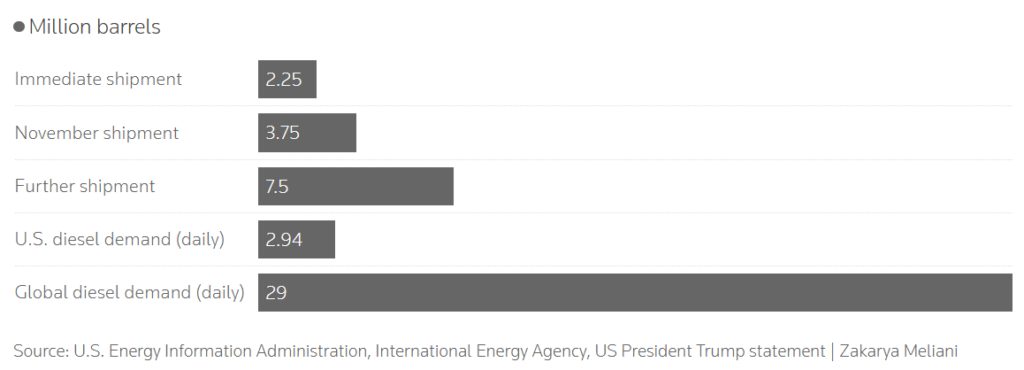
- More than 300,000 metric tons immediately, equivalent to about 2.25 million barrels.
- Another 500,000 tons in November.
- A further 1 million tons shortly afterward.
Washington temporarily eased sanctions on Russian diesel, while Moscow partially lifted its own export restrictions.
Why the price impact could be limited
The initial shipment represents less than one day of diesel consumption by the US transport sector alone.
Additional supplies could ease market pressure, but deliveries depend on refinery operations and access to ships. Ukrainian attacks have damaged Russian refining capacity, while sanctions on tankers complicate transportation.
The broader shortage also reflects disruption to supplies from Gulf producers during the Iran war. Russian exports alone cannot resolve those constraints.
Related: Rising Fuel Costs Reshape Politics as Voters Demand Relief.
What about the energy ceasefire?
Trump also announced a halt to attacks on energy infrastructure. However, the scope and implementation remained unsettled, with the Kremlin saying on October 12 that discussions were continuing.
Separately, Reuters reported that US envoys presented the diesel arrangement to Ukrainian officials as an incentive to bring Moscow back to peace negotiations.
Critics, including Ukrainian officials and some US lawmakers, argue that sanctions relief gives Russia additional revenue without securing sufficient concessions.
The deal’s practical test is whether it produces sustained additional deliveries. Announced volumes and sanctions relief do not automatically translate into a lasting reduction in fuel prices.
Disclosure: This article does not represent investment advice. The content is for informational and educational purposes only.