
TL;DR:
- Regular rebalancing realigns your portfolio to its original target, preventing risk from market-driven drift. It also enforces disciplined, emotion-free investment habits that enhance long-term wealth preservation. Most investors benefit from annual rebalancing combined with strategic use of new contributions and tax-advantaged accounts.
Most investors know they should diversify. Far fewer realize that a portfolio you set up years ago is probably nothing like the portfolio you have today. That’s where rebalancing comes in. What is rebalancing, exactly? It’s the process of realigning your portfolio back to its original target allocation after market movements have shifted the weights of your holdings. Without it, a well-thought-out investment plan quietly drifts into something riskier and less intentional, often without the investor ever noticing.
Table of Contents
- Key takeaways
- What is portfolio drift and why it matters
- Rebalancing strategies explained
- The benefits of rebalancing go beyond risk control
- How to rebalance a portfolio in practice
- Rebalancing challenges in today’s market
- My take on the real value of rebalancing
- Build your investing knowledge with Finblog
- FAQ
Key takeaways
| Point | Details |
|---|---|
| Rebalancing restores your plan | It brings your portfolio back to the original allocation after market drift changes asset weights. |
| Drift increases hidden risk | Strong equity growth can silently push your stock exposure far beyond your intended risk tolerance. |
| Annual rebalancing suits most investors | Quarterly rebalancing is typically unnecessary and adds costs without proportional benefit. |
| New contributions can do the work | Directing fresh capital toward underweight assets reduces the need to sell and avoids tax events. |
| Discipline beats timing | Consistent rebalancing builds behavioral habits that protect you from emotional investing mistakes. |
What is portfolio drift and why it matters
Before you can appreciate rebalancing, you need to understand what it’s correcting. Portfolio drift happens when different assets grow at different rates, which they always do, and your actual allocation slowly diverges from your target.
Here’s a concrete example. You start with a classic 60% stocks and 40% bonds portfolio. Stocks have a strong three-year run. Without any action, your portfolio might now look closer to 75% stocks and 25% bonds. On paper, your wealth has grown. In practice, your risk exposure has shifted significantly, and you’re now carrying far more equity risk than you intended when you built your plan.
The effects of drift are not just theoretical. Consider what can happen:
- Higher volatility exposure. A stock-heavy portfolio experiences wider swings, which can be psychologically damaging in a downturn.
- Correlation breakdown. Bonds exist in your portfolio partly as a cushion against equity losses. When bonds shrink as a share of your holdings, that cushion shrinks too.
- Sector concentration risk. If a specific sector drove that stock growth, say technology, you may now be heavily concentrated in one area of the market.
- Misalignment with your timeline. An investor five years from retirement with a 75/25 portfolio is taking on risk they likely cannot afford to recover from.
Portfolios tend to become stock-heavy in prolonged bull markets when left unmanaged, which dramatically increases risk and volatility at exactly the moment when preservation starts to matter.
Rebalancing strategies explained
Portfolio rebalancing is the deliberate process of buying and selling assets to restore your intended allocation. The rebalancing meaning in finance is straightforward: you sell what has grown beyond its target weight and use those proceeds to buy what has fallen below it.
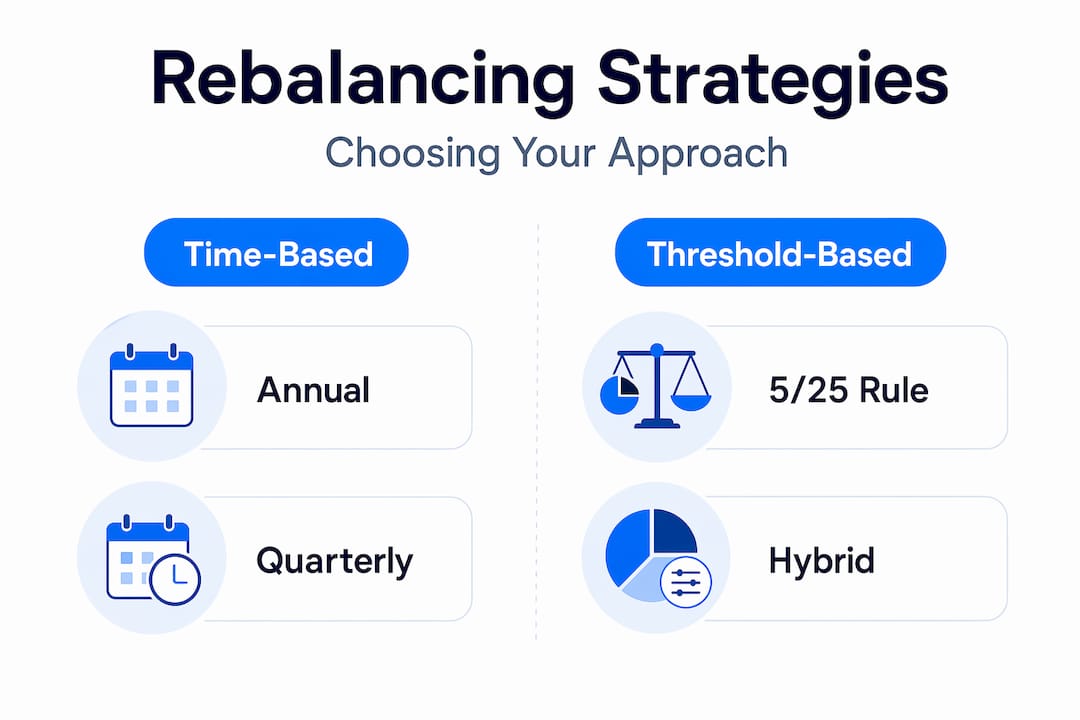
There are three main approaches, each with real trade-offs.
| Strategy | How it works | Best for | Key drawback |
|---|---|---|---|
| Time-based | Rebalance on a fixed schedule (annually, quarterly) | Most individual investors | May miss large drift events between check-ins |
| Threshold-based | Rebalance when an asset drifts by a set percentage | Hands-on investors | Requires active monitoring |
| Hybrid | Combine a schedule with a drift trigger | Experienced investors | More complex to manage |
Annual rebalancing is recommended for most individual investors. Quarterly rebalancing is generally unnecessary and adds transaction costs and tax drag without meaningful benefit to your risk profile.
The threshold approach has a well-known professional variant called the 5/25 rule. This means you rebalance when an asset class drifts by 5 percentage points or 25% relative to its target, whichever comes first. So if your target equity allocation is 60%, you would rebalance when it crosses 65% or drops below 45%. This heuristic prevents unnecessary trading while keeping your risk exposure in check.
The hybrid approach is arguably the most practical for investors who want both discipline and responsiveness. You check your portfolio annually, but you also set a drift threshold that would prompt you to act between scheduled reviews. You get structure without rigidity.
Pro Tip: If you’re managing a smaller portfolio, stick to annual rebalancing. The cost savings alone are worth it. Larger portfolios with multiple asset classes and taxable accounts can benefit from a threshold trigger layered on top.
The benefits of rebalancing go beyond risk control
Most explanations of why you should rebalance focus on risk management. That part is real, but it’s only half the story.
The deeper benefit is behavioral. Rebalancing enforces a disciplined “sell high, buy low” behavior that most investors struggle to execute on instinct. Buying more of an asset that has underperformed feels uncomfortable. Selling an asset that is on a hot streak feels counterintuitive. Rebalancing turns both of those uncomfortable moves into a systematic process, removing emotion from the equation.
“The psychological benefit of rebalancing is often greater than the mathematical one. It keeps investors in the market, following a plan, rather than reacting to headlines.” — Adapted from portfolio rebalancing research
There’s also the diversification angle. Restoring original allocations protects against overexposure to a single asset class, which is the core purpose of diversification. Many investors believe they are diversified because they own multiple assets, but if one asset has grown to dominate the portfolio, the diversification benefit has eroded.
Understanding the psychology of investing helps explain why rebalancing matters beyond numbers. Investors who rebalance consistently are less likely to panic-sell during corrections, because their plan already accounts for market swings as an expected part of portfolio management rather than an emergency.

Rebalancing also modestly improves risk-adjusted returns over long periods. During a bull market, selling equities to rebalance may slightly reduce absolute gains, but it significantly reduces risk exposure that could threaten long-term wealth preservation. The goal of investing is not to maximize returns in any single year. It’s to build sustainable wealth over decades.
How to rebalance a portfolio in practice
Knowing what rebalancing is and actually doing it are two different things. Here is a practical process for implementing it.
- Calculate your current allocation. Log into your accounts and add up the current value of each asset class. Divide each by your total portfolio value to get the current percentage weight.
- Compare to your target allocation. Write down what your target percentages are. Identify which assets are overweight and which are underweight.
- Decide how to close the gap. You have two tools: selling overweight assets to buy underweight ones, or directing new contributions toward underweight assets.
- Prioritize new contributions first. Directing new capital toward underweight assets avoids transaction costs and taxable events, making it the lowest-friction approach available.
- Handle taxable accounts carefully. In taxable brokerage accounts, selling appreciated assets triggers capital gains tax. Prioritize rebalancing inside tax-advantaged accounts like 401(k)s and IRAs where possible.
- Execute the trades. Place your buy and sell orders. Keep records for tax purposes.
Pro Tip: Tax-loss harvesting during rebalancing can offset some of the capital gains from selling winners. If you’re selling an overweight position in a taxable account, look for positions in the same asset class that are sitting at a loss, and sell those too to reduce your tax bill.
Tax considerations are critical in taxable accounts. Capital gains from rebalancing sales can erode returns if not managed thoughtfully. Tax-advantaged accounts should be your first choice for rebalancing activity wherever your asset allocation allows it.
For investors nearing retirement, rebalancing takes on added urgency. Your capacity to recover from a major drawdown shrinks as your timeline shortens. Reviewing your retirement savings strategy alongside your rebalancing plan helps make sure your risk profile matches your actual needs, not just your original assumptions.
Rebalancing challenges in today’s market
The investing environment in 2026 has made rebalancing more pressing than usual, and more complex.
| Market factor | Impact on rebalancing |
|---|---|
| Strong equity growth | Stock allocations have drifted far above targets for many buy-and-hold investors |
| Bond market volatility | Bonds dropped 18% between 2020 and 2022, complicating the traditional 60/40 recalibration |
| Rising interest rates | Fixed-income assets carry higher sensitivity to rate changes, affecting rebalancing timing |
| Retirement proximity | Investors in their 50s and 60s face amplified consequences from unmanaged drift |
The S&P 500 nearly quadrupled over the last decade. Any investor who built a balanced portfolio in 2015 and never touched it is now holding a very different risk profile than they planned. That’s not a success story. It’s drift that has gone unaddressed.
Rebalancing frequency should be customized to portfolio size, cost structure, and risk tolerance. A smaller portfolio with lower transaction costs may benefit most from a simple annual review. A larger, multi-account portfolio with significant taxable holdings may need threshold-based monitoring to catch major drift events before they become costly to correct.
The balance between risk and reward is not static. It shifts with your life stage, your market conditions, and the performance of your individual holdings. Rebalancing is the mechanism that keeps your portfolio aligned with reality.
My take on the real value of rebalancing
I’ve spent years watching investors make the same mistake: they build a well-considered portfolio, then let it run on autopilot and assume that staying invested is the same as staying on plan. It isn’t.
What I’ve learned is that most investors underestimate how much risk silently accumulates through drift. They see their account balance grow and interpret that as things going well. They rarely stop to check whether the portfolio doing that growing still matches the risk they actually want to carry.
The investors I’ve seen build lasting wealth are not the ones obsessing over when to rebalance or which threshold to use. They are the ones who have a process and follow it consistently. Annual rebalancing with a simple drift check is enough for most people. The biggest enemy isn’t the wrong strategy. It’s inconsistency.
My personal recommendation: keep it simple. Set a target allocation, review it once a year, and rebalance if any asset class has drifted more than 5 to 10 percentage points from its target. Use new contributions whenever possible to avoid selling. And always rebalance inside tax-advantaged accounts first. That combination handles 90% of what rebalancing needs to do without adding unnecessary complexity.
— Povilas
Build your investing knowledge with Finblog
Rebalancing is one piece of a larger investing discipline. At Finblog, you’ll find practical guides on retirement savings optimization, risk management, and the behavioral patterns that separate confident investors from reactive ones. Whether you’re early in your accumulation phase or managing a portfolio approaching retirement, Finblog’s educational content helps you make more informed decisions with less second-guessing. Explore the full library at Finblog and build the kind of investing foundation that holds up through any market cycle.
FAQ
What is rebalancing in simple terms?
Rebalancing is the process of realigning your portfolio back to your original target allocation after market movements have shifted your asset weights. You sell what has grown too large and buy what has shrunk too small.
How often should you rebalance your portfolio?
Most individual investors benefit from annual rebalancing, which reduces costs and tax drag while keeping risk in check. Quarterly rebalancing is generally unnecessary unless portfolio drift is significant.
What is the 5/25 rule for rebalancing?
The 5/25 rule triggers a rebalance when an asset class drifts by 5 percentage points or 25% relative to its target, whichever comes first. It’s a practical way to rebalance only when it genuinely matters.
Does rebalancing hurt your returns?
Rebalancing may slightly reduce absolute returns in a strong bull market by trimming winners, but it reduces risk exposure that could threaten long-term wealth. Risk-adjusted returns tend to improve over time with consistent rebalancing.
What is the most tax-efficient way to rebalance?
The most tax-efficient approach is to rebalance inside tax-advantaged accounts like 401(k)s or IRAs first, and to use new contributions to top up underweight assets in taxable accounts rather than selling appreciated positions.