

TL;DR:
- Passive income is earnings from assets or investments that require minimal ongoing effort after initial setup. It includes sources like dividends, rental income, royalties, and interest, each with different upfront costs and management demands. Building sustainable passive income requires patience, diversification, and careful planning, as most streams need time and capital to become truly self-sustaining.
Passive income is earnings generated with minimal active involvement after an initial investment of time, money, or both. Dividends, rental income, royalties, and interest are the most common sources, each requiring upfront capital or effort before the income becomes self-sustaining. The term is often used interchangeably with residual income, though the two carry slightly different meanings in financial planning. For anyone pursuing financial independence, understanding how passive income works, what it actually costs to build, and how the IRS taxes it is the foundation of every serious wealth-building strategy.
What is passive income and how does it work?
Passive income is defined as money earned from assets or activities that do not require your daily labor to generate returns. The IRS defines passive activities as business or trade activities you do not materially participate in, plus most rental activities. That legal definition matters because it determines how losses and gains are reported on your tax return.
The everyday financial planning definition is broader. It covers any income stream where the earning mechanism is ownership or a prior investment rather than ongoing work. A landlord collecting rent, a shareholder receiving quarterly dividends from S&P 500 index funds, and an author earning royalties from a published book are all earning passive income by this definition.
What is residual income? The term overlaps heavily with passive income but is used more precisely in personal finance to describe income that continues after a specific project or contract ends. Think of a musician whose album continues selling years after recording. For most practical purposes, passive income and residual income describe the same wealth-building goal: money that works while you sleep.
Types of passive income: what are the main streams?
Passive income sources fall into three broad categories: investment income, real estate income, and intellectual or business income. Each carries a different upfront cost, risk profile, and time commitment.
Investment income includes dividends from stocks, interest from bonds or high-yield savings accounts, and distributions from real estate investment trusts (REITs). Dividend stocks from companies like Johnson & Johnson or Realty Income Corporation pay shareholders quarterly without requiring any active management. REITs let you own a slice of commercial real estate without buying property directly.
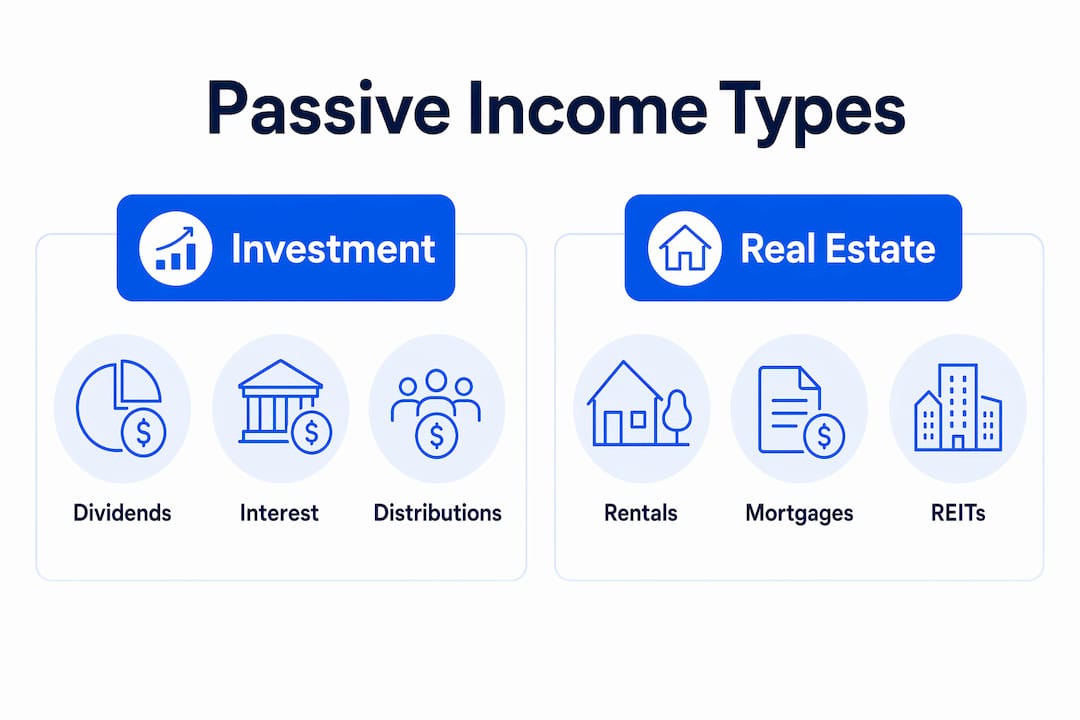
Real estate income is the most capital-intensive category. Buying a rental property through a conventional mortgage or an investment property loan requires a down payment, ongoing maintenance costs, and at minimum occasional landlord duties. The income is classified as passive under IRS rules even if you manage the property yourself, unless you qualify as a real estate professional.
Intellectual and digital income covers royalties from books, music, photography, and software, plus revenue from online courses, affiliate marketing programs, and content monetization on platforms like YouTube. These streams often require the most upfront time rather than capital, but once established, they can generate income for years.
| Type | Upfront requirement | Typical ongoing involvement |
|---|---|---|
| Dividend stocks | Capital to invest | Minimal (periodic rebalancing) |
| Rental property | Capital + management setup | Low to moderate |
| REITs | Capital to invest | Minimal |
| Royalties (books, music) | Time to create content | Very low after publication |
| Online courses | Time to build content | Low (occasional updates) |
| Affiliate marketing | Time to build audience | Low to moderate |
- Dividend stocks from established companies offer the lowest barrier to ongoing involvement.
- Rental properties generate the highest per-asset income but carry the most management risk.
- Digital products like online courses on platforms such as Teachable or Udemy scale without proportional effort increases.
- REITs combine real estate exposure with stock-market liquidity, making them accessible to investors without large capital reserves.
Pro Tip: If you are new to passive income, dividend-focused index funds like those tracking the Dividend Aristocrats index offer diversification and consistent payouts without requiring you to pick individual stocks.
How does passive income differ from active income?
Active income is compensation directly tied to your labor: salary, wages, freelance fees, and consulting payments. The moment you stop working, the income stops. Passive income denotes how earnings are generated through ownership or assets, not the absence of initial effort.

The distinction matters most at tax time. The IRS treats earned income and passive income differently, and conflating the two leads to planning mistakes. Here is a direct comparison:
| Income type | Example | IRS classification | Tax treatment |
|---|---|---|---|
| Active (earned) income | Salary, freelance fees | Earned income | Ordinary income tax rates + payroll taxes |
| Passive income | Rental income, limited partnership | Passive activity | Ordinary income rates; losses limited to passive gains |
| Portfolio income | Dividends, capital gains | Portfolio/investment | Qualified dividends taxed at 0%, 15%, or 20% |
Passive income is taxable, but the rate depends on the source. Qualified dividends from stocks held longer than 60 days are taxed at capital gains rates, which are lower than ordinary income rates for most investors. Rental income is taxed at your marginal rate, but you can offset it with deductions for depreciation, mortgage interest, and repairs. Passive activity losses can only be used to offset passive activity income, not your salary.
Investors should distinguish IRS passive activity rules from the general concept of passive income to avoid costly errors in financial planning. A tax professional or a resource like Finblog’s guide to managing investment taxes can clarify which rules apply to your specific streams.
Pro Tip: Track each income stream separately from day one. Mixing rental income records with dividend records creates headaches at tax time and makes it harder to evaluate which streams are actually performing.
What are the real challenges of building passive income?
The biggest misconception about passive income is that it requires no effort. Passive income usually requires upfront investment of money, time, or both before the stream becomes self-sustaining. The word “passive” describes the ongoing mechanism, not the setup phase.
Here are the most common challenges investors face:
- Capital requirements. Generating $1,000 per month in dividends at a 4% yield requires approximately $300,000 invested. Most people build toward that figure gradually over years, not months.
- Ramp-up time. Early returns are gradual, not immediate. An online course may take six months to build and another six months to gain enough audience traction to generate consistent revenue.
- Income variability. Passive income can be less predictable than a salary. Dividend cuts, vacancy periods in rental properties, and algorithm changes on content platforms can all reduce income unexpectedly.
- Management overhead. Rental properties require maintenance coordination, tenant communication, and compliance with local regulations. Even “passive” real estate is rarely zero-effort.
- Concentration risk. Relying on a single stream, such as one rental property or one affiliate program, creates fragility. Diversification across multiple stream types reduces the impact of any single disruption.
- Tax complexity. Different streams carry different tax rules, and failing to account for depreciation recapture on real estate or self-employment tax on certain royalties can erode returns significantly.
The setup phase is where most people quit. They expect income within weeks and abandon the strategy when returns take months to materialize. Viewing passive income as a gradual build rather than an instant payoff is the mindset that separates successful wealth builders from those who give up early.
How to start building passive income streams
Building passive income follows a logical sequence. Skipping steps, particularly the assessment phase, is the most common reason early efforts fail.
- Assess your starting resources. Calculate how much capital you can invest without affecting your emergency fund or short-term financial obligations. Determine how many hours per week you can realistically dedicate to setup work.
- Choose streams that match your profile. If you have capital but limited time, dividend stocks or REITs are the most efficient entry points. If you have time but limited capital, creating digital content, writing an e-book, or building an affiliate site requires minimal upfront spending.
- Start with one stream. Spreading effort across five passive income ideas simultaneously produces weak results in all of them. Master one stream before adding a second.
- Reinvest early returns. Compounding is the most powerful force in passive income growth. Reinvesting dividends through a DRIP (Dividend Reinvestment Plan) or rolling rental profits into property improvements accelerates the income curve.
- Diversify after establishing your first stream. Once one stream generates consistent monthly income, add a second from a different category. Combining dividend income with a digital product, for example, reduces exposure to any single market or platform.
- Review and adjust quarterly. Passive income streams require active oversight despite their hands-off nature. Review performance data, tax implications, and market conditions every quarter.
Pro Tip: For tax efficiency, hold dividend-paying stocks inside a Roth IRA or traditional IRA where possible. Qualified dividends inside a tax-advantaged account grow without annual tax drag, which compounds significantly over a 20-year horizon.
Finblog’s guide to passive income ideas for investors covers specific strategies for each stream type, including how to evaluate risk-adjusted returns before committing capital.
Key takeaways
Passive income is money earned through ownership or prior investment, not daily labor, and building it requires upfront capital, time, or both before returns become consistent.
| Point | Details |
|---|---|
| Core definition | Passive income comes from assets or activities that do not require your daily labor to generate returns. |
| Tax treatment varies | Rental income, dividends, and royalties each follow different IRS rules that affect your net return. |
| Upfront effort is real | Most passive income streams require significant capital or time investment before generating consistent cash flow. |
| Diversification reduces risk | Combining streams across investment income, real estate, and digital products protects against single-source disruption. |
| Patience is the strategy | Viewing passive income as a gradual build rather than an instant payoff is what separates sustainable wealth builders from those who quit early. |
Why passive income changed how I think about financial security
I spent years treating passive income as a bonus, something to pursue after the “real” financial work was done. That framing was wrong, and it cost me time I cannot recover.
The shift happened when I started tracking what I call the “replacement ratio”: the percentage of my monthly expenses covered by passive streams. At 10%, passive income feels like a nice extra. At 50%, it changes your relationship with risk entirely. You negotiate differently at work, take smarter investment bets, and stop making fear-based financial decisions.
What most articles get wrong is the sequencing advice. They tell you to diversify early, but spreading thin across five streams before mastering one is how people end up with five underperforming experiments. I have seen investors hold dividend stocks, a rental property, an affiliate site, and a peer-to-peer lending account simultaneously, none of them generating enough to matter, because none received enough focused attention during the setup phase.
The other thing I would push back on is the obsession with “truly passive” income. Almost nothing qualifies. Rental properties need management. Dividend portfolios need rebalancing. Online courses need updating. The goal is not zero effort. The goal is effort that is decoupled from time, so that your income does not stop when you do. That distinction, once internalized, makes the whole pursuit feel more honest and more sustainable.
Building toward financial independence through passive income is a long game. The investors who win it are not the ones who found the best stream. They are the ones who stayed consistent long enough for compounding to do the heavy lifting.
— Povilas
Build your passive income foundation with Finblog
Finblog publishes in-depth guides designed for investors who want more than surface-level advice. Whether you are evaluating your first dividend stock, exploring rental property financing, or building a financial freedom roadmap that incorporates multiple income streams, Finblog’s resources cover each step with the specificity serious investors need. The active vs. passive investing guide is a strong starting point for understanding how passive income fits into a broader portfolio strategy. Explore the full library at finblog.com to find guides matched to your current stage, whether you are just starting out or optimizing an existing portfolio for tax efficiency and long-term growth.
FAQ
What is passive income in simple terms?
Passive income is money earned from assets or prior investments rather than from active daily work. Common examples include dividends from stocks, rent from property, and royalties from published content.
Is passive income taxable?
Yes, passive income is taxable, but the rate depends on the source. Qualified dividends are taxed at capital gains rates, while rental income is taxed at ordinary income rates, though deductions for depreciation and expenses can reduce the taxable amount significantly.
How much money do you need to start earning passive income?
The amount depends on the stream. Dividend investing through a brokerage account like Fidelity or Vanguard can start with as little as $100, while rental property typically requires a down payment of 15% to 25% of the purchase price. Digital income streams like online courses can start with near-zero capital but require significant time investment.
What is the difference between passive income and residual income?
Passive income is the broader term covering all earnings generated without active daily labor. Residual income refers specifically to income that continues after a defined project or effort ends, such as royalties from a book. In practice, the two terms are often used interchangeably in personal finance.
How long does it take to build meaningful passive income?
Most passive income streams require six months to several years before generating consistent, meaningful returns. Dividend portfolios grow through compounding over decades, while digital products may generate income within a year if the audience-building phase is executed well. The ramp-up timeline depends directly on the size of the initial investment and the consistency of reinvestment.