

The single most effective tax strategy for retirement is not about finding deductions. It’s about controlling which accounts you pull from, when you pull from them, and how much you pull each year to stay within favorable tax brackets, keep Medicare premiums low, and avoid triggering extra taxes on Social Security. Done well, this kind of retirement tax planning can save you tens of thousands of dollars over a 20-year retirement without requiring any exotic moves.
Here’s what that looks like in practice:
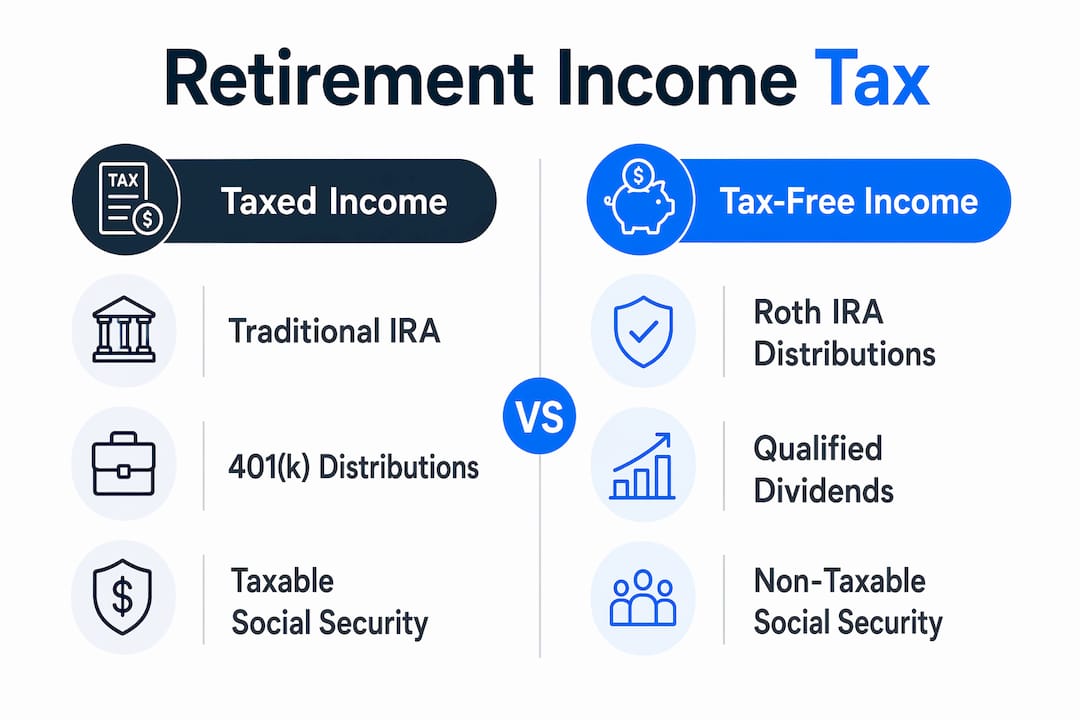
- Understand your income sources. Traditional IRA and 401(k) withdrawals are fully taxable as ordinary income. Roth IRA withdrawals are generally tax-free. Up to 85% of Social Security benefits can become taxable depending on your combined income. Capital gains and qualified dividends get preferential rates.
- Sequence withdrawals across all three account types. The old “taxable first, then tax-deferred, then Roth” rule leaves money on the table. Modern bracket-filling strategies draw from all three simultaneously to keep annual income in the lowest possible bracket.
- Watch the IRMAA cliffs. A single dollar over a Medicare income threshold can cost a married couple thousands in extra premiums for the entire following year.
- Use Roth conversions in low-income years. The window between retirement and age 73 (when Required Minimum Distributions begin) is often the best time to convert traditional IRA funds to Roth at lower tax rates.
- Use Qualified Charitable Distributions (QCDs) once you hit 70½. A QCD satisfies your RMD without adding to your adjusted gross income (AGI), protecting both your Medicare premiums and Social Security tax status.
- Review your plan every year. Tax laws change. Your income changes. A strategy that worked at 67 may cost you at 72.
Table of Contents
- How different types of retirement income are taxed
- Tax-savvy withdrawal strategies in retirement
- Dos and don’ts of tax planning in retirement
- Navigating IRMAA and income tax cliffs for Medicare savings
- Reviewing and adjusting your tax strategy regularly
- Key Takeaways
- Finblog helps you put this into practice
How different types of retirement income are taxed
Not all retirement income hits your tax return the same way, and the differences are large enough to drive major planning decisions.
Traditional IRA and 401(k) distributions
Every dollar you withdraw from a traditional IRA or 401(k) is taxed as ordinary income in the year you take it. There’s no capital gains treatment, no special rate. If you pull $60,000 from a traditional IRA in a year when your other income puts you in the 22% bracket, that $60,000 gets taxed at 22%. This is why large, unplanned distributions are so costly.
Roth IRA distributions
Roth accounts flip the model entirely. You contributed after-tax dollars, so qualified distributions in retirement are completely federal-income-tax-free. They also don’t count toward your AGI, which means they won’t trigger IRMAA surcharges or push more of your Social Security into taxable territory. For tax-free retirement income, Roth accounts are the most flexible tool you have.
Social Security benefits
This is where many retirees get surprised. Up to 85% of your Social Security benefit can become taxable income at the federal level, depending on your “combined income” (AGI plus tax-exempt interest plus half of your Social Security benefit).

| Filing status | No SS taxable | Up to 50% taxable | Up to 85% taxable |
|---|---|---|---|
| Single | Below $25,000 | $25,000–$34,000 | Above $34,000 |
| Married filing jointly | Below $32,000 | $32,000–$44,000 | Above $44,000 |
A couple drawing from Roth accounts and living below $32,000 in combined income pays zero federal tax on Social Security. Add a $30,000 traditional IRA distribution and suddenly 85% of their benefit is taxable. That’s a steep marginal cost on one decision.
Capital gains and qualified dividends
Long-term capital gains and qualified dividends are taxed at 0%, 15%, or 20% depending on your taxable income. For married couples filing jointly in 2026, the 0% long-term capital gains bracket applies up to $98,900 in taxable income. Retirees with low AGI can harvest gains in taxable accounts, reset their cost basis, and owe nothing. That’s a planning opportunity most people miss.
State taxes on retirement income
State tax treatment varies widely and can significantly affect your net income. Some states exempt Social Security entirely. Others exempt pension income up to certain limits. A handful have no income tax at all. If you’re considering relocating in retirement, the tax environment for retirees in states like Florida can be a meaningful financial factor, not just a lifestyle one.
The 2026 senior deduction
A new provision available from 2025 through 2028 adds a $6,000 deduction per person for taxpayers age 65 and older, stacking on top of the standard deduction and the existing age-65 add-on. For a married couple, this brings the total standard deduction to a high amount, which can effectively eliminate federal taxes on Social Security for lower-income households. The deduction phases out for single filers above $75,000 and joint filers above $150,000.
Tax-savvy withdrawal strategies in retirement
The old textbook answer for withdrawal sequencing was simple: spend taxable accounts first, then tax-deferred, then Roth. That approach made sense when tax rates were flat and predictable. Today, with IRMAA cliffs, Social Security taxation thresholds, and wide bracket ranges, emptying one bucket at a time often produces exactly the outcome you’re trying to avoid: a spike in taxable income that triggers surcharges and pushes you into a higher bracket for years.
The bracket-filling approach
The modern method starts with a target AGI for the year, then fills that target from multiple sources simultaneously. You identify your required income (Social Security, pensions, RMDs, dividends), then fill the remaining space with a mix of traditional IRA withdrawals, capital gains harvesting, or Roth conversions. Any additional cash needs come from Roth withdrawals or taxable account principal, neither of which affects AGI.
“The conventional wisdom is taxable → tax-deferred → Roth. Modern planning says fill brackets, not ‘empty one bucket at a time.’” — AdvisorGuide, Withdrawal Strategy in Retirement
This approach keeps your AGI predictable year over year, which is exactly what you need to stay below IRMAA thresholds and control Social Security taxation.
Managing Required Minimum Distributions
The IRS requires distributions from traditional IRAs and 401(k)s starting at age 73 (or 75 for those born in 1960 or later under SECURE 2.0). Missing an RMD carries a 25% penalty on the shortfall, reducible to 10% if corrected quickly. Beyond the penalty, large RMDs can push you into a higher bracket and trigger IRMAA surcharges for the following year.
The solution is to start planning before RMDs begin. The years between retirement and age 73 are often your lowest-income years, making them ideal for Roth conversions that reduce the future traditional IRA balance and, therefore, the size of future RMDs.
Roth conversions in the gap years
Partial Roth conversions during low-income years before RMDs start are one of the most powerful moves available to retirees. You pay tax now at a lower rate to avoid paying at a higher rate later. The key is to convert only enough each year to fill your current bracket without crossing into the next one or triggering an IRMAA surcharge. A multi-year ladder of conversions, done carefully, can dramatically reduce the size of your taxable RMDs at 73 and beyond.

Pro Tip: If you’re between ages 60 and 72 and your income is temporarily low, that window is worth modeling carefully. Converting $20,000–$30,000 per year at the 12% rate now may save you from paying 22% or more on those same dollars as RMDs later.
Spreading large purchases across tax years
Big one-time expenses in retirement, like a home renovation or helping a grandchild with tuition, often require a large distribution. Taking the full amount in one year can push you over an IRMAA threshold or into a higher bracket. The fix is to split the distribution across two calendar years: take half in December and the other half in January. Each year sees only half the taxable income, keeping you in a lower bracket and potentially below a Medicare surcharge tier.
Top retirement withdrawal strategies and their tax effects:
- Bracket filling: Draw from all account types to keep AGI at the top of a low bracket without crossing into the next.
- 0% capital gains harvesting: Sell appreciated assets in taxable accounts when AGI is below $98,900 (MFJ) to reset basis at zero tax cost.
- Roth conversions: Convert traditional IRA funds in low-income years to reduce future RMDs and taxable income.
- QCD transfers: Direct IRA funds to charity to satisfy RMDs without increasing AGI.
- December income timing: Delay or accelerate distributions to land in the most favorable tax year.
Dos and don’ts of tax planning in retirement
Getting retirement tax planning right is as much about avoiding mistakes as it is about executing clever strategies. The two lists below cover the moves that consistently make the biggest difference.
Dos
- Max out tax-advantaged contributions before you retire. If you’re still working, contribute the maximum to your 401(k) and IRA, including catch-up contributions available after age 50. These reduce your taxable income now and build the account balances you’ll manage strategically later.
- Analyze your tax bracket every year. Project your AGI under a “do nothing” scenario, then identify how much room you have before hitting the next bracket or an IRMAA threshold. That gap is your planning space.
- Use QCDs for charitable giving once you’re 70½. A Qualified Charitable Distribution of up to $111,000 per person per year goes directly from your IRA to a qualified charity. It counts toward your RMD and never appears in your AGI. For charitably inclined retirees, this is almost always better than writing a personal check and trying to itemize.
- Diversify your income sources. Having money in taxable accounts, traditional IRAs, and Roth accounts gives you flexibility to draw from whichever source keeps your AGI lowest in any given year.
- Manage December income carefully. Year-end is when you know your full-year income picture. A small distribution adjustment in December can keep you below an IRMAA cliff or a Social Security taxation threshold.
- Take advantage of the 2026 senior deduction. If you’re 65 or older and your income falls below the phase-out thresholds, the additional senior deduction per person can meaningfully reduce your federal tax bill through 2028.
Don’ts
- Don’t ignore RMDs. Missing a Required Minimum Distribution triggers a 25% penalty on the amount you should have withdrawn. Set calendar reminders and work with an advisor to calculate the correct amount each year.
- Don’t overlook IRMAA cliffs. Going $1 over a Medicare income threshold raises Part B and Part D premiums for both spouses for the entire following year. The cost of crossing a threshold can easily exceed $2,000 annually per couple.
- Don’t treat all income sources as equivalent. A dollar from a Roth account and a dollar from a traditional IRA have very different tax consequences. Treating them the same in your spending plan is a common and costly mistake.
- Don’t wait until April to think about taxes. By the time you’re filing, the year is over and your options are gone. Tax planning is a December activity, not an April one.
- Don’t assume your state taxes work like federal taxes. State rules on Social Security, pension income, and capital gains vary enormously. A strategy optimized for federal taxes may still leave significant state tax on the table.
Navigating IRMAA and income tax cliffs for Medicare savings
IRMAA (Income-Related Monthly Adjustment Amount) is the Medicare surcharge that applies when your modified adjusted gross income (MAGI) from two years prior exceeds certain thresholds. Your 2024 MAGI determines your 2026 Medicare premiums. The structure is a cliff, not a slope: crossing a threshold by even $1 moves you into the next premium tier for the entire year.
| MAGI (single) | MAGI (married filing jointly) | Part B monthly premium |
|---|---|---|
| Up to $98,900 | — | $202.90 |
| — | — | $284.30 |
| — | — | — |
| — | — | — |
| — | — | — |
| — | — | — |
A married couple at $219,000 MAGI pays the same Part B premium as one at $273,000. The difference between $217,999 and $218,001 in annual income is the difference between $202.90 and $284.30 per person per month. Over a full year, for two people, that’s a gap of nearly $1,950 in Medicare premiums triggered by $2 of extra income.
Key planning insight: Going $1 over an IRMAA threshold raises Medicare Part B and Part D premiums for both spouses for the entire next year. A small distribution adjustment in December can save almost $2,000 in next-year premium costs.
How QCDs protect your IRMAA tier
A Qualified Charitable Distribution is one of the few tools that reduces your AGI directly, rather than just reducing taxable income after deductions. Because QCDs don’t appear in AGI, they preserve your IRMAA tier, reduce the taxable share of Social Security, and lower your exposure to the Net Investment Income Tax. For a retiree who gives to charity anyway, routing that giving through a QCD rather than a personal check is a straightforward upgrade.
The $111,000 annual QCD limit per person is indexed for inflation. Eligibility begins at age 70½, and the transfer must go directly from a traditional IRA to a qualified charity. Donor-Advised Funds generally don’t qualify, with one limited exception under SECURE 2.0.
Actionable steps to manage IRMAA
- Project your MAGI each December using actual year-to-date figures, not estimates.
- Identify the nearest IRMAA threshold and calculate how much room you have.
- If you’re close to a cliff, consider delaying a distribution to January or pulling it forward from next year, depending on which direction helps.
- Use QCDs to satisfy RMDs without adding to MAGI.
- If you had an unusual income event (a home sale, a large Roth conversion) that pushed you over a threshold, file Form SSA-44 to request a reduction in IRMAA based on a life-changing event.
- For retirees considering where to live, states with no income tax and favorable retirement climates like those on Amelia Island can reduce state-level tax drag, giving you more flexibility to manage federal MAGI thresholds.
Reviewing and adjusting your tax strategy regularly
A retirement tax plan is not a document you write once and file away. Tax law changes. Your income changes. Your account balances shift. A strategy that kept you below the IRMAA threshold at 68 may push you well above it at 74 once RMDs kick in.
The most effective retirement income planning treats tax review as an annual event, not a reaction to a problem. Each fall, project your full-year AGI, compare it against current bracket limits and IRMAA thresholds, and identify any adjustments worth making before December 31.
What to watch for each year
- Bracket creep from RMDs. As your traditional IRA balance grows and RMDs increase, your AGI rises automatically. Model this trajectory five to ten years out so you’re not surprised.
- Legislative changes. The current senior deduction expires after 2028. The standard deduction amounts, bracket thresholds, and IRMAA tiers are all adjusted annually for inflation. What’s true in 2026 may not be true in 2028.
- Social Security claiming decisions. If you haven’t claimed yet, the year you start affects your combined income calculation and, therefore, how much of your benefit is taxable.
- State tax law changes. States periodically revise their treatment of retirement income. A state that exempts pension income today may not in five years.
Practical reminders for ongoing tax planning
- Review your AGI projection every October or November, before year-end moves become urgent.
- Recalculate your RMD amount each year. The IRS uses updated life expectancy tables, and your account balance changes annually.
- Revisit your Roth conversion ladder. If your income was higher than expected this year, you may need to convert less. If it was lower, you may have room to convert more.
- Check whether your charitable giving is better routed through a QCD or a direct contribution, given the current standard deduction level and the new 0.5% AGI floor on cash charitable deductions effective in 2026.
- Consult a tax professional or financial advisor at least once a year. The interaction between federal brackets, IRMAA, Social Security taxation, and state taxes is genuinely complex, and the cost of a planning error usually exceeds the cost of professional advice.
Pro Tip: Build a simple spreadsheet that projects your AGI for the next five years under three scenarios: no changes, Roth conversions each year, and QCDs replacing cash giving. The difference between scenarios is often striking and makes the right path obvious.
For retirees who want to stay current on 2026 tax planning strategies, the combination of the new senior deduction, updated IRMAA tiers, and SECURE 2.0 changes to RMD ages makes this a particularly important year to run the numbers fresh.
Key Takeaways
The most effective tax strategy for retirement combines withdrawal sequencing across account types, proactive IRMAA management, and annual income projection to minimize lifetime taxes, not just this year’s bill.
| Point | Details |
|---|---|
| Withdrawal sequencing matters | Drawing from taxable, tax-deferred, and Roth accounts simultaneously keeps AGI in lower brackets year over year. |
| Social Security taxation is avoidable | Couples keeping combined income below $32,000 pay zero federal tax on Social Security benefits. The 50% taxation threshold starts at $32,000 and the 85% threshold at $44,000 for married filing jointly. |
| IRMAA cliffs are costly | Crossing a Medicare income threshold by $1 can cost a married couple nearly $1,950 more in annual Part B premiums. |
| QCDs reduce AGI directly | A Qualified Charitable Distribution of up to $111,000 per person per year satisfies RMDs without increasing adjusted gross income. |
| Finblog supports your planning | Finblog offers financial education and consulting resources to help retirees model withdrawal strategies and manage income thresholds. |
Finblog helps you put this into practice
Retirement tax planning at this level, managing IRMAA cliffs, Roth conversion ladders, QCD timing, and bracket-filling withdrawals simultaneously, is genuinely difficult to do alone. The variables interact in ways that aren’t obvious until you model them, and a single misstep can cost more than a year of careful saving.
Finblog is built for exactly this kind of planning. The site offers financial education and consulting resources designed for retirees and pre-retirees who want to understand their options clearly before making decisions. Whether you’re trying to figure out how much to convert this year, whether a QCD makes sense for your giving, or how to project your AGI five years out, Finblog gives you the framework to think it through.
The content covers tax-advantaged account strategies, withdrawal sequencing, and the specific 2026 rule changes that affect retirees right now. If you want a clearer picture of your retirement tax situation, start with Finblog’s retirement planning resources at finblog.com.