
TL;DR:
- Smart, year-round tax planning can legally increase after-tax investment returns.
- Placing high-yield, tax-inefficient assets in tax-advantaged accounts maximizes tax efficiency.
- Consistent monitoring and strategic organization prevent costly tax mistakes and enhance long-term growth.
You worked hard to build your portfolio, and then April arrives and a significant chunk of your gains disappears to taxes. It stings. Many investors accept this as unavoidable, but the reality is that smart, year-round tax planning can legally keep thousands more dollars working for you. Tax-efficient investing is not just for the ultra-wealthy. Whether you hold a brokerage account, a 401(k), or a mix of both, understanding how investment taxes work and how to minimize them is one of the highest-return moves you can make in 2026.
Table of Contents
- Understanding the basics of investment taxation
- Key requirements for effective tax planning
- Step-by-step tax-saving strategies for investors
- Avoiding common mistakes in investor tax planning
- Measuring your tax planning success
- What most investors get wrong about tax planning
- Ready to sharpen your tax planning?
- Frequently asked questions
Key Takeaways
| Point | Details |
|---|---|
| Know your tax types | Understanding how investments are taxed is key to keeping more of your returns. |
| Prepare before you invest | Organize your account records and use tax-advantaged tools to ensure maximum savings. |
| Apply proven tax strategies | Implement steps like tax loss harvesting and proper asset location to cut annual taxes. |
| Avoid costly mistakes | Double-check your filings and know the common pitfalls to stay out of trouble. |
| Measure your results | Evaluate after-tax returns every year to fine-tune your approach and boost your bottom line. |
Understanding the basics of investment taxation
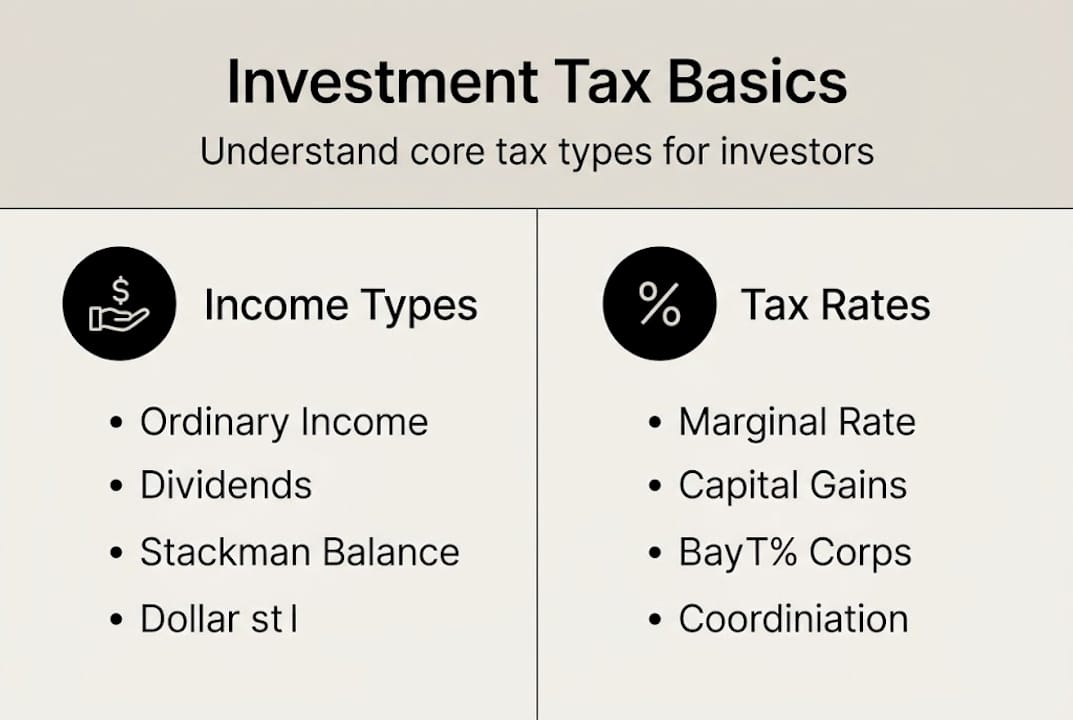
Before you can reduce your tax bill, you need to know exactly what you’re paying and why. Investors face different tax rates for ordinary income, short-term capital gains, and long-term capital gains, and confusing them is an expensive mistake.
Ordinary income includes wages, interest, and non-qualified dividends. It is taxed at your standard marginal rate, which can reach 37% in 2026. Short-term capital gains apply to assets sold after holding them for one year or less, and they are also taxed as ordinary income. Long-term capital gains apply to assets held longer than one year and are taxed at preferential rates of 0%, 15%, or 20%, depending on your taxable income.
Here is a quick reference for 2026 federal rates:
| Income type | Tax rate range | Holding period |
|---|---|---|
| Ordinary income | 10% to 37% | N/A |
| Short-term capital gains | 10% to 37% | 12 months or less |
| Long-term capital gains | 0% to 20% | More than 12 months |
| Qualified dividends | 0% to 20% | Varies |
Beyond rates, there is a concept called tax drag, which is the gradual erosion of your compounding returns caused by annual taxes on dividends, interest, and realized gains. Even a 1% annual tax drag can reduce a portfolio’s value by tens of thousands of dollars over 20 years. That is why average investors, not just high-net-worth individuals, need to care about capital gains taxes and how they interact with their specific holdings.
The main categories of taxable investment income you need to track include:
- Interest income from bonds, CDs, and savings accounts
- Qualified and non-qualified dividends from stocks and funds
- Short-term capital gains from frequent trading
- Long-term capital gains from buy-and-hold positions
- Passive income from REITs or limited partnerships
Key requirements for effective tax planning
With the tax types clear, the next step is getting your financial house in order so you don’t miss any opportunities. Good tax planning starts with good recordkeeping, not clever strategies.
Before you can execute any strategy, you need these fundamentals in place:
- Accurate cost basis records for every holding (what you paid, when you bought it)
- At least three years of prior tax returns for reference
- A clear picture of your current marginal tax bracket
- Knowledge of which accounts hold which assets
- Year-end statements from all brokerage and retirement accounts
One of the most powerful structural decisions you can make is choosing where to hold your investments. Tax-advantaged accounts can significantly increase after-tax returns by sheltering growth from annual taxation. Here is how common account types compare:

| Account type | Tax treatment | Best for |
|---|---|---|
| Traditional IRA / 401(k) | Tax-deferred growth, taxed on withdrawal | High earners expecting lower retirement income |
| Roth IRA / Roth 401(k) | After-tax contributions, tax-free growth | Younger investors or those expecting higher future rates |
| HSA | Triple tax advantage | Medical expenses and long-term savings |
| Taxable brokerage | No shelter, full flexibility | Investments not fitting in tax-advantaged accounts |
The goal is to match asset type to account type. High-yield bonds that generate ordinary income belong in tax-sheltered accounts. Index funds with low turnover are better suited for taxable accounts.
Pro Tip: Use a digital portfolio tracker like Empower or Monarch Money that can export transaction data directly into tax software. This alone can save you two to three hours every spring and reduce the chance of costly data entry errors.
Step-by-step tax-saving strategies for investors
Now, with your foundation set, here are the exact strategies you can put into action. These are not obscure loopholes. They are legal, IRS-approved methods that disciplined investors use every year.
-
Practice tax loss harvesting. Tax loss harvesting lets you sell underperforming positions to realize a loss, which offsets gains elsewhere in your portfolio. You can deduct up to $3,000 of net losses against ordinary income annually, with the remainder carried forward to future years.
-
Optimize asset location. Place tax-inefficient assets (high-yield bonds, REITs, actively managed funds) inside tax-advantaged accounts. Hold tax-efficient assets (index ETFs, growth stocks you plan to hold long-term) in your taxable brokerage account.
-
Time your capital gains. If you are close to crossing into a higher long-term gains bracket, delay selling until the new tax year. Conversely, if you have had a low-income year, consider realizing gains at the 0% long-term rate, which applies to single filers earning up to roughly $47,025 in 2026.
-
Maximize tax-advantaged account contributions. In 2026, the 401(k) contribution limit is $23,500, with a $7,500 catch-up for those 50 and older. Roth IRA limits are $7,000, or $8,000 if you are 50 or older. Filling these accounts first is one of the most reliable ways that tax-efficient investing compounds over time.
-
Use qualified opportunity zones or charitable giving strategies if you have large embedded gains. Donating appreciated stock directly to charity avoids capital gains tax entirely while giving you a full fair-market deduction.
Pro Tip: The wash sale rule prohibits you from claiming a tax loss if you buy the same or a substantially identical security within 30 days before or after the sale. Swap into a similar but not identical ETF to maintain market exposure while preserving your loss deduction.
Avoiding common mistakes in investor tax planning
Even well-planned strategies can go wrong. Here are the traps to watch out for and how to stay compliant.
The most expensive errors are rarely dramatic. They are quiet, administrative mistakes that pile up over time. Investors often overlook deductions and misapply rules, leading to IRS penalties that wipe out the savings they were trying to protect.
The five most common trouble spots at tax time:
- Incorrect cost basis reporting: Brokers sometimes default to average cost rather than specific identification, which may result in higher reported gains.
- Ignoring holding periods: Selling one day early can convert a 15% long-term gain into a 37% short-term gain.
- Missing foreign tax credits: If you hold international funds, you may have paid foreign taxes that qualify for a U.S. credit.
- Not harvesting losses before year-end: Losses must be realized by December 31 to count for that tax year.
- Overlooking net investment income tax (NIIT): High earners face an additional 3.8% tax on investment income above certain thresholds.
“The real cost of IRS penalties for unintentional errors goes beyond the fine itself. Interest accrues daily, and audit triggers can invite scrutiny of multiple tax years, not just the one in question.”
To protect yourself, cross-check your 1099-B forms against your own records before filing. If your portfolio includes options, partnerships, or foreign holdings, the complexity rises fast. Knowing how to maximize deductions and how to save on taxes requires staying current on rule changes, which is where a CPA or enrolled agent earns their fee.
Measuring your tax planning success
After you’ve set strategies in motion and avoided pitfalls, it’s critical to see if your effort actually paid off. The wrong benchmark gives you a false sense of security.
Tax planning success should be measured by after-tax return, not just the dollar amount you owed. An investor who paid $10,000 in taxes but earned 18% net of fees outperformed one who paid $5,000 in taxes but earned only 9%. The goal is to keep more of what you earn, not simply to pay less.
Here is a simple before-and-after scenario to illustrate common strategy impacts:
| Scenario | Before strategy | After strategy | Estimated annual savings |
|---|---|---|---|
| Tax loss harvesting on $20,000 gain | $3,000 tax owed | $900 tax owed | $2,100 |
| Moving bonds to IRA (32% bracket) | $640 in annual interest tax | $0 in annual interest tax | $640 |
| Holding stock 13 months vs. 11 months | 32% short-term rate | 15% long-term rate | Varies by gain size |
Review your effective tax rate (total taxes paid divided by total income) each year. If it is not trending down relative to your income growth, your strategy needs adjustment. Track your after-tax return in your portfolio tracker alongside your gross return.
Knowing when to bring in a professional matters too. If your portfolio exceeds $500,000, includes real estate or business interests, or you have experienced a major life event like a sale or inheritance, a fee-only tax advisor can minimize investment risk and uncover opportunities that software alone will miss.
What most investors get wrong about tax planning
Here is the uncomfortable truth: most investors treat tax planning like a once-a-year chore, scrambling in March to find deductions before the filing deadline. That mindset guarantees suboptimal results.
The investors who consistently keep more of their returns do not rely on last-minute tricks. They build tax awareness into every investment decision throughout the year. They think about holding periods before they buy, not after. They rebalance inside tax-advantaged accounts to avoid triggering gains. They treat true tax efficiency as a portfolio discipline, not a tax season event.
Chasing annual deductions while ignoring portfolio structure is like patching a leaky roof one shingle at a time. The real gains come from building a system: the right accounts, the right asset locations, and the habit of reviewing your tax position quarterly. That is what separates investors who feel the sting every April from those who barely notice it.
Ready to sharpen your tax planning?
If reading this made you realize there are strategies you have not yet put to work, you are not alone. Most investors leave meaningful money on the table simply because they lack a structured approach. The good news is that the strategies covered here are accessible to anyone willing to be intentional about how they invest and when they act.
Finblog tax insights offers regularly updated guides, tools, and expert perspectives designed for investors who want to go beyond the basics. From account optimization to advanced harvesting techniques, there is always a next level to reach. Start exploring today and make sure your 2026 tax strategy is working as hard as your portfolio.
Frequently asked questions
What is the most tax-efficient investment account for U.S. investors?
Roth IRAs and HSAs are among the most tax-efficient accounts due to tax-free growth and withdrawals, but the best choice depends on your income and goals. Tax-advantaged accounts can significantly increase after-tax returns when matched to the right investor profile.
How does tax loss harvesting help reduce my investment taxes?
Tax loss harvesting lets you offset gains with losses from your portfolio, directly reducing your taxable income for the year. Unused losses carry forward to offset future gains or income.
When should I consider seeing a tax professional for my investments?
Consult a tax advisor if your portfolio includes complex assets, cross-border investments, or you are unsure about new IRS rules. Overlooking deductions and misapplying rules can trigger IRS penalties that cost far more than an advisor’s fee.
What are the biggest mistakes investors make when planning taxes?
Common mistakes include missing deduction opportunities, not tracking cost basis, and misunderstanding holding period rules. Each of these errors can convert a manageable tax bill into a costly one, especially as your portfolio grows.