



TL;DR:
- Most companies lack robust succession plans, risking operational disruption and reduced competitiveness.
- Effective succession planning involves identifying critical roles, assessing talent, developing successors, and regular reviews.
- Modern tools like AI analytics and 360 feedback improve accuracy and reduce bias in leadership transition strategies.
Most business owners assume they have a handle on leadership transitions. The reality is sharply different. Only 14 to 21% of organizations have truly robust succession plans, and 65% have no CEO plan at all. That gap is not just an HR oversight — it is a direct threat to your company’s survival, valuation, and competitive edge. Succession planning is not simply about finding someone to fill a departing leader’s chair. It is a strategic discipline that shapes culture, protects institutional knowledge, and keeps your business performing through inevitable change. This article walks you through the essentials, the pitfalls, and the modern tools that separate resilient organizations from vulnerable ones.
Table of Contents
- What is succession planning and why does it matter?
- Core steps for effective succession planning
- Real-world succession challenges and edge cases
- Modern best practices and tools for succession success
- The uncomfortable truth: Why most succession plans fail (and how to break the cycle)
- Plan your company’s future with expert-backed guidance
- Frequently asked questions
Key Takeaways
| Point | Details |
|---|---|
| Start early | Succession planning is most effective when it starts before a transition is on the horizon. |
| Annual review | Update your succession plan every year to stay aligned with company needs and challenges. |
| Mix methods | Leverage both traditional and data-driven tools—like 9-box grids and 360-degree feedback—to assess talent. |
| Plan for edge cases | Include contingency strategies for sudden departures and family business transitions. |
| Go beyond roles | Document your company’s unique culture, knowledge, and judgment frameworks—not just job descriptions. |
What is succession planning and why does it matter?
Succession planning is the strategic process of identifying and developing future leaders before you need them. Think of it less like an emergency exit plan and more like a talent investment strategy. You are building a pipeline of capable people who can step into critical roles, whether that happens in five years or five weeks.
Most executives still think of succession as a CEO handoff. That framing is too narrow. Every critical role — from CFO and division heads to key technical specialists — deserves a succession pathway. When a critical role goes vacant unexpectedly, the cost is not just a recruitment fee. It is lost momentum, disrupted client relationships, and a rattled team.
The numbers make a compelling case. Organizations with effective plans outperform their peers by 2x, fill 90% of roles internally, and see 20% higher employee engagement. That last point is underrated. When employees see a visible path forward, they stay and they perform.
Here is what a well-designed succession plan actually delivers:
- Business continuity during unexpected departures or health crises
- Stronger talent retention because high performers see a future
- Faster role transitions that minimize operational disruption
- Cultural preservation by promoting leaders who already understand your values
- Investor and stakeholder confidence in the organization’s long-term stability
“Succession planning is not a one-time event. It is a living process that evolves with your business strategy.” — succession planning fundamentals
Only 14% of organizations practice robust succession planning. That means the majority of companies are operating without a safety net. For business owners thinking about generational financial planning and long-term wealth preservation, the absence of a succession plan is a financial risk as much as an operational one. The role of financial advisors in structuring these plans is often underestimated, yet their perspective on valuation, tax implications, and ownership transfer can be decisive.
Core steps for effective succession planning
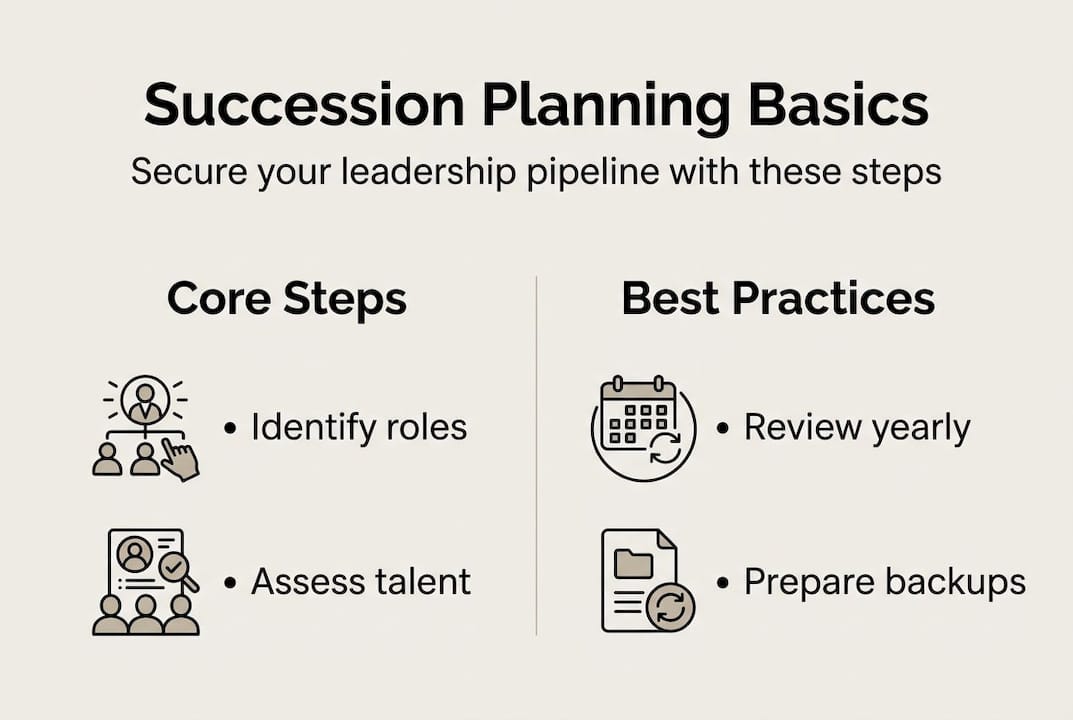
Building a succession plan does not require a massive HR department. It requires discipline, honest assessment, and a structured process. Succession planning involves identifying critical roles, assessing and developing internal talent, creating transition timelines, and regularly reviewing plans. Here is a practical five-step framework:
- Identify critical roles. Start by mapping which positions would cause the most disruption if left vacant. Do not limit this to the C-suite.
- Assess talent gaps. Evaluate your current bench. Who has the potential, and where are the skill shortfalls?
- Develop successors actively. Assign stretch projects, mentorships, and leadership training. Development must be deliberate, not accidental.
- Create transition timelines. Define realistic handoff windows for each role. Some transitions need 12 months; others need three years.
- Review and update annually. Business strategy shifts. Your succession plan must shift with it.
Methodology matters here. Key methodologies include 9-box grids, 360-degree feedback, competency profiles, and external benchmarking. The 9-box grid plots employees on a matrix of current performance versus future potential, making it easier to prioritize development investments objectively.
| Approach | Traditional | Best practice |
|---|---|---|
| Focus | Replacing specific people | Filling critical roles |
| Timeline | Reactive, post-departure | Proactive, ongoing |
| Candidate pool | Internal only | Internal plus external benchmarks |
| Review frequency | Rarely or never | Annually or after major shifts |
| Diversity consideration | Often overlooked | Intentionally built in |
Pro Tip: Review your succession plan at least once a year and immediately after any major business shift such as an acquisition, market pivot, or senior departure. Stale plans create false confidence.
The biggest pitfalls? Focusing on personalities instead of role requirements, building a plan and never touching it again, and ignoring diversity in your candidate pool. Avoiding common succession planning mistakes requires treating the plan as a strategic document, not a compliance checkbox. Working with financial advisor benefits in mind can also help align succession timelines with ownership transfer and tax planning.

Real-world succession challenges and edge cases
Even a well-built plan hits friction in the real world. The challenges look different depending on your business type, and ignoring edge cases is where organizations get blindsided.
Family businesses face a unique paradox. Family businesses often lack plans, with 41 to 55% having no formal succession process, and larger family firms increasingly prefer non-family CEOs for objectivity. The emotional complexity of passing leadership to a child or sibling — or deciding not to — creates delays that can cost the business dearly.
Small businesses face a different wall. 30% of small businesses fail during or after ownership transitions. That is not a rounding error. It reflects the reality that small business owners often wear every hat and rarely document the institutional knowledge that keeps operations running.
“The biggest threat to a small business is not competition. It is the undocumented knowledge walking out the door when a key person leaves.”
Sudden departures are another category entirely. An accident, a health crisis, or an abrupt resignation can force a transition in days rather than years. Without a contingency plan, organizations scramble, morale drops, and clients notice.
| Business type | % with formal succession plan | Primary challenge |
|---|---|---|
| Large corporations | 35 to 40% | Bureaucracy slows updates |
| Family businesses | 45 to 59% | Emotional complexity |
| Small businesses | Under 30% | Knowledge concentration |
| Nonprofits | Under 25% | Limited talent pipeline |
Here is a practical checklist for edge cases:
- Document critical processes so knowledge is not locked in one person’s head
- Identify an interim leader for every senior role before you need one
- Create a communication plan for stakeholders in case of sudden transitions
- Review buy-sell agreements and ownership transfer documents annually
- Test your plan with tabletop exercises, asking “what if this person left tomorrow?”
A strong investment strategy for continuity should account for these scenarios. Ownership transitions often trigger valuation events, and being financially prepared is as important as being operationally prepared.
Modern best practices and tools for succession success
The organizations pulling ahead are not using static spreadsheets and annual HR reviews. They are building dynamic, data-driven succession systems that update in real time and reduce human bias.
The shift is from “who do we like?” to “what does the data show?” Regular board reviews and AI tools enhance succession accuracy by removing gut-feel decisions and replacing them with structured assessments. This matters because bias in succession decisions is real and costly.
Here are the modern tools making the biggest difference:
- AI-powered talent analytics: Identify high-potential employees using performance data, engagement scores, and skills assessments
- 360-degree feedback platforms: Collect structured input from peers, direct reports, and managers to build a full picture of leadership readiness
- Competency mapping software: Match role requirements to individual skill profiles and flag gaps automatically
- Scenario planning tools: Model different departure timelines and test bench depth across multiple roles simultaneously
- External benchmarking databases: Compare your talent pipeline against industry peers to calibrate expectations
Pro Tip: Benchmark your talent pipeline against industry peers at least once a year. Knowing how your bench depth compares to competitors reveals blind spots that internal assessments miss.
The shift toward AI in finance succession processes is accelerating. Traditional succession planning falls short when it relies on informal networks and subjective impressions. The fix is not more paperwork — it is smarter systems that make the process continuous rather than episodic. Connecting succession planning to long-term investment planning ensures that leadership transitions align with financial goals, not just organizational charts.
The uncomfortable truth: Why most succession plans fail (and how to break the cycle)
Here is what most succession planning articles will not tell you: having a plan is not the same as having a working plan. Most organizations treat succession as a document to produce, not a system to run. They write the plan, file it, and revisit it only when a crisis forces their hand.
Traditional plans fail by focusing on replacing people rather than filling roles, and by ignoring agility and inclusivity. The deeper problem is that most plans chase the wrong goal. They try to clone the outgoing leader instead of defining what the role actually needs in the next phase of the business.
The organizations that get this right treat succession as an active discipline. They codify their business logic, document decision frameworks, and build judgment into their systems rather than leaving it in people’s heads. They also balance continuity with renewal, bringing in diverse perspectives and external benchmarks to challenge internal assumptions.
This is where AI and business adaptation intersects with succession strategy. Adaptive organizations use technology not to automate leadership decisions but to make the process more honest and more frequent.
Pro Tip: Schedule an annual “succession health check” alongside your strategic planning cycle. Treat it with the same rigor you give financial audits.
Plan your company’s future with expert-backed guidance
Succession planning is one of the highest-leverage decisions a business owner or executive can make, yet it is consistently underprioritized until a crisis hits. The strategies covered here give you a real foundation, but execution is where most plans stall. At finblog.com, you will find practical leadership transition resources and financial planning content designed for executives who want to act, not just read. If you are serious about protecting what you have built, start with our succession and wealth planning guide to connect leadership continuity with long-term financial security.
Frequently asked questions
What are the essential steps in business succession planning?
The main steps involve identifying critical roles, assessing internal talent, developing successors through active programs, setting realistic timelines, and reviewing the plan every year to keep it current.
Why do most succession plans fail?
Most fail because they are created once and never updated, they focus on specific people rather than role requirements, and they fail to account for diversity or changing business conditions.
How often should succession plans be reviewed?
Plans should be updated at minimum once a year, and immediately following any significant organizational change such as a merger, major hire, or strategic pivot.
Is succession planning only for CEOs?
No. Succession covers all critical leadership and technical roles across the organization. Limiting it to the CEO creates dangerous gaps in your overall leadership continuity.
How can technology improve succession planning?
AI tools enhance accuracy by reducing bias and making talent assessments more objective, while platforms like 360-degree feedback tools give a fuller picture of each candidate’s readiness.