
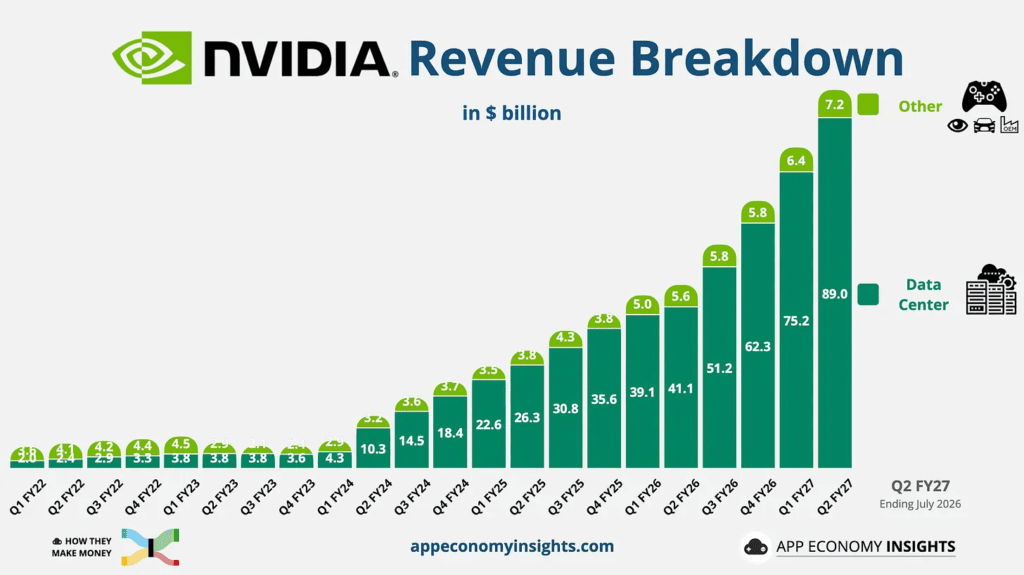
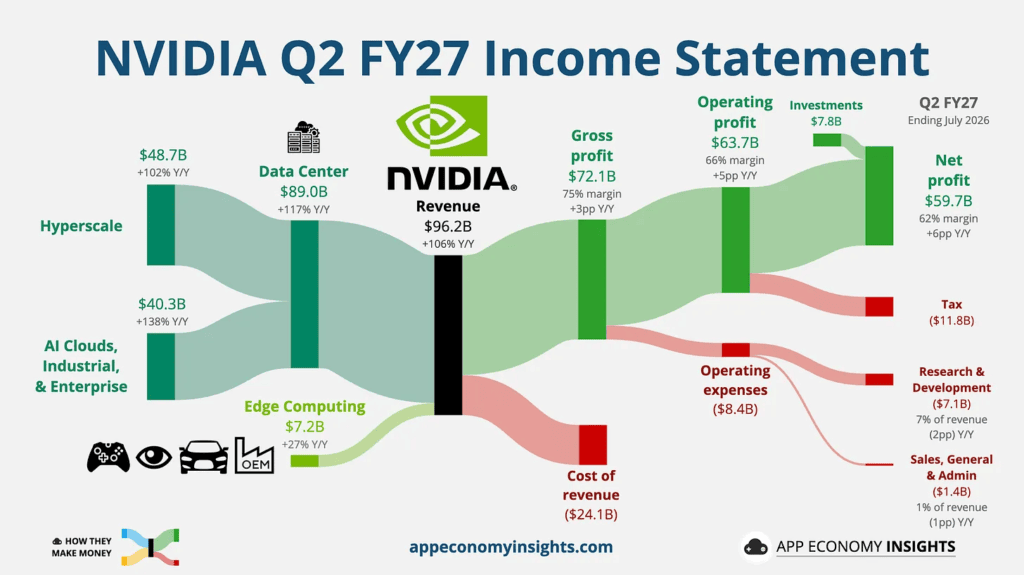
Nvidia’s growth accelerated again last quarter, with demand for AI infrastructure continuing to run ahead of the company’s ability to supply it. Revenue reached $96.2 billion in Q2 FY2027, up 106% from a year earlier and about $4.1 billion above expectations.
The scale is becoming remarkable even by Nvidia’s standards. Management expects roughly 70% revenue growth in FY2028, which would add more than $200 billion in annual revenue — and even that forecast remains constrained by available supply.
Data Center Growth Accelerates
The quarter was once again driven overwhelmingly by AI infrastructure.
- Revenue: $96.2 billion, up 106%
- Data Center: $89.0 billion, up 117%
- Edge Computing: $7.2 billion, up 27%
- Gross margin: 75%
- Operating margin: 66%
- Non-GAAP EPS: $2.22, beating expectations by $0.13
Nvidia generated $24.1 billion in operating cash flow and $21.3 billion in free cash flow. It ended the quarter with $99.4 billion in cash and marketable securities, compared with $33.4 billion of debt.
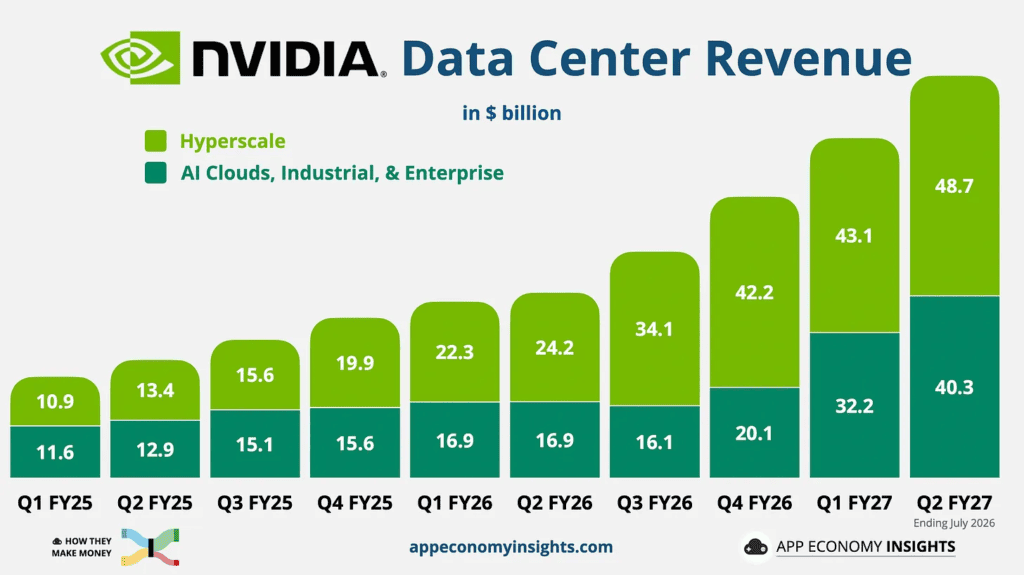
Growth is also spreading beyond the biggest technology companies. Hyperscalers generated $48.7 billion of Data Center revenue, while Nvidia’s AI Clouds, Industrial and Enterprise category reached $40.3 billion, showing stronger demand from neoclouds, businesses and sovereign AI projects.
Another $108 Billion Quarter Is Coming
For Q3, Nvidia expects revenue of $108 billion, up around 12% sequentially and 89% year over year. Importantly, that forecast assumes no Data Center compute revenue from China.
But maintaining this growth is becoming more expensive.
Gross margin is expected to decline from 75% to 74% in Q3, with App Economy Insights expecting pressure toward roughly 71%-72% in Q4 as memory costs rise. Nvidia has responded by aggressively securing future supply: its supply and capacity commitments jumped from $119 billion to $279 billion in just three months, largely to secure memory.
Rubin Arrives Before Blackwell Slows
Nvidia is already moving into its next generation of AI hardware even as Blackwell Ultra continues ramping.
The company estimates that the revenue opportunity from building one gigawatt of AI infrastructure has risen dramatically across generations: from roughly $18 billion with Hopper, to $25 billion with Blackwell and now around $40 billion with Vera Rubin.
Rubin combines Nvidia’s GPUs, CPUs, networking and software. According to the company, it can deliver 30 times higher throughput per megawatt and 35 times lower token costs than Grace Blackwell Ultra. Production shipments have already started, while Nvidia says the platform is ramping into full production.
That matters because there has been little sign of the expected pause between Nvidia’s product cycles. Instead, Rubin is beginning to arrive while Blackwell demand remains strong.
Nvidia Is Also Financing the AI Boom
Nvidia is increasingly doing more than selling chips.
The company has invested nearly $50 billion in frontier AI labs and is working with financial institutions including BlackRock, Blackstone, Goldman Sachs, KKR, Apollo and Brookfield on platforms intended to mobilize more than $500 billion in third-party capital for AI infrastructure over time.
Nvidia is also using financing arrangements to help AI labs and neocloud companies build capacity. That can create more customers for Nvidia hardware, but it also creates a new risk: Nvidia becomes increasingly exposed to whether those customers can eventually generate enough money from AI to justify their enormous infrastructure spending.
Hugging Face Pushes Nvidia Beyond Chips
The strategy is expanding into software as well. According to The Information, Nvidia has agreed to acquire Hugging Face for $12.9 billion.
Hugging Face is one of the world’s largest platforms for discovering and distributing open AI models. With annual revenue of only around $150 million, the acquisition is much more about strategic positioning than immediate earnings.
Owning the platform could bring Nvidia closer to developers and strengthen the connection between open-source AI adoption and Nvidia’s computing ecosystem.
Related: Nvidia Agrees to Buy Hugging Face for $12.9 Billion in Major AI Deal
The Risks Are Growing Too
Nvidia’s biggest challenge may eventually come from its own customers.
Companies are increasingly developing custom AI chips for specific workloads. OpenAI, for example, says its new Jalapeño inference chip produced 1.5 to 1.9 times more throughput per watt than the Nvidia systems it tested across several models. OpenAI still plans to use Nvidia broadly, but specialized chips could gradually take some inference workloads away from Nvidia.
Financing is another risk. Nvidia says AI labs receiving some form of balance-sheet support could represent roughly one-quarter of its business next year. Meanwhile, memory shortages are putting pressure on margins even as the company commits increasingly large amounts of money to securing supply.
Investor takeaway: Nvidia is still growing faster than almost anyone expected possible at its size. Demand is broadening, Blackwell remains strong and Rubin is arriving without a major pause between product cycles. But the next phase comes with bigger risks: higher supply commitments, lower margins, customer financing and growing competition from custom chips. For now, however, Nvidia’s biggest problem remains an unusual one — it simply cannot build enough AI infrastructure to meet demand.
Disclosure: This article does not represent investment advice. The content and materials featured on this page are for educational purposes only.
Supported source: App economic insights.