
The single most reliable way to improve decision making is to routinize a short structured process, add specific bias checks at the moments they matter most, and practice both in small, low-stakes reps. Process discipline beats raw intuition and pure gut feel almost every time stakes are real. This guide gives you a repeatable framework, the exact bias countermeasures backed by research, and templates you can copy into your notes before your next big call.
TL;DR:
- Implementing a structured, seven-step decision process for high-impact choices reduces bias and improves decision quality, especially when combined with bias checks.
- Using simple tools like pre-mortems, reference-class forecasting, and decision trees at the appropriate decision points can significantly lower common cognitive biases.
- Practicing deliberate decision-making daily and maintaining a decision journal helps build skills, while matching decision tools to the stakes ensures efficiency and accuracy.
- Ethical considerations and emotional intelligence play crucial roles, with reflection pauses and stakeholder analysis preventing risk of bias and moral pitfalls.
- Group decision-making benefits from structured roles, written opinions, and clear decision rights, avoiding pitfalls like groupthink and social reinforcement of biases.
Table of Contents
- What Is a Structured Decision-Making Framework?
- Which Cognitive Biases Distort Your Decisions?
- Which Decision-Making Tool Fits Your Situation?
- How Do You Practice Decision-Making Skills?
- What Should Be on Your Pre-Decision Checklist?
- Why Does Emotional Intelligence Matter in Decision Making?
- How Do Group Dynamics Affect Decision Quality?
- What Role Does Technology Play in Better Decisions?
- How Do You Decide With Incomplete Information?
- What Makes a Decision Ethical, Not Just Effective?
- Do Decision-Making Styles Differ, and How Do You Adapt?
- Why Process Discipline Beats Outcome Chasing
- Get Decision Templates and Weekly Market Insights From Finblog
- Sources
What Is a Structured Decision-Making Framework?
A structured decision-making framework is a repeatable sequence that forces you to slow down at the points where judgment typically breaks. The version taught in most academic and workplace guides runs seven steps, and it works whether you’re picking a job offer or allocating a portfolio.
- Identify the decision. Name the actual choice, not the vague problem around it. “Should I refinance this loan” is a decision; “money stress” is not.
- Gather information. Pull the facts you’re missing, but set a deadline. Open-ended research is how good decisions turn into stalled ones.
- Generate alternatives. Force at least three options, even a deliberately bad one. Two options is a false choice.
- Evaluate the evidence. Weigh each alternative against your actual constraints, not just the ones you find comfortable.
- Choose. Commit, on paper or out loud, to the option and the reasoning behind it.
- Act. Execute without relitigating the choice every few hours.
- Review. Revisit the decision later against the process you used, not just how it turned out.
This sequence traces closely to the seven-step decision process used in structured decision education, and it scales down as easily as it scales up. A personal example: choosing between two apartments, you’d name the trade-off (cost versus commute), list three options including staying put, and pick based on a two-year time horizon rather than which one “felt right” during the tour. A work example: deciding whether to hire a contractor versus a full-time employee means comparing total cost, ramp time, and flexibility before committing, then writing down why.
You don’t need all seven steps for a $40 purchase. Save the full method for decisions with real financial, relational, or career weight. For everything else, a three-item checklist is enough.
Which Cognitive Biases Distort Your Decisions?
Four biases account for most of the bad calls people make under normal conditions, and each has a specific, low-effort fix.
- Confirmation bias, the tendency to notice evidence that supports what you already believe, is countered by deliberately seeking disconfirming evidence before you finalize a choice.
- Outcome bias, judging a past decision by how it turned out rather than by the quality of the reasoning at the time, is countered by logging your decision rationale before you know the result, then reviewing the log instead of your memory.
- Availability bias, overweighting information that’s vivid or recent, is countered by taking an outside view: pulling a reference class of similar past cases instead of relying on the one example that comes to mind.
- Excessive coherence, the habit of building a tidy, plausible story out of sparse data, is countered by a structured pre-mortem that forces you to imagine how the story could be wrong.
The MIT Sloan Review identifies excessive coherence as a major source of decision noise. It’s why confident, well-reasoned-sounding plans still fail: the story felt complete because the data was thin, not because the plan was sound.
A SIOP and SHRM white paper on workplace decision quality found that structured tactics like consider-the-opposite and reference-class forecasting produce measurable reductions in bias, often in the same session where the decision itself gets made.
The common thread: none of these fixes require more time. They require one deliberate question inserted at the right moment, like “what would make this go wrong?” before you sign anything.
Which Decision-Making Tool Fits Your Situation?
Different decisions call for different tools, and matching the tool to the stakes and time available matters more than picking the “best” one.
- Decision trees work best when a choice branches into clear sequential outcomes with different probabilities, like whether to appeal a claim or settle.
- SWOT analysis fits broader strategic calls, such as whether to expand a business line, where you need to weigh internal and external factors side by side.
- 5 Whys is built for root-cause problems, tracing a symptom back to its actual origin instead of patching the surface issue.
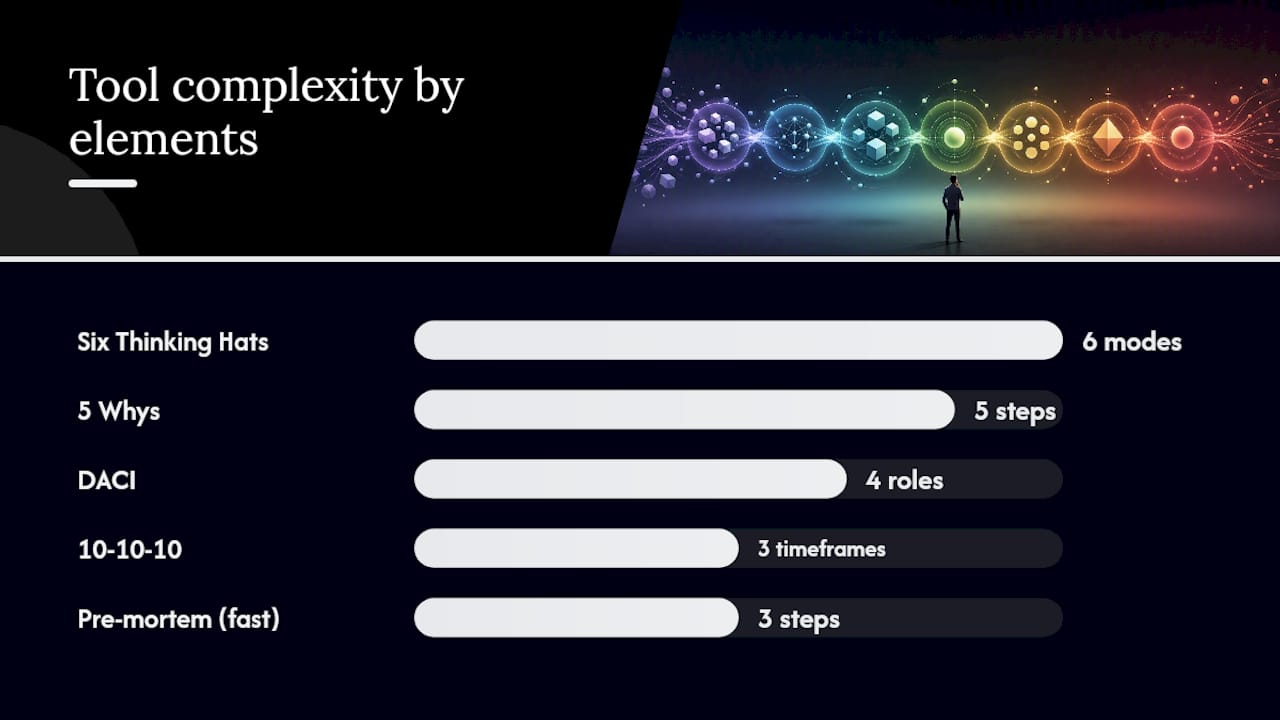
- Six Thinking Hats helps when a group keeps arguing from the same single perspective, since it forces the room through six modes deliberately: facts, feelings, risks, benefits, creativity, and process.
- DACI (Driver, Approver, Contributor, Informed) clarifies who actually decides in a group, which prevents the slow-motion paralysis that kills team decisions.
- 10-10-10 asks how you’ll feel about this choice in 10 minutes, 10 months, and 10 years, which is remarkably effective at defusing decisions driven by short-term emotion.
For speed, try this three-step pre-mortem: (1) assume the decision failed, (2) write down the three most likely reasons why, (3) adjust the plan to address at least one of them before you commit. Pair it with a one-minute rating chart: list your top three options across the top, your top three criteria down the side, and score each cell 1 to 5.
Pro Tip: Combine tools with the seven-step process instead of choosing one or the other. Use a pre-mortem inside step four (evaluate evidence) rather than treating it as a separate exercise.
How Do You Practice Decision-Making Skills?
Decision quality is a trained skill, not a fixed trait, and it improves fastest through small repeated reps rather than one big study session.
- Run daily micro-decisions deliberately. Pick one low-stakes choice each day (what to eat, which task to start with) and apply a mini version of the seven-step process. It builds the habit without any real cost of failure.
- Keep a decision journal. Write the decision, your reasoning, and your confidence level before you know the outcome. Review it monthly against actual results to separate process quality from outcome quality.
- Find a peer challenger. Ask one person to routinely ask “what’s the counterargument here?” before you finalize anything above a certain stakes threshold.
Use a 14-day sequencing rule: pick one technique, like the pre-mortem, and practice it daily for two weeks before layering on a second one. Trying to adopt five techniques at once is why most people quit after a week. Batch small recurring decisions into standing rules (a fixed grocery budget, a set investment contribution) so you reserve full structured effort for decisions that are genuinely novel or high-stakes.
What Should Be on Your Pre-Decision Checklist?
Keep a short version taped to your process for anything routine, and a longer version reserved for anything with real financial or career weight.
Short checklist (use for most decisions):
- Have I named the actual decision, not just the problem?
- Do I have at least three real alternatives?
- What would change my mind?
Full checklist (use for high-stakes decisions):
- Have I generated alternatives beyond the first two that came to mind?
- Have I argued the opposite case as seriously as I argued my own?
- Have I pulled a reference class of similar past decisions?
- Have I written down my reasoning before I know the outcome?
For financial decisions, add a specific reference-class question: “What happened the last three times someone made a similar call under similar conditions?” Our guide to evaluating investment opportunities walks through applying this exact checklist to a real allocation decision. For personal decisions, swap that for a values check: does this choice match what you said mattered to you a year ago?
Why Does Emotional Intelligence Matter in Decision Making?
Emotional intelligence isn’t a soft add-on to decision making. It’s the mechanism that determines whether you can even see your own bias in the moment.
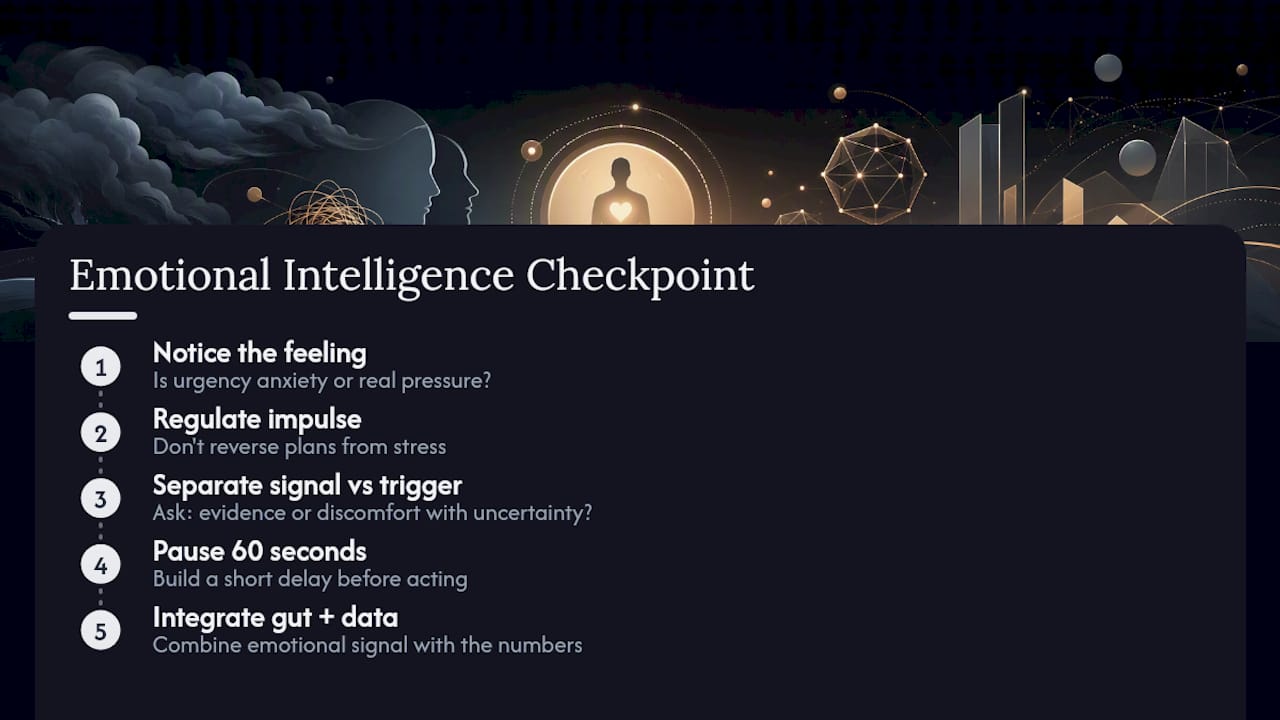
Self-awareness lets you notice when a decision feels urgent because of anxiety rather than actual time pressure, which is one of the most common ways people skip steps in a structured process. Self-regulation is what keeps you from reacting to a bad quarter or a stressful negotiation with an impulsive reversal of a plan you built carefully weeks earlier.
Emotions aren’t noise to filter out before deciding. They’re data, often faster and more accurate than conscious analysis about whether something feels wrong, but they need a check before they drive the final call. The practical move is to separate the signal from the trigger: if you feel a strong pull toward one option, ask whether that pull is coming from evidence or from discomfort with uncertainty. A decision made purely on logic while ignoring a strong gut objection often misses something the data didn’t capture. A decision made purely on emotion while ignoring the numbers usually ignores something the data captured clearly.
The practical habit: build a short pause into your process, even 60 seconds, between forming a strong emotional reaction and acting on it. That pause is where emotional intelligence actually gets applied, not in some abstract sense of “being in touch with your feelings,” but as a specific checkpoint inside your decision process.
How Do Group Dynamics Affect Decision Quality?
Groups don’t just average out individual judgment. They amplify certain errors and suppress others, and the direction depends entirely on how the discussion is run.
Groupthink happens when a team converges on a shared narrative too fast, usually because the most confident or senior voice speaks first and everyone else anchors to it. This is the same excessive coherence problem that shows up in individual judgment, except now it’s socially reinforced, which makes it harder to challenge out loud.
The fix is procedural, not attitudinal. Collect opinions in writing before the group discussion starts, so people commit to a position before hearing anyone else’s. Assign someone the explicit role of devil’s advocate for that meeting, rotating the job so it doesn’t become a personality trait. Use a framework like DACI to separate who contributes an opinion from who actually approves the final call, since ambiguity about decision rights is one of the most common reasons group decisions stall or get quietly overturned later.
The IMD research on decision quality under pressure emphasizes inclusive processes and probabilistic framing as two of the ten principles that consistently separate strong group outcomes from weak ones. Smaller, more diverse groups with clear decision rights tend to outperform larger consensus-seeking ones, mainly because consensus-seeking rewards agreement over accuracy.
What Role Does Technology Play in Better Decisions?
Decision support tools don’t replace judgment, but they remove a lot of the manual friction that causes people to skip steps under time pressure.
Spreadsheet-based rating charts and scoring models formalize step four of the structured process, forcing explicit criteria instead of a vague sense of which option “feels better.” Behaviorally informed scorecards, like the kind described in frameworks for self-directed traders, go further by tracking your own historical bias patterns so you can see, over time, whether you consistently overweight recent losses or underweight downside risk.
Structured courses and practitioner guides, including material from Coursera’s decision-making curriculum, consolidate tools like decision trees and stakeholder mapping into formats that are easy to apply without a statistics background. The value isn’t the software. It’s that a tool forces you to write down your criteria before you see the outcome, which is the exact discipline that prevents outcome bias from rewriting your memory of why you chose something.
The risk with any decision-support tool is treating its output as an answer rather than an input. A rating chart that spits out a top score is still built on the weights you assigned, and those weights carry your biases forward. Use the tool to structure the conversation, not to outsource the judgment.
How Do You Decide With Incomplete Information?
Waiting for complete information is itself a decision, usually the wrong one, since most real choices have a deadline whether you acknowledge it or not.
The practical approach is probabilistic thinking: instead of asking “what will happen,” ask “what’s the range of outcomes and how likely is each one.” This reframes uncertainty from a wall you can’t see past into a distribution you can reason about, even with thin data. Assign rough confidence levels (low, medium, high) to your key assumptions, then identify which assumption, if wrong, would change your decision. That single question tells you where to spend your limited research time instead of researching everything equally.
Reversible decisions deserve less analysis than irreversible ones, since you can correct course cheaply if new information arrives. A decision that’s hard or expensive to undo, like a long-term lease or a career change, justifies the full structured process even under real time pressure. When you genuinely can’t gather more information before a deadline, default to the option that keeps the most future options open, sometimes called the “regret minimization” approach, rather than the option that looks best under a single assumed scenario.
What Makes a Decision Ethical, Not Just Effective?
An effective decision and an ethical one aren’t automatically the same thing, and conflating them is how good processes produce outcomes people later regret.
Start by naming who’s affected beyond the immediate decision-maker. Most flawed ethical calls happen because someone genuinely didn’t map out the second-order effects on a customer, a coworker, or a community, not because they consciously chose to cause harm. A short stakeholder list, even three names long, catches most of these blind spots before they become a problem.
Test the decision against transparency: would you be comfortable explaining your reasoning publicly, to the people it affects, in plain language? If the honest answer requires euphemism or omission, that’s a signal the decision needs revisiting, not just better wording. Pair that with a consistency check: would you make the same call if the situation were reversed, and you were on the receiving end instead of the one deciding?
Ethical decisions also benefit from the same disconfirming-evidence habit used against confirmation bias. Actively look for the argument that your decision is wrong on ethical grounds, not just on practical ones, before you finalize it. That single step catches most rationalized shortcuts before they turn into decisions you have to defend later.
Do Decision-Making Styles Differ, and How Do You Adapt?
People default to different decision styles, and the mismatch between your natural style and the situation is often where things go wrong, not the style itself.
Analytical decision-makers gather extensive data before choosing and do well with complex, high-stakes decisions but tend to stall on time-sensitive ones. Intuitive decision-makers move fast on pattern recognition built from real experience, which works well in familiar domains and poorly in genuinely novel ones. Directive decision-makers value speed and clear ownership, which helps in crises but can skip steps that matter in ambiguous situations. Conceptual decision-makers focus on the big picture and long-term implications, valuable for strategy but sometimes light on execution detail.
None of these styles is wrong on its own. The skill is matching style to context: an intuitive style is efficient in a domain where you have real pattern-matching experience, and dangerous in one where you don’t. The adaptation move is simple. Before a decision, ask which style you’re defaulting to and whether the situation actually calls for it. A directive style facing a genuinely novel, high-stakes choice is a mismatch worth catching before you act, not after.
Why Process Discipline Beats Outcome Chasing
Most people judge their financial decisions by how they turned out, which is exactly backward. A good process can produce a bad outcome through no fault of the decision-maker, and a bad process can get lucky. If you only track results, you’ll reinforce the wrong lessons for years without noticing.
The practitioners who improve fastest are the ones who log their reasoning before the outcome is known, then review that log on a schedule, separate from the emotional charge of a win or a loss. Try it for two weeks: write down the decision, the alternatives you considered, and your confidence level, then don’t look at it again until day 14. What you’ll usually find isn’t that your outcomes were random. It’s that your process had a specific, fixable gap you couldn’t see in the moment.
— Povilas
Get Decision Templates and Weekly Market Insights From Finblog
The checklists in this guide work best when they’re in front of you before the decision, not reconstructed from memory afterward. The site provides practical decision templates and financial analysis designed for people applying structured thinking to significant money decisions, such as evaluating an investment, timing a major purchase, or working through a financial plan. Our step-by-step investment planning guide walks through applying the same seven-step framework to building a plan from scratch, and our breakdown of financial mistakes to avoid shows what happens when these bias checks get skipped. Sign up for the newsletter to get decision templates and weekly market analysis sent directly to your inbox, and start your next financial decision with the checklist already in hand.
This article is general information, not a substitute for advice from a qualified financial advisor. Consult a qualified financial professional about your own circumstances before acting on anything here.
Sources
- Decision-making process (UMass Dartmouth)
- Evidence-Based Strategies to Improve Workplace Decisions (SIOP/SHRM white paper)
- A structured approach to strategic decisions (MIT Sloan Review)
- Ten principles for making better decisions (IMD)