

More than half of American investors admit they are unsure about their true risk tolerance when starting out. Understanding your personal goals and how much uncertainty you are comfortable with is the first essential step in making sound investment choices. This article breaks down a clear process any American can use to clarify their objectives, analyze opportunities, and protect themselves from common investing pitfalls.
Table of Contents
- Step 1: Define Your Investment Objectives And Risk Profile
- Step 2: Research Market Trends And Gather Essential Data
- Step 3: Analyze Financial Statements And Key Performance Metrics
- Step 4: Compare Potential Opportunities Using Standardized Criteria
- Step 5: Verify Due Diligence And Review For Potential Risks
Quick Summary
| Key Point | Explanation |
|---|---|
| 1. Define Your Investment Goals | Establish clear investment objectives aligned with your financial situation and risk tolerance for effective strategy creation. |
| 2. Conduct Comprehensive Market Research | Gather and analyze market trends and data from various sources to identify potential investment opportunities. |
| 3. Analyze Financial Statements Thoroughly | Review income statements, balance sheets, and cash flow to evaluate the financial health of investment options. |
| 4. Use Standardized Criteria for Comparisons | Create a systematic comparison matrix using key performance indicators to objectively evaluate and rank investments. |
| 5. Perform Due Diligence to Assess Risks | Investigate potential vulnerabilities and develop risk mitigation strategies to enhance informed investment decisions. |
Step 1: Define your investment objectives and risk profile
Defining your investment objectives and risk profile serves as the foundational blueprint for your entire investment strategy. Effective investment management requires clear communication of investment goals that align with your personal financial circumstances and long-term aspirations.
To create a robust investment profile, start by honestly assessing your financial situation and future goals. Consider factors like your current income, expected retirement timeline, risk tolerance, and liquidity needs. These elements will help you determine whether you are seeking aggressive growth, stable income, capital preservation, or a balanced approach. Your risk tolerance can be determined through comprehensive evaluation of your emotional comfort with market fluctuations, investment timeline, and financial capacity to absorb potential losses.
A strategic investment approach involves matching your personal risk profile with appropriate investment vehicles. Conservative investors might prioritize bonds and stable dividend stocks, while more aggressive investors could allocate larger percentages to growth stocks or emerging market funds. Remember that your investment objectives are not static your investment plan should evolve with changing life circumstances, requiring periodic reassessment and potential rebalancing.
Step 2: Research market trends and gather essential data
Marketing intelligence involves systematically gathering crucial information that helps investors make informed decisions about potential investment opportunities. In this step, you will learn how to effectively collect and analyze market data that provides meaningful insights into potential investment strategies.
Begin your research by exploring multiple authoritative sources, including financial news platforms, industry reports, and economic indicators. Advanced techniques like natural language processing can help predict stock price fluctuations by identifying key events and trends that might impact market performance. Pay close attention to sector performance, economic indicators, global market movements, and emerging technological developments that could influence investment opportunities.
To ensure comprehensive market analysis, diversify your information sources and cross reference data from different perspectives. Understanding how to spot market trends requires a methodical approach that combines quantitative data with qualitative insights. Consider tracking leading economic indicators, quarterly earnings reports, geopolitical events, and technological innovations that might signal potential market shifts. Remember that successful market research is an ongoing process requiring consistent monitoring and adaptable strategy refinement.
Step 3: Analyze financial statements and key performance metrics
Modern portfolio theory provides a sophisticated mathematical framework for evaluating investment opportunities by systematically breaking down financial performance. This step will help you develop critical analytical skills to assess potential investments through comprehensive financial statement review and performance metric evaluation.
Start by examining three fundamental financial statements income statement, balance sheet, and cash flow statement. Look for key indicators like revenue growth, profit margins, debt levels, and cash reserves. Portfolio management strategies emphasize the importance of understanding asset allocation and risk management through detailed financial analysis. Pay special attention to trends over multiple reporting periods, comparing current performance against historical data and industry benchmarks.

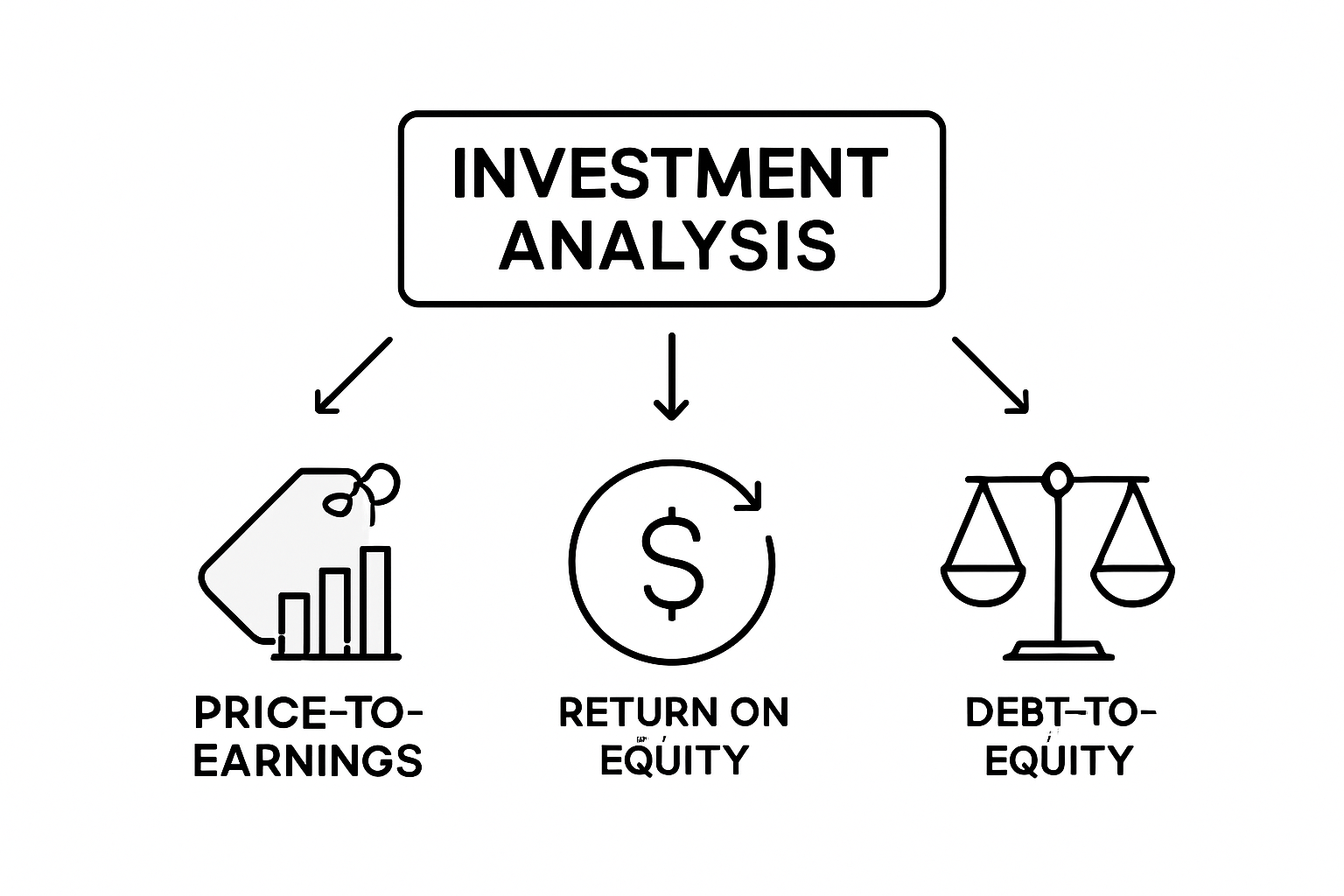
To gain deeper insights, calculate critical financial ratios such as price to earnings, return on equity, and debt to equity. These metrics provide a nuanced view of a company’s financial health and potential for future growth. Creating an investment plan requires a systematic approach that goes beyond surface level numbers and seeks to understand the underlying financial narrative of each potential investment opportunity.
Step 4: Compare potential opportunities using standardized criteria
Roy’s safety-first criterion offers a strategic approach to evaluating investment opportunities by establishing a systematic method for comparing potential investments. This step will help you develop a structured framework for assessing and ranking investment options based on objective, measurable criteria.
Create a comprehensive comparison matrix that includes key performance indicators such as historical returns, risk levels, volatility, and potential for growth. Advanced optimization techniques using fuzzy logic can enhance your comparative analysis by providing nuanced insights beyond traditional numerical assessments. Consider developing a weighted scoring system that assigns importance to different metrics based on your personal investment objectives and risk tolerance.
Ensure your evaluation process remains consistent by establishing clear benchmarks and avoiding emotional decision making. Understanding how to create an effective investment plan requires disciplined analysis that goes beyond surface level comparisons. Focus on long-term potential and alignment with your overall financial strategy rather than short-term fluctuations or market noise.
Step 5: Verify due diligence and review for potential risks
Clear communication regarding investment objectives and risks forms the cornerstone of responsible investment decision making. This critical step involves a comprehensive examination of potential vulnerabilities and hidden challenges that could impact your investment performance.
Conduct an exhaustive risk assessment by investigating multiple dimensions of potential investments. Examine regulatory compliance, management team background, competitive landscape, and potential market disruptions that could affect your investment. Look beyond financial statements to understand the broader context of each investment opportunity including technological trends, geopolitical factors, and industry specific challenges that might not be immediately apparent from standard financial reporting.
Implement a systematic risk mitigation strategy that includes scenario planning and stress testing potential investments. Creating an investment plan requires a proactive approach to understanding and managing potential risks. Develop a disciplined framework for continuously monitoring your investments, establishing clear exit strategies, and maintaining the flexibility to adapt your portfolio as market conditions evolve.
Make Confident Investment Decisions with Expert Guidance
Navigating the complexities of evaluating investment opportunities requires a clear understanding of your investment objectives, risk tolerance, and thorough market research. This article highlights challenges like assessing financial statements and comparing options with standardized criteria. Don’t let uncertainty or complex analysis hold you back from making strategic and confident choices.
At finblog.com, we offer tailored insights and expert advice designed to help you craft a personalized investment plan that adapts to your goals. Whether you are focused on risk management or looking to deepen your financial statement analysis skills, our resources provide a practical and disciplined approach to investing.
Take control today. Visit finblog.com and discover tools and advice that empower you to evaluate investment opportunities with confidence. Start building a strategy that works for your future by exploring our guides on creating an investment plan and learn more about effective risk management. Your financial success begins with informed decisions. Act now to secure your investment journey.
Frequently Asked Questions
How do I define my investment objectives?
To define your investment objectives, assess your current financial situation, risk tolerance, and future goals. Start by identifying whether you seek aggressive growth, stable income, capital preservation, or a balanced approach.
What market trends should I research before making an investment decision?
Research market trends by analyzing economic indicators, sector performance, and emerging technologies. Begin by tracking leading economic indicators and quarterly earnings reports to gain insights into potential investment strategies.
How do I analyze financial statements to evaluate investment opportunities?
To analyze financial statements, start by reviewing the income statement, balance sheet, and cash flow statement for key indicators such as revenue growth and debt levels. Calculate financial ratios like price-to-earnings and return on equity to gain a clearer picture of a company’s financial health.
What criteria should I use to compare potential investment opportunities?
Use a structured comparison matrix that includes key performance indicators such as historical returns and volatility. Develop a weighted scoring system to prioritize metrics that align with your investment objectives and risk profile.
How can I perform due diligence on potential investments?
Perform due diligence by assessing regulatory compliance, management backgrounds, and competitive landscapes. Investigate potential market disruptions and develop a proactive risk mitigation strategy to adapt your portfolio as conditions change.
Recommended
- Master Building an Investment Portfolio for Profits – Finblog
- 7 Safe Investment Options for Your Financial Future – Finblog
- 7 Common Investment Mistakes and How to Avoid Them – Finblog
- Creating an Investment Plan: Step-by-Step Success Guide – Finblog
- Private equity CRM solutions: What you Need to Know | Singleclic
- Pourquoi investir dans la vidéo professionnelle : Guide complet