

Start by listing every loan with its balance, APR, minimum payment, and due date. That single step, done in one sitting, decides which payoff method actually fits your life. From there, pick either the debt avalanche or the debt snowball method and commit to it. The exact strategy matters less than the fact that you choose one and stick with it long enough to see progress.
TL;DR:
- Building a complete debt inventory, including interest rates and due dates, allows you to determine which repayment method aligns with your discipline and motivation.
- The debt avalanche saves more money by targeting the highest-interest loans first, while the debt snowball offers quicker psychological wins from paying off smaller balances.
- Extra payments, such as automatic transfers or windfall redirects, can reduce your payoff timeline by up to two years and significantly lower interest costs.
- Confirm that any consolidation or refinancing plan has clear benefits by calculating fees, interest rates, loan terms, and their impact on your credit to avoid increasing total costs.
- Automating payments, tracking progress visually, and maintaining consistent habits are essential to prevent behavioral slip-ups and stay committed to your debt payoff plan.
Table of Contents
- How to Pay Off Loans: Build Your Debt Inventory First
- Debt Avalanche or Debt Snowball: Which Should You Use?
- Payment Tactics That Cut Your Payoff Time
- Is Consolidation or Refinancing Worth It?
- Where Can You Find Extra Cash Each Month?
- Negotiating With Creditors: What to Say and What to Avoid
- How to Stay on Track Once the Plan Is in Motion
- How Much Time and Interest Do Extra Payments Actually Save?
- Why Willpower Alone Won’t Get You Debt Free
- Does Paying Off a Loan Help or Hurt Your Credit Score?
- Are There Tax Benefits to Paying Off Certain Loans?
- Author Perspective: Practical Priorities From a Finblog Advisor
- How Finblog Can Help You Build a Plan That Sticks
- Sources
How to Pay Off Loans: Build Your Debt Inventory First
You can’t out-strategize a debt you haven’t fully counted. Before choosing how to pay off loans, sit down and build a complete inventory of what you owe.
For each loan, write down:
- Creditor or loan servicer name
- Current balance
- APR (interest rate)
- Minimum monthly payment
- Due date
- Online account login details
Each field earns its place on the list. The APR tells you which debt is bleeding you the most in interest. The due date tells you where cash-flow problems might sneak up on you. Miss either one and you’re guessing, not planning.
Pull this information from recent billing statements, your lender’s online portal, or your official credit file at AnnualCreditReport.com, which can surface accounts you forgot about entirely. Give yourself one hour. That’s usually enough to get every number on paper and move to the next step.
Debt Avalanche or Debt Snowball: Which Should You Use?
Once your inventory is built, order it two different ways and see which order motivates you more.
The debt avalanche ranks debts by APR, highest first. You throw every extra dollar at that top-rate loan while paying minimums on everything else. Mathematically, this saves you the most money in interest over the life of your repayment, because you stop the most expensive debt from compounding first.
The debt snowball method ranks debts by balance, smallest first, regardless of interest rate. You pay it off fast, then roll that entire payment into the next smallest balance. It’s less efficient on paper, but it delivers quick wins that keep you engaged.
Statistic to consider: the psychological research behind the snowball method suggests people who focus on knocking out small balances first are more likely to complete their debt payoff plan than those chasing pure interest savings alone, simply because early wins keep momentum alive.
- Choose avalanche if you’re disciplined enough to wait months before seeing a balance hit zero.
- Choose snowball if you’ve abandoned debt plans before and need visible progress to stay in the game.
Order your inventory accordingly, circle debt number one, and send every spare dollar there starting with your next paycheck.
Payment Tactics That Cut Your Payoff Time
Picking a strategy is half the battle. Execution is where balances actually shrink. A few tactics compress your timeline without requiring a windfall.
- Pay more than the minimum, every time. Even an extra $50 a month reduces the principal balance the interest is calculated against.
- Split your payment in two. Paying half your monthly amount every two weeks instead of once a month adds up to one extra full payment per year, almost without noticing.
- Round up and redirect windfalls. Round every payment up to the next $50 or $100, and send tax refunds, bonuses, or rebates straight to principal instead of your checking account.
- Use 0% balance-transfer offers carefully. These cards can pause interest accrual during a promotional window, but they typically charge a 3 to 5 percent upfront transfer fee, and the rate jumps sharply once the promo period ends. Only transfer a balance if you have a realistic plan to pay it off before that deadline hits.
Pro Tip: Call your lender before assuming extra payments go where you think. Some auto and mortgage servicers apply extra money to next month’s payment instead of knocking down principal, unless you explicitly tell them otherwise.
Also confirm there’s no prepayment penalty buried in your loan terms. Most personal loans don’t carry one, but some private student loans and older auto loans still do.
Is Consolidation or Refinancing Worth It?
Sometimes, yes. Sometimes it quietly costs you more. It depends entirely on the math you run before signing anything.
The main routes are a personal consolidation loan, a home-equity loan or line of credit, student loan consolidation, and credit card balance transfers. Each rolls multiple debts into one payment, often at a lower rate than what you’re currently paying across several cards or loans.
Before committing, run the numbers on:
- Total fees, including origination charges
- The actual APR after any promotional period ends
- The new loan term length
- How your monthly payment changes
- Whether you’re putting up collateral, like your home
Consolidation can backfire in two specific ways. Stretching a five-year debt into a twelve-year loan often lowers your payment but increases total interest paid, sometimes substantially. And rolling federal student loans into a private consolidation loan permanently forfeits income-driven repayment options and forgiveness programs. Read the fine print before you trade flexibility for a lower monthly number.
Where Can You Find Extra Cash Each Month?
Every payoff plan needs fuel, and that fuel is monthly cash you’re not currently sending toward debt. Finding it starts with an honest audit, not a drastic lifestyle overhaul.
- Calculate your actual take-home pay after taxes and deductions.
- List every fixed essential cost: rent, utilities, insurance, minimum debt payments.
- Go through your bank statement line by line and flag every subscription and recurring charge you don’t actively use.
- Apply a 50/30/20 style framework as a starting point, adjusting the debt-payoff slice upward if you’re carrying high-interest balances.
The subscription audit surprises most people. Three forgotten $15-a-month services add up to $540 a year, redirected entirely to principal instead of streaming platforms nobody watches anymore.
Pro Tip: If your monthly audit still comes up short, a short-term side gig or selling unused items for a month or two, with every dollar committed to your target debt, can shave real time off your payoff date without permanently changing your budget.
Negotiating With Creditors: What to Say and What to Avoid
Creditors would rather work with you than send your account to collections. That gives you more leverage than most people assume.
Before calling, prepare your documents, know your current balance and rate, and have a specific, realistic payment amount ready to propose. Ask directly whether a lower rate, a temporary forbearance, or a modified payment plan is available.
- A lowered rate reduces future interest without touching your credit.
- Temporary forbearance pauses payments but often lets interest keep accruing.
- A modified plan can extend your term, which lowers monthly cost but raises total interest paid.
Be cautious with for-profit debt settlement firms. The FTC warns that many of these companies instruct you to stop paying creditors entirely while you save toward a lump-sum settlement, a move that can severely damage your credit and trigger collections activity in the meantime. Free, HUD-approved credit counseling can usually design a comparable payment plan without the fees or the risk.
How to Stay on Track Once the Plan Is in Motion
Momentum dies quietest in month three, not month one. Building a few habits early keeps your plan running on autopilot instead of willpower alone.
- Automate your minimum payments so nothing slips into a late fee.
- Schedule your extra payment for the same day each month, right after payday.
- Check your statement afterward to confirm the extra amount actually reduced principal rather than sitting as a prepaid future payment.
- Build a small starter emergency fund, even $500 to $1,000, so a flat tire or a broken appliance doesn’t force you back onto a credit card.
Statistic to consider: people who track progress toward a goal visually, whether on a spreadsheet, an app, or a printed chart, are consistently more likely to reach that goal than those who don’t measure it at all. A simple payoff tracker does the same job for debt.
Pull your credit report periodically through AnnualCreditReport.com to confirm paid-off accounts are reporting correctly and no new collection items have appeared.
How Much Time and Interest Do Extra Payments Actually Save?
The math behind extra payments is more dramatic than most people expect, because interest compounds against whatever principal remains, not your original loan amount.
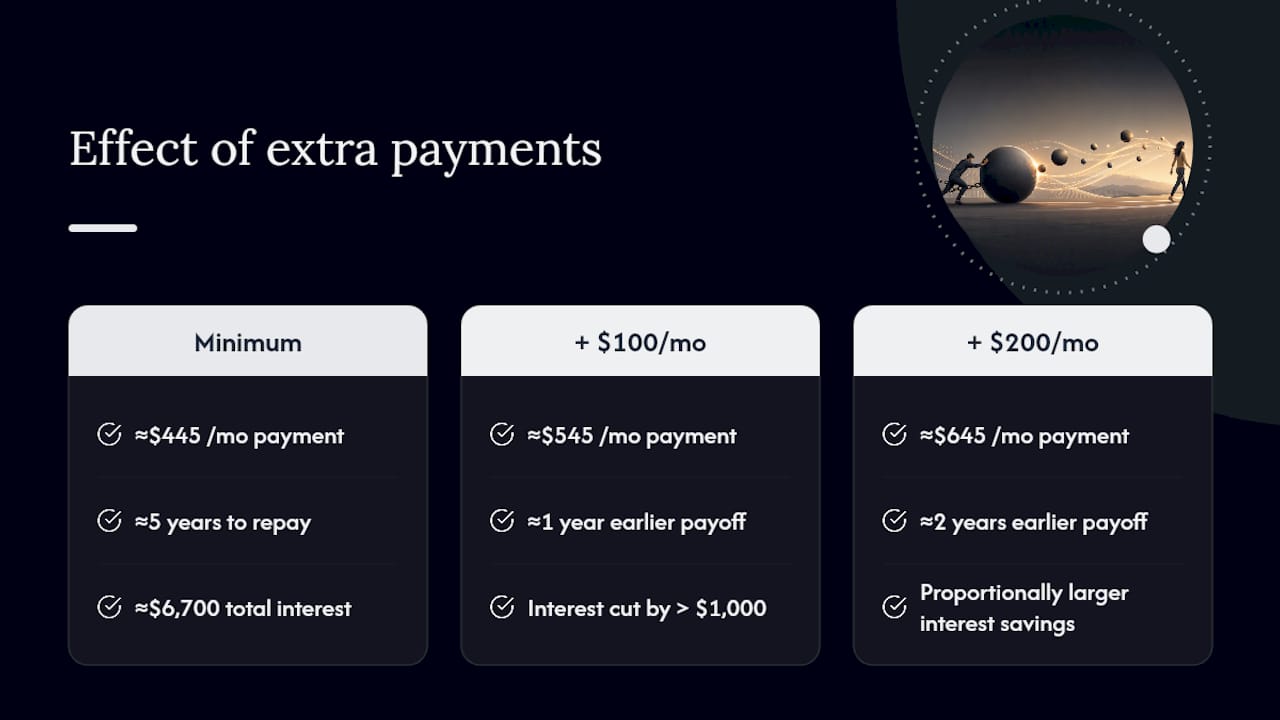
Picture a $20,000 personal loan at 12% APR on a five-year term. The minimum payment runs a little over $445 a month, and by the time it’s paid off, you’ve handed over roughly $6,700 in interest on top of the original balance. Add just $100 extra to that payment every month, applied to principal, and the loan typically pays off close to a year early, cutting total interest paid by more than $1,000. Push the extra payment to $200 a month and the timeline compresses further, sometimes by close to two years, with proportionally larger interest savings.
The pattern holds across loan types, though the numbers shift with the rate. A high-APR credit card balance sees an even bigger swing from extra payments than a lower-rate auto loan, because more of every minimum payment on a high-rate card goes toward interest instead of principal in the early months. That’s exactly why the avalanche method targets high-APR debt first: every dollar applied there does more work than the same dollar applied to a low-rate loan.
The compounding effect works in reverse too. Skip a payment or pay only the minimum for a stretch, and the timeline extends in the same nonlinear way it would have compressed. Consistency, not occasional large payments, is what actually bends the curve. A single $2,000 windfall payment helps, but $150 extra every month for two years usually beats it, because it keeps compound interest working against a shrinking balance the entire time instead of just once.
Why Willpower Alone Won’t Get You Debt Free
Paying off debt is a math problem for exactly the first five minutes. After that, it’s entirely a behavior problem, and most payoff plans fail for behavioral reasons, not because the strategy was wrong.
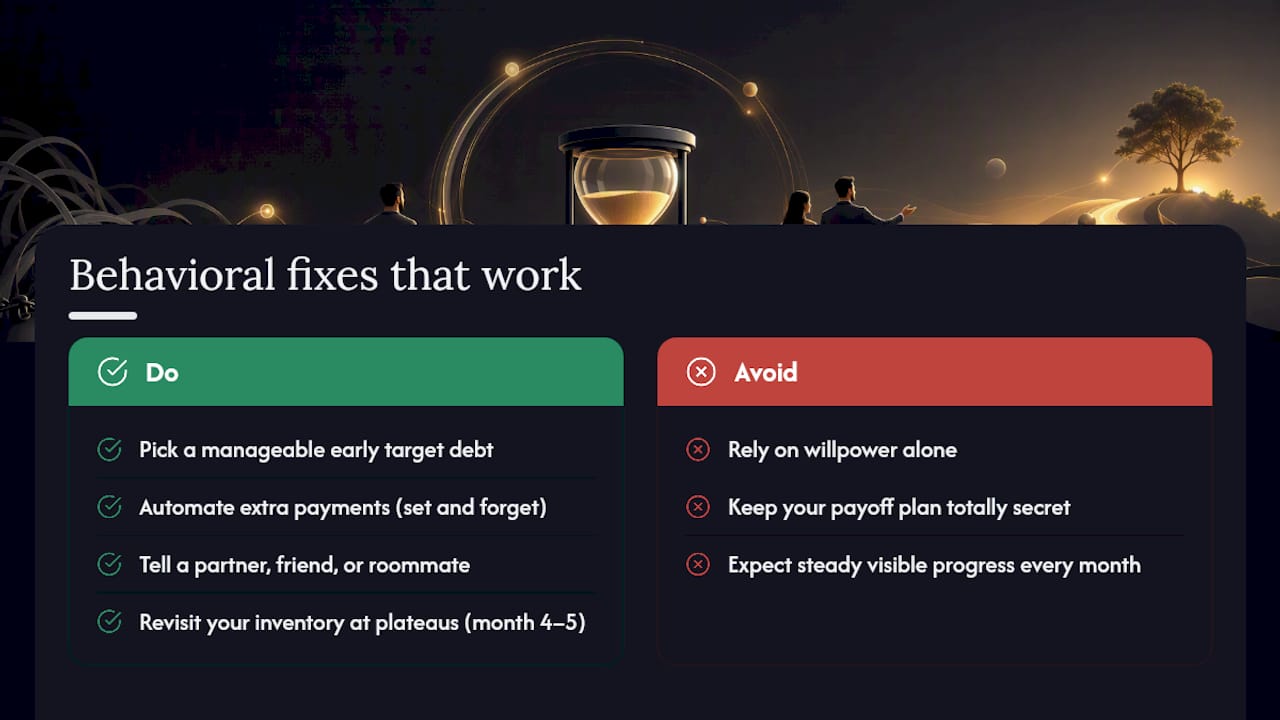
The snowball method’s popularity exists almost entirely because of this. Watching a $400 balance disappear in two months delivers a psychological payoff that a 0.5% interest rate reduction never will, even when the interest reduction saves more money in the long run. Give yourself those small wins on purpose. Pick a manageable early target debt, even if it’s not mathematically optimal, and let the visible progress carry you through the harder middle stretch.
Automating extra payments removes the daily decision entirely, which matters more than it sounds. Every month you have to actively decide to send extra money is a month you might talk yourself out of it. Set it, forget it, and let your bank account do the discipline for you.
Tell someone what you’re doing. Debt payoff done in total secrecy is easier to quietly abandon than one a partner, roommate, or friend knows about and occasionally asks about. It doesn’t need to be public, just not entirely private.
Expect a plateau. Somewhere around month four or five, progress can feel like it’s stalled even though the math says otherwise, because early wins on small balances give way to the slower grind on larger ones. That’s normal, not a sign the plan isn’t working. Revisit your written inventory at that point and remind yourself how far the balance has actually dropped since day one.
Does Paying Off a Loan Help or Hurt Your Credit Score?
Both, briefly, and then it helps significantly. Paying off an installment loan, whether it’s a personal loan, auto loan, or student loan, can cause a small, temporary dip in your credit score right after the account closes, because it changes your credit mix and average account age. That dip is usually minor and short-lived.
The longer-term effect is almost always positive. Your on-time payment history stays on your credit report for years even after the account closes, continuing to support your score. Your credit utilization on revolving accounts like credit cards improves dramatically once you’re not carrying a balance, since utilization is calculated on what you owe, not what you’ve paid off historically. Lower utilization is one of the more heavily weighted factors in most scoring models.
Paying off high-interest debt also frees up income that lenders factor into your debt-to-income ratio, a number mortgage and auto lenders scrutinize closely. A lower ratio, combined with a demonstrated payoff track record, generally puts you in a stronger position for future borrowing at better rates, not a weaker one.
One caution: closing your oldest credit account can shorten your average account age, which carries some weight in scoring models. If you’re debt free on an old credit card with no annual fee, consider keeping it open with a small recurring charge rather than closing it entirely.
Are There Tax Benefits to Paying Off Certain Loans?
Some loan interest carries a tax benefit while you’re still paying it off, which is worth understanding before you decide which debt to prioritize.
Student loan interest is the clearest example. Borrowers may be able to deduct interest paid on qualified student loans, subject to income limits and phase-outs set by the IRS, which changes the after-tax cost of carrying that debt slightly compared to a credit card charging the same rate. That deduction disappears once the loan is paid off, since there’s no more interest to deduct, but for most borrowers the interest savings from an accelerated payoff still outweighs the value of the deduction itself.
Mortgage interest works similarly for homeowners who itemize deductions rather than taking the standard deduction, though the math depends heavily on your total itemized deductions and current tax bracket.
Personal loans, auto loans, and credit card interest generally carry no tax deduction at all, regardless of what the money was used for, with narrow exceptions for loans tied directly to a business or investment purpose. That’s one more argument for tackling high-rate, non-deductible debt aggressively while treating loans with a tax benefit and a lower rate with somewhat less urgency.
Tax rules around deductions shift periodically and phase-outs depend on filing status and income, so confirm current thresholds with a tax professional or the IRS directly before assuming a specific deduction applies to your situation.
Author Perspective: Practical Priorities From a Finblog Advisor
The plans that actually work are boring. They involve one method, chosen early, followed for months without dramatic pivots between snowball, avalanche, or whatever new strategy shows up online. Consistency beats optimization almost every time.
Professional guidance earns its cost when your debt spans multiple loan types, your time is genuinely limited, or you know from experience that a DIY spreadsheet won’t survive month three.
— Povilas
How Finblog Can Help You Build a Plan That Sticks
There are DIY spreadsheets, budgeting apps, and free calculators scattered across the internet, and plenty of them work fine for a straightforward, single-loan situation. Where they fall short is complexity: multiple loan types, inconsistent income, or a debt-to-income ratio that makes lenders nervous about your next mortgage or auto loan application.
Finblog’s advisory consultations are built for exactly that gap. Instead of piecing together advice from a dozen different sources, you get a plan built around your actual numbers, whether that means sequencing an avalanche across five accounts or evaluating whether a consolidation loan genuinely saves you money over your specific timeline. If your situation feels bigger than a spreadsheet can handle, or you simply want a second set of eyes before committing years of payments to one strategy, visit Finblog to schedule a consultation or sign up for the newsletter for ongoing guidance on debt strategy and personal finance.
Sources
- How to get out of debt (Experian)
- How to Get Out of Debt (Better Money Habits, Bank of America)
- How to get out of debt (FTC)
- Debt snowball method (Wikipedia)
This article is general information, not a substitute for advice from a qualified financial advisor. Consult a qualified financial professional about your own circumstances before acting on anything here.