
European government borrowing costs are rising again as higher oil prices revive inflation fears and put additional pressure on countries already dealing with weak growth and tight budgets.
Renewed tensions between the US and Iran have pushed Brent crude toward $97 a barrel, raising concerns that expensive energy could keep inflation higher and force central banks to maintain tighter monetary policy.
France, Italy and UK Face the Most Pressure
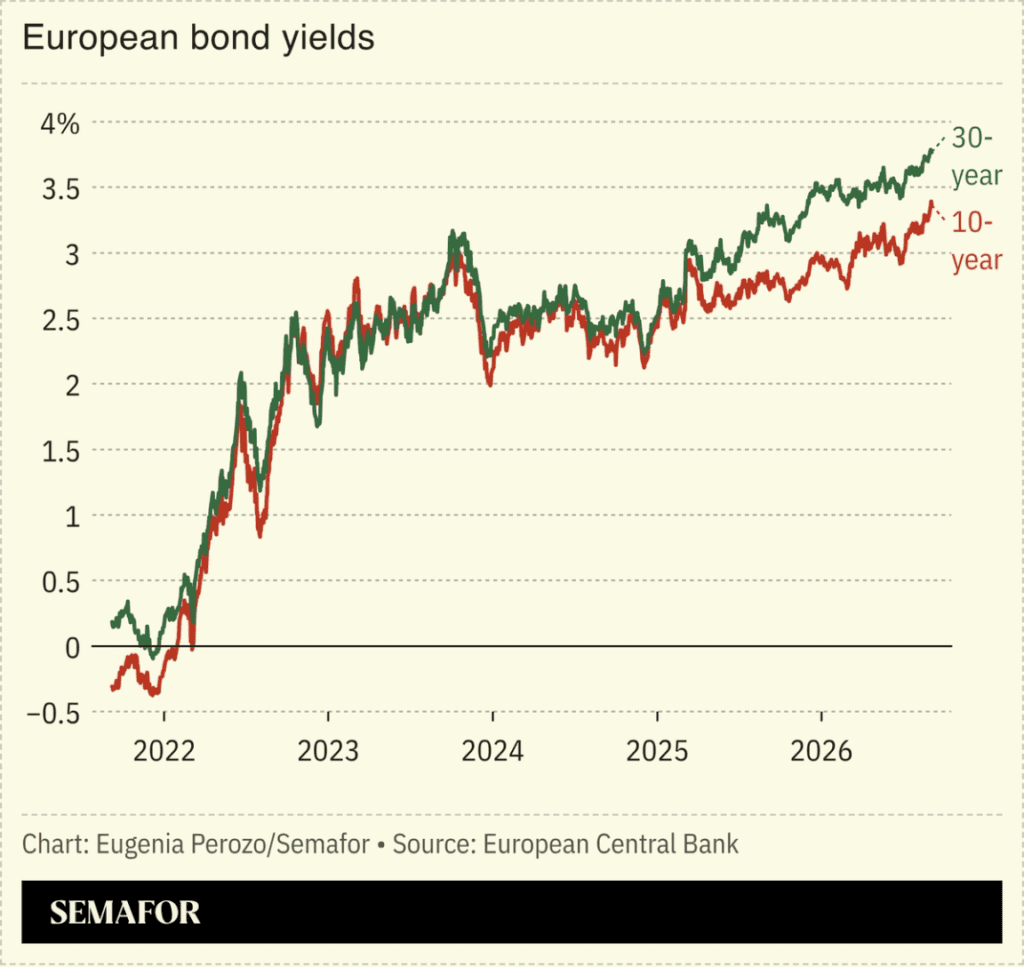
Bonds from France, Italy and the UK have been among the weakest in the G7 over the past month.
The UK has been particularly exposed. Its 10-year government bond yield recently climbed above 5.2%, increasing the cost of servicing government debt and reducing the amount of money available for other spending.
Britain’s government has promised to rebuild its fiscal buffer, but doing so could require higher taxes or spending cuts.
France is facing similar pressure from high debt and political uncertainty, while investors are demanding higher returns to hold its bonds.
German Yields Hit Multi-Year Highs
Even Germany, traditionally one of Europe’s safest borrowers, is seeing higher yields.
The 10-year Bund yield has risen around 50 basis points during the third quarter to a 15-year high, largely because markets expect the European Central Bank to raise rates again.
Political uncertainty has added another concern after the AfD won 44% of the vote in Saxony-Anhalt’s state election, putting additional pressure on Chancellor Friedrich Merz’s government.
Europe Has Less Room Than the US
US Treasury yields are rising too, with the 10-year yield recently near 4.8%.
But Europe’s challenge may be more difficult because economic growth is weaker and several governments already have limited room to increase spending.
Higher yields therefore create a difficult combination: governments face more expensive debt, slower growth and higher energy costs at the same time.
Investor takeaway: Europe’s bond selloff is becoming more than an interest-rate story. High oil prices, inflation, government debt and political uncertainty are all pushing borrowing costs higher. If energy prices remain elevated, governments such as the UK, France and Italy could f
Disclosure: This article does not represent investment advice. The content and materials featured on this page are for educational purposes only.
Related: Death of the Safe Haven: How to Fix Your Bond Strategy as Yields Rise