


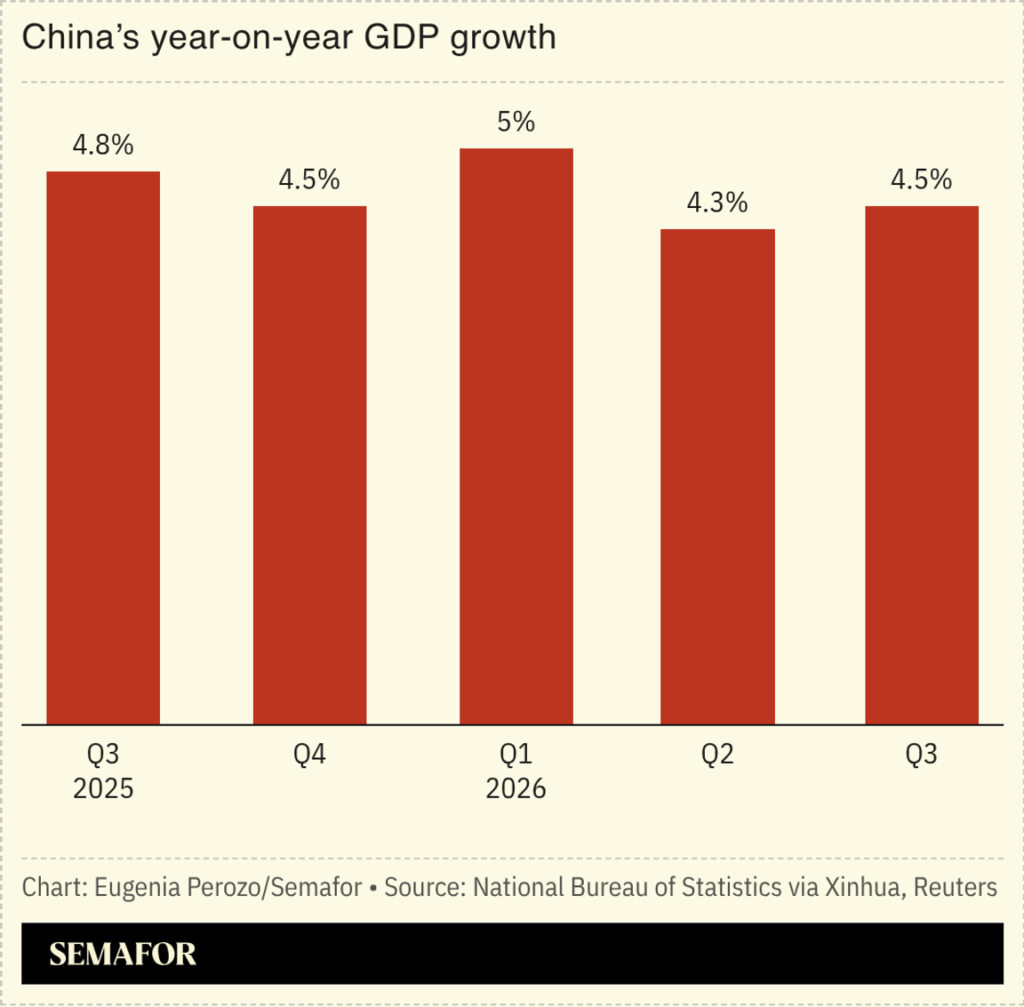
China’s economy grew faster than expected in the third quarter, but the improvement revealed a familiar divide: strong overseas sales alongside cautious spending at home.
GDP expanded 4.5% year over year, exceeding the 4.4% forecast in a Reuters poll and improving from 4.3% in the second quarter.
The National Bureau of Statistics reported on October 19 that growth reached 4.6% over the first nine months, keeping Beijing’s 4.5% to 5% annual target within reach.
Factories outperform consumers
September’s figures showed the difference between production and household spending:
- Industrial output rose 5.5%, accelerating from 5.2% in August.
- Retail sales increased 1.1%, beating expectations of 0.6% but remaining subdued.
- Fixed-asset investment fell 7.2% over January through September.
- Property investment dropped 20.6% over the same period, compared with a 19.9% decline through August.
The property slump remains a constraint on a broader recovery. Falling property values can weaken household confidence, while struggling developers and lower construction activity weigh on investment.
Exports provide support, but create exposure
Exports surged by more than a third in September, helping offset domestic weakness. Demand for technology products and manufactured goods has supported production, Reuters reported.
But dependence on overseas customers leaves China exposed to changing global demand and trade restrictions.
Those tensions are explored in Europe Hardens Its Stance on China as Trade Tensions Rise.
Better growth may reduce pressure for stimulus
The stronger GDP result could reduce the urgency for a large additional support package. Economist Ho Woei Chen of UOB told Reuters that external demand was helping keep growth on target, making broad-based easing less likely.
For businesses, however, the headline growth rate does not describe every market. Export manufacturers and companies dependent on Chinese household spending face different conditions.
China’s growth has improved, but a more balanced recovery still depends on stronger domestic spending and greater stability in property investment.
Disclosure: This article does not represent investment advice. The content is for informational and educational purposes only.