



The AI industry needs trillions in new revenue to support its infrastructure ambitions. Meanwhile, businesses and governments face rising bills even as the price of individual AI tasks falls.
Two consulting reports highlight the financial challenge on both sides of the market: suppliers must earn enough to justify their investments, while customers must prove that expanding AI use delivers value.
The $6 trillion revenue challenge
Bain & Company’s September 29 report announcement estimates that supporting AI compute demand would require $6 trillion in annual revenue by 2031.
Existing consumer and enterprise applications could contribute $1.2 trillion to $1.8 trillion, leaving at least $4.2 trillion to come from additional opportunities. This is a requirement under Bain’s analysis, rather than a forecast that customers will definitely spend that amount.
Bain identifies four potential sources, in this order:
- AI search and advertising: Model providers capturing search activity and introducing advertising.
- Autonomous systems: Vehicles, trucks, drones and industrial automation.
- Physical AI: Robotics, simulations and digital twins used in research and manufacturing.
- New products and markets: Applications that are not yet established, potentially including drug discovery, mental health and energy generation.
The distinction matters: the entire $4.2 trillion does not depend on inventions that do not exist today. Some would come from expanding technologies already under development.
Cheaper tokens do not guarantee smaller bills
McKinsey’s report on government AI economics explains why falling unit prices can coexist with rising expenditure.
AI agents perform multiple steps, repeatedly calling models and processing information. Such workflows can consume five to 30 times as many tokens as a simple chatbot query, with complex cases using more. Tokens are the units of information models process.
Government agencies also face a transition from discounted pilots to commercial pricing. Expanding access and automating more work can increase total consumption faster than prices decline.
Budget overruns are already appearing
McKinsey reported that 93% of respondents in its enterprise AI cost research exceeded their planned budgets. The research surveyed 120 enterprises, with 75 sufficiently advanced respondents used for its cross-industry analysis.
The accompanying breakdown showed:
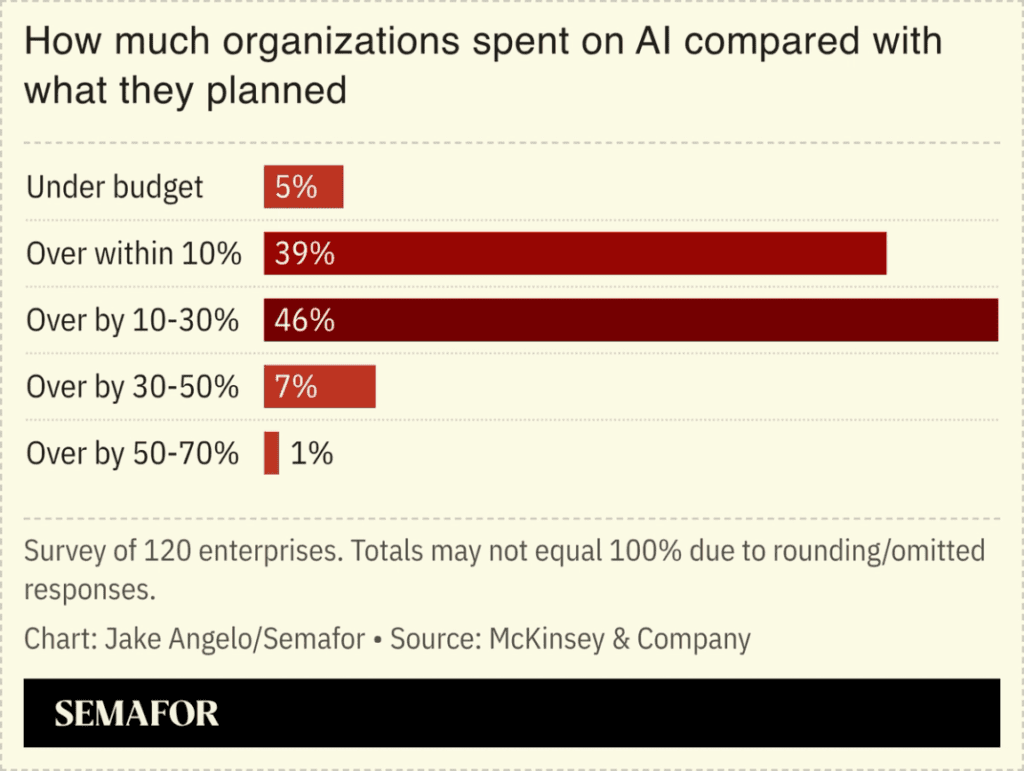
These findings describe the surveyed organisations, rather than all businesses or government agencies.
Growth must translate into returns
For investors, rising usage is only part of the story. Suppliers need sustainable revenue and margins, while buyers need measurable improvements that justify continued spending.
A budget overrun alone does not prove an AI project has failed. Equally, processing more tokens does not prove it has succeeded. The useful comparison is the cost of completing work against the value that work creates.
Related: The AI Boom Is Increasingly Being Financed by Debt.
AI adoption can keep growing while financial returns remain uncertain. The next test is whether useful results grow fast enough to justify the bill.
Disclosure: This article does not represent investment advice. The content is for informational and educational purposes only.