

File for unemployment, secure your health coverage, calculate your runway, prioritize survival bills, and call your lenders before you touch retirement savings. Do these five things now, in this order. Here’s the fast start:
- File for unemployment today with your state agency, even if severance is coming.
- Gather documents: final pay stub, severance letter, COBRA notice, W2s, bank statements.
- Call HR about severance structure before you sign anything.
- Call your landlord or mortgage servicer to flag the situation early.
- Calculate your runway using liquid cash divided by essential monthly costs.
Key Takeaways
Coping with job loss financially means filing for unemployment immediately, calculating your exact runway, and prioritizing bills by consequence, not interest rate.
| Point | Details |
|---|---|
| File for UI same week | Filing the day after separation preserves your benefit year even if severance is coming. |
| Know your state’s severance rule | Permissive, proration, threshold, and disqualifying states treat severance pay differently for UI eligibility. |
| Calculate runway first | Divide liquid assets by essential monthly costs to know exactly how many months you can survive. |
| Contact creditors before missing payments | Hardship programs, forbearance, and fee waivers are widely available but rarely advertised. |
| Protect retirement accounts last | Early 401(k) or IRA withdrawals trigger taxes and a 10% penalty; explore Finblog’s guides before withdrawing. |
This article is general information, not a substitute for advice from a qualified financial advisor. Consult a qualified financial professional about your own circumstances before acting on anything here.
Table of Contents
- How to Cope With Job Loss Financially in the First Week
- How Do You Calculate Your Financial Runway After Job Loss?
- Does Severance Pay Affect Your Unemployment Benefits?
- How to Handle Bills and Talk to Creditors Without Panicking
- Should You Withdraw From Your 401(k) or IRA After Job Loss?
- What Are Realistic Short-Term Income Options While Job Hunting?
- Where Can You Find More Help Managing Job Loss Finances?
- What Most Advice Gets Wrong About Coping With Job Loss
- Get More Personalized Financial Guidance From Finblog
- Sources
How to Cope With Job Loss Financially in the First Week
The financial shock of job loss hits fastest in housing and health coverage, which is why the first week is about triage, not strategy. You’re not solving your whole financial life this week. You’re stopping the bleeding.
Days 1 to 3 are for documentation and restraint. Pull your final pay stub, severance offer, benefits summary, and any COBRA paperwork HR hands you. Do not sign a severance agreement on the spot; most give you at least 21 days to review, and rushing costs you leverage. This is also the moment to resist any urge to make big money moves. The 30-day survival framework from The Budgetnista is built around exactly this: breathe, document, don’t cash out retirement yet.
Days 4 to 7 move you into action. File your unemployment claim if you haven’t already. Confirm the exact date your health insurance ends, since that triggers COBRA and Marketplace enrollment windows. Take a quick cash snapshot: what’s in checking, savings, and any accessible brokerage cash.
Days 8 to 30 are about stabilizing every recurring obligation. Call every creditor and servicer, pause subscriptions and nonessential recurring charges, and lock in health coverage before any gap opens.
- Document and pause (days 1 to 3)
- File and confirm (days 4 to 7)
- Negotiate and stabilize (days 8 to 30)
Pro Tip: Call HR and ask for your severance in writing before your last day. A verbal promise means nothing to an unemployment office or a future employer checking references.
How Do You Calculate Your Financial Runway After Job Loss?
Runway is simple math: liquid assets divided by essential monthly expenses equals the number of months you can survive without new income. If you have $9,000 in checking and savings and your non-negotiable costs run $3,000 a month, you have three months. That number should drive every decision you make next, from whether you take the first job offer to how aggressively you cut spending now.
Non-negotiables are housing, utilities, minimum debt payments, groceries, insurance, and transportation needed for work searching. Everything else gets suspended immediately:
- Streaming subscriptions and gym memberships
- Dining out and delivery apps
- Nonessential shopping and upgrade purchases
- Automatic charitable donations or recurring upgrades
Go through your bank statement line by line and cancel anything charging you automatically that isn’t keeping the lights on. Call your internet and phone providers too; many offer hardship-rate downgrades if you ask. Finblog’s budgeting framework walks through building this kind of survival budget with actual worksheets, and the companion guide on prioritizing spending helps you rank which bills get paid first once cash gets tight.
Does Severance Pay Affect Your Unemployment Benefits?
It depends entirely on your state, and that’s exactly why you file the day after your last day of work rather than waiting to see how severance shakes out. States fall into four rough categories: permissive states like California and Texas let you collect unemployment alongside severance with no reduction, proration states spread your lump sum across weeks and delay benefits accordingly, threshold states only disqualify you once severance exceeds a set percentage of pay, and a smaller group of disqualifying states blocks benefits outright while severance payments continue.
Filing immediately, according to SimpleSeverance’s state-by-state analysis, locks in your benefit year and preserves your eligibility for retroactive back-pay on any qualifying weeks. Wait two or three weeks to “figure it out” and you can permanently forfeit that money.
The structure of your severance matters too. Salary continuation, where you keep getting a paycheck for a set period, is usually treated as wages by state unemployment agencies and can push your UI start date back. A lump-sum payment often compresses that disqualification window into a shorter stretch. If HR gives you a choice, ask which structure your state treats more favorably before you sign.
- Certify weekly exactly as instructed, even during any waiting period
- Report severance income accurately to avoid overpayment penalties later
- Keep every UI confirmation email and claim number
How to Handle Bills and Talk to Creditors Without Panicking
Rank every bill by what happens if you miss it, not by which one has the highest interest rate. Housing and secured loans (your car, anything with collateral) come first because losing them is catastrophic and hard to reverse. High-interest revolving debt like credit cards comes next, since balances compound fast even at a lower nominal rate than a mortgage. Utilities and insurance follow, then everything discretionary gets cut entirely.
Call before you miss a payment, not after. A simple hardship script works: state your name and account, explain you’ve lost your job, and ask directly, “What hardship or deferral programs do you have available?” Servicers routinely offer forbearance, reduced payments, or fee waivers that they don’t advertise, according to Business Standard’s guidance on post-layoff finances.
- Ask card issuers about hardship programs or temporary rate reductions
- Avoid balance transfers with short 0% windows you can’t realistically pay off
- Pull your credit report and document every agreed hardship plan in writing
Pro Tip: Get every hardship agreement confirmed by email. A verbal “yes, we’ll pause your payment” from a call center rep means nothing without a paper trail if it gets reversed.
Should You Withdraw From Your 401(k) or IRA After Job Loss?
Treat retirement accounts as your last resort, not your emergency fund. Withdrawing from a traditional 401(k) or pre-tax IRA before age 59½ typically triggers a 10% early withdrawal penalty on top of ordinary income tax, according to the Consumer Financial Protection Bureau. That’s a steep price to pay for cash you might need again in five years.
- Roth IRA contributions (not earnings) can often be withdrawn penalty-free, making them a safer early-access option than a traditional account
- Fixed-income or short-term bond funds are better sources of near-term cash than liquidating equity positions during a downturn
- A 401(k) loan avoids taxes and penalties but becomes due in full if you land another job that doesn’t offer the same plan, or worse, if you’re unemployed again when it’s due
Finblog’s 401(k) guide and retirement withdrawal strategies break down the tax mechanics in more depth if you’re weighing this option.
What Are Realistic Short-Term Income Options While Job Hunting?
Gig work, freelance contracts, and temp staffing agencies can bridge the gap, but each comes with tradeoffs in time, pay, and how much it slows your actual job search.
- Freelance or contract work in your field pays better and keeps your resume current
- Gig platforms (delivery, rideshare) pay fast but eat hours you’d rather spend interviewing
- Temp staffing agencies can lead to permanent offers, sometimes within weeks
Accept temporary work when your runway drops below two months; hold out longer if you’re still comfortably inside your calculated window. Skip payday loans and instant cash-advance apps entirely. Their fees erase any short-term relief almost immediately.
Where Can You Find More Help Managing Job Loss Finances?
Finblog covers unemployment claims data, layoff trends, and severance negotiation regularly, giving readers context beyond a single checklist. If you want the fuller versions of the tools mentioned here, start with the budgeting templates and credit card debt strategies guides, both built around the same survival-first framework.

What Most Advice Gets Wrong About Coping With Job Loss
Most guidance treats job loss as an emotional event first and a financial one second. That ordering is backward for the reader who’s three weeks from missing rent. The math has to come before the mindset work, because a wrong move on severance timing or a panicked 401(k) withdrawal can cost you thousands of dollars that no amount of positive thinking recovers.
The biggest mistake I see repeated across generic advice columns is treating unemployment filing as optional if severance is coming. It isn’t. File the same week regardless of what HR promises, because state agencies decide severance treatment on their own timeline and rules, not yours.
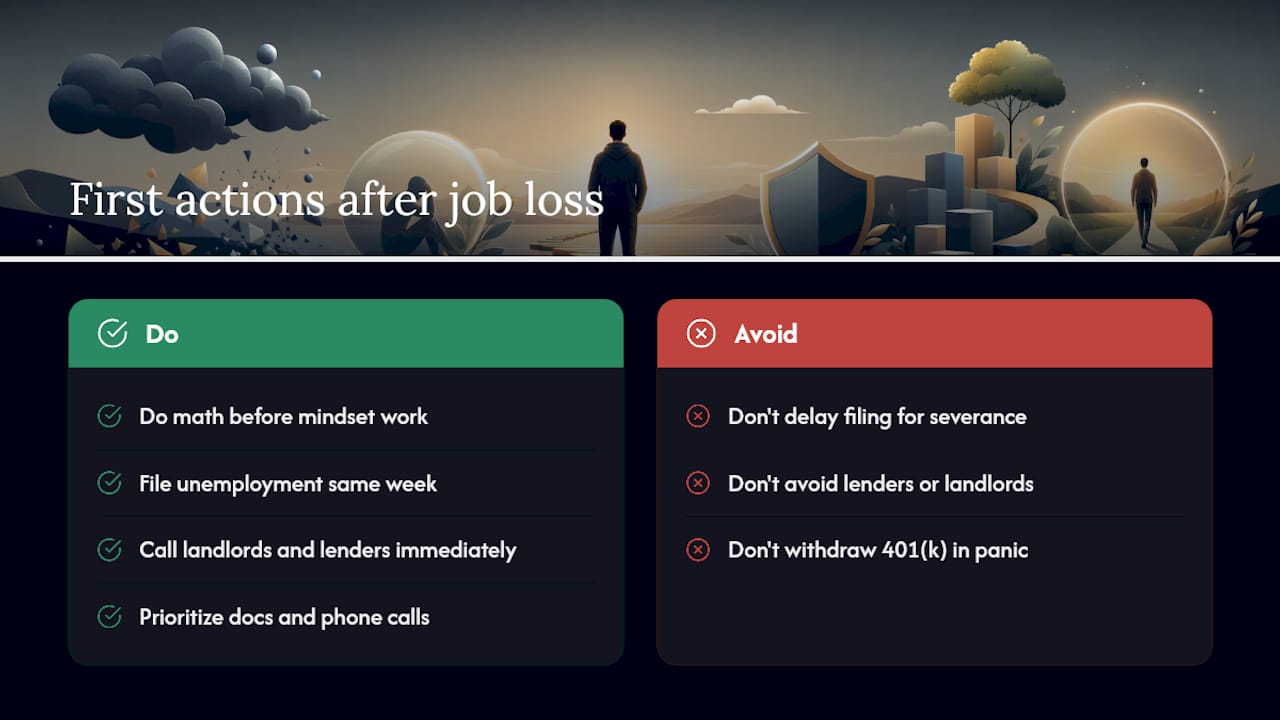
The second mistake is contact avoidance. People delay calling landlords and lenders out of embarrassment, and that delay is what actually destroys credit and housing stability. The people who come out of a layoff intact are the ones who called their mortgage servicer in week one, not week eight.
Prioritize documentation and phone calls over spreadsheets in the first ten days. The spreadsheet can wait a week. The unemployment claim and the landlord call cannot.
— Povilas
Get More Personalized Financial Guidance From Finblog
Finblog gives you a faster path to a survival budget than piecing one together from scattered blog posts. Instead of guessing which bills to prioritize or how your state treats severance, Finblog’s guides and advisory intake connect you directly to financial planning resources built for exactly this situation: stretched cash, benefit deadlines, and decisions that affect your credit for years. Sign up at Finblog to get budgeting tools, retirement withdrawal guidance, and access to advisory support tailored to your runway and timeline. Start there before you make any irreversible move with your savings.
Sources
- Can I Collect Unemployment With Severance? 2026 State-by-State Answer | SimpleSeverance
- Unexpected job loss | Consumer Financial Protection Bureau
- What to Do When You Lose Your Job: A 30-Day Financial Survival Plan – The Budgetnista
- How to handle your finances after a job loss: Cut costs, manage debt wisely | Business Standard