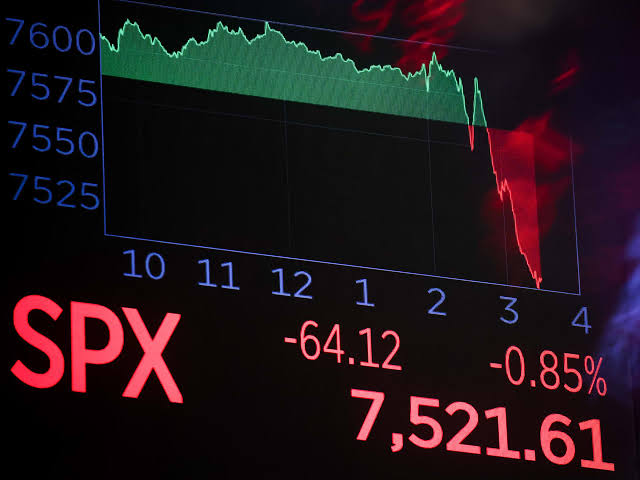

When financial anxiety hits, do this first: take three slow breaths, then open one account and write down the balance. That’s it. One number on paper converts a swirling “what if” into a fact you can actually work with.
Here’s a one-day starter plan you can use right now:
- Take four slow breaths in through your nose, hold for four counts, out through your mouth.
- Open one bank or credit card account and write down the current balance.
- Move $5 to a savings account, or set a reminder to do it tomorrow morning.
- Write down one financial call you’ve been avoiding and schedule it for this week.
- Set a 15-minute “worry time” slot on your calendar for later today.
Pro Tip: Pairing an emotional-first move (breathing, grounding) with a tiny financial action breaks the anxiety cycle at both ends. The breath lowers your physiological arousal; the $5 transfer or written balance proves to your brain that you are not helpless. That combination, not willpower alone, is what interrupts the spiral.
Key Takeaways
Overcoming financial anxiety requires pairing emotional-first techniques with concrete financial actions, repeated consistently until the system runs itself.
| Point | Details |
|---|---|
| Start with one grounding move | Box breathing plus writing down one account balance breaks the panic cycle immediately. |
| Use “worry time” daily | Schedule 15–20 minutes to sort worries into actionable and acceptance columns, then act on one item. |
| Build a $500 buffer first | A small emergency fund reduces anxiety faster than a perfect budget because it removes the fear of one bad event. |
| Choose your debt strategy | Debt snowball builds motivation through early wins; debt avalanche minimizes total interest paid. |
| Get free help when needed | NFCC, CFPB, 988, and SAMHSA offer free or low-cost support; call 988 if anxiety becomes a crisis. |
| Finblog resources | Finblog provides financial education tools and consultation access for readers ready to build a concrete plan. |
Table of Contents
- What is financial anxiety and how does it show up?
- How to overcome financial anxiety in the moment
- Concrete money steps that reduce uncertainty and restore control
- Why these recommendations work: the evidence behind the advice
- Where can you get free or low-cost help in the U.S.?
- When does financial anxiety become a clinical emergency?
- Sustainable habits that keep financial anxiety from coming back
- The part most financial advice skips
- Finblog can help you take the next step
- Sources
What is financial anxiety and how does it show up?
Financial anxiety is not the same as having a tight budget. It’s a diffuse, anticipatory fear about money that persists even when the numbers aren’t catastrophic. Someone earning a solid income can still lie awake at 2 AM convinced they’re one unexpected bill away from ruin. That gap between the actual situation and the felt danger is the defining feature.
Common signs span three domains:
Emotional: persistent dread about checking accounts, shame about spending, irritability when money comes up in conversation, a sense of helplessness even after paying bills on time.
Behavioral: avoiding bank statements or credit card apps, compulsively refreshing account balances, impulse-buying as a short-term mood fix, or freezing entirely and making no financial decisions at all.
Physical: disrupted sleep, tension headaches, stomach tightness before payday, difficulty concentrating at work.
If three or more of those sound familiar, you’re in the right place. Financial anxiety cuts across income levels, and tracking finances rather than avoiding them is one of the fastest ways to start replacing that vague dread with something you can actually address.
How to overcome financial anxiety in the moment
These techniques work because they interrupt the physiological stress response before it locks you into avoidance or catastrophic thinking. Use them in order when panic rises.
Step-by-step: a two-minute reset
- Box breathing. Inhale for four counts, hold for four, exhale for four, hold for four. Repeat twice. This activates your parasympathetic nervous system and lowers cortisol enough to think clearly.
- Grounding (60 seconds). Name five things you can see, four you can touch, three you can hear. This pulls attention out of the future-catastrophe loop and into the present room.
- One factual statement. Write or say aloud: “Right now, I have $_____ in checking.” A number, even an uncomfortable one, is less frightening than the shapeless worst-case your brain invents.
- Pick one tiny task. Not “fix my finances.” Something like: “I’ll call my credit card company Tuesday at noon.” Write it down.
The “worry time” technique
Therapists consistently recommend scheduling a bounded daily slot, roughly 15–20 minutes, to deal with money worries rather than letting them bleed into every hour. When a money thought intrudes outside that window, write it on a list and return to it at the scheduled time. During worry time. Divide your list into two columns: actionable (things you can do something about this week) and acceptance (things outside your control right now). The actionable column becomes a to-do list. The acceptance column gets acknowledged and set aside. This approach converts diffuse anxiety into discrete tasks, which is far easier to manage.
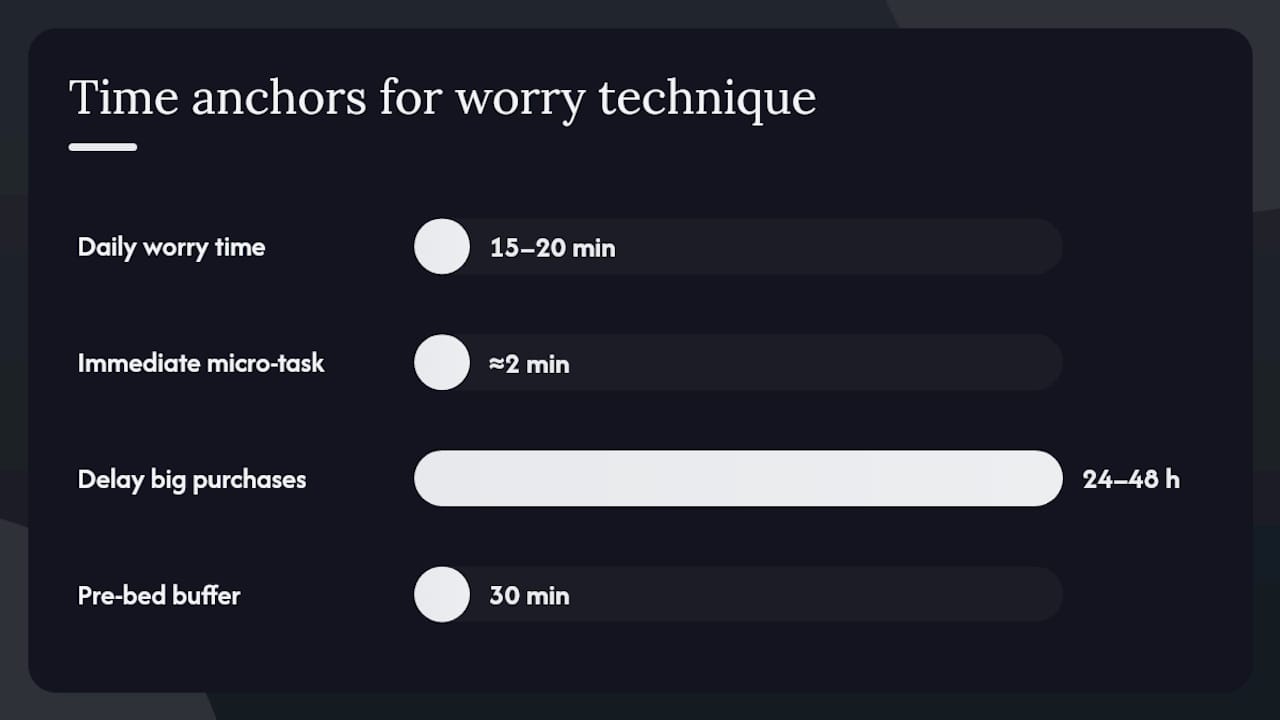
Pro Tip: After worry time, do one micro-task from your actionable list immediately, even if it takes two minutes. The sequence of “name the worry, then act on it” is what retrains your brain to see money problems as solvable rather than overwhelming.
A few behavioral anchors worth building in:
- Avoid financial news and account-checking in the 30 minutes before bed. Screen light and stress hormones together wreck sleep quality.
- When you feel the urge to make a large purchase impulsively, delay it 24–48 hours. Most urgency fades.
- When a catastrophic thought appears (“I’ll never pay this off”), ask: “What’s the actual evidence for that?” CBT reframing doesn’t require a therapist; it just requires slowing down long enough to question the thought.
Coping with financial stress involves both emotional regulation and practical action, and the research consistently shows that neither alone is as effective as both together.
Concrete money steps that reduce uncertainty and restore control
Anxiety thrives in vagueness. The antidote is specificity, and you don’t need a financial planner to get specific.
Take a financial inventory first
Before budgeting, list what you actually have and owe:
- All accounts (checking, savings, retirement, any investment accounts) with current balances.
- All income sources and their monthly amounts.
- All recurring bills with due dates and amounts.
- Any upcoming known expenses in the next 90 days (insurance renewal, car registration, medical bills).
This inventory is not about judgment. It’s about converting “I don’t know where I stand” into a one-page fact sheet.
A simple one-page budget skeleton
Divide your monthly take-home into three buckets:
The percentages are a starting point, not a rule. Write the real numbers. A step-by-step budgeting framework can walk you through filling this out in detail.
Emergency fund: start smaller than you think
The standard advice of three-to-six months of expenses feels paralyzing when you’re already anxious. Start with $500. Set up an automatic transfer of whatever you can manage, even $10 a week, to a separate savings account. Research consistently shows that even a small cash buffer reduces financial anxiety because it converts the fear of “one bad thing will destroy me” into “one bad thing will cost me my buffer, which I can rebuild.” The HelpGuide guidance on financial stress frames this buffer as a psychological tool as much as a financial one.

Debt snowball vs. debt avalanche: which fits you?
Both methods work. The question is whether you need psychological momentum or pure math efficiency.
| Method | How it works | Best for |
|---|---|---|
| Debt snowball | Pay minimums on all debts; throw extra money at the smallest balance first | People who need early wins to stay motivated |
| Debt avalanche | Pay minimums on all debts; throw extra money at the highest-interest debt first | People who can stay disciplined and want to minimize total interest paid |
The debt snowball method produces faster emotional relief because you eliminate accounts quickly. The avalanche saves more money over time. If you’re not sure which to pick, choose the snowball. Motivation is the scarce resource, not math.
A few quick actions that cost nothing but time:
- Call your creditors and ask about hardship programs. Many will reduce your interest rate or defer a payment without a credit hit.
- Set up autopay for at least the minimum on every account to eliminate late fees.
- Audit your subscriptions and cancel anything unused.
For structured help, the FTC’s debt guidance explains your rights with creditors and how to find legitimate credit counseling. The National Foundation for Credit Counseling (NFCC) connects you with nonprofit counselors who charge little or nothing.
Why these recommendations work: the evidence behind the advice
Grounding and small tasks reduce anxiety through a well-documented mechanism: they interrupt avoidance. Avoidance is the core driver of financial anxiety. Every time you don’t open the bill, your brain learns that the bill is dangerous, which makes the next avoidance more likely. Doing one tiny financial action, even writing down a balance, breaks that loop and restores a sense of agency.
Peer-reviewed research links financial strain directly to poorer sleep quality and worse health outcomes, which means sleep hygiene is not a soft recommendation here. It’s a clinical one. Poor sleep impairs the prefrontal cortex, the part of the brain responsible for rational financial decision-making, which creates a feedback loop: financial stress disrupts sleep, and disrupted sleep makes financial decisions worse.
Tracking finances converts hypothetical “what-if” thinking into objective facts. AARP’s reporting on money dysmorphia notes that people who track income and expenses consistently report lower anxiety, not because their numbers improve immediately, but because they’re no longer fighting an imaginary worst case.
A few evidence-backed points worth keeping:
- Exercise reduces cortisol and improves sleep, both of which directly affect financial decision quality. Even a 20-minute walk counts.
- Social support, talking to a trusted person about money stress, reduces shame and often surfaces practical options you hadn’t considered.
- Structured repayment plans, whether snowball or avalanche, outperform “I’ll pay more when I can” because they remove the daily decision of how much to pay.
AARP’s guidance on financial stress frames exercise, sleep, and routine as clinical interventions, not lifestyle extras, because financial anxiety is a full-body experience that responds to full-body care.
Where can you get free or low-cost help in the U.S.?
You don’t have to navigate this alone, and most of the best resources cost nothing.
Mental health support
- 988 Suicide and Crisis Lifeline: Call or text 988. Available 24/7 for any mental health crisis, including money-related distress. Counselors are trained to help you stabilize and connect to local resources.
- SAMHSA National Helpline: 1-800-662-4357. Free, confidential, 24/7 referrals to mental health and substance use treatment services.
- NAMI (National Alliance on Mental Illness): nami.org or call 1-800-950-6264. Peer support, education programs, and local chapter connections.
Financial counseling and consumer protection
| Agency | What they help with | Contact |
|---|---|---|
| NFCC (National Foundation for Credit Counseling) | Free or low-cost nonprofit credit counseling, debt management plans | nfcc.org |
| CFPB (Consumer Financial Protection Bureau) | Complaint filing, financial tools, consumer rights education | consumerfinance.gov |
| HUD (U.S. Dept. of Housing and Urban Development) | Housing assistance, foreclosure prevention, rental help | hud.gov |
| FTC Consumer Advice | Debt rights, scam protection, creditor contact guidance | consumer.ftc.gov |
If job loss or reduced income is driving your anxiety, Usa aggregates federal and state unemployment, food assistance, and healthcare programs in one place.
Questions to ask a financial counselor or therapist before you start
- What are your fees, and do you offer sliding-scale pricing?
- Are you a nonprofit or fee-only advisor? Do you earn commissions?
- What will you review in our first session?
- How do you handle confidentiality?
- Have you worked with clients whose anxiety is the primary issue, not just the numbers?
When does financial anxiety become a clinical emergency?
Most financial anxiety responds to the steps above. Some situations require immediate professional care.
Reach out to 988 or go to your nearest emergency room if you experience:
- Thoughts of suicide or self-harm, even if they feel passive (“I’d be better off gone”).
- Panic attacks that leave you unable to breathe, drive, or function.
- Complete inability to perform daily tasks, getting out of bed, eating, going to work, for more than a few days.
- Severe withdrawal from family, friends, or responsibilities.
- Using alcohol or substances to manage money-related distress.
If you’re calling a mental health professional or hotline for the first time, this script helps: “I’ve been experiencing severe anxiety related to my financial situation. It’s affecting my sleep and my ability to function. I’m not sure where to start, and I’d like help figuring out next steps.” You don’t need to have the details ready. The counselor will guide you.
Pro Tip: You don’t have to be in crisis to call 988. If money stress is making daily life feel unmanageable, that’s enough reason to reach out. Counselors there can also connect you to local mental health services, many of which are free or income-based.
Sustainable habits that keep financial anxiety from coming back
One-time fixes don’t hold. What holds is a repeatable system that requires almost no willpower once it’s running.
Weekly and monthly routine
- Weekly (10 minutes): Check all account balances, log any unusual expenses, confirm upcoming bills are covered.
- Monthly (30 minutes): Review your budget vs. actual spending, adjust one category if needed, confirm automatic transfers ran, measure one progress metric (debt balance, savings total).
Setting goals that actually reduce anxiety
Vague goals (“save more,” “get out of debt”) increase anxiety because they have no finish line. Specific, process-focused goals do the opposite:
- Write the goal in numbers: “Pay $200 extra toward my Visa balance each month.”
- Attach it to a behavior, not an outcome: “Every payday, I transfer $200 to debt before I spend anything.”
- Celebrate the process, not just the result. Completing the transfer is the win, regardless of what the balance does.
- Review and adjust every 90 days, not every week. Weekly outcome-checking creates anxiety; monthly or quarterly reviews create perspective.
Communication and social media boundaries
Talking about money with a partner or family member works best with a structure: pick a regular time (Sunday evening, first of the month), agree on a 30-minute limit, and focus on one agenda item per conversation. Avoid open-ended “we need to talk about money” conversations, which tend to escalate.
Iowa State research found that spending more than three hours daily on social media correlates with more impulsive spending and higher anxiety. Cutting that time, or at minimum unfollowing accounts that trigger comparison spending, is a concrete anxiety-reduction move.
Long-term mindset practices
- Keep a financial diary: one line per day noting what you spent, how you felt, and one thing you did right. Over weeks, patterns emerge that replace anxiety with data.
- Build financial literacy in small doses. One article or podcast episode per week on a topic relevant to your situation compounds into real confidence over months.
- Slow every major financial decision by at least 48 hours. Urgency is almost always manufactured.
A debt repayment plan that runs automatically in the background removes the daily decision fatigue that feeds anxiety.
The part most financial advice skips
Here’s what I keep coming back to after reading the research and the therapist interviews: the conventional approach to financial anxiety gets the order wrong. Most guides lead with the spreadsheet. The spreadsheet matters, but it’s the second move, not the first.
The first move is always emotional. Shame, avoidance, and catastrophic thinking are not character flaws. They’re predictable responses to a threat your nervous system treats as physical danger. Until you address those responses, the budget template sits unopened.
What actually works, consistently, is the pairing: a grounding technique that lowers arousal, followed immediately by one tiny financial action that proves you’re not helpless. That sequence, repeated over days and weeks, rebuilds the neural association between “money” and “something I can handle” rather than “something that will destroy me.”
The other thing most guides underestimate is the role of sleep. Financial anxiety and poor sleep form a loop that’s hard to break from the financial side alone. Protecting sleep, even before the budget is sorted, is one of the highest-leverage moves available. It’s not a soft suggestion. The peer-reviewed evidence on financial strain and health outcomes makes that clear.
Start with the breath. Write down one number. Then open the budget template.
Finblog can help you take the next step
If you’ve worked through this guide and want structured support, Finblog offers financial education resources and consultation access designed for people who are ready to move from anxiety to a concrete plan. No jargon, no pressure, no assumption that you already have everything figured out.
Whether you want a free worksheet to build your one-page budget or you’re ready to talk through your specific situation with a financial advisor, Finblog’s resources are a practical next step. Paid advisory services are available for readers who want personalized guidance beyond the free tools.
Sources
These U.S. agencies and resources are referenced throughout this guide:
- PubMed Central article relating stress and health outcomes
- How to get out of debt | FTC Consumer Advice
- Usa
This article provides general information for educational purposes and is not a substitute for professional financial, legal, or mental health advice. Confirm current program details and eligibility with the relevant agency or a qualified professional.