



You can reliably spend less than you earn starting today by doing three things: automate a fixed savings transfer the moment your paycheck lands, pause or cancel one major recurring expense this week, and turn on transaction tracking in your bank app or a free tool like Mint or YNAB for the next 30 days. That’s it. Everything else in this article builds on those three moves.
Here’s a quick-start checklist you can run through today:
- Automate a savings transfer. Set up an automatic transfer to a separate savings account on payday. Even $50 or $100 a week adds up fast, and FDIC-insured accounts keep that money safe and accessible.
- Pause one big recurring expense. Look at housing, transportation, or food first. Cancel a streaming service, pause a gym membership, or pack lunch for a week. Pick one.
- Enable transaction tracking. Log into your bank or open a free budgeting app and turn on category tracking. The CFPB’s monthly budget worksheet is a free, printable starting point.
Most people who feel financially stuck are running closer to 70/25/5 without realizing it.
Key Takeaways
Spending less than you earn consistently comes down to automating savings before you can spend it, cutting the Big 3 expenses first, and designing a system that doesn’t require daily willpower.
| Point | Details |
|---|---|
| Pay yourself first | Automate a savings transfer on payday so surplus is protected before discretionary spending begins. |
| Prioritize the Big 3 | Housing, transportation, and food drive 60–70% of most budgets — one structural cut there beats dozens of small ones. |
| Use the 50/30/20 rule | Target 50% needs, 30% wants, 20% savings and debt; most overspenders run closer to 70/25/5 without realizing it. |
| Set a 90-day milestone | Aim for a 15% free cash-flow rate and a one-month emergency fund within 90 days as your first measurable goal. |
| Finblog’s resources | Finblog’s budgeting templates and consulting help you build and stick to a personalized spending surplus plan. |
Table of Contents
- Why do people keep spending more than they earn?
- What does living below your means actually look like?
- Concrete steps to build a lasting spending surplus
- Why the Big 3 expenses deserve your attention first
- What’s a realistic timeline for seeing results?
- How to cut spending without feeling deprived
- The part most financial advice gets wrong
- Finblog can help you put this into practice
- Sources
Why do people keep spending more than they earn?
The problem is rarely math. It’s behavior.
Present bias is the biggest culprit. The brain values a $5 coffee right now more than $5 in a savings account next month, even though the math clearly favors the account. That’s not irrationality — it’s how human cognition works under uncertainty. Knowing this lets you design around it rather than fight it.
Lifestyle inflation is the quieter trap. Every raise, bonus, or promotion tends to get absorbed into a slightly nicer apartment, a newer car, or more frequent restaurant meals. The income goes up; the surplus stays flat. Social comparison accelerates this: when neighbors, coworkers, or social media feeds signal a certain standard of living, spending follows even when income doesn’t support it.
The CFPB’s consumer spending tips highlight three practical traps worth naming directly:
- Subscription creep. Most households underestimate their monthly subscriptions by $50–$100. The fix: pull up your last two bank statements and highlight every recurring charge. Cancel anything you haven’t used in 30 days.
- Payment-by-month illusions. A $400/month car payment feels manageable. The total cost over 60 months — plus interest — often doesn’t register until you do the math. Always calculate the full price, not the monthly slice.
- Windfall misuse. Tax refunds, bonuses, and gifts tend to vanish into lifestyle spending within weeks. The fix: commit the allocation before the money arrives. Decide in writing: 50% to savings, 30% to debt, 20% discretionary.
One more thing worth knowing: the “latte factor” debate misses the point. Cutting a $5 coffee saves $150/month at best. Cutting $300 from your car payment or negotiating your rent saves $3,600 a year. Small habits matter for discipline; large fixed costs move the needle on cash flow. Experts consistently point to housing, transportation, and food as the Big 3 to prioritize.
Pro Tip: When your income rises, automate an increase to your savings transfer before you touch the extra cash. Set a calendar reminder for the day after your raise takes effect and bump your auto-transfer by at least half the raise amount. Lifestyle inflation is nearly impossible to reverse once it sets in — but it’s easy to prevent.
What does living below your means actually look like?
Living below your means means spending less than your net income consistently, every month, so a surplus remains for savings, investing, or debt paydown. That’s the whole definition. It doesn’t mean eating rice and beans or never going on vacation. It means your spending choices are deliberate and aligned with what actually matters to you.
Three budgeting frameworks fit different situations:
- 50/30/20: Half of take-home pay to needs (rent, groceries, utilities, minimum debt payments), 30% to wants, 20% to savings and extra debt payments. Simple, forgiving, and a good starting point for most people. Vanguard recommends this framework alongside pay-yourself-first automation.
- Zero-based budgeting: Every dollar gets assigned a job before the month starts. Income minus all allocations equals zero. More work upfront, but it eliminates the “where did my money go?” problem entirely.
- Percent-based buckets: A looser version where you set target percentages for broad categories (housing under 30%, transportation under 15%, savings at least 15%) and adjust monthly. Good for variable-income earners.
The test that cuts through overthinking: Would I buy this in cash right now? If the answer is no, that’s useful information. It doesn’t mean you can’t buy it — it means you should pause and decide deliberately rather than swipe automatically.
SoFi’s research on living within your means makes a point worth repeating: people at modest income levels who consistently spend less than they earn build more financial security over time than higher earners who spend everything they make. The gap between income and spending matters more than the income level itself.
Concrete steps to build a lasting spending surplus
This is the system. Follow it in order and you’ll have measurable results within 90 days.
Step 1: Know your real take-home pay
Average your last three months of actual bank deposits, not your salary figure. If you’re salaried, this is straightforward. If income varies, use the lowest month as your baseline. That number is your planning floor.
Step 2: Track every transaction for 30 days
You cannot cut what you cannot see. Use your bank’s built-in categorization, or a free app. The CFPB’s budget worksheet gives you a printable template to categorize spending by hand if you prefer.
Step 3: Build a simple budget
Here’s a sample percent-based template for someone with $4,000/month take-home pay:
| Category | Target % | Monthly Amount |
|---|---|---|
| Housing (rent/mortgage) | 30% | $1,200 |
| Transportation | 20% | $800 |
| Groceries and food | 15% | $400 |
| Utilities and phone | 7% | $600 |
| Savings (auto-transfer) | 20% | $800 |
| Debt payments | 8% | $400 |
| Discretionary/fun | 15% | $600 |
Savings is a non-negotiable line item, not what’s left over. That mental shift is the whole game.
Step 4: Automate everything you can
Set up automatic transfers to savings and retirement accounts on payday. Automate bill payments to avoid late fees. FDIC-insured savings accounts are the right home for your emergency fund and short-term goals.
Step 5: Attack high-interest debt
Two approaches work:
- Debt avalanche: Pay minimums on everything, throw every extra dollar at the highest-rate balance. Saves the most money mathematically.
- Debt snowball: Pay off the smallest balance first for a psychological win, then roll that payment to the next. Works better for people who need motivation.
Paying an extra $200/month eliminates it in about 20 months and saves close to $800 in interest.
Step 6: Cut and negotiate fixed expenses
This is where AARP’s 99 ways to save is genuinely useful. Specific moves that work:
- Call your insurance provider and ask for a loyalty discount or get competing quotes. Switching car insurance alone often saves $300–$600/year.
- Negotiate your phone plan. Prepaid carriers frequently offer the same coverage for $30–$50/month less than major carriers.
- Refinance high-rate loans when rates drop. Even a 1-point reduction on a $200,000 mortgage saves roughly $2,000/year.
Step 7: Widen the gap with more income
Cutting expenses has a floor. Income has no ceiling. Small, realistic income moves: sell unused items, pick up one freelance project per month, or ask for a raise with a documented case. That rule keeps the surplus growing without feeling punishing.
Pro Tip: The moment a raise hits your account, log into your payroll portal and increase your 401(k) contribution by 1–2 percentage points. You’ll never miss money you never saw in your checking account.
Why the Big 3 expenses deserve your attention first
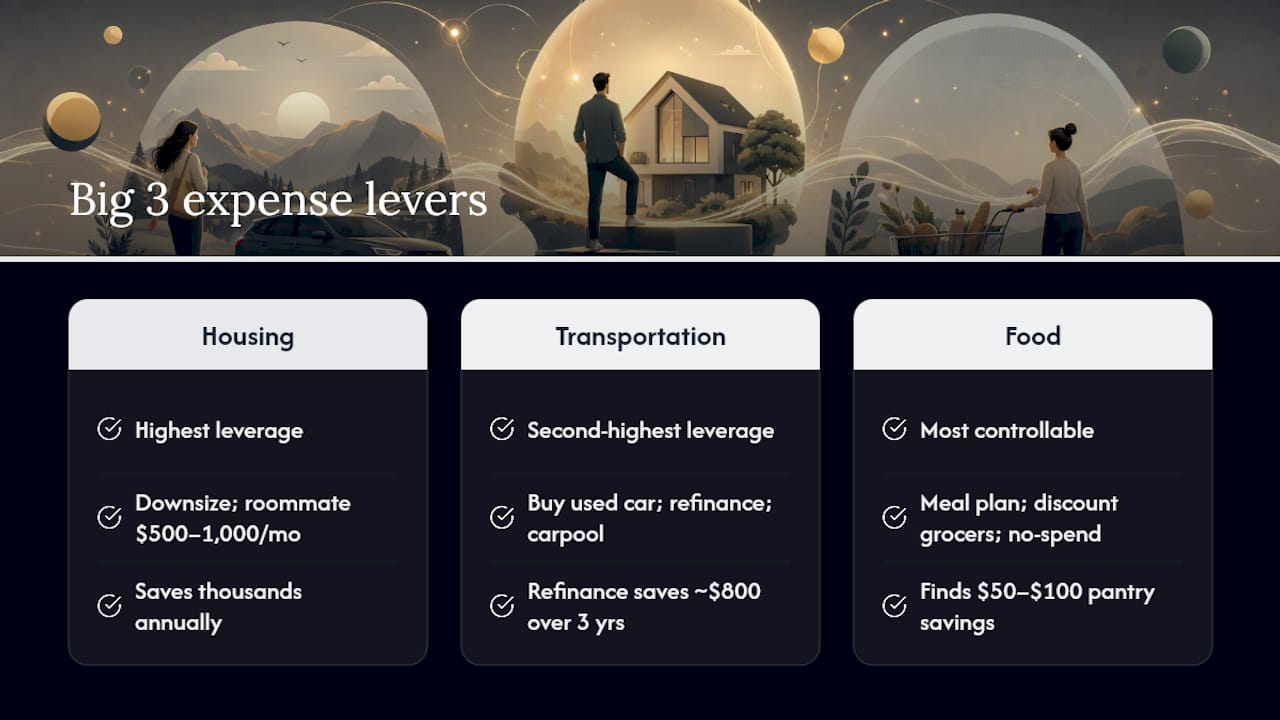
Housing, transportation, and food typically consume a large majority of a household’s budget. That’s where the leverage is.
Frugal living expert Austin Williams makes this point clearly: optimizing a major expense once produces recurring monthly savings indefinitely, while cutting small daily purchases requires constant willpower for modest returns.
Housing is the highest-leverage lever. Options include downsizing to a smaller unit, taking on a roommate ($500–$1,000/month in shared rent), moving to a less expensive neighborhood, or appealing your property tax assessment. A renter who moves from a higher-cost apartment to a more affordable unit can save thousands annually — far more than most save by cutting coffee for many years.
Transportation is the second-biggest opportunity. Buying a reliable used car instead of a new one avoids several thousand dollars in first-year depreciation. Refinancing a car loan from 8% to 4% on a $20,000 balance saves roughly $800 in interest over three years. Switching to transit or carpooling for a daily commute can eliminate a few hundred dollars per month in gas, parking, and wear.
Food is the most controllable of the three. Meal planning and a weekly grocery list cut impulse purchases significantly. Shopping at discount grocers like Aldi or Lidl versus premium chains typically saves a significant percentage on the same items. A no-spend challenge — one weekend where you cook only from what’s already in the pantry — resets spending habits and often reveals $50–$100 in forgotten food.
SoFi’s guidance on downsizing major costs reinforces the same logic: one structural change to a major expense outperforms dozens of small cuts. For planning major purchases and understanding their full financial impact, this guide to how major purchases change your finances is worth reading before you commit.
Pro Tip: Tackle the Big 3 in order of your largest monthly spend. Pull up last month’s bank statement, rank housing, transportation, and food by dollar amount, and focus your first 30 days on the biggest one. One change there beats six months of coupon clipping.
What’s a realistic timeline for seeing results?
Results come faster than most people expect, but slower than motivation peaks. Here’s an honest roadmap:
| Timeframe | Action | Expected Outcome |
|---|---|---|
| Days 1–7 | Set up auto-transfer, enable tracking, cancel one unused subscription | First surplus dollars protected; full spending picture emerging |
| Days 8–30 | Complete one full month of tracked spending; build your budget | Know exactly where money goes; budget in place |
| Days 30–60 | Negotiate one fixed expense; increase auto-transfer by $50–$100 | Monthly savings rate rises; first month of intentional surplus |
| Days 60–90 | Attack highest-rate debt; review Big 3 for one structural change | Debt paydown accelerating; major expense reduced |
| Months 4–6 | Emergency fund reaches one month of expenses | Financial cushion exists; stress measurably lower |
| Months 7–9 | Emergency fund at 3 months; savings rate at 15–20% of take-home | Solid foundation; ready to invest surplus |
At $4,000/month take-home, that’s $400–$800 per month going to savings or debt beyond minimums. Reaching a three-month emergency fund is the milestone that most financial planners point to as the moment financial stress noticeably drops.
For building out your financial goal-setting process, Finblog’s five-step framework gives you a structured way to set and track those milestones.
How to cut spending without feeling deprived
Deprivation is the reason most budgets fail. The fix isn’t more willpower — it’s better design.

The “money dials” concept is useful here: identify two or three categories where spending genuinely improves your life, and protect those. Cut aggressively everywhere else. Someone who loves travel but doesn’t care about restaurants should slash dining out and redirect that money to a travel fund. That’s not sacrifice — it’s alignment. Finblog’s guide on prioritizing spending for financial stability walks through this in more detail.
Practical low-deprivation switches that actually work:
- Cook your favorite restaurant meals at home once a week. The experience is 80% as good at 20% of the cost.
- Host a potluck instead of going out. Social connection stays intact; the bill disappears.
- Swap one brand-name product per grocery trip for the store brand. Most people can’t taste the difference in staples like pasta, canned goods, or cleaning products.
The 48-hour rule for purchases over $50: add the item to a list, wait two days, then decide. Most impulse purchases lose their appeal within 48 hours. For the ones that don’t, you’ve made a deliberate choice rather than a reactive one. This connects directly to understanding emotional spending triggers — a pattern worth examining if impulse buying is a recurring issue.
A guilt-free spending bucket makes the whole system sustainable. Allocate a fixed amount each month — $100, $200, whatever fits your budget — that you can spend on anything with zero guilt. No tracking, no justification. When it’s gone, it’s gone. This one change prevents the “I’ve already blown the budget” spiral that derails most plans.
No-spend challenges work as periodic resets. A no-spend weekend means zero discretionary purchases for 48 hours: cook from the pantry, find free entertainment, skip the mall. Most people who try it discover $50–$150 in spending they didn’t miss. AARP’s savings tactics list includes several variations worth trying.
Here’s a simple three-step structure for a 30-day low-spend challenge:
- Define the rules clearly upfront (what counts as discretionary, what’s exempt).
- Track daily and share progress with one other person for accountability.
- At the end, redirect the savings to a specific goal — not back into general spending.
Pro Tip: When a raise or bonus arrives, give yourself 48 hours to celebrate, then immediately redirect at least half to savings or debt before it touches your checking account. Framing it as “I’m paying future-me first” works better psychologically than “I’m restricting myself.”
The part most financial advice gets wrong
Most personal finance content treats living below your means as a discipline problem. It isn’t. It’s a design problem.
The people who consistently spend less than they earn aren’t more virtuous or more motivated. They’ve built systems that make the right behavior automatic and the wrong behavior inconvenient. The auto-transfer happens before they see the money. The credit card is off the phone’s saved-payment list. The grocery list goes into the store app before they walk in. Friction is placed on spending, not on saving.
There’s also a tendency in financial media to moralize small purchases while ignoring structural costs. A $6 coffee is visible and easy to criticize. The math says otherwise. Redirecting attention to the Big 3 is the single most underrated shift in personal finance thinking.
One more thing: the goal isn’t to minimize spending. It’s to maximize the gap between what you earn and what you spend, while keeping quality of life high enough that the system lasts. A plan that makes you miserable for six months and then collapses produces worse outcomes than a modest, sustainable surplus held for years. Slow and steady isn’t a consolation prize — it’s the actual strategy.
Finblog can help you put this into practice
Getting the system right in the first 30 days is where most people stall. Finblog offers budgeting guides, downloadable templates, and one-on-one financial consulting designed specifically for people who want to build a real spending surplus without overhauling their lifestyle.
The Finblog financial stability guide covers the full framework in one place, including a step-by-step budget template you can use immediately. If you’d rather work through it with a consultant, Finblog’s advisory service helps you identify your highest-impact expense cuts, set up automation, and build a 90-day plan tailored to your actual numbers.
Start with the free budget template, run your first 30-day tracking period, and schedule a quick consult if you want a second set of eyes on your numbers. The first conversation costs nothing.
Sources
These are the primary sources behind this article. Each one offers free tools, worksheets, or research worth bookmarking:
- Files
- Aarp
- Living below your means
- 8 Steps To Live Below Your Means, According to Frugal Living Expert Austin Williams
- Fdic