



TL;DR:
- Net income is what you truly have after taxes and deductions, crucial for budgeting and financial decisions.
- Calculating net income involves subtracting all mandatory and voluntary deductions from gross income.
- Using net income rather than gross helps set realistic goals, avoid overspending, and improve financial confidence.
Your employer says you earn $60,000 a year, but your bank account tells a completely different story. That gap between what you’re supposedly making and what you can actually spend is one of the most common sources of financial stress for young professionals. Getting clarity on net income, the money that truly lands in your pocket after all deductions, is the single most important step toward building a budget that works, setting goals you can actually hit, and making investment decisions grounded in reality.
Table of Contents
- What is net income and why does it matter?
- How to calculate your net income
- Net income vs. other financial terms: A quick comparison
- How to use your net income for better financial decisions
- The hidden impact of net income: What most people overlook
- Ready to master your finances with deeper insights?
- Frequently asked questions
Key Takeaways
| Point | Details |
|---|---|
| Net income clarity | Net income shows how much money you truly have available to spend or save after deductions. |
| Calculation steps matter | Subtract all taxes and regular deductions from your gross pay to find your net income correctly. |
| Not all income terms are equal | Gross income, net income, and cash flow mean different things in personal finance. |
| Informed financial choices | Base budgets and investments on your real net income for smarter money management. |
| Regular review pays off | Check your net income regularly to adjust to pay changes and keep financial goals on track. |
What is net income and why does it matter?
Now that we’ve established why this concept shouldn’t be overlooked, let’s dig into what net income actually means.
When most people talk about their salary, they’re quoting their gross income, which is the total amount earned before anything is subtracted. Net income, on the other hand, is what remains after the government, your employer’s benefits programs, and other withholdings take their share. Net income refers to your total income after deductions like taxes and benefits are taken out. Think of gross income as a pizza fresh out of the oven, and net income as your actual slice after everyone else grabs theirs first.
Common deductions that reduce your gross pay include:
- Federal income tax: Ranges from 10% to 37% depending on your income bracket
- State and local income taxes: Varies widely by location, from 0% in states like Texas or Florida to over 13% in California
- Social Security and Medicare (FICA): A flat 7.65% taken from most employees’ paychecks
- Health insurance premiums: Your share of employer-sponsored health coverage
- Retirement contributions: Amounts directed to a 401(k) or similar plan
- Other voluntary deductions: Life insurance, FSA contributions, union dues
Why does this matter for your daily money choices? Because every financial decision you make, from splitting rent to deciding how much to invest each month, should be based on net income, not gross. Effective personal finance management starts with knowing your real number. When you plan based on gross income, you routinely overestimate how much you can spend, and that leads to overdrafts, debt, and frustration.
“Your gross salary is what you’re worth to your employer. Your net income is what you actually have to work with. Never confuse the two.”
Net income is also the metric lenders look at when evaluating your ability to repay a loan. It’s what landlords check before approving a lease. And it’s the foundation of any realistic savings or investment strategy. Skipping over it isn’t just a minor oversight. It’s like planning a road trip using the wrong map.
How to calculate your net income
Once you know what net income is, the next step is understanding how to calculate it accurately for yourself.
The formula is refreshingly simple: Net Income = Gross Income minus Total Deductions. The tricky part is identifying every deduction that applies to you. Here’s a step-by-step process to walk you through it.
- Find your gross income. Check your employment contract, offer letter, or the top line of your pay stub. This is your starting number.
- List all mandatory deductions. These include federal tax, state tax, and FICA withholdings. Your pay stub will show exact dollar amounts.
- Add voluntary deductions. Include anything you’ve opted into: retirement contributions, health insurance premiums, commuter benefits.
- Total all deductions. Add every line item together for a single deduction figure.
- Subtract from gross income. The result is your net income for that pay period.
Net income is found by subtracting all deductions from gross income. It sounds straightforward, but most people never actually sit down and do the math. Let’s make it concrete with a sample monthly paycheck breakdown.
| Pay stub line item | Amount |
|---|---|
| Gross monthly salary | $5,000.00 |
| Federal income tax | ($625.00) |
| State income tax | ($200.00) |
| Social Security (6.2%) | ($310.00) |
| Medicare (1.45%) | ($72.50) |
| Health insurance premium | ($180.00) |
| 401(k) contribution (5%) | ($250.00) |
| Net income (take-home pay) | $3,362.50 |
Notice that a $5,000 gross salary becomes $3,362.50 in actual take-home pay. That’s a difference of $1,637.50 every single month. If you had budgeted based on $5,000, you’d be overspending by more than $1,600 without realizing why. This is exactly why starting your budgeting step-by-step process with net income is non-negotiable.

Pro Tip: Review your pay stub every pay period, not just when something seems off. Payroll errors happen more often than you’d expect, and small discrepancies in withholding or benefit deductions can add up to hundreds of dollars over a year. Catching them early saves money and headaches.
Net income vs. other financial terms: A quick comparison
You may hear other money terms that sound similar. Let’s make sure you know exactly how net income stands apart.
Financial language can get confusing fast. Gross income, net income, take-home pay, cash flow: these terms get used interchangeably in casual conversation, but they each mean something distinct. Net income is distinct from gross income and cash flow, each representing different stages of your finances. Mixing them up leads to poor planning and unrealistic expectations.
Here’s a side-by-side comparison to clear things up:
| Term | Definition | When to use it |
|---|---|---|
| Gross income | Total earnings before any deductions | Comparing job offers, understanding tax brackets |
| Net income | Earnings after all deductions | Budgeting, bill-paying, day-to-day spending |
| Take-home pay | Synonymous with net income for employees | Refers specifically to what’s deposited in your account |
| Cash flow | Money moving in and out over time | Tracking monthly spending vs. income patterns |
Understanding when to use each metric gives you a clearer financial picture at every stage of planning. Here’s a quick guide to applying each one:
- Use gross income when evaluating a job offer or estimating your annual tax liability
- Use net income for every budgeting decision, from rent to groceries to subscriptions
- Use take-home pay to confirm what’s actually deposited after payroll processing
- Lean on cash flow when reviewing monthly cash flow understanding patterns to spot spending leaks or savings opportunities
One subtlety worth noting: take-home pay and net income are nearly identical for salaried employees, but they can differ if your employer delays posting deposits or if there are processing-day variations. For freelancers or self-employed individuals, net income involves more complexity because you must subtract self-employment taxes and business expenses separately before arriving at a true bottom line.
How to use your net income for better financial decisions
Now that you can calculate and distinguish your net income, here’s how to put it into action for real-world results.
Knowing your net income is only the starting point. The real value comes from applying it systematically to every financial choice you make. Knowing your net income helps you create a realistic budget and avoid overspending. Here’s a structured approach to doing exactly that.
-
Build your spending plan around net income. Take your monthly net income and allocate it across categories: housing, food, transportation, savings, and discretionary spending. A popular framework is the 50/30/20 rule: 50% to needs, 30% to wants, and 20% to savings and debt repayment. All of these percentages should be calculated against your net income, never your gross.
-
Set financial goals with real numbers. Say you want to save $6,000 for an emergency fund over 12 months. That’s $500 per month. If your net income is $3,362.50, that’s a realistic 14.9% savings rate. If you had used your gross income of $5,000, you might have set a higher savings target and then consistently failed to hit it.
-
Track progress monthly. Use a monthly budgeting template to compare what you planned to spend against what you actually spent. This habit builds awareness and reveals patterns you’d otherwise miss.
-
Apply it to investment decisions. Before committing to any investment, whether that’s maxing out a Roth IRA or putting money into an index fund, confirm the contribution fits comfortably within your net income. Overcommitting to investments and then pulling money out early because you need cash defeats the purpose.
-
Review your personal balance sheet regularly. Your personal balance sheet example should always reflect figures based on net income to show your true financial position, including assets you’re building and liabilities you’re reducing.
Pro Tip: Base every financial goal, whether saving for a house down payment, paying off student loans, or building an investment portfolio, on your actual net income. Goals anchored to gross income almost always overshoot what you can realistically achieve, and repeated “failure” to hit inflated targets erodes your motivation over time.
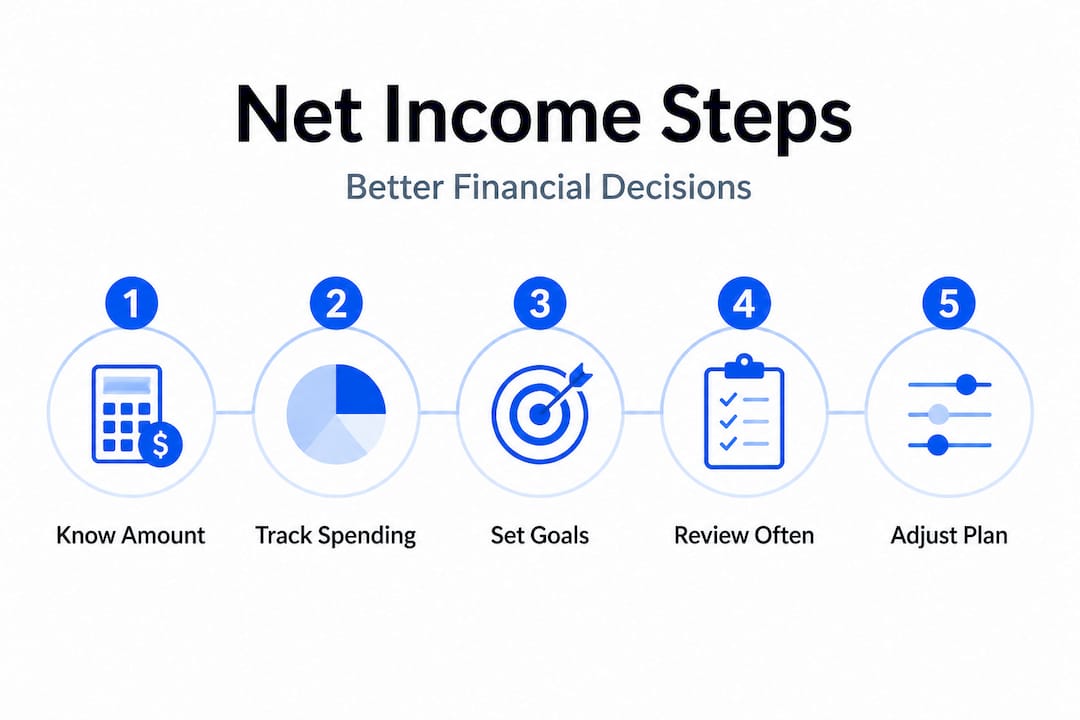
The practical impact of this approach compounds over time. A 26-year-old who correctly uses net income to guide savings decisions will likely accumulate significantly more wealth by age 40 than a peer who consistently overestimates available funds based on gross pay. The math isn’t complicated. The discipline to apply it is what separates good financial outcomes from constant frustration.
The hidden impact of net income: What most people overlook
Most personal finance articles give you the definition of net income, show you the formula, and stop there. But there’s a deeper, more subtle impact that deserves your attention.
Here’s what we’ve seen time and again: small recurring deductions are the biggest silent drain on financial progress. Consider someone who signs up for a slightly more expensive health insurance plan at open enrollment, adds a voluntary life insurance policy, and increases their 401(k) contribution all in the same month. Each individual change seems minor. Together, they might reduce take-home pay by $300 or more monthly. That’s $3,600 per year in reduced spendable income that nobody mentioned at orientation.
The problem isn’t that these deductions are bad choices. Most of them are genuinely beneficial. The problem is that people don’t update their budget when their net income changes. They keep spending as if nothing changed and wonder why they’re falling short. Monitoring your cash flow strategies after every deduction change is how you stay ahead of this.
There’s also a confidence dimension that rarely gets discussed. When you don’t know your exact net income, financial decisions feel vague and stressful. Should you take that weekend trip? Can you afford a gym membership? These feel like judgment calls when they’re actually math problems. Once you anchor every decision to a concrete net income figure, the guesswork disappears. You spend less mental energy on money and more on the things that actually matter.
The uncomfortable truth is this: most people overestimate their spending capacity by 20% to 30% simply because they think in terms of gross salary. That miscalculation doesn’t just cause overdrafts. It delays retirement savings, extends debt repayment timelines, and creates a persistent low-grade financial anxiety that affects quality of life. Net income is not just a number. It’s the honest foundation that everything else in your financial life should be built upon.
Ready to master your finances with deeper insights?
If you’re looking to go further, you don’t have to navigate personal finance alone. Building on your understanding of net income is just the beginning of what’s possible when you approach money with clarity and intention. Finblog’s expert guides cover everything from calculating your first budget to making your first investment, all structured for people who want real, actionable information rather than vague advice. Whether you’re ready to build a detailed spending plan, evaluate investment options, or simply get a firmer grip on your monthly cash flow, the personal finance management resources at Finblog are designed to take you from confusion to confidence, one step at a time.
Frequently asked questions
Is net income the same as take-home pay?
Net income is often referred to as take-home pay because it represents what you actually receive after all deductions are processed and the funds are deposited in your account.
What deductions are commonly subtracted to calculate net income?
Typical net income deductions include federal and state income taxes, Social Security, Medicare, health insurance premiums, and retirement contributions like a 401(k).
Why should investors care about net income?
Net income is vital for evaluating true profitability and ensuring that investment contributions or financial commitments are based on money you actually have available, not theoretical gross earnings.
How often should you recalculate your net income?
You should check net income after any change to your pay, tax withholding, or benefit deductions, and at minimum conduct a full review every year during tax season or open enrollment.
Can bonuses or side hustle earnings be included in net income?
Yes. Net income includes all sources of earnings, but you must subtract all applicable taxes and deductions from those amounts before adding them to your overall net income figure.