


TL;DR:
- Inflation reduces the purchasing power of savings over time, even if account balances stay the same.
- Lower-income households are more affected by inflation due to higher spending on essentials.
- Using inflation-protected investments and reviewing savings strategies can help preserve wealth.
Most people assume that money sitting in a savings account is safe. The balance doesn’t drop, the bank is insured, and nothing looks wrong on paper. But there’s a quieter force working against you every single day: inflation. Even at a modest rate, inflation chips away at what your dollars can actually buy, year after year. By the time most savers notice the damage, it’s already years in the making. This article breaks down exactly how inflation works against your savings, who takes the hardest hit, and what concrete steps you can start taking right now to stay ahead of it.
Table of Contents
- What is inflation and why does it matter for your savings?
- How inflation impacts different types of savers
- The real cost: How inflation erodes your savings over time
- Strategies to protect your savings from inflation
- Our perspective: Why ignoring inflation is the biggest savings mistake
- Take control of your savings and future
- Frequently asked questions
Key Takeaways
| Point | Details |
|---|---|
| Inflation erodes savings | Money kept in traditional savings accounts loses purchasing power as prices rise each year. |
| Impact varies by income | Lower-income households are hit hard since essentials cost a higher share of their budget. |
| Update your savings plan | Adjust your emergency fund and savings approach regularly to keep up with inflation. |
| Use inflation protection tools | High-yield accounts and inflation-protected investments help reduce the real loss from rising prices. |
What is inflation and why does it matter for your savings?
Inflation, in simple terms, means that prices rise over time. A dollar today buys less than a dollar did ten years ago, and it will buy even less ten years from now. The inflation rate measures how fast prices are climbing, usually expressed as an annual percentage. The Consumer Price Index (CPI) and the Personal Consumption Expenditures (PCE) index are the two most common tools economists use to track it.
Here’s where it gets personal for savers: your savings balance might stay exactly the same, but its purchasing power (what it can actually buy) shrinks every year inflation is above zero. Inflation steadily reduces the value of money over time, and that effect compounds quietly, the way rust spreads on metal you forgot to check.
Let’s make this concrete. Suppose you set aside $1,000 today and leave it untouched for 10 years. At a 2.5% annual inflation rate, that $1,000 would have the purchasing power of roughly $781 in today’s dollars by year ten. You didn’t lose a single cent from your account balance, yet you lost nearly $220 in real value. That’s money you can no longer use for groceries, rent, or your child’s tuition.
Understanding how inflation affects investments follows the same logic. Any asset that doesn’t outpace inflation is, in real terms, losing ground.
Here are the key terms you’ll encounter when researching this topic:
- Inflation rate: The annual percentage increase in the general price level
- Purchasing power: How much your money can buy at any given time
- Real return: Your return after subtracting the inflation rate
- Price index: A tool for measuring changes in the cost of goods and services over time
“The real danger of inflation isn’t that your account balance drops. It’s that the world around your balance gets more expensive while your money stands still.”
Even a seemingly small inflation rate of 2% or 2.5% adds up significantly across 10, 20, or 30 years. For young professionals and families building their financial base right now, that window of time makes inflation one of the most important forces to understand and plan for.
With the basics of inflation affecting what you can buy, let’s see who feels the impact most.
How inflation impacts different types of savers
Not every household feels inflation the same way. Your income level, spending habits, and financial cushion all shape how much damage inflation does to your real wealth.

Research shows that lower-income households face a higher inflation burden, with an average annual PCE (Personal Consumption Expenditures) rise of 2.5% from 1984 to 2022, compared to just 2.2% for the top income quintile. That gap might sound small, but over nearly four decades, it produces a significant difference in cumulative financial stress. The bottom income quintile saw a cumulative PCE increase of 154% over that period, versus 128% for the top quintile.
Why the gap? Lower-income families tend to spend a larger share of their budgets on essentials like food, utilities, and transportation. These categories often see faster price increases than luxury goods or discretionary spending. When energy bills spike or grocery prices surge, families with tighter budgets have less room to absorb the shock.
| Household group | Avg. annual PCE rise (1984-2022) | Cumulative PCE increase |
|---|---|---|
| Bottom income quintile | 2.5% | 154% |
| Top income quintile | 2.2% | 128% |
| Difference | 0.3% per year | 26 percentage points |
For young professionals just starting out, or families trying to build an emergency fund while paying down debt, this disparity is a critical reality check. You may be working hard to save, but if your savings aren’t earning enough to offset your personal inflation rate, you’re effectively moving backward.
Understanding the saving vs investing differences is also key here. Savings accounts preserve your nominal balance but often fail to preserve real value. Investing, while riskier, has historically offered better protection against inflation over long time horizons.
Pro Tip: Track your own spending categories and compare how much those specific items have risen in price over the past two to three years. Your personal inflation rate may be higher than the headline number you see in the news.
Knowing inflation affects different savers uniquely, let’s see how it eats into savings accounts in real life.
The real cost: How inflation erodes your savings over time
Let’s put real numbers to the problem. Most traditional savings accounts in 2026 offer interest rates that hover below the long-run average inflation rate. That gap is the danger zone.
Accounts with interest rates below inflation lead to a loss in real value, even if the account balance technically grows. Here’s a practical comparison:
| Scenario | Starting amount | Annual interest rate | Inflation rate | Real value after 10 years |
|---|---|---|---|---|
| Regular savings account | $5,000 | 1.0% | 2.5% | ~$4,280 (in today’s dollars) |
| High-yield savings account | $5,000 | 4.5% | 2.5% | ~$5,990 (in today’s dollars) |
| No savings account (cash) | $5,000 | 0% | 2.5% | ~$3,894 (in today’s dollars) |
The difference between doing nothing and choosing the right account is over $2,000 in real purchasing power on just $5,000 saved. Multiply that across the full value of your emergency fund or longer-term savings, and the stakes become much clearer.
Here’s a step-by-step way to evaluate whether your savings are truly keeping up:
- Find your account’s current annual percentage yield (APY). Most banks display this prominently in your account dashboard.
- Look up the current inflation rate. The U.S. Bureau of Labor Statistics publishes monthly CPI data.
- Subtract the inflation rate from your APY. The result is your real return. If it’s negative, your savings are losing real value.
- Factor in taxes. Interest income is taxable, which further reduces your real return.
- Revisit this calculation once a year, since both rates change over time.
For families planning over a 20 or 30-year horizon, this matters enormously. Explore best practices for saving to learn how to choose accounts and structures that give your money a fighting chance against inflation.
Quick stat: At a 2.5% inflation rate, $10,000 loses roughly 22% of its purchasing power over 10 years, even if the account balance stays the same.
With the impact exposed, what can you practically do to fight back?
Strategies to protect your savings from inflation
The good news is that inflation doesn’t have to win. With the right moves, you can significantly reduce its impact on your financial future. These aren’t complicated strategies. Most require only a few hours of attention each year.
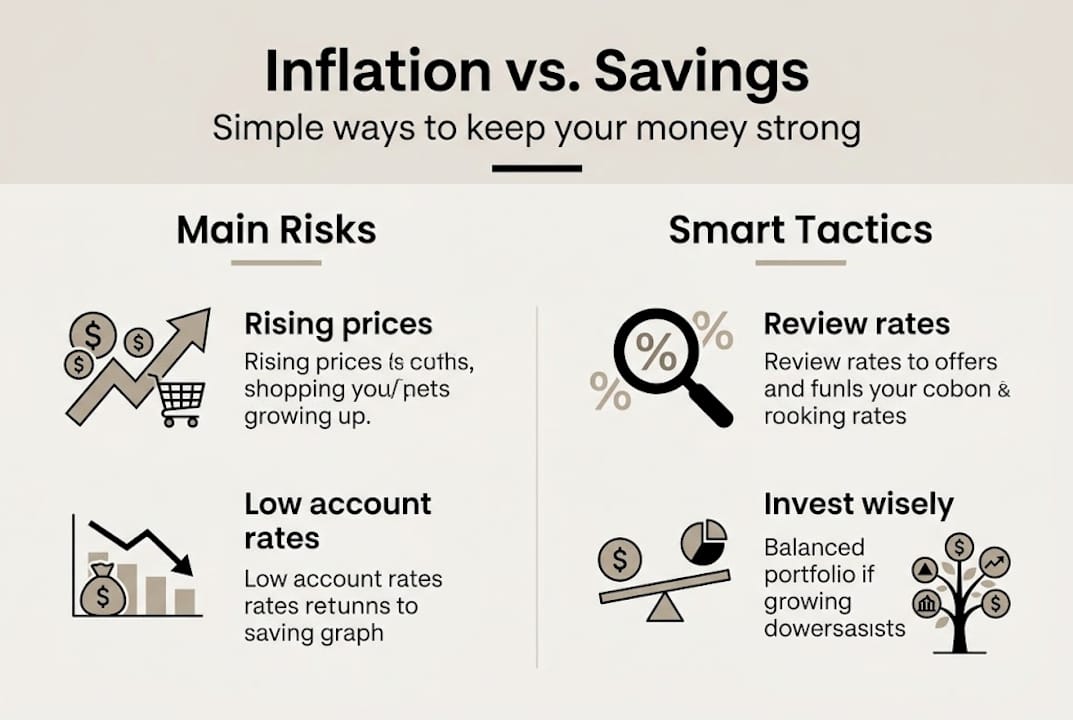
First, revisit your emergency fund. Families adjust emergency funds upward during high-inflation periods, with 6 to 12 months of expenses recommended for those with variable or unpredictable income. If your income fluctuates due to freelance work, commission-based pay, or seasonal employment, being on the higher end of that range is a smart cushion. You can read more about setting this up through solid emergency fund planning.
Here are the core strategies to consider:
- High-yield savings accounts (HYSAs): Online banks frequently offer APYs several times higher than traditional bank accounts. Moving your emergency fund here is a simple first step.
- Treasury Inflation-Protected Securities (TIPS): These are U.S. government bonds specifically designed to keep pace with inflation. Their principal adjusts with CPI changes.
- I-Bonds: Issued by the U.S. Treasury, I-Bonds pay interest based partly on the current inflation rate, making them a strong short to medium-term option.
- Diversify into investments: Stocks, real estate, and diversified funds have historically outpaced inflation over long periods. Learning how to invest during inflation can help you shift some savings toward growth assets.
- Inflation hedging: Certain commodities, real estate investment trusts (REITs), and diversified portfolios serve as natural hedges. Explore inflation hedging strategies for a structured approach. A hedging investments guide can help you match strategies to your risk tolerance.
Pro Tip: Set a calendar reminder every January to review your savings rates, inflation data, and emergency fund size. A 30-minute annual checkup can prevent years of silent loss.
Finally, review your savings strategy at least once a year. Rates change, inflation fluctuates, and your personal expenses shift as life moves forward. Staying static is itself a financial decision, and usually not a good one.
Even with these tools, there’s more to keep in mind when protecting your financial future in an inflationary world.
Our perspective: Why ignoring inflation is the biggest savings mistake
We’ve seen this pattern again and again: savers work hard, set money aside, and feel a quiet sense of accomplishment. Then years pass, and they realize their savings haven’t kept up with their cost of living. The account grew, but their purchasing power shrank. They were moving forward on paper, backward in reality.
Inflation is genuinely a silent thief. Unlike a stock market drop that shows up in red numbers, inflation’s damage is invisible until you try to spend. A family that carefully saved $40,000 over a decade may find it only covers what $32,000 would have bought when they started.
The most common mistake we see isn’t bad investment choices. It’s delay. People put off adjusting their savings, emergency funds, and account types until after the damage is obvious. By then, they’ve already lost real value they can never recover.
Treating inflation protection as a core, annual part of your financial planning is the mindset shift that separates confident savers from stressed ones. Small, consistent tweaks, moving to a higher-yield account, adjusting your emergency fund target, or exploring wealth protection strategies, can produce outsized results over time. Don’t wait for inflation to become a headline before you act.
Take control of your savings and future
Inflation won’t pause while you figure things out, but the right information makes all the difference. At Finblog, we’ve built a library of practical, no-jargon guides designed for people exactly like you: professionals and families who want to make their money work harder without needing a finance degree to do it. Whether you’re looking to maximize returns on your emergency fund, explore inflation-resistant accounts, or build a longer-term plan, Finblog’s savings resources are a strong starting point. Take a few minutes to browse our saving best practices guide and walk away with at least one change you can make this week.

Frequently asked questions
How does inflation decrease the value of my savings?
Inflation causes prices to rise, so your money buys less over time even if your savings balance stays the same. As inflation steadily reduces the value of money, every year your savings don’t outpace the inflation rate, you lose real purchasing power.
Are certain people or households more vulnerable to inflation?
Yes, lower-income households are more affected since they spend more on essentials like food and energy, which typically rise faster in price. Research confirms that lower-income households face an average annual PCE increase of 2.5% compared to 2.2% for top earners over nearly four decades.
Should I increase my emergency fund during high inflation?
Many experts recommend increasing emergency savings to 6 to 12 months of expenses during high-inflation periods if your income is unpredictable. Families adjust emergency funds upward specifically because inflation raises the cost of those months of living expenses.
How can I protect my savings from inflation?
You can use strategies like high-yield accounts, inflation-protected investments such as TIPS and I-Bonds, and regularly reviewing your financial plan. Exploring high-yield savings and inflation-protected assets is a well-supported starting point for most savers.