
Persistent price increases can quickly turn familiar investment strategies upside down for even seasoned professionals. Inflation, especially when driven by complex shifts in core and energy costs, forces investors across markets like the United States, Europe, and Canada to rethink how assets perform and protect real value. Understanding the nuanced relationship between inflation and portfolio dynamics provides critical context for selecting resilient asset classes, responding to risks, and preserving purchasing power in an ever-changing global economy.
Table of Contents
- Defining Inflation and Investment Dynamics
- Asset Types Most Affected by Inflation
- How Inflation Changes Portfolio Performance
- Risks of Ignoring Inflation Exposure
- Strategies to Protect Investments From Inflation
Key Takeaways
| Point | Details |
|---|---|
| Understanding Inflation’s Impact | Inflation diminishes purchasing power, affecting returns and investment strategies across asset classes. Investors should proactively adjust portfolios to mitigate these effects. |
| Asset Class Sensitivities | Different assets react uniquely to inflation; real assets and commodities often offer better protection than traditional bonds and growth equities. Diversification across inflation-resistant classes is crucial. |
| Dynamic Portfolio Management | Regularly reassessing portfolio allocations in response to inflation is necessary for maintaining purchasing power. Implementing quarterly reviews can enhance portfolio resilience. |
| Proactive Risk Management | Investors should stress-test portfolios against inflation scenarios and utilize instruments like Treasury Inflation-Protected Securities to safeguard investments. Ongoing vigilance is required to adapt to economic changes. |
Defining Inflation and Investment Dynamics
Inflation represents a critical economic phenomenon where the purchasing power of currency systematically declines, affecting investment strategies across global markets. At its core, inflation measures the rate at which the general price level of goods and services increases over time, eroding the real value of money. This complex economic mechanism directly impacts investment returns, asset allocation, and portfolio performance.
Understanding inflation requires examining its multifaceted nature through macroeconomic lenses. Inflation dynamics reveal critical economic interactions between monetary policy, government spending, and market expectations. Economists typically track inflation through consumer price indices, which aggregate price changes across various consumer goods and services. These indices help investors and policymakers understand how rapidly currency values are shifting and potential implications for investment strategies.
The relationship between inflation and investments is nuanced and dynamic. Different asset classes respond uniquely to inflationary pressures: stocks may provide some hedge through corporate earnings growth, while bonds often suffer during high inflation periods due to fixed interest payments. Real assets like real estate and commodities historically demonstrate stronger performance during inflationary environments, offering investors potential protective mechanisms against declining currency values.
Pro tip: Regularly reassess your portfolio’s inflation sensitivity by calculating the real rate of return, which accounts for inflation’s impact on your investment performance.
Asset Types Most Affected by Inflation
Inflation does not impact all asset classes uniformly, creating complex challenges for investors seeking to protect their wealth. Some investments demonstrate remarkable resilience, while others become significantly vulnerable during periods of rising prices. Different asset classes exhibit distinct inflation sensitivities that require careful strategic analysis and proactive portfolio management.
Fixed-income securities like traditional bonds often suffer most dramatically during inflationary periods. Their fixed interest payments become less valuable as currency purchasing power declines, leading to potential substantial real value erosion. Stocks present a more nuanced scenario: while some sectors like energy and commodities can provide natural inflation protection through price adjustments, others struggle to maintain real returns. Technology and growth stocks frequently underperform during high inflation environments due to their sensitivity to interest rate changes and reduced future earnings value.

Real assets emerge as particularly robust inflation hedges. Commodities, especially energy-related investments, residential real estate, and infrastructure assets typically demonstrate stronger performance during inflationary cycles. These assets possess inherent characteristics that allow value preservation: physical commodities can be directly repriced, real estate rental income can be adjusted, and infrastructure investments often include inflation-linked revenue streams. Investors can strategically allocate portions of their portfolio to these asset types to mitigate inflation-related risks and maintain purchasing power.
Pro tip: Diversify your portfolio across inflation-resistant asset classes, prioritizing a mix of commodities, real estate, and inflation-protected securities to build robust financial resilience.
Here’s a comparison of how key asset types typically respond during periods of rising inflation:
| Asset Class | Typical Inflation Impact | Main Vulnerability | Potential Strategic Role |
|---|---|---|---|
| Traditional Bonds | Negative performance | Fixed interest loses value | Use inflation-linked bonds instead |
| Equities | Mixed, by sector | Growth sectors sensitive to rates | Overweight inflation-resistant sectors |
| Real Estate | Typically positive | Sensitive to financing conditions | Generate inflation-adjusted income |
| Commodities | Strong positive | Prone to volatility | Hedge against currency devaluation |
| Infrastructure | Generally positive | Regulatory risks | Provides inflation-linked cash flows |
How Inflation Changes Portfolio Performance
Inflation fundamentally transforms portfolio dynamics, creating a complex landscape where traditional investment strategies may suddenly become ineffective. Inflation episodes dramatically reshape asset return correlations by altering risk premia and introducing substantial variability in portfolio performance. Investors must recognize that inflation is not a uniform economic phenomenon, but a nuanced force that can produce divergent impacts across different asset classes and investment approaches.
The performance transformation occurs through multiple interconnected mechanisms. Fixed-income investments typically experience the most direct negative pressure, as rising inflation erodes the real value of predetermined interest payments. Equity portfolios demonstrate more varied responses, with sectors like energy and commodities often outperforming technology and growth-oriented stocks. Some industries can naturally adjust prices, creating internal inflation protection, while others struggle to maintain real returns in high-inflation environments.
Successful portfolio management during inflationary periods requires dynamic reallocation strategies. Investors need to continuously monitor asset class correlations, reassess risk exposures, and potentially increase allocations to inflation-resistant investments like real assets, commodities, and inflation-protected securities. The goal shifts from pure return maximization to maintaining purchasing power and protecting real wealth against currency devaluation. This approach demands ongoing analysis, flexibility, and a willingness to deviate from traditional portfolio construction models.
Pro tip: Implement a quarterly portfolio review process focused specifically on inflation sensitivity, adjusting asset weights to maintain optimal risk-adjusted returns during changing economic conditions.
Risks of Ignoring Inflation Exposure
Ignoring inflation exposure represents a critical financial vulnerability that can systematically erode investment value and long-term wealth accumulation. High inflation creates substantial economic uncertainty741495_EN.pdf) by distorting price signals, reducing purchasing power, and introducing unpredictable market dynamics that can devastate unprepared investment portfolios. Investors who fail to acknowledge inflation’s pervasive impact risk experiencing significant financial losses across multiple asset classes.
The consequences of neglecting inflation exposure extend beyond immediate portfolio performance, potentially triggering broader economic disruptions. Fixed-income investments suffer most dramatically, with bond yields often failing to keep pace with rising prices, effectively guaranteeing negative real returns. Equity portfolios face similar challenges, as corporate earnings get compressed between rising operational costs and constrained pricing power. Retirement savings and long-term financial plans become particularly vulnerable, with decades of accumulated wealth potentially losing substantial real-world value if inflation risks are not proactively managed.
Mitigating inflation exposure requires a sophisticated, multi-layered approach that goes beyond simple asset allocation strategies. Investors must develop dynamic portfolio frameworks capable of adapting to rapidly changing economic conditions. This involves regularly stress-testing investment holdings against different inflation scenarios, maintaining diversified asset mixes with inherent inflation-resistant characteristics, and continuously monitoring macroeconomic indicators that signal potential inflationary pressures. Sophisticated investors recognize that inflation protection is not a one-time decision but an ongoing strategic commitment requiring constant vigilance and flexible response mechanisms.
Pro tip: Conduct an annual comprehensive portfolio stress test specifically focused on inflation scenarios, simulating potential value erosion and identifying preemptive reallocation opportunities.
Strategies to Protect Investments From Inflation
Investors must deploy sophisticated, multi-dimensional strategies to effectively shield their portfolios from inflation’s corrosive effects. Fiscal policy offers critical protections against inflation risks by creating targeted economic stabilization mechanisms. Successful protection requires a comprehensive approach that combines asset diversification, strategic allocation, and proactive risk management techniques.
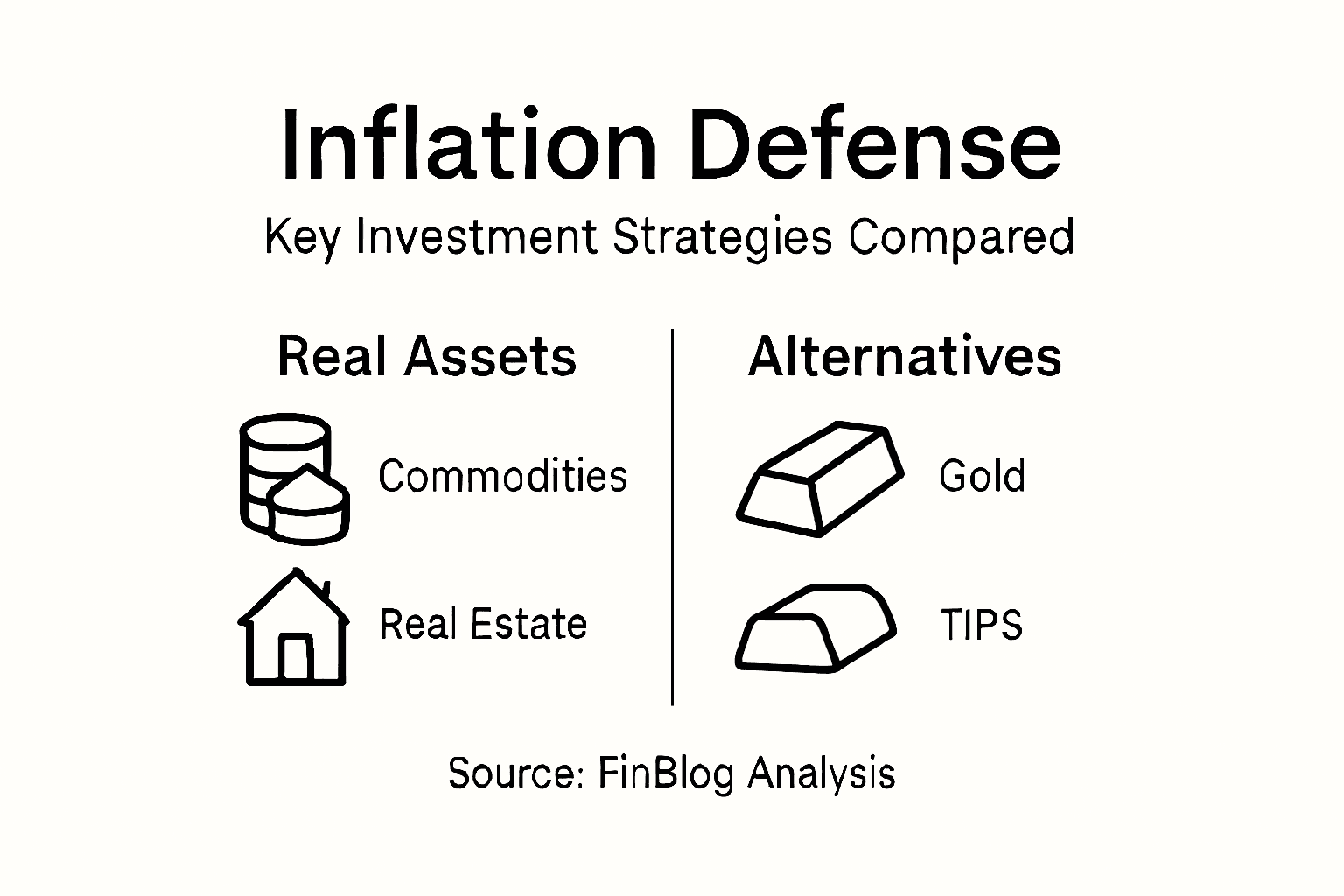
Key defensive strategies include allocating investments across inflation-resistant asset classes. Real assets like commodities, real estate, and infrastructure investments demonstrate remarkable resilience during inflationary periods. Treasury Inflation-Protected Securities (TIPS) provide direct inflation hedging by adjusting principal values based on consumer price index changes. Investors should also consider sectors with inherent pricing power, such as energy, healthcare, and consumer staples, which can more readily pass increased costs to consumers and maintain profit margins.
Dynamic portfolio management becomes crucial in navigating inflationary environments. This involves regularly rebalancing asset allocations, maintaining flexible investment positions, and continuously monitoring macroeconomic indicators. Sophisticated investors utilize instruments like inflation swaps, commodity futures, and international diversification to create robust, adaptable investment frameworks. The goal extends beyond simple preservation, focusing on maintaining real purchasing power and identifying opportunities created by economic transformations during inflationary cycles.
Pro tip: Implement a quarterly portfolio stress test focusing specifically on inflation scenarios, simulating potential value erosion and identifying preemptive reallocation strategies.
The table below summarizes methods investors use to address inflation risks and their unique benefits:
| Strategy | Key Benefit | Implementation Challenge |
|---|---|---|
| Asset Diversification | Spreads risk across market changes | Requires ongoing portfolio review |
| Allocation to Real Assets | Preserves value during inflation | May increase exposure to volatility |
| Inflation-Protected Securities | Maintains real returns | Limited yield in stable periods |
| Dynamic Rebalancing | Adapts to changing conditions | Demands frequent monitoring |
| Sector Rotation | Captures outperforming sectors | Timing market shifts is difficult |
Strengthen Your Investment Strategy Against Inflation Today
Inflation poses complex challenges that threaten the real value of your investments and wealth accumulation. As the article highlights, navigating inflation requires understanding how different asset classes respond and adopting dynamic portfolio strategies to preserve purchasing power. If you feel uncertain about managing inflation exposure or worried that your current investments may underperform in rising price environments, you are not alone.
At FinBlog, we specialize in empowering investors like you with expert guidance tailored to inflation protection. Our financial consulting services focus on strategic asset allocation, real asset diversification, and inflation-protected instruments to help you maintain and grow real returns. Don’t leave your portfolio vulnerable to currency devaluation or unexpected market shifts. Explore our insights and secure your financial future by visiting FinBlog’s homepage and taking advantage of personalized advice designed to tackle inflation risks head-on.
Act now to build resilience and confidence with your investments. Learn more about portfolio optimization techniques and risk management strategies by visiting FinBlog today.
Frequently Asked Questions
What is inflation and how does it affect investments?
Inflation is the rate at which the general price level of goods and services rises, leading to a decline in purchasing power. It affects investments by eroding the real value of returns, impacting different asset classes in varying ways.
How can investors protect their portfolios from inflation?
Investors can protect their portfolios from inflation by diversifying across inflation-resistant asset classes, such as real estate, commodities, and Treasury Inflation-Protected Securities (TIPS). Dynamic management of asset allocations and sector rotation also help maintain purchasing power.
Which asset classes are most vulnerable to inflation?
Fixed-income securities, particularly traditional bonds, are most vulnerable to inflation as their fixed interest payments lose value. Growth stocks, especially in sectors sensitive to interest rates, also tend to struggle during high inflation periods.
What strategies can be used to adjust portfolios during inflationary periods?
Strategies to adjust portfolios during inflation include regular rebalancing to increase exposure to inflation-resistant assets, stress testing against inflation scenarios, and maintaining flexible investment positions to respond to changing market conditions.
Recommended
- Investing During Inflation: Proven Strategies to Protect Wealth – Finblog
- Inflation Hedging Investments: Complete Expert Guide – Finblog
- Inflation Forecast 2025: Impacts on Global Investments – Finblog
- Understanding the Tax Implications of Investing – Finblog
- AI Investment Management Platform for Automated Portfolio Management