



Managing multiple debts can feel overwhelming, especially when minimum payments barely make a dent. The debt snowball method offers a straightforward, psychologically proven approach to eliminate debt by targeting your smallest balances first. This strategy builds momentum through quick wins, keeping you motivated as you work toward financial freedom. Unlike methods focused solely on interest rates, the snowball approach harnesses behavioral economics to help you stay committed and see real progress fast.
Table of Contents
- Why The Debt Snowball Method Works: Psychological Motivation Over Math
- Getting Started: What You Need To Prepare Before Using The Debt Snowball Method
- How To Execute The Debt Snowball Method: Step-By-Step Instructions
- Common Pitfalls And How To Stay On Track With The Debt Snowball Method
- What To Expect: Results And Benefits From Using The Debt Snowball Method
- Discover Expert Resources To Conquer Debt Faster
Key takeaways
| Point | Details |
|---|---|
| Smallest balance priority | The debt snowball targets debts from smallest to largest balance, ignoring interest rates entirely. |
| Psychological momentum | Quick wins from eliminating small debts first create motivation that sustains long-term commitment. |
| Minimum payments maintained | You make minimum payments on all debts while aggressively attacking the smallest one with extra funds. |
| Accelerating payoff cycle | Each paid-off debt rolls its payment into the next smallest, creating an accelerating repayment snowball. |
Why the debt snowball method works: psychological motivation over math
The debt snowball method prioritizes behavior over pure mathematics, and research backs this approach. Focusing on smaller balances first increases the likelihood you’ll stick with your debt payoff plan, even though it might cost slightly more in interest compared to targeting high-rate debts. The reason is simple: humans need wins to stay motivated.
When you eliminate a debt completely, you experience immediate psychological satisfaction. That victory reduces overwhelm and builds confidence in your ability to become debt-free. These emotional rewards matter more than most people realize. Many individuals abandon mathematically optimal strategies because they feel too slow or abstract, while the tangible progress of eliminating debts quickly keeps you engaged.
Behavioral economics shows we’re not purely rational about money. We respond to visible progress and emotional feedback. The debt snowball leverages this reality by giving you frequent celebrations as smaller debts disappear. Each completed payment becomes proof you can succeed, fueling your commitment to tackle the next balance.
This psychological foundation makes the snowball method particularly effective for people who’ve struggled with debt in the past or feel paralyzed by multiple obligations. The method transforms an abstract goal into concrete milestones you can check off, creating a positive feedback loop that carries you through the entire journey. While you might pay marginally more interest over time, the increased completion rate and reduced stress make it worthwhile for most people pursuing various debt repayment strategies.
Pro Tip: Track each debt payoff with a visual chart or checklist where you can physically mark completed debts, amplifying the psychological reward of each victory.
The satisfaction of quickly eliminating smaller debts provides motivation that mathematical approaches often fail to deliver, making behavioral wins more valuable than interest savings for many people.
Getting started: what you need to prepare before using the debt snowball method
Before launching into the debt snowball, gather complete information about your financial situation. List all debts with balances and minimum payments so you know exactly what you’re working with. Include credit cards, personal loans, medical bills, and any other liabilities.

Next, build a realistic monthly budget that accounts for all essential expenses and debt obligations. Your budget creation must ensure you can cover minimum payments on every debt without fail. Missing payments triggers penalties and damages your credit, undermining your progress.
Identify how much extra money you can allocate beyond minimum payments. This becomes your snowball amount, the funds you’ll throw at your smallest debt. Even small extra amounts make a difference, so scrutinize your budget for opportunities:
- Cut discretionary spending like dining out or subscription services temporarily
- Redirect windfalls such as tax refunds or bonuses entirely to debt
- Consider side income opportunities to boost your snowball payment
- Review recurring bills for savings through negotiation or switching providers
Maintain an emergency fund of at least $500 to $1,000 before aggressively attacking debt. This buffer prevents unexpected expenses from derailing your plan or forcing you to rely on credit cards again. Once you have this safety net, you’re ready to channel extra funds toward eliminating your smallest balance.
Organize your debt list from smallest to largest balance, regardless of interest rate. This ordered list becomes your roadmap. Verify you can make all minimum payments comfortably, then calculate your total available snowball payment for the first target debt. With these preparations complete, you’re positioned to execute the method effectively and maintain momentum through managing debt steps systematically.
Pro Tip: Automate minimum payments on all debts except your target to eliminate the risk of missed payments while you focus extra funds on your smallest balance.
How to execute the debt snowball method: step-by-step instructions
Executing the debt snowball requires consistent action following a specific sequence. Make minimum payments on all debts every month without exception. This protects your credit and prevents late fees that would slow your progress.
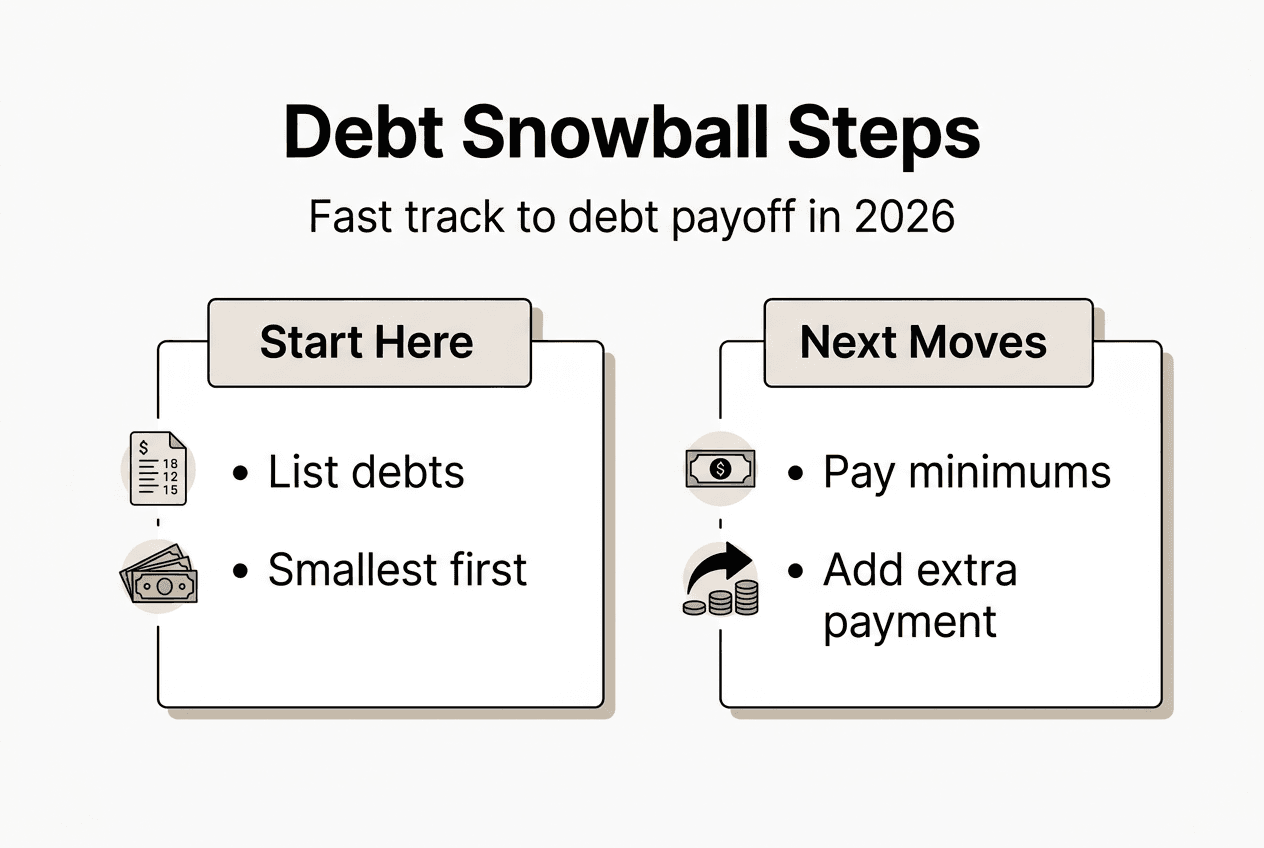
- Pay minimums on every debt to stay current across all accounts
- Add all extra available money to the minimum payment on your smallest debt
- Continue this focused attack until the smallest debt reaches zero balance
- Celebrate the victory, then immediately redirect that entire payment to the next smallest debt
- Repeat the process, watching your snowball payment grow with each eliminated debt
- Maintain momentum until all debts are completely paid off
The power emerges as you eliminate each debt. When your smallest balance disappears, you don’t reduce your total debt payments. Instead, you roll that entire payment amount into attacking the next target. This creates an accelerating effect where your snowball payment grows larger with each victory.
For example, if you pay $50 minimum on a small credit card plus $100 extra, you’re sending $150 monthly to that debt. Once it’s gone, you add that full $150 to the minimum payment of your next smallest debt. If that second debt has a $75 minimum, you’re now paying $225 monthly toward it. The snowball keeps growing.
| Debt | Balance | Minimum | Snowball Payment | Months to Payoff |
|---|---|---|---|---|
| Credit Card A | $500 | $25 | $125 | 4 |
| Medical Bill | $1,200 | $50 | $175 | 7 |
| Credit Card B | $3,000 | $90 | $265 | 11 |
| Personal Loan | $5,000 | $150 | $415 | 12 |
This table shows how your snowball payment accelerates as you knock out each debt, dramatically reducing payoff time for larger balances. The psychological wins come fast early on, building confidence for tackling bigger debts later. Track your progress visually to maintain motivation and adjust your budget if you find additional funds to accelerate the process further through credit card debt management techniques.
Pro Tip: Set up automatic transfers for your snowball payment on payday to remove the temptation to spend that money elsewhere and ensure consistent progress toward reducing debt fast.
Common pitfalls and how to stay on track with the debt snowball method
Many people stumble when implementing the debt snowball, but recognizing these pitfalls helps you avoid them. The most common mistake is switching to the avalanche method mid-journey because you calculate potential interest savings. While the math might favor avalanche, switching strategies undermines the psychological momentum that makes snowball effective. Commit to one approach and see it through.
Another critical error is failing to maintain minimum payments on all debts while focusing on your smallest balance. Missing payments triggers late fees, interest rate increases, and credit score damage. These setbacks cost more than any benefit from attacking your target debt aggressively. Always protect your minimums first.
Key challenges to anticipate and address:
- Unexpected expenses derailing your snowball payment without an emergency fund buffer
- Losing motivation after initial quick wins when facing larger, slower-to-eliminate debts
- Accumulating new debt on paid-off credit cards instead of closing or freezing accounts
- Comparing your progress to others instead of focusing on your personal journey
- Neglecting to celebrate milestones, which reduces the psychological benefit of the method
Build accountability into your process. Share your debt payoff goals with a trusted friend or join online communities where people support each other through similar journeys. External accountability dramatically increases completion rates. When motivation wanes, revisit your list of paid-off debts to remind yourself how far you’ve come.
Keep visual reminders of progress prominent. Some people create debt thermometers showing balances decreasing, while others maintain a physical chain where they remove a link for each debt eliminated. These tangible representations reinforce your commitment during difficult months. Explore various debt repayment strategies to find complementary techniques that strengthen your snowball approach, and consider reviewing credit card debt strategies to prevent new balances from accumulating.
What to expect: results and benefits from using the debt snowball method
The debt snowball delivers results that extend beyond simple debt elimination. Most people experience their first victory within weeks or months, depending on their smallest balance and available funds. These early wins create powerful motivation that sustains effort through the longer journey ahead.
Full debt freedom timelines vary widely based on total debt and monthly snowball payments. Someone with $15,000 in debt and $500 monthly extra might achieve freedom in three years, while another person with $50,000 and $300 monthly could need seven years. What matters most is consistent progress, not comparison to others.
Compared to the avalanche method, you might pay modestly more in total interest using the snowball approach. However, behavioral economics research shows people complete debt payoff more often with snowball because the psychological rewards keep them engaged. A method you actually finish beats a theoretically optimal strategy you abandon.
Key benefits you can expect:
- Reduced financial stress as the number of creditors and bills decreases steadily
- Improved credit score from consistent payments and declining credit utilization
- Greater sense of control and confidence in managing personal finances
- Skills and discipline that support long-term wealth building after debt freedom
- Mental energy freed from debt anxiety to focus on saving and investing
| Method | Focus | Psychological Impact | Interest Cost | Completion Rate |
|---|---|---|---|---|
| Debt Snowball | Smallest balance first | High motivation from quick wins | Slightly higher | Higher adherence |
| Debt Avalanche | Highest interest first | Slower visible progress | Mathematically lower | Lower adherence |
The snowball method supports your journey toward broader financial independence by building habits of disciplined payment and budget management. These skills transfer directly to saving and investing once you’re debt-free. The confidence gained from eliminating debt creates momentum for pursuing other financial goals with the same systematic approach.
Discover expert resources to conquer debt faster
Your debt snowball journey becomes easier with the right support and resources. At Finblog, we provide comprehensive guides designed to help you stay on track and maximize your repayment progress. Our detailed debt management strategies offer proven techniques for handling various debt types while maintaining financial stability.
Access our budget creation tools to identify additional funds you can redirect toward your snowball payment each month. We’ve helped thousands of readers optimize their finances to accelerate debt elimination. Our expert advice covers everything from negotiating with creditors to avoiding common mistakes that derail progress. Explore our platform to find personalized strategies that complement your debt snowball plan and support your path to complete financial freedom.
Frequently asked questions
What is the debt snowball method?
The debt snowball method pays off debts by targeting the smallest balance first, regardless of interest rate. You make minimum payments on all debts while putting extra money toward the smallest one until it’s eliminated. This approach builds motivation through quick wins, creating psychological momentum that helps you stay committed to becoming debt-free.
How is the debt snowball different from the avalanche method?
The snowball method prioritizes smallest debt balances first to generate quick psychological victories. The avalanche method targets debts with the highest interest rates first for maximum mathematical efficiency. Snowball sacrifices some interest savings for motivational benefits, while avalanche optimizes total interest paid but may feel slower and less rewarding emotionally.
What are common mistakes to avoid with the debt snowball method?
The biggest mistakes include failing to maintain minimum payments on all debts, which triggers penalties and credit damage. Many people also switch to the avalanche method prematurely when they calculate interest costs, undermining the psychological momentum. Neglecting to build a small emergency fund before aggressively attacking debt often forces people back into borrowing when unexpected expenses arise.
How long does it typically take to pay off debt using the debt snowball?
Payoff timelines depend entirely on your total debt amount and how much extra you can pay monthly beyond minimums. Many people eliminate their first small debt within a few months, creating immediate motivation. Complete debt freedom often takes several years for substantial balances, but consistent effort with the snowball method accelerates progress as your payment amounts grow with each eliminated debt.