

TL;DR:
- Compound interest accelerates wealth growth by earning on both the principal and accumulated interest, producing exponential returns over time. Its frequency and early application significantly influence final savings, while high-interest debt compounds against your financial progress. Prioritizing consistent contributions, reinvestment, and debt elimination magnifies the powerful effects of compounding in personal finance.
Compound interest is defined as interest calculated on both your original principal and all previously earned interest, causing your money to grow at an accelerating rate over time. Unlike a flat return, it builds on itself with every compounding period. You find it at work in high-yield savings accounts (HYSAs), certificates of deposit (CDs), and money market accounts, as well as in credit card debt and personal loans. Understanding how it works is the single most useful concept in personal finance, because it determines whether time is working for you or against you.
What is compound interest and how does it work?
Compound interest is interest earned on the principal plus all previously accumulated interest, which separates it from simple interest that applies only to the original amount. This distinction produces exponential growth for compound interest versus the linear growth you get with simple interest. The difference looks small in year one and enormous in year twenty.
The standard compound interest formula is:
A = P(1 + r/n)^(nt)
Each variable has a specific role:
- A = the final amount (principal plus all interest earned)
- P = the principal, meaning your starting deposit or loan balance
- r = the annual interest rate expressed as a decimal (5% becomes 0.05)
- n = the number of times interest is compounded per year
- t = the number of years the money is invested or borrowed
Here is a concrete example. You deposit $5,000 into a HYSA at a 5% annual rate, compounded monthly (n = 12), for 10 years. Plugging into the compound interest formula: A = 5,000(1 + 0.05/12)^(12 × 10). That gives you roughly $8,235. The same $5,000 at simple interest for 10 years at 5% yields only $7,500. The gap is $735 and it widens every year you stay invested.
Compounding frequency matters here. Monthly compounding (n = 12) produces more interest than annual compounding (n = 1) because interest is added to the principal more often, giving each new cycle a slightly larger base to work from.

Pro Tip: When comparing savings accounts, look past the stated annual interest rate and check the Annual Percentage Yield (APY). APY already accounts for compounding frequency, so it gives you a true apples-to-apples comparison between accounts.
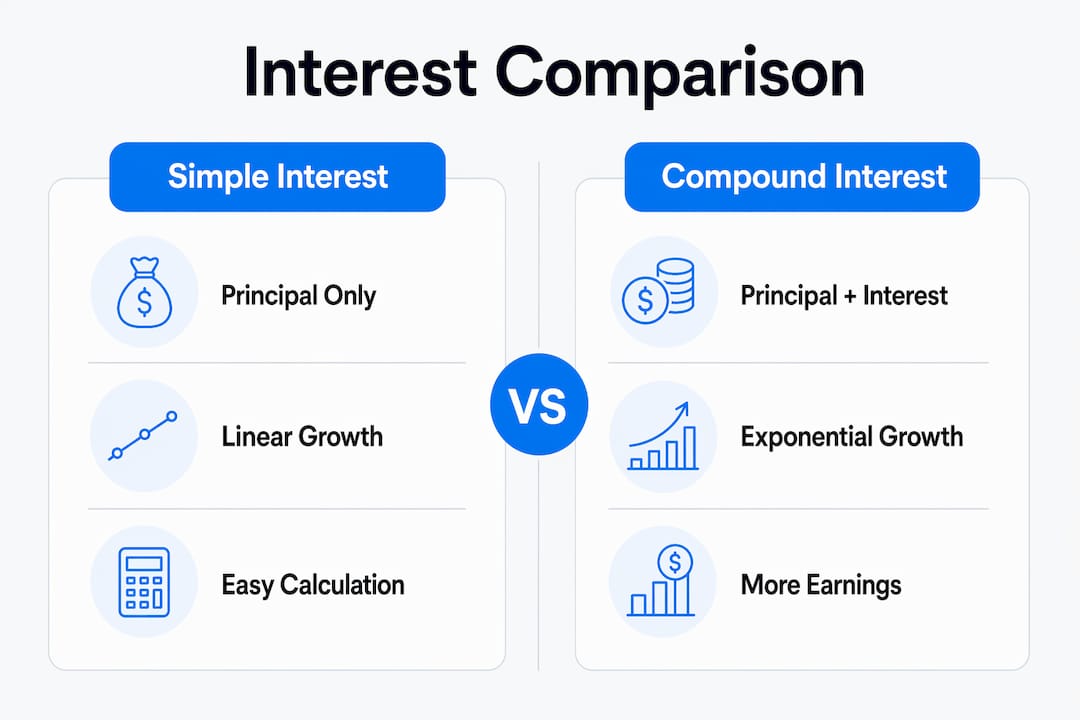
Simple interest vs. compound interest: what’s the real difference?
Simple interest applies only to the original principal, every single period, without exception. If you deposit $1,000 at 10% simple interest for 5 years, you earn $100 per year and finish with $1,500. The math never changes because the base never changes.
Compound interest recalculates the base after each period. That same $1,000 at 10% compounded annually grows to $1,610.51 after 5 years. The difference is $110.51, which represents the interest you earned on your interest. The compounding effect becomes even more dramatic over longer periods: a $1,000 loan at 10% monthly compounding for 10 months produces $2,593.74, compared to $2,000 with simple interest. That is nearly $600 more owed, from the same starting balance.
Here is a side-by-side comparison using $10,000 at 6% annual interest:
| Year | Simple interest balance | Compound interest balance (annual) |
|---|---|---|
| 5 | $13,000 | $13,382 |
| 10 | $16,000 | $17,908 |
| 20 | $22,000 | $32,071 |
| 30 | $28,000 | $57,435 |
The gap at year 30 is over $29,000 from the same starting deposit. That is the power of compounding in a table.
Where does each type appear in real life?
- Simple interest: auto loans, some personal loans, U.S. Treasury bonds
- Compound interest (working for you): HYSAs, CDs, money market accounts, index fund reinvestment
- Compound interest (working against you): credit card balances, payday loans, most revolving debt
Knowing which type applies to any financial product you hold is not optional. It is the baseline for making informed decisions about where to save and what debt to pay off first.
How compounding frequency and time affect your returns
Compounding frequency directly controls how fast your balance grows. The more often interest is added to your principal, the larger the base for the next calculation. The four most common frequencies are:
- Daily: used by many HYSAs and online banks; produces the highest yield for a given rate
- Monthly: standard for most CDs and savings accounts
- Quarterly: common in some bond funds and older savings products
- Annually: the least frequent; produces the lowest effective yield
The difference between daily and annual compounding on a $10,000 deposit at 5% over 10 years is roughly $130. That sounds modest, but at $100,000 over 20 years, the gap becomes significant. Frequency is a free gain. Always choose the account that compounds most often when rates are otherwise equal.
Time is the more powerful variable. The Rule of 72 gives you a fast way to estimate how long it takes to double your money: divide 72 by your annual interest rate. At 6%, your money doubles in approximately 12 years. At 9%, it doubles in 8 years. This rule works because it captures the exponential nature of compounding in a single, memorable calculation.
Starting early amplifies everything. A 25-year-old who invests $5,000 once at 7% annual compounding will have roughly $74,872 by age 65. A 35-year-old making the same single investment at the same rate ends up with about $38,061. The 10-year head start is worth more than $36,000 from a single deposit. Experts describe compound interest as the “eighth wonder of the world” precisely because of this time-driven exponential effect.
Pro Tip: The best time to start compounding is today. The second best time is tomorrow. Even small, consistent contributions to a HYSA or Roth IRA at age 22 will outperform larger contributions made at 35, because time is the multiplier that no rate can fully replace.
Practical applications of compound interest in personal finance
Compound interest shows up in the products most people already use or should be using. Common savings vehicles that compound interest include HYSAs, CDs, and money market accounts, most of which compound monthly or more frequently. Retirement accounts like 401(k)s and Roth IRAs do not pay interest directly, but the dividends and capital gains you reinvest inside them compound in the same way.
To put compound interest to work effectively, consider these strategies:
- Automate contributions. Set up recurring transfers to your HYSA or investment account. Consistency matters more than the amount, especially early on.
- Reinvest all earnings. Whether it is dividends from an index fund or interest from a CD, reinvesting keeps the compounding base growing. Withdrawing interest breaks the cycle.
- Prioritize high-APY accounts. A difference of 1% in APY on $20,000 over 10 years is worth roughly $2,000. Shop accounts the way you shop for any major purchase.
- Ladder CDs for liquidity. A CD ladder staggers maturity dates so you capture higher compounding rates without locking up all your cash at once.
The flip side is debt. High-interest debt compounds against you with the same force it works for savers. A credit card balance at 22% APR, compounded daily, grows faster than almost any investment can keep pace with. Carrying a $5,000 credit card balance for 3 years at 22% costs you roughly $3,800 in interest alone. Paying off high-rate debt is the highest guaranteed return available to most people.
The double-edged nature of compounding means your first priority should be eliminating high-rate revolving debt, then directing that same cash flow into compounding savings. Seniors planning for long-term care costs can also explore how compounding assets interact with funding strategies, as outlined in resources like this senior finance guide. The math works identically in both directions. You choose which side you are on.
Key takeaways
Compound interest is the most powerful force in personal finance because it turns time itself into a return-generating asset.
| Point | Details |
|---|---|
| Core definition | Interest earned on principal plus all previously accumulated interest, producing exponential growth. |
| The formula | A = P(1 + r/n)^(nt) calculates your final balance using rate, frequency, and time. |
| Compound vs. simple | At 6% over 30 years, $10,000 grows to $57,435 with compounding versus $28,000 with simple interest. |
| Frequency and time | Daily compounding beats annual; starting 10 years earlier can more than double your final balance. |
| Debt warning | High-rate credit card debt compounds against you just as powerfully as savings compound for you. |
Why most people underestimate compound interest until it’s too late
I have spent years reading personal finance research and talking with investors at every stage of wealth-building, and the pattern is consistent: people intellectually accept that compound interest works, but they do not feel it until they see their own account statement after a decade of consistent saving. By then, they wish they had started five years earlier.
The biggest misconception I encounter is that you need a large starting amount to benefit. You do not. The variable that matters most is time, not the initial deposit. A 23-year-old putting $200 a month into a Roth IRA at a 7% average annual return will have more at retirement than a 40-year-old putting in $600 a month at the same rate. The math is counterintuitive until you run it yourself.
The debt side of this equation gets far less attention than it deserves. I have seen people diligently saving in a HYSA at 4.5% APY while carrying a credit card balance at 24% APR. That is a guaranteed net loss of nearly 20 percentage points per year. Compound interest does not care about your intentions. It only responds to the numbers you feed it.
My honest advice: treat compound interest as a system, not a concept. Automate your savings, reinvest every dividend, and eliminate high-rate debt before you do anything else. The generational wealth strategies that actually last are built on exactly this discipline, applied consistently over decades.
— Povilas
Start building your wealth with Finblog’s finance resources
Finblog covers the full spectrum of personal finance strategy, from foundational concepts like compounding to advanced investment frameworks. If you want to see exactly how compound interest stacks up against simple interest across different time horizons and account types, the compound interest comparison guide on Finblog walks through real numbers with practical takeaways. For a detailed look at how a single $10,000 deposit can grow to $76,000 and beyond, the compound growth breakdown shows the math step by step. Visit Finblog to explore calculators, strategy articles, and guides built for serious savers.
FAQ
What is compound interest in simple terms?
Compound interest is interest you earn on both your original deposit and the interest that deposit has already earned. It causes your balance to grow faster over time because each period’s interest becomes part of the new base.
How is compound interest different from simple interest?
Simple interest applies only to the original principal every period, producing linear growth. Compound interest recalculates the base after each period, producing exponential growth that widens significantly over long time horizons.
What is the compound interest formula?
The formula is A = P(1 + r/n)^(nt), where A is the final amount, P is the principal, r is the annual interest rate as a decimal, n is the number of compounding periods per year, and t is the number of years.
Does compound interest work against you on debt?
Yes. High-interest debt like credit card balances compounds daily in most cases, meaning the amount you owe grows faster than simple interest calculations suggest. Paying off high-rate debt first is the most effective use of compound interest logic.
How often should interest compound to maximize savings growth?
Daily compounding produces the highest yield for a given interest rate, followed by monthly, quarterly, and annually. When comparing accounts, use the APY rather than the stated rate, since APY already reflects the compounding frequency.