



TL;DR:
- Goal setting techniques help define clear and motivating targets grounded in behavioral research. Frameworks like SMART, WOOP, and backcasting tailor strategies to task complexity and emotional engagement, enhancing success likelihood. Focusing on implementation intentions and regular feedback, rather than perfect frameworks, significantly improves goal achievement.
Goal setting techniques are structured methods that help you define clear, measurable, and motivating targets to increase personal productivity and achieve what matters most. Frameworks like SMART goals, WOOP, and implementation intentions are grounded in decades of behavioral research, most notably Locke and Latham’s goal-setting theory, which synthesized over 1,000 studies confirming that specific, challenging goals consistently outperform vague ones. MindTools, Gollwitzer, and Oettingen have each contributed practical tools that move goal planning from wishful thinking into repeatable execution. Whether you are working toward financial independence, career advancement, or personal development goals, the right framework makes the difference between intention and outcome.
What are the most effective goal setting frameworks?
The most widely used goal planning technique is the SMART method, which requires every goal to be Specific, Measurable, Achievable, Relevant, and Time-bound. SMART goals reduce ambiguity by forcing you to define exactly what success looks like and when you expect to reach it. A goal like “get fit” becomes “run a 5K in under 30 minutes by September 1.” That shift from vague to precise is what makes tracking and accountability possible.
Beyond SMART, several other frameworks address what SMART alone misses, particularly the psychological side of goal pursuit.
- WOOP (Wish, Outcome, Obstacle, Plan): Developed by psychologists Gabriele Oettingen and Peter Gollwitzer, WOOP adds a critical step that pure visualization skips. Obstacle anticipation and planning increases persistence beyond simply imagining success. You identify your wish, picture the best outcome, name the biggest internal obstacle, and create an if-then plan to handle it.
- Implementation intentions: Also developed by Gollwitzer, this technique links a situational cue to a specific behavior. “When I sit down at my desk at 8 a.m., I will open my budget spreadsheet and update last week’s numbers.” Cue-driven behavior automates action initiation, which removes the daily decision of whether to start.
- Backcasting: You start from a vivid picture of your desired future and work backward to identify the milestones needed to get there. Backcasting yields greater strategic clarity and lower time pressure compared to forward planning, making it especially useful for complex, multi-year goals.
- OKRs (Objectives and Key Results): Used widely in organizations like Google and Intel, OKRs pair an ambitious qualitative objective with two to five measurable key results. They work well when you need alignment between multiple goals or want to track progress at a team or personal level.
- BHAG (Big Hairy Audacious Goal): Coined by Jim Collins and Jerry Porras, a BHAG is a long-horizon, emotionally compelling target that anchors your direction without specifying every step. It pairs well with shorter-term SMART goals.
One nuance most goal-setting guides skip: task complexity determines which framework fits. Performance goals work when the task is well understood. Learning goals work better when you are figuring out new strategies, because they prevent you from locking in on outcomes before you have mastered the process.
Pro Tip: Use SMART for near-term, well-defined goals. Use WOOP or backcasting when the goal is emotionally loaded or spans more than six months.

How to apply goal setting techniques step by step
Applying effective goal strategies is not about picking one framework and following it rigidly. The process below integrates the best of each method into a practical sequence.
-
Clarify your core values first. Before writing a single goal, identify what actually matters to you. Goals misaligned with your values lose motivational fuel quickly. Write down your top three priorities for the next 12 months.
-
Define a specific, challenging goal. Specific, difficult goals produce higher performance by directing attention, mobilizing effort, and increasing persistence. Vague goals produce vague results. Use the SMART criteria to sharpen your target.
-
Break it into proximal subgoals. Large goals feel abstract until you divide them into weekly or monthly milestones. Each milestone gives you a feedback signal and a small win that sustains motivation. If your goal is to save $12,000 this year, your proximal subgoal is $1,000 per month.
-
Write your implementation intention. Specify the exact first action, the cue that triggers it, and the location. A precise first action, such as “open document and write first sentence,” reduces initiation friction far more than a vague instruction like “work on project.” This is where most people lose momentum, and this step prevents that.
-
Run a WOOP session. Spend ten minutes visualizing the best outcome, then name the most likely internal obstacle (procrastination, distraction, self-doubt), and write a specific if-then plan: “If I feel the urge to check my phone during work time, then I will put it face-down in a drawer.”
-
Build a feedback loop. Frequent progress reviews maintain motivation and allow you to adapt your strategy. A weekly 15-minute review beats an annual check-in every time. Use a simple tracker: a spreadsheet, a journal, or an app like Notion or Todoist.
-
Limit your active goals. Focus on 1 to 3 high-impact goals per quarter. Spreading effort across eight goals produces mediocre results on all of them.
Pro Tip: Schedule your weekly review at the same time each week, such as Sunday evening for 15 minutes. Consistency turns review into a habit rather than a chore.
What are common mistakes in goal setting?
Most goal-setting failures trace back to a small set of repeatable errors. Recognizing them early saves months of wasted effort.
- Using one framework for every goal. Applying the wrong framework to the wrong task is one of the most common reasons goal-setting fails. A performance goal on a novel creative task locks you into outcomes before you understand the process.
- Setting vague or unmeasurable goals. “Be healthier” gives you no way to know if you are succeeding. Writing goals precisely increases accountability and reduces avoidance by making progress visible.
- Skipping obstacle planning. Positive visualization alone is not enough. Planning for anticipated obstacles combined with visualization enhances persistence more than visualization alone. If you have not named your obstacles, you have not finished planning.
- Reviewing goals too infrequently. Annual reviews are ineffective for sustained goal achievement. Motivation drops when feedback is absent for weeks at a time.
- Setting too many goals at once. Diffusing effort across too many targets reduces effectiveness across all of them. Prioritize ruthlessly.
- Ignoring commitment levels. A goal you do not genuinely care about will not survive the first real obstacle. Locke and Latham’s research identifies commitment as a critical moderator of goal effectiveness.
Pro Tip: At the start of each quarter, audit your active goals. If you cannot explain why a goal matters to you in one sentence, drop it or defer it.
How to tailor goal planning techniques to different contexts
Not every goal responds to the same approach. Matching your method to the goal type and timeframe is what separates average goal-setters from consistent achievers.
| Goal type | Best framework | Why it fits |
|---|---|---|
| Short-term, well-defined | SMART | Clear metrics and deadlines reduce ambiguity |
| Novel or creative tasks | Learning goals | Avoids premature optimization; builds strategy first |
| Long-term or transformational | Backcasting | Works backward from vision to create a clear milestone path |
| Emotionally driven goals | WOOP or HARD goals | Integrates obstacle planning and emotional engagement |
| Multi-goal alignment | OKRs | Links individual goals to broader priorities |
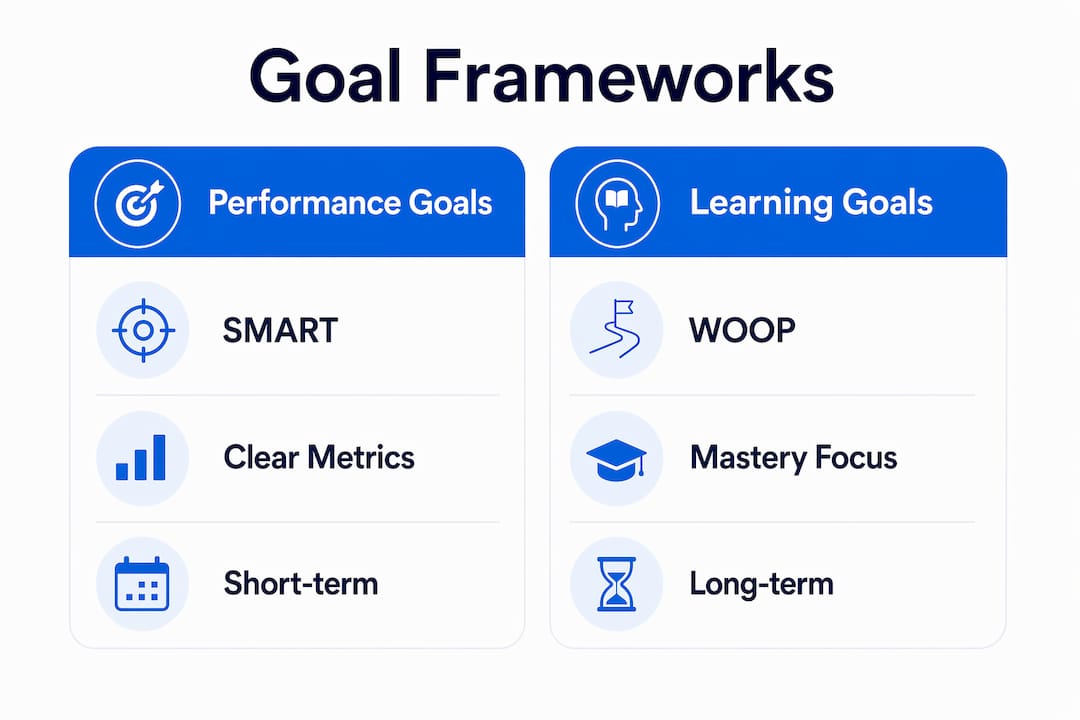
For novel or creative work, delaying outcome metrics in favor of mastering strategies avoids the trap of optimizing for the wrong thing too early. A writer trying to publish a book should focus on daily word count and craft development before worrying about sales figures.
Stretch goals, sometimes called HARD goals (Heartfelt, Animated, Required, Difficult), work best when you have a strong emotional connection to the outcome and a realistic baseline of competence. Setting a stretch goal in an area where you lack foundational skills produces anxiety rather than motivation. Build the foundation first, then raise the bar.
Personality and motivation style also matter. If you are driven by external accountability, OKRs or a goal-tracking partner will outperform solo journaling. If you are intrinsically motivated, WOOP and implementation intentions give you the internal structure to stay consistent without external pressure. The best practice for goal setting is not a universal prescription. It is a personalized system you actually use.
Key takeaways
The most effective goal setting techniques combine a structured framework like SMART or WOOP with implementation intentions, regular feedback loops, and obstacle planning tailored to the specific goal type and context.
| Point | Details |
|---|---|
| Match framework to task type | Use performance goals for familiar tasks; use learning goals for novel or complex work. |
| Write precise implementation intentions | Specify the exact cue, location, and first action to automate goal-consistent behavior. |
| Plan for obstacles explicitly | WOOP’s obstacle step increases persistence beyond visualization alone. |
| Limit active goals to 1 to 3 per quarter | Focusing effort on fewer goals produces stronger results than spreading across many. |
| Review progress weekly, not annually | Frequent feedback maintains motivation and allows timely strategy adjustments. |
Why most goal advice misses the most important step
I have worked through dozens of goal-setting systems over the years, and the one element almost every popular guide underweights is the implementation intention. People spend hours crafting the perfect SMART goal and zero minutes deciding exactly when and where they will take the first action. That gap between intention and initiation is where most goals die.
The research from Gollwitzer is unambiguous on this. Linking a cue to a concrete behavior does not just help you remember to act. It creates what researchers call strategic automaticity, where the behavior fires in response to the cue without requiring a fresh decision each time. That is a significant cognitive advantage, especially when motivation is low.
I have also seen people treat goal-setting frameworks as a substitute for commitment rather than a tool for channeling it. SMART goals do not manufacture motivation. They clarify direction for motivation that already exists. If you are setting a goal because you think you should rather than because you genuinely want the outcome, no framework will save it.
My honest recommendation: spend less time perfecting your goal format and more time on two things. First, run a WOOP session to surface the real obstacles. Second, write one specific implementation intention for the first action. Those two steps, done well, outperform an elaborate goal-planning system that never gets executed.
For financial goals specifically, the same principles apply with added stakes. Applying these techniques to financial goal setting can be the difference between a retirement plan that stays on track and one that drifts for years.
— Povilas
Take your goal setting further with Finblog
Finblog publishes practical, research-backed guides for individuals who want to apply proven goal planning techniques to their financial and personal lives. If you are ready to move from general productivity goals to specific financial targets, the SMART financial goals guide walks you through applying the SMART framework to savings, investment, and income goals with concrete examples. For a broader foundation, the financial goal setting guide covers the full range of frameworks tailored to investors and professionals. Finblog also offers financial goal setting tips that address the most common pitfalls people face when planning for long-term financial success.
FAQ
What is the SMART goal method?
SMART is a goal-setting framework requiring goals to be Specific, Measurable, Achievable, Relevant, and Time-bound. It turns vague intentions into trackable plans with clear success criteria and deadlines.
How do implementation intentions improve goal achievement?
Implementation intentions link a situational cue to a specific behavior, such as “When X happens, I will do Y.” This automates action initiation and significantly increases the likelihood of follow-through compared to setting goals without a concrete trigger.
What is WOOP and when should you use it?
WOOP stands for Wish, Outcome, Obstacle, Plan. Developed by Oettingen and Gollwitzer, it is most useful for emotionally significant goals or any goal where past attempts have stalled, because it forces you to identify and plan around real internal obstacles.
How many goals should you set at one time?
Focus on one to three high-impact goals per quarter. Setting more than three active goals simultaneously diffuses effort and reduces performance across all of them, according to Locke and Latham’s goal-setting research.
When should you use a learning goal instead of a performance goal?
Use a learning goal when the task is new, complex, or requires developing a strategy you do not yet have. Performance goals work best when the task is well understood and you are optimizing execution rather than building new skills.