
TL;DR:
- A recession is a significant decline in economic activity lasting over a few months and affecting multiple indicators. It is usually triggered by demand shocks and often results in long-term employment and income damage that affects communities and households.
A recession is defined as a significant decline in economic activity spread across the economy, lasting more than a few months, and visible in indicators like GDP, employment, income, and industrial production. Most people think of a recession as simply two bad quarters of growth. The reality is more complex, more damaging, and far more personal. Understanding what a recession is, how it starts, and what it does to jobs and wealth gives you a real edge when economic conditions shift.
What is a recession, and how is it officially defined?
A recession is not just a technical reading on a spreadsheet. The National Bureau of Economic Research (NBER), the official arbiter of U.S. business cycles, defines a recession as a significant decline in economic activity that is spread across the economy and lasts more than a few months. That definition deliberately avoids a single number.
The NBER’s Business Cycle Dating Committee evaluates six economic indicators to date recessions: real personal income less transfers, nonfarm payroll employment, household survey employment, real personal consumption expenditures, real manufacturing and wholesale-retail sales, and industrial production. No single indicator triggers a declaration. The committee weighs all six together.
The popular “two consecutive quarters of negative GDP” rule is a shortcut, not the standard. The NBER often dates recessions retroactively, sometimes months after the downturn began. That lag matters because by the time a recession is officially confirmed, you are likely already living through it.
How other countries define recessions
Most European economies and the United Kingdom use the two-quarter GDP rule as their working definition. The U.S. approach is more nuanced because GDP alone can miss labor market deterioration that hits workers before output falls. The NBER method captures that broader damage earlier.
| Indicator | What it measures |
|---|---|
| Real personal income less transfers | Household earning power excluding government payments |
| Nonfarm payroll employment | Job creation and loss across most U.S. industries |
| Real personal consumption expenditures | Consumer spending adjusted for inflation |
| Industrial production | Output from manufacturing, mining, and utilities |
| Wholesale-retail sales | Business activity across supply chains |
| Household survey employment | Employment as reported directly by workers |
What causes a recession and triggers economic downturns?
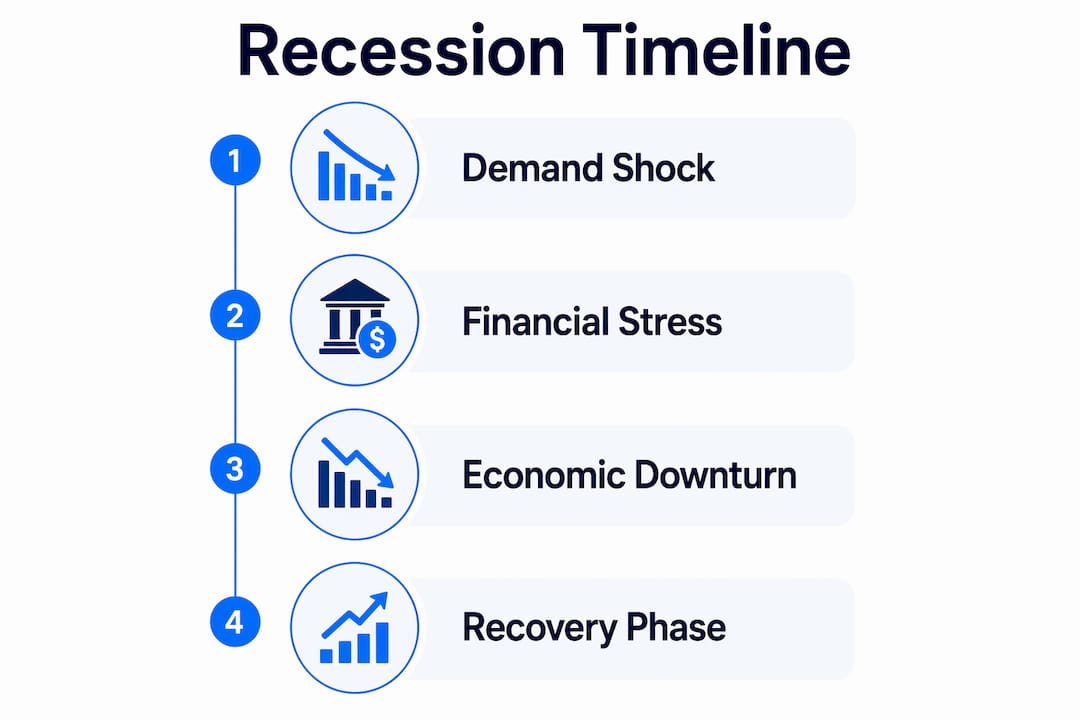
Recessions rarely have a single cause. A recession is typically triggered by a demand shock that causes consumer and business spending to drop sharply. Once spending falls, businesses cut production, lay off workers, and reduce investment. Those workers then spend less, which deepens the original drop. That feedback loop is what turns a shock into a sustained downturn.
Common triggers include:
- Bursting asset bubbles. The 2008 housing collapse wiped out trillions in household wealth and froze credit markets, triggering the Great Recession.
- Financial crises. Bank failures and credit crunches cut off lending to businesses and consumers simultaneously.
- External shocks. The COVID-19 pandemic caused the sharpest U.S. GDP contraction on record in the second quarter of 2020, driven by forced shutdowns rather than financial imbalances.
- Monetary tightening. Rapid interest rate increases raise borrowing costs, slow investment, and can tip an overheated economy into contraction.
- Geopolitical events. Wars and energy price spikes raise costs across the economy and suppress consumer confidence.
Recessions usually result from a combination of causes, with demand shocks reinforcing financial stress and vice versa. Treating any single recession as a one-cause event misses how these forces compound each other.
Pro Tip: When analysts debate whether a recession is coming, watch consumer confidence surveys and credit conditions alongside GDP. Those two signals often turn negative before official output data does.

What are the effects of a recession on individuals and the economy?
The economic damage from a recession is measurable. GDP typically falls about 2% in routine downturns and 5% or more in severe ones. That contraction sounds abstract until you connect it to wages, jobs, and household balance sheets.
Labor markets bear the deepest and longest-lasting damage. Labor market impairment caused by recessions tends to last much longer than the GDP contraction itself. GDP can recover within a year or two. Job quality, wage growth, and full employment often take far longer to return.
“Recessions cause job loss, reduced income, and long-term employment impacts that outlast the official economic contraction.” — Economic Policy Institute
Recovery is also deeply unequal. After the Great Recession, middle-income households took 9 years to recover their pre-recession income levels. Top-income households recovered in roughly 4 years. That gap reflects differences in asset ownership, job security, and access to credit. You can track how these dynamics play out in real time through Finblog’s coverage of post-recession recovery.
The damage also spreads geographically. Areas with large job losses during recessions show persistent declines in employment, population, and earnings per capita for years afterward. Detroit after 2008 and coal-dependent communities after the 1980s recession are clear examples of this scarring.
Common recession impacts include:
- Rising unemployment and underemployment
- Wage freezes and reduced hours
- Tighter credit conditions for consumers and small businesses
- Falling home values and retirement account balances
- Reduced government tax revenue, leading to cuts in public services
- Increased rates of bankruptcy among small businesses
One underreported effect is career scarring. Entering the labor market during a recession can permanently reduce lifetime earnings. Workers who graduate into a weak job market often accept lower-quality positions and never fully close the wage gap with peers who graduated in stronger conditions.
What are the signs a recession might be starting?
Spotting a recession early gives you time to adjust. The challenge is that official recession declarations lag the actual downturn. The NBER typically announces a recession months after it has already begun. By the time the declaration arrives, the worst job losses may already be underway.
Watch these signals instead:
- Inverted yield curve. When short-term Treasury yields exceed long-term yields, banks tighten lending. Every U.S. recession since 1955 has been preceded by an inverted yield curve.
- Rising initial jobless claims. A sustained increase in weekly unemployment filings signals that businesses are cutting staff. Finblog tracks jobless claims trends as part of its regular economic coverage.
- Falling consumer confidence. The Conference Board’s Consumer Confidence Index and the University of Michigan’s Consumer Sentiment Index both measure willingness to spend. Sharp drops precede spending contractions.
- Declining manufacturing orders. The ISM Manufacturing PMI below 50 signals contraction in factory output, a leading indicator of broader economic slowdown.
- Tightening credit standards. When banks report stricter lending criteria in the Federal Reserve’s Senior Loan Officer Survey, business investment typically follows downward.
The U.S. labor market is one of the most reliable real-time signals. Job growth that slows but stays positive can mask deteriorating conditions in hours worked, temporary employment, and wage growth. Look at the full picture, not just the headline number.
Pro Tip: Bookmark the Federal Reserve Bank of St. Louis’s FRED database. It publishes all major U.S. economic indicators in real time, free of charge, and lets you chart multiple indicators side by side.
Recession vs. depression: where is the line?
A depression is a recession that is both deeper and longer. The Great Depression of the 1930s saw U.S. GDP fall by roughly 30% and unemployment exceed 20%. No formal threshold separates the two terms, but economists generally reserve “depression” for contractions that last several years and cause structural damage to the economy’s productive capacity.
Key Takeaways
A recession causes damage that outlasts the official contraction, hitting workers, communities, and lower-income households hardest and longest.
| Point | Details |
|---|---|
| Official definition | The NBER defines a recession using six indicators, not just two quarters of negative GDP. |
| Causes are compound | Demand shocks, asset bubbles, and financial crises typically combine to trigger a recession. |
| Labor damage outlasts GDP | Employment and wage recovery take far longer than GDP recovery after a recession ends. |
| Recovery is unequal | Middle-income households took 9 years to recover after the Great Recession; top earners took 4. |
| Early signals exist | Inverted yield curves, rising jobless claims, and falling consumer confidence precede official declarations. |
What most people get wrong about recessions
Most professionals I talk to treat recessions as binary events: either the economy is fine, or it is in recession. That framing causes real harm. The damage accumulates long before any official declaration and persists long after the all-clear. Workers who lose jobs in the first six months of a recession often spend years rebuilding their earnings, even after GDP has fully recovered.
The other misconception I see constantly is that recessions are primarily a stock market story. Markets can recover in 12 months while the labor market stays impaired for three or four years. If you are making financial or career decisions based on equity prices alone, you are reading the wrong signal.
What actually matters for most people is the labor market, credit availability, and household balance sheet health. Those three factors determine whether a recession feels like a temporary dip or a decade-long setback. The professionals who navigate downturns best are the ones who track leading indicators before the headlines confirm what they already suspected. Understanding the economic cycle stages gives you the framework to do exactly that.
— Povilas
Economic insights to help you stay ahead
Finblog publishes regular analysis on U.S. economic conditions, labor market trends, and investment strategy for professionals who want more than headlines. Whether you are tracking early recession signals, assessing how a downturn might affect your portfolio, or looking for recession-resilient business models, Finblog’s content gives you the data and context to make informed decisions. Visit finblog.com for real-time economic updates, in-depth guides, and market analysis built for serious investors and financially engaged professionals.
FAQ
What is the official recession definition in the U.S.?
The NBER defines a recession as a significant decline in economic activity spread across the economy lasting more than a few months. It evaluates six indicators, not just GDP.
How does a recession start?
A recession typically starts with a demand shock that causes spending to drop sharply, triggering a feedback loop of reduced business activity, job losses, and falling consumer confidence.
How long does a recession usually last?
The average U.S. recession lasts roughly 10–17 months, though labor market recovery extends well beyond the official end date.
What is the difference between a recession and a depression?
A depression is a prolonged and severe recession. The Great Depression saw GDP fall roughly 30% and unemployment exceed 20%, far beyond the scale of a typical recession.
What are the most reliable early signs of a recession?
An inverted yield curve, rising initial jobless claims, falling consumer confidence, and declining manufacturing orders are the most consistent leading indicators of a coming recession.