


The US trade deficit widened sharply in July as strong domestic demand and heavy investment in artificial intelligence pushed imports of computers, semiconductors and other capital goods to a record high.
The trade gap increased 24.4% to $88.6 billion, up from $71.2 billion in June, according to the Commerce Department. Economists had expected a slightly larger $90 billion deficit.
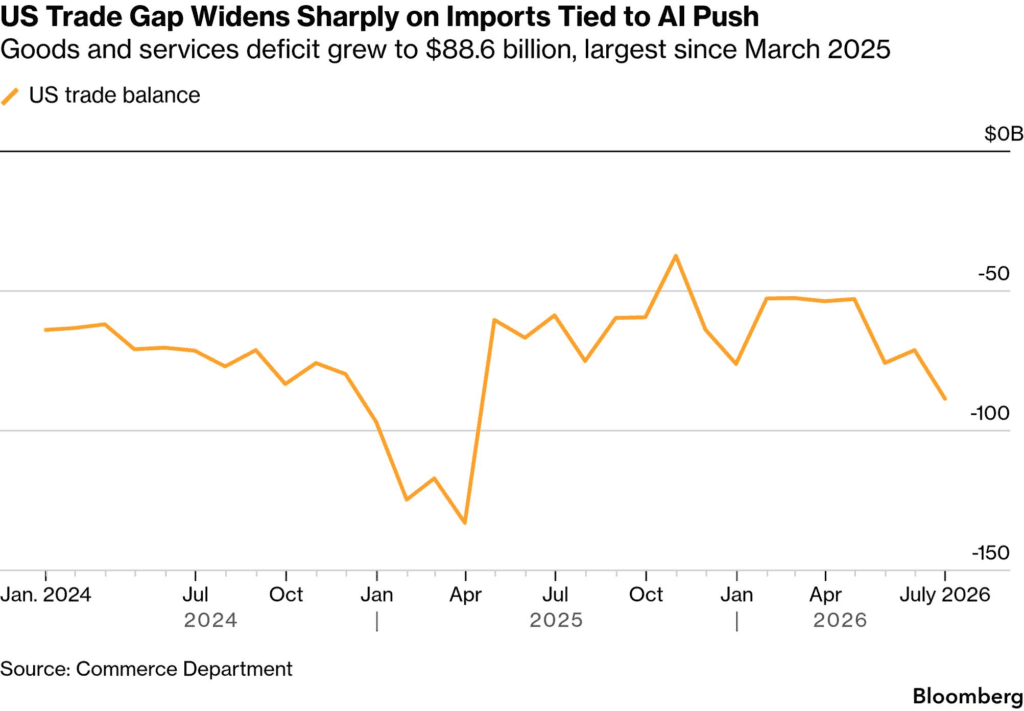
AI Boom Drives Record Imports
Total imports rose 2.8% to $399.3 billion, while goods imports increased 3.7% to $320.6 billion.
The biggest increase came from capital goods, which jumped $14.4 billion to a record $140.3 billion. That included:
- Computers: +$6.9 billion
- Computer accessories: +$6.6 billion
- Semiconductors: +$1.2 billion
Reuters said the surge likely reflects continued heavy spending on AI infrastructure, as US companies import more technology needed for data centers and computing capacity.
Exports Move Lower
US exports fell 2.1% to $310.7 billion, mainly because shipments of industrial supplies and materials declined.
Exports of crude oil fell $4.5 billion, while nonmonetary gold exports dropped $3.9 billion. Capital goods and consumer goods exports increased slightly.
The goods trade deficit consequently widened 17.3% to $119.6 billion.
Trade Could Weigh on US Growth
The widening deficit suggests trade could again become a drag on third-quarter GDP growth.
Strong imports are partly a sign of healthy domestic demand and business investment. But because imports are subtracted when calculating GDP, the rapid increase can reduce headline economic growth even when companies are investing aggressively.
Investor takeaway: The bigger trade deficit is not simply a sign of economic weakness. A major part of the increase comes from companies importing computers, chips and other equipment for the AI buildout. The risk is that these imports could weigh on near-term GDP while investors wait to see whether massive AI spending eventually produces enough productivity and profits to justify it.
Disclosure: This article does not represent investment advice. The content and materials featured on this page are for educational purposes only.