
Pick a structured beginner course that pairs a clear curriculum with hands-on practice, especially a built-in simulator or paper-trading module, and a dedicated risk-management section. That combination matters more than instructor fame or video count. If you’re weighing options right now, enroll in a course offering simulated trading, or open a free paper-trading account today and use it alongside whatever course you choose.
TL;DR:
- Choose a beginner course that includes practical exercises like paper trading or simulators, not just theoretical lessons, to build real confidence.
- Ensure the course covers fundamental and technical analysis, risk management, and provides recorded trade walkthroughs to translate knowledge into skills.
- Verify the instructor’s credentials, review course previews, and confirm the inclusion of a risk management module, as these factors heavily impact course effectiveness.
- Spend at least three to five hours weekly on foundational modules, progressively practicing with simulated trades before risking real money.
- Focus on mastering risk controls, position sizing, and trading discipline, since these habits determine long-term survival more than specific chart patterns or tips.
Table of Contents
- What Does a Stock Trading for Beginners Course Actually Teach?
- How Do You Choose the Right Beginner Trading Course?
- How Long Does It Take to Learn Stock Trading Basics?
- What Practical Exercises Should Your Course Include?
- Why Risk Management Matters More Than Any Single Chart Pattern
- A Simple 30 to 90 Day Learning Plan After Enrolling
- Where Finblog Fits Into Your Trading Education
- Day Trading, Swing Trading, or Long-Term Investing: Which Fits a Beginner?
- The Mistakes That Wreck Beginner Traders Before They Get Started
- What Beginners Get Wrong About “Learning to Trade”
- Keep Building Your Trading Foundation With Finblog
- Sources
What Does a Stock Trading for Beginners Course Actually Teach?
A well-built beginner curriculum follows a predictable arc. It starts with market mechanics, moves through analysis methods, and ends with risk controls and live practice. Reviewers who compared dozens of programs found this same structure showing up again and again in the courses that actually work for novices: Investopedia examined 25 stock trading courses and found the strongest beginner options consistently cover market basics, both major analysis styles, risk management, and practical exercises.
Here’s what that looks like broken into modules:
- Market mechanics and terminology. How exchanges function, what a ticker symbol represents, why liquidity affects your ability to enter or exit a position without moving the price against yourself.
- Order types and execution. The difference between a market order (executes immediately at the current price) and a limit order (executes only at your specified price or better), plus stop-loss orders that automatically sell if a stock drops to a set level.
- Fundamental analysis basics. Reading an earnings report, understanding price-to-earnings ratios, and grasping why a “cheap” stock isn’t automatically a good buy.
- Technical analysis basics. Candlestick charts, support and resistance levels, and a handful of simple indicators like moving averages, taught as tools for timing entries and exits rather than crystal balls.
- Risk management and position sizing. How much of your account to risk on a single trade, and why this single skill separates traders who survive a bad month from those who blow up their account.
- Practical components. Recorded trade walkthroughs where an instructor narrates a real decision, downloadable cheat sheets for order types and chart patterns, and exercises you complete rather than just watch.
The courses that skip that last category, the hands-on piece, tend to leave students able to define terms but unable to actually place a trade with confidence. Marketplace courses like the ones on Udemy often bundle this structure into a single package. One popular stock trading masterclass runs well past 15 hours of video and pairs each concept with a downloadable resource, which is roughly the depth you should expect from a serious beginner program, not a 90 minute crash course that glosses over risk management entirely.
Fundamental analysis and technical analysis are not competing philosophies you have to pick between as a beginner. Most solid courses teach both, because most working traders blend them, using fundamentals to decide what to watch and technicals to decide when to act.
How Do You Choose the Right Beginner Trading Course?
Course quality varies wildly, and price tells you almost nothing about it. A $20 marketplace course can outperform a $500 program if it has better practical content, and the reverse is just as common. The real problem beginners run into isn’t a shortage of course options, it’s matching a course to their actual starting point and goals, since a syllabus that quietly assumes you already know what a P/E ratio is will leave a true novice lost by lesson three.
Run through this checklist before you pay for anything:
- Match the format to how you actually learn. Self-paced video works if you’re disciplined and want to rewind sections. A live cohort with fixed sessions works better if you need accountability and a start date to commit to.
- Confirm true beginner fit. Skim the first three lesson titles. If they’re already using jargon without defining it, the course was not built for someone starting from zero.
- Check for real hands-on practice. Look specifically for the words “simulator,” “paper trading,” or “practice account” in the course description, not just “exercises,” which sometimes means quizzes.
- Vet the instructor. Search their name outside the course platform. A verifiable trading background or financial credential beats a slick sales page every time.
- Read the actual reviews, not just the star average. A 4.7 rating built on 40,000 reviews tells you something different than a 4.9 built on 12. Marketplaces like Udemy surface both the rating and the review count for exactly this reason.
- Look for a refund policy and lifetime access. These two signals correlate strongly with course quality because platforms that stand behind their content tend to offer both.
- Weigh price against what’s actually included. A cheaper course with a working simulator and a risk-management module beats an expensive one that’s mostly talking-head video.
Pro Tip: Open the course’s free preview lessons before buying. If the instructor spends the first ten minutes selling you rather than teaching, that pattern usually continues through the paid content.
Instructor credentials deserve extra scrutiny here. Structured certificate programs, the kind offered through institutions like NYIF, often build in mentorship or live feedback sessions, which can matter a lot if you’re the type of beginner who needs a human to answer questions rather than a comment section that gets checked once a week.
How Long Does It Take to Learn Stock Trading Basics?
Course length varies by design, not just by content depth, and each format delivers something different. A 5 to 15 hour self-paced course is built for someone who wants the core concepts fast and plans to practice independently afterward. Courses running 20+ hours, like the more comprehensive Udemy programs, usually add deeper technical analysis modules and more trade walkthroughs. Cohort-based programs run on a fixed calendar, often four to eight weeks, and trade some flexibility for structure and live interaction.
For a realistic weekly target, aim for three to five hours if you’re serious about retaining the material. Here’s roughly how that time should break down as you progress:
- Weeks 1 to 2: Market mechanics, terminology, and order types. Goal: you can explain what a limit order does without looking it up.
- Weeks 3 to 4: Chart reading and basic technical analysis. Goal: you can identify support and resistance on a real chart.
- Weeks 5 to 6: Risk management and your first simulated trades. Goal: five to ten paper trades logged with reasoning.
- Weeks 7 to 8 and beyond: Building a simple trading plan and refining it based on simulator results.
The biggest timeline mistake beginners make is rushing from lesson completion straight into a funded account. Finishing the videos is not the same as being ready. Give yourself at least a few weeks of simulated practice between “I understand the concept” and “I’m risking real money on it.”
What Practical Exercises Should Your Course Include?
Instruction without practice produces trivia knowledge, not trading skill. The gap between knowing what a stop-loss is and actually placing one under pressure is real, and it’s the gap simulators exist to close.

A stock market simulator lets you place trades with fake money against real, live prices. Most brokers offer one for free. Interactive Brokers’ Traders’ Academy, for instance, pairs educational content with practice tools, and running a broker’s free simulator alongside a paid course gives you two different practice environments instead of one.
Beyond the simulator itself, look for a course that assigns you actual work:
- A trade setup checklist. A short list you fill out before every trade: entry price, stop-loss level, position size, and reason for the trade. If you can’t complete the checklist, you don’t take the trade.
- A simple backtest. Pick one basic strategy, like buying when a stock crosses above its 50-day moving average, and manually check how it would have performed on a handful of past stocks.
- A trading journal. Log every simulated trade with what you expected to happen and what actually happened. This is where most of the real learning happens, not in the initial lesson.
- Screener practice. Use a stock screener to filter for candidates matching a simple rule set, like companies trading above their 200-day average with rising volume, so you get comfortable narrowing a universe of thousands of stocks down to a watchlist of five or ten.
Pro Tip: Repetition without review teaches bad habits just as fast as good ones. After every ten simulated trades, stop and reread your journal entries before placing an eleventh. Patterns in your mistakes show up faster than you’d expect.
Why Risk Management Matters More Than Any Single Chart Pattern
No indicator, strategy, or hot stock tip protects you the way basic risk controls do. This is the module beginners are most tempted to skip, and it’s the one that determines whether they’re still trading a year from now.
Position sizing is the starting point. A common beginner rule caps risk on any single trade at 1% to 2% of total account value. On a $5,000 account, that means a maximum loss of $50 to $100 per trade, which means your stop-loss distance and position size have to be calculated together, not guessed.
Here’s a worked example. Say you buy a stock at $50 and set your stop-loss at $48, a $2 per share risk. With a $100 maximum loss budget, you can buy 50 shares ($100 divided by $2), not however many shares “feel right.”
A few more rules worth building into every trade before you place it:
- Set a risk-reward ratio target, commonly at least 1:2, meaning your potential profit target is at least twice your potential loss.
- Decide your exit before you enter, both the profit target and the stop-loss, so a stressful moment doesn’t force a decision you haven’t thought through.
- Expect drawdowns and plan for them. A string of losing trades doesn’t necessarily mean your strategy is broken; it might mean you’re in a normal losing streak that a sound strategy will still recover from.
- Never revenge trade. Increasing your position size to “win back” a loss is how a manageable mistake turns into an account-ending one.
Course reviewers consistently find that the top-rated beginner programs treat risk management as a required module, not an optional add-on tacked onto the end. That’s the section to read the syllabus for before you buy anything. The traders who last are rarely the ones with the best entries. They’re the ones who never let a single bad trade wipe out a month of gains.
A Simple 30 to 90 Day Learning Plan After Enrolling
A course only becomes a skill once you turn its lessons into a practice routine, and a short structured plan is what keeps that from slipping.
- Days 1 to 10: Foundations. Complete the market mechanics and terminology modules. Daily task: 30 to 45 minutes of lessons plus writing five new terms in your own words.
- Days 11 to 25: Chart reading. Work through technical analysis lessons. Daily task: spend 20 minutes identifying support, resistance, and trend direction on three different stocks.
- Days 26 to 45: Strategy practice. Pick one simple strategy from the course and start applying it in a simulator. Weekly task: log five paper trades with full reasoning in your journal.
- Days 46 to 70: Simulator refinement. Increase trade frequency slightly and start reviewing your journal weekly, looking specifically for repeated mistakes.
- Days 71 to 90: Readiness check. Before moving to a funded account, confirm three things: consistent simulated results over several weeks, a journal showing you’re following your own rules, and a risk-management routine you don’t have to think twice about.
If those three boxes aren’t checked yet, that’s not failure, it’s information. Repeat the simulator phase for another 30 days rather than funding an account you’re not ready to trade in. Once you do go live, treat it as another loop: study, practice, review, adjust, on a rolling basis rather than a one-time finish line.
Where Finblog Fits Into Your Trading Education
Finblog focuses on financial news, investment insights, and educational content built for people learning the fundamentals from scratch, not seasoned traders looking for a niche edge. The site’s guides break down complex mechanics into plain language, which matters if you’re the kind of beginner who needs a term defined the moment it appears rather than assumed.
For context beyond course curricula, Finblog’s own library covers a lot of the same ground: the basics of how markets and investing work, a risk management guide that expands on position sizing and stop-loss placement, and a glossary of stock market terms worth bookmarking while you work through any paid course’s jargon.
A few things worth knowing about how Finblog approaches this content:
- Guides are written for people with zero prior trading background, not repurposed advisor material.
- The site is built around clean, professional resources rather than clickbait market predictions.
- Educational content is separated clearly from consultation and advisory lead capture, so readers know what’s free versus what involves talking to someone.
- The audience skew is intentional: working professionals and serious hobbyist investors who want a real foundation, not day-trading hype.
The recommendations in this piece come from comparing what top-reviewed courses actually include in their curricula against what independent course roundups flag as differentiators, weighing curriculum breadth against practical, hands-on components.
Day Trading, Swing Trading, or Long-Term Investing: Which Fits a Beginner?
Most beginner courses touch on all three styles, and it’s worth understanding the tradeoffs before you commit to one.
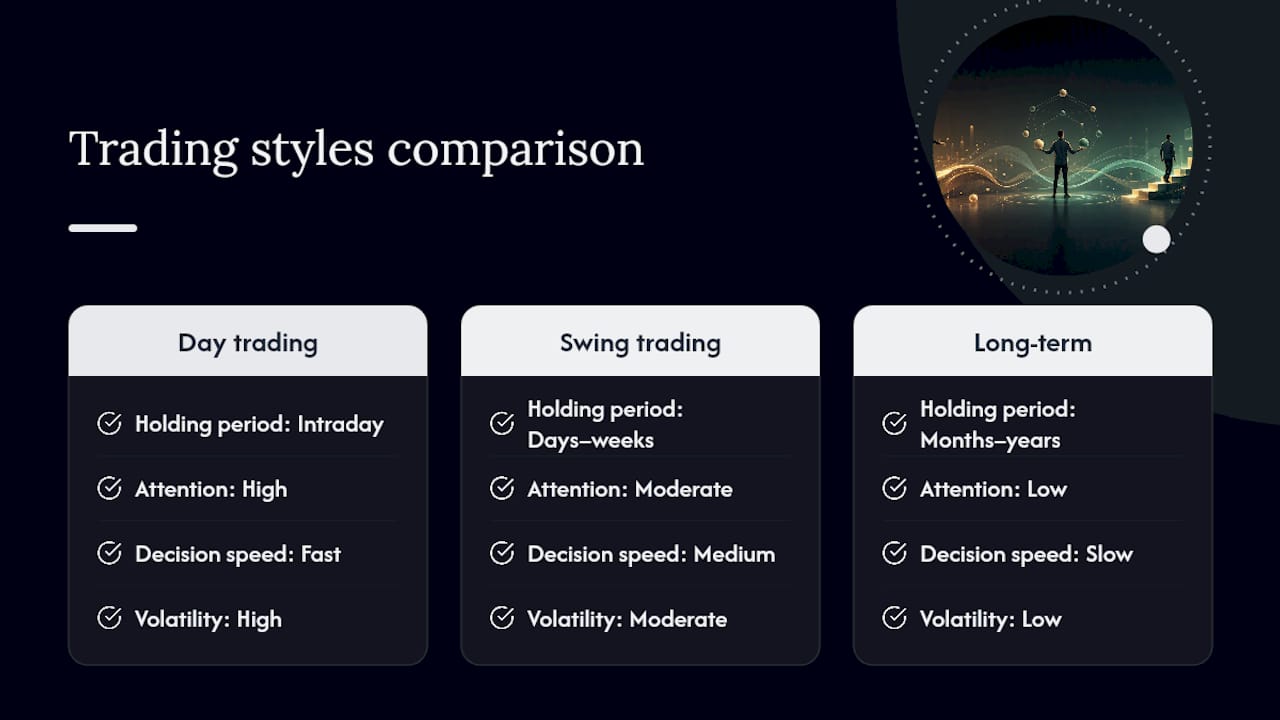
Day trading means opening and closing positions within a single day, sometimes multiple times. It demands constant attention, fast decision-making, and a stomach for volatility. It’s also the style with the steepest learning curve, and jumping in without months of simulated practice is how most beginners lose money fastest.
Swing trading holds positions for days to a few weeks, aiming to catch a price move without needing to watch a screen all day. It’s a reasonable middle ground for beginners who work full-time jobs but still want to practice active decision-making.
Long-term investing means buying and holding for months or years, betting on a company’s fundamentals rather than short-term price swings. It requires the least daily attention and the least trading skill, which makes it the lowest-pressure entry point, even though it teaches you the least about active trading mechanics.
Most beginner courses recommend starting with paper-traded swing trading or day trading to build skill, while keeping any real money in a long-term, buy-and-hold approach until your simulated results are consistent. That split lets you learn actively without risking your actual savings on a learning curve.
The Mistakes That Wreck Beginner Traders Before They Get Started
A handful of errors show up in almost every beginner’s first few months, and nearly all of them are preventable with the modules covered above.
Skipping risk management to get to the “exciting” parts. Beginners often want to jump straight to chart patterns and stock picks, treating position sizing as homework to do later. It should be the first habit you build, not the last.
Trading with real money before the simulator results are consistent. A single lucky trade with real cash feels like validation. It usually isn’t, and it’s how overconfident beginners fund accounts they’re not ready for.
Chasing every “hot stock” tip instead of following a plan. A trade made because of a headline or a social media post, without a predefined entry, exit, and risk level, is a gamble dressed up as a trade.
Revenge trading after a loss. Increasing size to recover a loss quickly is one of the fastest ways to turn a small mistake into a large one.
Ignoring the journal. Skipping trade logs means repeating the same mistake five times before noticing the pattern, instead of catching it after the first.
Every one of these traces back to skipping the practice and risk-management components a good course builds in from the start.
What Beginners Get Wrong About “Learning to Trade”
Most beginner advice treats stock trading as a knowledge problem: learn enough terms and chart patterns, and profitability follows. The research on what actually separates functional beginner courses from ineffective ones tells a different story. It’s not information density that predicts whether someone sticks with trading. It’s whether the course forces them to practice under conditions that mimic real decision pressure, and whether it teaches risk controls as a habit rather than a chapter to skim.
The overrated part of most curricula is the technical analysis section, taught as if pattern recognition alone produces an edge. The underrated part is the boring stuff: position sizing math, journal discipline, and knowing exactly when to walk away from a losing streak. If you take one thing from this roadmap, prioritize the course that makes you practice risk management before it lets you feel clever about a chart pattern. Cleverness doesn’t keep beginners in the game. Discipline does.
— Povilas
Keep Building Your Trading Foundation With Finblog
Finblog gives you a place to keep learning after the course ends, when most beginners are left figuring out the next step alone. Signing up for the Finblog learning hub gets you curated beginner resources, practical checklists you can apply the same day, and the option to connect with an advisor if you decide you want a second set of eyes on your plan.
What makes this a useful next step rather than another inbox subscription: the content stays focused on beginners specifically, not buried under advanced trading jargon aimed at people who’ve already been at this for years. You get ongoing updates as markets shift, without having to comb through unrelated market noise to find what applies to you.
If you’re ready to keep the momentum from your course going, visit the Finblog learning hub and sign up to get structured beginner content and optional advisory access sent directly to you.
This article is general information, not a substitute for advice from a qualified financial advisor. Consult a qualified financial professional about your own circumstances before acting on anything here.
Sources
- Best Online Stock Trading Classes for July 2026 — Investopedia
- Stock Trading Masterclass: Stock Market & Trading Strategies — Udemy
- Stock Trading Professional Certificate: Online — NYIF