
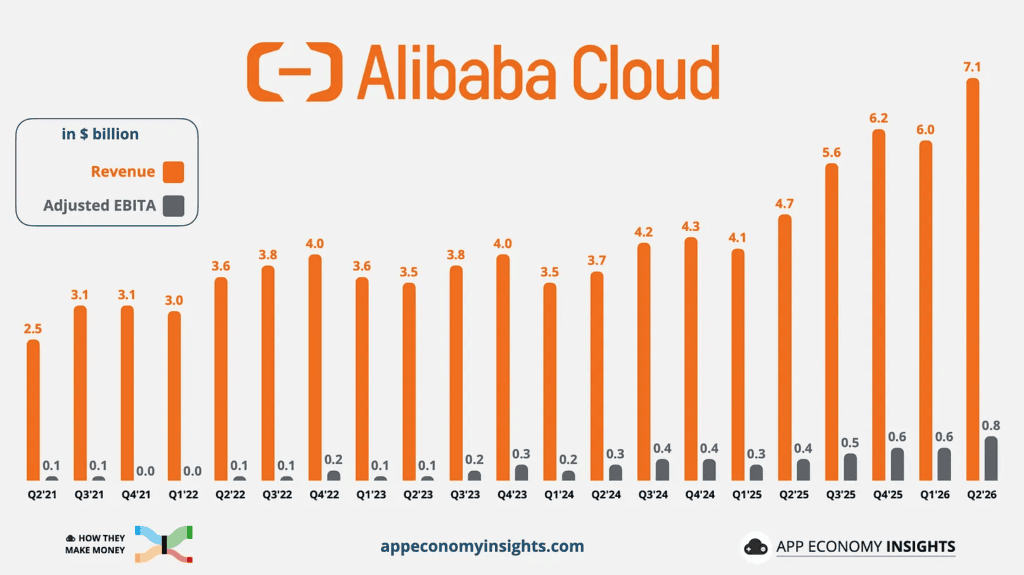
Alibaba’s huge AI spending is starting to produce clearer results. Revenue rose 9% year over year to $39.6 billion, while its Cloud business grew 45% to $7.1 billion, the fastest growth rate in more than five years.
AI is becoming an increasingly important part of that growth. AI-related product revenue has now grown at triple-digit rates for 12 consecutive quarters, while AI products account for roughly 35% of external Cloud revenue, up from 30% last quarter.
More importantly, Cloud is becoming more profitable. Cloud adjusted EBITA jumped 133% to $830 million, lifting the segment’s margin to roughly 12%. Alibaba says demand for AI computing capacity still exceeds the amount it can currently provide.
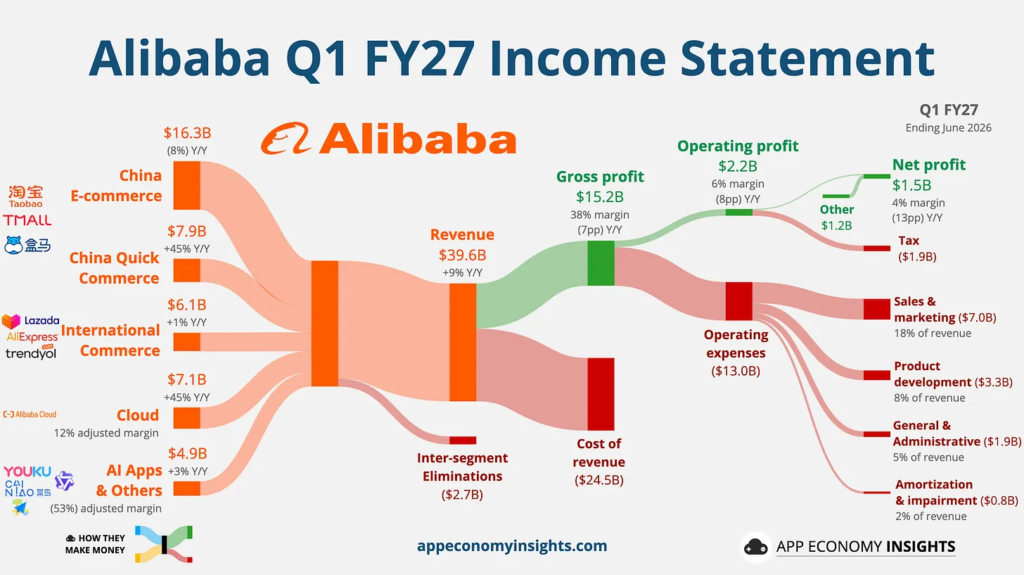
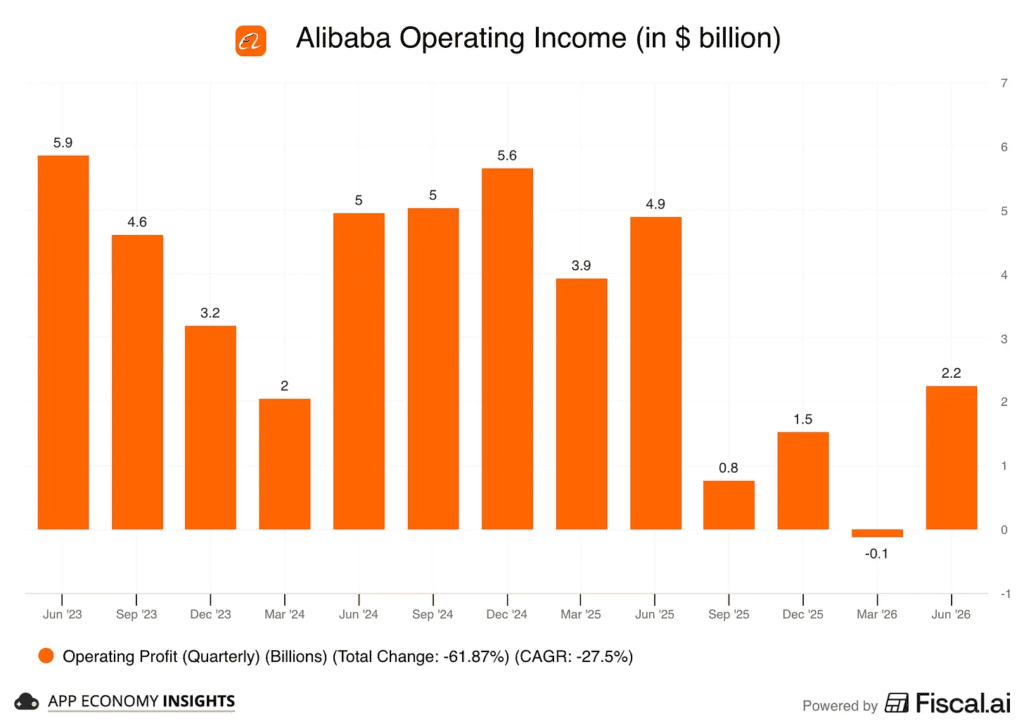
But getting there is expensive. Alibaba spent almost $10 billion on CapEx during the quarter, up 75%, primarily to expand AI and cloud infrastructure. Free cash flow turned into a $6.6 billion outflow, while company-wide adjusted EBITA dropped 30% to $4 billion. Operating margin also fell to 6% from 14% a year earlier.
Alibaba is sticking with its 380 billion yuan, or roughly $56 billion, three-year AI investment plan. Management estimates that its AI computing infrastructure can currently recover its investment in around three years, potentially falling toward 2.5 years as utilization and margins improve.
Alibaba Wants to Control More of the AI Stack
The company is not relying only on cloud computing. It is building across several parts of AI:
- Alibaba Cloud provides the computing infrastructure.
- Qwen has surpassed 3 billion downloads, with more than 300,000 derivative models created from it.
- Its Model-as-a-Service business has reached more than 16 billion yuan, or about $2.4 billion, in annual recurring revenue.
- Alibaba’s T-Head Zhenwu chips are already being used by more than 650 external customers across 20+ industries.
Using its own chips could eventually reduce Alibaba’s dependence on expensive third-party hardware and improve the economics of its AI infrastructure.
Not every part of the AI business is profitable yet. AI Labs and Applications generated around $500 million in revenue, up 16%, but its adjusted EBITA loss widened to roughly $2 billion as Alibaba continued spending heavily on model development and AI applications.
Outside AI, Quick Commerce was another major growth engine. Revenue jumped 45% to $7.9 billion, while traditional China E-commerce fell 8% to $16.3 billion. Alibaba expects Quick Commerce to reach overall profitability by FY29.
Investor takeaway: Alibaba is spending heavily enough on AI to hurt current cash flow and margins, but Cloud’s 45% growth and improving profitability provide some of the clearest evidence yet that the investment is producing returns. The next test is whether Alibaba can maintain that growth while bringing down the enormous cost of building its AI infrastructure.
Disclosure: This article does not represent investment advice. The content and materials featured on this page are for educational purposes only.