

The essential workplace communication skills are active listening, clarity and concision, emotional intelligence, adaptable channel choice, feedback delivery, nonverbal awareness, and persuasive influence. Start practicing today with one simple drill: spend five minutes after your next meeting writing down three things the other person said, without adding your own interpretation. That single habit, done consistently, builds the listening foundation everything else depends on.
U.S. businesses lose an estimated $1.2 trillion annually due to workplace miscommunication. That figure alone makes the case for treating communication as a professional skill, not a personality trait. The 7 Cs of communication — Clear, Concise, Concrete, Correct, Coherent, Complete, and Courteous — give you a reusable checklist for every message you send or speak. Finblog’s resources for finance professionals extend this framework into high-stakes conversations where precision and trust are non-negotiable.
Start here, right now:
- After your next meeting, write down three specific things the other person said (active-listening drill).
- Before sending your next email, cut it by 20% and move the main point to the first sentence.
- Ask one clarifying question today instead of assuming you understood.
Key Takeaways
Strong workplace communication skills improve through deliberate, structured practice, not passive awareness, and the fastest gains come from starting with active listening, applying the 7 Cs to every message, and building team-level norms that make good communication the default.
| Point | Details |
|---|---|
| Start with active listening | Do the 5-minute post-meeting reflection daily for two weeks before adding other skills. |
| Apply the 7 Cs to every message | Run the pre-send checklist before emails and meetings to cut follow-up questions. |
| Use SBI for all feedback | Situation, Behavior, Impact keeps feedback specific, observable, and non-personal. |
| Follow the 60–90 day plan | Progress through listening, clarity, feedback, persuasion, and integration in sequence. |
| Build team-level systems | Agenda-first meetings, decision logs, and async templates reduce miscommunication at scale. |
Table of Contents
- What are the core workplace communication skills?
- How do the four communication modalities work at work?
- How to use the 7 Cs as a pre-send checklist
- Practical techniques you can start using today
- How to handle the most common workplace scenarios
- Your 60–90 day communication practice plan
- How teams build communication systems that actually scale
- What most communication advice gets wrong
- Sources
What are the core workplace communication skills?
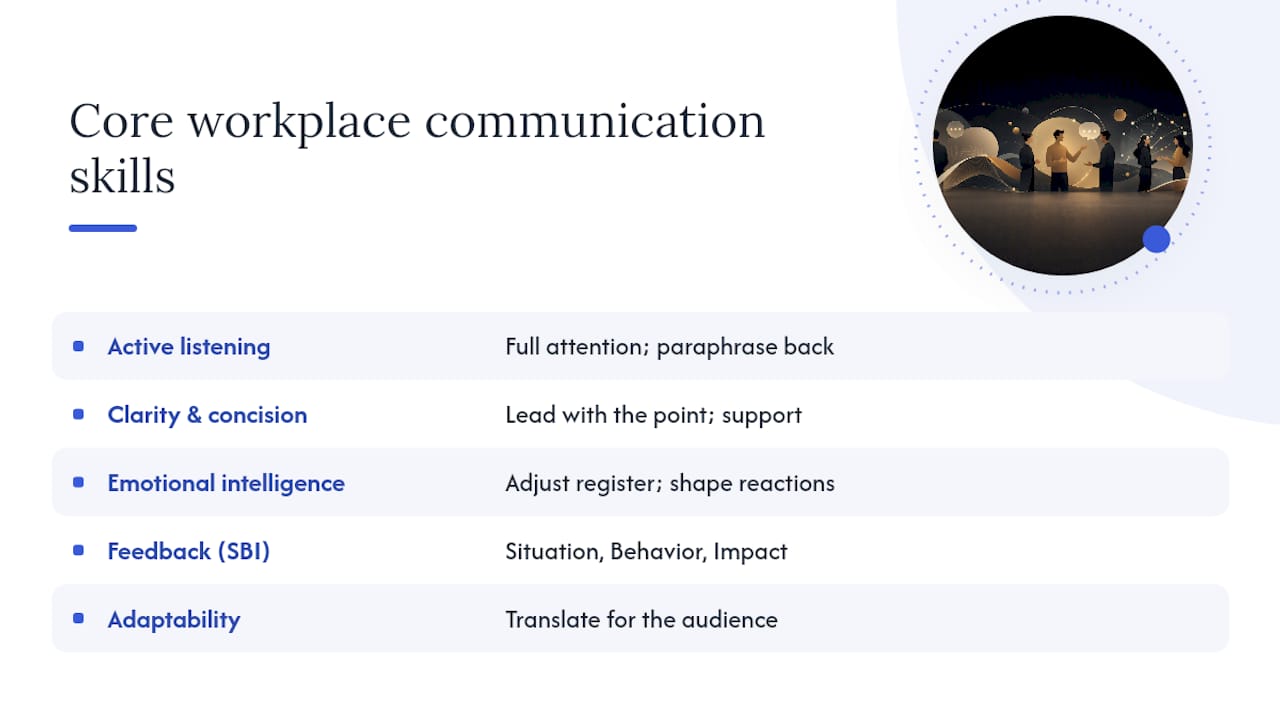
Strong business communication skills are not one thing. They are a cluster of distinct capabilities, each with its own mechanics and its own payoff at work.
Active listening is the most underestimated skill on this list. Research from Positive Psychology confirms that true active listening requires full attention, reflection, and resisting the urge to respond before the other person finishes. In practice, that means making eye contact, nodding to signal comprehension, and paraphrasing back: “So what you’re saying is the deadline moved to Friday, not the scope?” One clarifying question like that prevents an entire week of rework.
Clarity and concision determine whether your message gets acted on or ignored. A status update that buries the key risk in paragraph four is functionally useless. Lead with the point, then support it. In a one-on-one: “The project is on track, but we need a decision on the vendor by Thursday or we slip two weeks.” That is a complete, useful message in one sentence.
Emotional intelligence and tone shape how your words land, regardless of what you intend. Telling a colleague “that approach won’t work” and “I’m not sure that approach fits the constraints we have” carry the same information but produce entirely different reactions. Recognizing the emotional state of the room, and adjusting your register accordingly, is what separates communicators who build trust from those who create friction.
Giving and receiving feedback is a skill most professionals underuse. The SBI model (Situation, Behavior, Impact) structures feedback so it stays specific and non-personal: “In yesterday’s client call [Situation], you interrupted the client twice [Behavior], and they stopped sharing their concerns [Impact].” That framing is harder to dismiss than “you need to listen better.”
Adaptability means reading your audience and shifting your approach. Explaining a budget variance to a CFO sounds different than explaining it to a product manager. Translating technical content for non-specialist stakeholders is one of the highest-value skills in any professional setting. Finblog’s guide on simplifying financial jargon shows how that translation works in practice.
Confidence and assertiveness are not about volume. They are about stating your position clearly and holding it under pressure without becoming defensive. “I hear your concern, and my recommendation remains X because of Y” is assertive without being aggressive.
Persuasion and influence rely on evidence, framing, and timing. AMA’s research highlights storytelling as a high-leverage technique for leaders: a short, specific story about a past outcome lands harder than a slide full of projections.
Written communication covers email, Slack, memos, and reports. The core rule: main point first, short paragraphs, no jargon the reader has to decode. A well-written email reduces follow-up questions. A poorly written one generates a meeting.
How do the four communication modalities work at work?
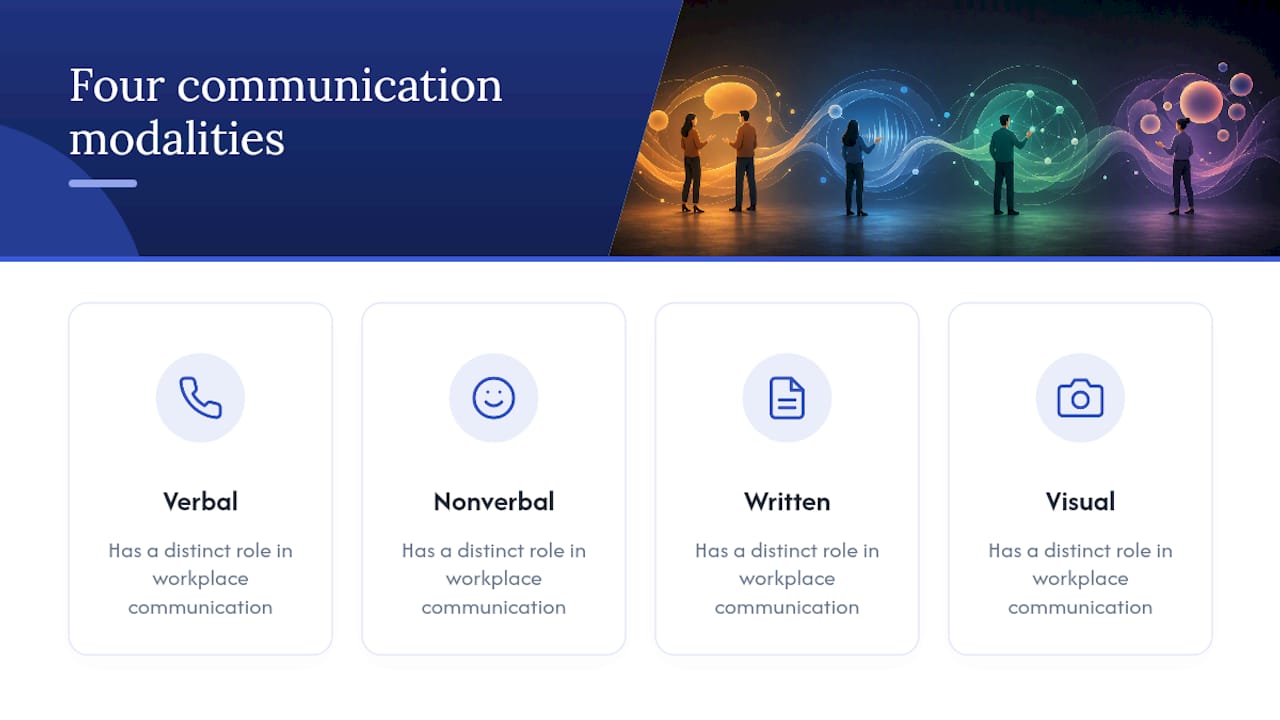
Slack’s research on effective workplace communication identifies four modalities: verbal, nonverbal, written, and visual. Each has a distinct role, and choosing the wrong one for the situation is one of the most common and costly communication errors professionals make.
Verbal communication
Verbal communication covers meetings, presentations, phone calls, and hallway conversations. It is the fastest channel for complex, nuanced topics where back-and-forth matters. The micro-behaviors that make verbal communication land: vary your pace to signal importance, pause before key points, and ask a direct question at the end to confirm understanding. In presentations, Coursera’s workplace communication guide recommends pre-sharing materials so the meeting time focuses on discussion, not information transfer.
Nonverbal communication
Body language, facial expression, posture, and vocal tone carry as much meaning as words, sometimes more. Crossed arms during a feedback session signal defensiveness even when your words are neutral. Maintaining an open posture and steady eye contact signals engagement and confidence. Tone is the nonverbal element most professionals underestimate in written channels: a one-word reply (“Fine.”) reads as curt even when you meant it as agreement.
Written communication
Email and chat strip out nonverbal cues entirely. That makes precision non-negotiable. AMA’s business-writing guidance is direct: put the main point first, use short paragraphs, and add visual cues (bold, headers, bullet points) to guide the reader’s eye. A subject line like “Decision needed by Thursday: vendor selection” is more useful than “Update.”
Visual communication
Slides, charts, and diagrams work when data is complex or when you need to align a group quickly. The failure mode is using visuals as a crutch: slides dense with text that the presenter reads aloud. A single well-labeled chart showing a trend beats five bullet points describing it.
How to choose the right modality:
- High complexity or emotional sensitivity: verbal (call or in-person).
- Permanent record needed: written (email or documented decision log).
- Data-heavy comparison: visual (chart or table).
- Quick status or low-stakes coordination: written (chat or brief email).
- Circular or misinterpreted text thread: switch to a call immediately.
Pro Tip: If a text or email thread has gone three rounds without resolution, stop typing. A five-minute call resets tone and alignment faster than any written clarification.
How to use the 7 Cs as a pre-send checklist
The 7 Cs of communication give you a fast, reusable filter for every message before it leaves your hands. Run through them before you hit send on an email or before you open your mouth in a meeting.
The 7 Cs applied:
- Clear: Is the main point obvious in the first sentence? Email example: “I need your approval on the Q3 budget by Friday.”
- Concise: Have you cut every word that doesn’t add meaning? Spoken update: “We’re on track. One risk: vendor delivery slips to next week.”
- Concrete: Are there specific facts, numbers, or examples? “Revenue is up 12% versus last quarter” beats “revenue is improving.”
- Correct: Are the facts, names, and figures accurate? Double-check the number before you present it.
- Coherent: Does the message flow logically from point to point? Read it aloud. If you stumble, the reader will too.
- Complete: Does the reader have everything they need to act? Include the deadline, the decision owner, and the next step.
- Courteous: Is the tone respectful, even when the message is difficult? “I’d appreciate your input by Thursday” works better than “I need this now.”
Pre-send / pre-meeting checklist (copy this):
- Does the first sentence state the main point or request?
- Can I cut 20% of the words without losing meaning?
- Have I included at least one specific fact or number?
- Are all names, dates, and figures verified?
- Does the structure follow a logical sequence?
- Does the reader know what to do next, and by when?
- Would I be comfortable if my manager read this tone?
This checklist takes under two minutes. Applied consistently, it reduces follow-up questions and meeting time spent re-explaining what you already sent.
Practical techniques you can start using today
Reading about communication is not the same as improving at it. Mursion’s research on workplace communication development is clear: real improvement requires deliberate practice in realistic scenarios, not just awareness. Here are the drills and templates that transfer fastest to real work.
Active-listening drill (5 minutes daily)
After any meeting or conversation, write down:
- Three specific things the other person said.
- One thing you were tempted to say but held back.
- One question you could have asked but didn’t.
Do this for two weeks. You will notice patterns in what you miss and where you interrupt.
Clarity drill (one-sentence summary)
After reading any email or document, write a single sentence summarizing the main point and required action. Then compare it to what the sender intended. The gap between your summary and their intent is your clarity gap.
Feedback template: SBI model
Use this structure for any feedback conversation:
- Situation: “In the client presentation on Tuesday…”
- Behavior: “…you skipped the risk section without flagging it…”
- Impact: “…and the client followed up with three questions we’d already answered.”
This keeps feedback specific, observable, and non-personal. It works for positive feedback too: “In this morning’s standup [S], you flagged the blocker before anyone asked [B], which saved us from discovering it at end of day [I].”
Written update template (email)
Subject: [Action/Decision/FYI] + [Topic] + [Deadline if applicable]
Body:
- Sentence 1: Main point or request.
- Sentence 2: Key context or constraint.
- Sentence 3: Next step and owner.
Example: “Subject: Decision needed — Q4 vendor by Friday. The shortlist is down to two options. I’ve attached the comparison. Please confirm your choice by end of day Thursday so procurement can proceed.”
Clarifying question templates:
- “Can you say more about what you mean by [X]?”
- “Just to confirm — you need [Y] by [date], correct?”
- “What would a good outcome look like from your perspective?”
Pro Tip: Role-play difficult conversations with a trusted colleague before the real one. Ask them to push back. The discomfort in practice is far cheaper than the discomfort in the actual meeting. HelpGuide’s communication research shows that open-ended questions and nonverbal monitoring are among the highest-impact repeatable habits.
How to handle the most common workplace scenarios
Scripts and templates only help when they fit the actual situation. Here are the five scenarios professionals encounter most often, with short, ready-to-use language and the adjustments that matter for remote or cross-cultural contexts.
Meeting status update
Script: “We’re on track for the deadline. One item needs a decision today: [specific issue]. My recommendation is [X] because [one-sentence reason]. Can we confirm that now or schedule 15 minutes this week?”
Do: State status, flag the one risk, propose a resolution.
Don’t: List everything that happened since the last meeting. Don’t end without a clear next step.
Remote adjustment: Send a written pre-read 24 hours before. Start the call by confirming everyone received it.
One-on-one check-in
Script: “What’s one thing going well this week, and what’s one thing that’s slowing you down?”
Do: Listen without interrupting. Take notes. Follow up on the blocker before the next check-in.
Don’t: Turn it into a status report. Don’t skip the question when you’re busy.
Cross-cultural note: In some cultures, direct criticism in a one-on-one feels confrontational. Frame concerns as questions: “What would make [X] easier?” rather than “Why isn’t [X] done?”
Performance feedback conversation
Script (using SBI): “In last week’s client call [S], you presented the numbers without the context we’d discussed [B], and the client asked for a follow-up meeting to clarify [I]. Next time, let’s add two sentences of context before the figures. What would help you remember that?”
Do: Be specific. End with a forward-looking question.
Don’t: Generalize (“you always do this”) or deliver feedback in front of others.
Difficult conversation
Script: “I want to talk about something that’s been affecting our work together. I’d like to share what I’ve observed and hear your perspective. Is now a good time?”
Do: Open with intent, not accusation. Pause and listen after you speak.
Don’t: Send this as an email. Don’t start with “I feel like you always…”
Remote async status report
Script: “Status: [Green/Yellow/Red]. This week: [two sentences on progress]. Blocker: [one sentence, if any]. Next week: [one sentence on plan]. Need from you: [specific ask or ‘nothing’].”
Coursera’s workplace communication research notes that effective meetings require pre-shared materials and clear outcomes. The same principle applies to async updates: structure removes ambiguity when tone and body language aren’t available.
Your 60–90 day communication practice plan
Training raises awareness. Practice builds skill. Mursion’s findings show that improvement in workplace communication requires deliberate practice in realistic conversations and repeated feedback loops, not just reading or watching videos. This plan gives you both.
| Weeks | Theme | Daily Exercise | Measurable Metric |
|---|---|---|---|
| 1–2 | Active listening | Post-meeting reflection: 3 things heard, 1 question missed | Clarifying questions asked per day (target: 2+) |
| 3–4 | Clarity and concision | One-sentence email summary before sending; cut 20% of words | Follow-up emails received (track weekly; aim to reduce) |
| 5–6 | Feedback skills | Deliver one SBI feedback per week; request one piece of feedback | SBI conversations logged; feedback received and acted on |
| 7–8 | Nonverbal and tone | Record one video call; review posture, eye contact, pace | Self-rating on 3 nonverbal dimensions after each call |
| 10 | Persuasion and influence | Prepare one story-based argument per week for a real proposal | Stakeholder agreement rate on proposals (track outcomes) |
| 12 | Integration | Apply all skills in one high-stakes conversation per week | Peer feedback score on communication (1–5 scale, bi-weekly) |
Exercise checklist (print or copy to your task manager):
- Listen for three specific points in every meeting.
- Ask at least one open-ended question per conversation.
- Apply the 7 Cs before every email you send.
- Deliver one SBI feedback per week.
- Review one recorded call per month for nonverbal habits.
- Request peer feedback every two weeks using a specific question: “What’s one thing I could communicate more clearly?”
Measuring progress works best with a mix of qualitative and simple quantitative signals. Qualitative: ask your manager or a trusted peer to rate your communication on one dimension each month. Quantitative: count the follow-up emails you receive after sending a status update. Fewer follow-ups mean your messages are landing. Reduced meeting time spent re-explaining decisions is another clean proxy.
For professionals managing packed schedules, integrating these exercises into existing routines matters more than carving out separate time. Finblog’s time management guide for finance professionals covers exactly that kind of habit-stacking approach.
How teams build communication systems that actually scale
Individual skill is necessary but not sufficient. A team where every member communicates well still fails if the team has no shared norms. Here are the practices that reduce miscommunication at the system level.
Agenda-first meetings: No agenda, no meeting. Send it 24 hours in advance with the desired outcome stated explicitly: “By the end of this meeting, we will have decided X.” This single practice cuts meeting time and eliminates the “what was the point of that?” feeling.
Decision logs: After every significant decision, write a one-paragraph record: what was decided, who owns it, and why. Shared in a team channel or document, this eliminates the “I thought we agreed to…” conversations that waste hours.
Async update templates: Standardize the format for weekly status updates (Green/Yellow/Red + progress + blocker + next step). When everyone uses the same structure, reading updates takes 90 seconds instead of five minutes.
Core hours for synchronous work: Define the hours when the team is available for real-time conversation. Outside those hours, async is the default. This is especially important for hybrid and remote teams where time zones and focus time collide.
Feedback rituals: Build feedback into the team rhythm, not just performance reviews. A brief “one thing that went well, one thing to improve” at the end of a sprint or project keeps feedback normalized and low-stakes.
“No-reply” subject patterns: Use subject-line conventions to signal what a message requires. “FYI:” means no action needed. “Decision needed by [date]:” means respond by that date. “Action: [name]” means one specific person needs to act. This alone reduces inbox confusion significantly.
Leader behaviors that set the tone:
- Prepare for every meeting you run: agenda, outcomes, pre-read.
- Name the decision owner at the end of every discussion.
- Ask “Does everyone have what they need?” before closing a meeting.
- Model the feedback culture by requesting feedback publicly: “What could I have explained more clearly in that presentation?”
- Acknowledge when a message you sent was unclear, and restate it.
Pro Tip: Measure team communication health with a quarterly pulse question: “On a scale of 1–5, how clearly does our team communicate expectations?” Follow up with one open question: “What’s one thing we could change?” Two questions, five minutes, and you have a signal worth acting on.
What most communication advice gets wrong
Most articles on this topic treat communication as a collection of tips. Add a tip, improve a little. That framing misses the actual mechanism of change.
Communication is a practiced skill, not a personality trait. The professionals who communicate most effectively are not naturally gifted talkers. They are people who have put in deliberate repetitions in realistic situations and received specific feedback on what landed and what didn’t. That is the same logic behind coaching in finance, medicine, and athletics. Financial coaching research makes the same point in a different domain: structured feedback loops accelerate skill development faster than self-study alone.
The second thing most advice gets wrong is sequencing. Professionals try to work on everything at once, make marginal progress on all of it, and conclude they are “just not a good communicator.” The 60–90 day plan in this article is structured the way it is for a reason: listening before clarity, clarity before feedback, feedback before persuasion. Each layer builds on the one before it.
The third gap is measurement. Without a signal that tells you whether you’re improving, practice becomes repetition of the same habits, good and bad. The metrics in this plan are deliberately simple: follow-up emails received, clarifying questions asked, peer feedback scores. They are not perfect measures, but they are honest ones.
One more thing worth saying directly: the hardest communication situations, the difficult conversation, the cross-cultural misread, the feedback that lands wrong, are not failures of technique. They are failures of preparation. Professionals who rehearse difficult conversations before they happen, who think through the other person’s perspective in advance, and who choose the right channel for the message perform better in those moments. Not because they are more talented, but because they prepared.
Finblog’s financial literacy resources extend this kind of structured, evidence-backed approach into investment and wealth management, for readers who want to apply the same discipline to their financial decision-making.
Sources
- The 7 Cs of Communication
- Effective Workplace Communication: Techniques to Succeed | Slack
- How to improve communication skills in the workplace | Mursion
- Communication skills: The 20 skills and how to improve them
- 10 Must-Have Communication Skills for Business Success | Salesforce
- Essential communication skills (AMA PDF)
- Workplace Communication: What Is It & Why Is It Important? | Coursera
- Effective Communication: Improving Your Interpersonal Skills | HelpGuide